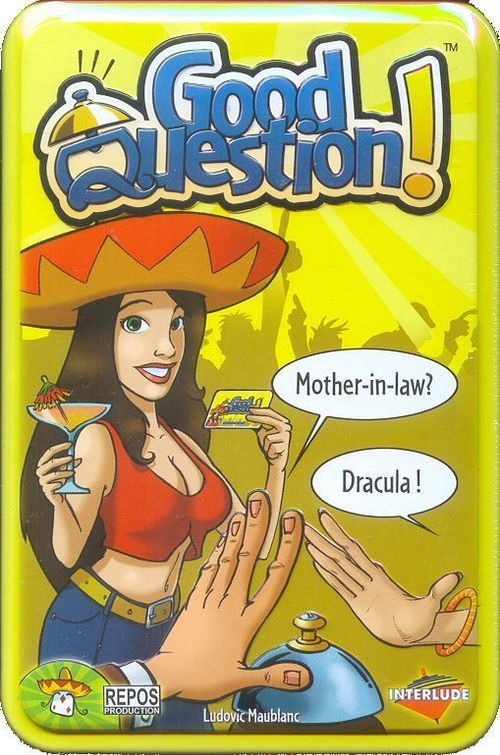
Good Question!
Good Question! Rulebook
Table of Contents
Table of Contents
Components
- 40 "Bonne Question" cards for your first games, marked with a little boy symbol.
- 97 "Bonne Question" cards, each with 16 words arranged in 2 columns of 8 words, marked with a Mexican woman symbol.
- 20 "Theme" cards, each with 4 different themes and 1 free theme.
- 40 tokens worth 1 point.
- 50 tokens worth 2 points.
- 1 bell.
- 1 rulebook.
Object of the Game
Have the most points at the end of the game.
Points are earned:
- When you find the correct answer (the word chosen by the player).
- When you get the other players to guess a word you chose, having first asked them a question on a chosen theme.
Setup
If this is your first time playing, take the 40 "Bonne Question" cards marked with the little boy symbol.
If you are already familiar with the game, shuffle ALL the "Bonne Question" cards (including the "First Games" cards) and place them face down in the centre of the table:
- 40 cards if you play with 4, 5 or 8 players;
- 42 cards if you play with 3, 6 or 7 players.
Set aside the remaining "Bonne Question" cards; they will not be used in this game.
Also place in the centre of the table:
- All the "Theme" cards, face down;
- The bell.
Playing the Game
Before starting, the players must agree on the answer zone: the set of words from which answers may be chosen.
There are several options. For your first games, we recommend the first column (sombrero).
This choice is final for the whole game!
Later, you can make the game harder and choose:
- 1/2 column (4 words) (for example words 1 to 4 of the cocktail column) instead of a full column (8 words);
- 1 horizontal row (2 words) (for example row 5);
- 1 word only (for example row 5, column sombrero).
Each round, the youngest player:
- Takes a "Theme" card, reads it aloud and chooses a theme (or invents one) which will be used by all players this turn;
- Deals each player one "Bonne Question" card, face down.
All players (including the youngest player) turn over their "Bonne Question" card and choose ONE word from among the words in the answer zone agreed for the game.
They then think up a question which must:
- Respect the imposed theme (the question does not have to be true or accurate);
- Not contain any words sharing the same root as the answer;
- If the word is a conjugated verb (for example "on mange" for "manger");
- Be phrased so that the other players will find the chosen word neither too quickly nor too slowly.
Questions that are colourful, twisted, comical (even totally ridiculous) are strongly encouraged, provided there is still a minimal respect for the imposed theme.
Tip for Beginners
It is more profitable to score 1 point than to keep attempting 3-point questions and failing. In your first games, start by inventing simple questions and take risks later. Creating a question that is neither too simple nor too complex is not easy at first, but reassure yourselves: after 2 or 3 turns, it comes naturally!
When a player is ready, they ring the bell, announce it to the group, and then ask their question aloud. Be careful: they have only one attempt. There is no set order or turn around the table; any player who is ready may ask their question.
As soon as a player thinks they have the correct answer, they ring the bell. The questioner stops asking their question (if they had not finished) and listens to the answer given by that player.
An answer is correct if the chosen word is pronounced by the person.
However, a certain tolerance is allowed:
- If the chosen word is contained in the answer (for example "le vieux fusil" for "fusil").
- If the word is pronounced phonetically within the answer (for example "un verre de tequila" for "vert").
If the answer is wrong, the player may no longer propose answers for this question, and the "questioner" resumes their question if it was not finished.
Be careful: the questioner may not lengthen their question and/or add details once they have finished asking it.
If the player who rang the bell gave the correct answer, they score, as does the "questioner", a number of points that depends on the order in which the answers were proposed.
The points awarded depend on the order in which the answers were proposed:
| Correct answer found by... | Points |
|---|---|
| 1st player to ring the bell | 1 |
| 2nd player to ring the bell | 2 |
| 3rd player to ring the bell | 3 |
| 4th player to ring the bell | 2 |
| 5th player to ring the bell | 1 |
| all the others... | 0 |
The "questioner" is responsible for counting the number of answers. If you have trouble, do not hesitate to count on your fingers (thumb 1 point, index 2 points, middle 3 points, ring 2 points and little finger 1 point).
If no one finds an answer after a reasonable time, left to general judgement (5 seconds for example), the questioner gives the answer, and the group may laugh and treat the question as a "Bonne Question" of bad question!
If a player cannot come up with a question using their words, they may enlarge their answer zone, for example by taking the second column. If, after a reasonable time, left to general judgement, they still cannot ask a question, they must give up and discard their card.
Example
Small example, to be enjoyed without moderation:
Around the table: Roberto F., Sylvie B., Bruno F., Dominique E., Ludovic M. and William A.
The imposed theme is "SPORT", and Roberto F. of Saint-Malo decides to speak first in order to get the word "CHAMPAGNE" guessed. He announces the row corresponding to his answer (row 5) and asks the following question: "What does the winner of a Formula 1 race throw to the crowd?"
Sylvie B., on the starting blocks since the beginning of the game, answers first and proposes "DES FLEURS" ("flowers"). Bad luck, that is a wrong answer.
Bruno F., who is not short of inspiration either, offers "SON MAILLOT" ("his jersey"). This is also a wrong answer.
William A., clearly more inspired than the others, proposes "DU CHAMPAGNE" and scores 3 points, just like Roberto F. It was a "Bonne Question!" from Roberto F. of Saint-Malo.
Next, Bruno F. takes the floor. He announces row 4 and asks the following question: "What do boxers give each other during matches?"
William A. proposes "DES COUPS DE POINGS" ("punches").
Sylvie, knowing Bruno's mischievous spirit, proposes "DES PAINS" ("breads"), and it is a correct answer. Bruno F. and Sylvie B. each score 2 points.
During a new turn on the theme "HORROR FILMS", William A. announces row 1 and asks the question: "In the film, coming soon to our screens, 'Freddy gets married in Transylvania', who plays Freddy's sworn enemy?"
Sylvie B. answers directly "DRACULA", which is a wrong answer. Roberto F. proposes "LA MARIEE" ("the bride"), which is not correct. Bruno F. offers "LE CURE" ("the priest"), followed by Dominique E. with "LE PAPE" ("the pope"). Fortunately for William, Ludovic M. proposes "MA BELLE-MERE" ("my mother-in-law"), which is a correct answer. They both score 1 point.
New Round
Once all players have asked their question, the player to the left of the one who gave the previous theme draws a new "Theme" card and chooses or invents one. Then each player receives a new "Bonne Question" card and prepares a new question!
End of the Game
When the "Bonne Question" deck is exhausted, the game ends. The player with the most points wins. In case of a tie between a boy and a girl, the girl wins (yes, it is hard on the boys!). If there is no girl, or only girls, the tie is settled by arm wrestling!
Variant: "Variable Difficulty"
If you play with adults and children, give the adults a smaller answer zone than the children. This system lets you adjust the difficulty to the level of the players.