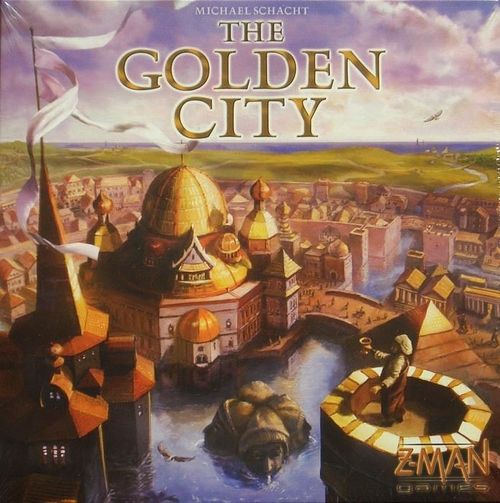
The Golden City
The Golden City Rulebook
Table of Contents
Table of Contents
Contents
- 1 Board
- 72 business buildings (18 each in four colors)
- 50 landform cards (10 each in five landforms)
- 16 score cards
- 8 bonus cards
- 6 key cards
- 8 goods cards
- 35 coins
- 100 letters of business: 20 x value 1, 40 x value 2, 40 x value 5
- 4 bidding hands
- 1 start-player key
Preparation
- Before the first game, remove all the pieces from their frames.
- Put the board in the middle of the table.
- Each player takes the pieces of one color: the businesses (with 3 players take 18 each, with 4 players take 16 each) and the bidding hand.
- Each player takes 3 coins, which he places in front of him. The remaining coins are placed as a supply next to the board.
- Each player is given 1 'coast' landform card. The remaining landform cards are shuffled and placed as a face-down draw-pile next to the board. Each player is dealt another landform card from the draw-pile. The player holds their cards hidden from view.
- Shuffle the 8 goods cards and place them next to the board in a face-down deck. Lay out the top 3 cards face-up next to one another.
- Place the 8 bonus cards as a face-down deck next to the board. Sort the 'letters of business' by value, and place them and the 6 key cards ready for play.
- Sort the 16 scoring cards into 3 piles according to whether they have a '1', a '2' or a '3' on their backs. Shuffle each pile and then form them into one face-down deck; the cards with a '3' go at the bottom, then those with a '2', and those with a '1' go on the top.
- The youngest player gets the start-player key and begins the game.
The Game Board
The board shows an island. Around its edge there are 16 coastal locations. Inland there are 30 rural locations on the four landforms of the island; woodland, meadows, mountains and desert. 12 of these locations are situated on the four rivers. Each location shows a reward which is given to the player who sets up a business there. In the center of the island stands the Golden City; which has four city quarters, each consisting of one inner and two outer parts. Locations and the parts of the city are connected to each other by roads.
The board is marked with location types: Coastal, Rural, and River, plus the four landforms (Meadow, Wald/Woodland, Mountain, Desert), the City Quarter, the Inner City Quarter, and the Outer City Quarter.
Playing the Game
A game consists of several rounds; each round being made up of 6 phases which are played through one after the other.
The Phases in Detail
1. Reveal score card
Turn over the top card of the score card deck and lay it face-up alongside the deck.
2. Lay out landform cards
- Turn over landform cards from the deck and lay them out face-up. With 3 players, 6 cards are laid out, and with 4 players, 8 cards. The cards are laid out in pairs. Tip: To ensure that the pairs are properly shuffled, first lay out a column of 3 or 4 cards and then lay out the second card of each pair.
- Once the draw-pile has been used up, shuffle the discard pile to make a new draw-pile.
3. Play your bidding hand
- The start-player places his bidding hand on the pair of cards which he would like to take. The other players follow in clockwise order.
- There is no charge for placing your hand on an unoccupied pair.
- To place your hand on a pair where there is already another bidding hand, you must pay 1 coin to the supply. The other player has to pick his bidding hand back up. When it is this player's next turn, he again places his bidding hand on a pair of cards (the same one as before or a different one).
- The cost increases with each further expulsion in the same round. The second expulsion in a round costs 2 coins, the third expulsion costs 3 coins, and so on. The cost increases regardless of who does the expelling or who is expelled, and regardless of whether it is for the same or a different pair of cards.
- During this phase, when it is a player's turn again, he only actually takes another turn if his bidding hand has been expelled by another player.
- The bidding phase ends when there is finally one bidding hand on each pair. Each player takes his bidding hand and adds the landform cards to his hand.
Note: In the next round, the cost of expelling a hand starts again at one coin.
Example of a bidding phase:
- Red bids on the coast/desert pair. Blue bids on the woodland/woodland pair. White also wants the two woodland cards. He pays 1 coin to the supply, puts his bidding hand on the two cards and gives Blue's bidding hand back to Blue.
- Black expels the red hand from the coast/desert pair, paying 2 coins to the supply.
- It is now Red's turn again. He places his hand on the unoccupied coast/coast pair. Blue expels White from the pair he wanted, paying 3 coins to do so.
- This is too expensive for White. He would now have to pay 4 coins. He places his hand on the unoccupied mountain/desert pair. There is now a bidding hand on every pair and the bidding phase ends.
4. Building businesses
In principle, a continuous road connection is necessary for establishing a business: from a coastal location where you already have a business to the location where you wish to build. Every location along this route must also have one of your businesses built on it.
- Only one business can be built on a coastal or rural location.
- Each player can establish one business in each part of the Golden City - but never more than one.
- The start-player begins. Each player takes one turn in clockwise order. On your turn you may place 1 or 2 businesses on the board.
- To place a business, you play cards from your hand whose landform matches that of the location where you are placing the business.
- You can build a business on a coastal location, when it is your turn to build, at any time during the game - coastal businesses are not restricted by the road connection rule. To do so, you play 1 'coast' landform card.
- To build in a rural location, or in an outer part of the city, you must play 2 identical landform cards, matching the landform of that location or that part of the city.
- To build in one of the four inner city parts, you must additionally give up 1 key card that you have previously obtained (see 'Rewards').
- Joker rule: 2 landform cards of the same landform can be used as 1 card of any other landform. So, for example, 2 'desert' can be used as 1 'woodland' card; or for another example, 2 'coast' cards can be used as 1 'mountain' card. Note: The joker rule can be used as often as you like in a turn.
- Each time you build a business you immediately receive a one-off reward.
- Player landform cards are placed on a face-up discard pile next to the draw-pile. If a key card is played it is put back into the box.
- Hand card limit: You cannot own more than 5 landform cards at the end of your turn. If you have more, you must put a card or cards of your choice on the discard pile.
- Once each player has taken a turn, the building phase is over.
Note: It is not usually possible for a player to build a business in every round of the game.
Example of building businesses:
Blue had built a business on the coast of the desert. He then built inland and then in the outer desert part of the city. He can build his next business on a neighboring location (along the blue arrows) in the desert or mountains or part of the city. If he wishes to build in the desert inner city part, he must first obtain a key card which he can get by building on the desert rural location that has a key pictured on it. The player could also build his next business on any free coastal location by playing a 'coast' landform card.
5. Scoring
Scoring is now carried out using the face-up score card turned over in the first phase. Scoring is always carried out in two categories: for goods and for businesses, either on one of the rivers, or in one of the city quarters.
Note: The wind rose in the left corner of each score card corresponds to the orientation of the wind rose on the board, making it easier to correctly identify the area.
- Goods scoring: Each player who has the pictured goods in front of him receives 2 'letters of business'.
- River scoring: Each player that has a business on the pictured river receives 2 'letters'.
- City quarter scoring: Each player that has a business in the pictured city quarter receives 2 'letters'. Note: To receive the 2 'letters of business', you merely need to be represented in the scored area or have at least one of the scoring goods. The number of goods or businesses you have is of no importance for this.
- Majority bonus: If you are the only player to have any of the pictured goods you receive an additional 2 'letters'. If you are the only player to have a business on a pictured river or in a pictured city quarter, or if you have more businesses there than any other player, you also receive 2 additional 'letters'.
- The scoring phase for this round is ended once the 'letters' have been handed out. Put the score card back into the box. Note: The 'letters of business' come in values of 1, 2 and 5, and can be exchanged at any time. The number of 'letters' you have can be kept secret.
Scoring example:
- Pottery, and the river between the mountains and the meadows, are being scored. White and Black have each built on one of the three locations on the river. They both receive 2 'letters of business'. If only one of them had built there, that player would have received an additional 2 'letters' for the majority. Alternatively, if White or Black had built on the third unoccupied location, that player would have gained the 2 additional 'letters'.
- Wine and the desert city quarter are being scored. Red, Blue and Black each receive 2 'letters of business', as they have all built in this city quarter: Red has 3 businesses there, which is more than any other player (Blue 2, Black 1), so Red receives the 2 additional 'letters'.
6. Change of start player
The round ends with the start-player key being given to the next player in clockwise direction. He is the new start player for the next round. The next round begins by again revealing a score card and laying out the landform cards.
Rewards
There is a one-off reward pictured on each location and each part of the city, which is revealed by the player immediately after he has built his business:
- Coins icon: The player receives 1 or 2 coins from the supply.
- Landform cards icon: The player draws 1 landform card from the draw-pile and adds it to his hand.
- Key icon: The player receives 1 key card from the deck and places it in front of him.
- Bonus card icon: The player looks through and picks out 1 card from the face-down deck of bonus cards and places it face-down in front of him. He then puts the deck back. Players receive 'letters of business' for their bonus cards at the end of the game (see 'Bonus cards').
- Goods icon: The player takes 1 goods card. He may take one of the three face-up cards which are laid out or the top card of the face-down deck. He places the card face-up in front of him. If he took a card from the display, he refills the display back to 3 by turning over a card from the deck, unless it has run out. There are two different goods shown on each goods card. Important: A player can own no more than 4 goods cards. If he gets a fifth, he must put any one of his goods cards back in the box.
- Outer city part icon (5/3): Each outer part of the city has a reward of 5 'letters' for the first business built there. The second player to build a business there receives 3 'letters'. Other players who build in the same part of the city do not get anything. The first player in four of the outer parts of the city also receives 1 coin.
- Inner city part icon (10/6): Each inner part of the city has a reward of 10 'letters' and 1 landform card from the draw-pile for the first player to build a business there. The second player to build a business there receives 6 'letters'. Other players who build in the same part of the city do not get anything.
Note: Even though the third and fourth player to build in a part of the city do not receive a reward, it can still be worth building there. By doing so, 'letters' may be received during a scoring, and also it may make a connection to a neighboring part of the city that otherwise could not be reached.
Bonus Cards
There are eight different cards. Players owning bonus cards will receive 'letters of business' for them at the end of the game:
- The player receives 3 'letters' for each of his goods cards.
- The player receives 2 'letters' for each of his coins.
- The player receives 1 'letter' for each of his businesses in the Golden City.
- The player receives 2 'letters' for each of his businesses on a river.
- The player receives 1 'letter' for each of his businesses, in a rural location or in the city, that have been built on the pictured landform.
End of the Game
The game can end in two ways:
- One of the players has built all his businesses on the board. The current round is still played to its end.
or
- The final score card has been scored.
The players reveal their bonus cards and receive the appropriate 'letters of business' for them. The players then add up the values of their 'letters of business'. The winner is the player with the highest total. If there is a tie, the winner is the tied player who has built the most businesses in the Golden City. If there is still a tie, the winner is the one from among those still tied, who has the most coins. If there is still a tie, there is more than one winner.
Note: The game ends early if it should happen that a player, who still has businesses that have not been built, will no longer be able to build at all. For this to happen there would have to be no more vacant coastal locations, and the player would have no connections to any vacant rural locations and would also have already built in all parts of the city he could reach. This player automatically loses the game. The current round is still played to its end. Then you do the scoring of the bonus cards and finding out who has won, as usual.