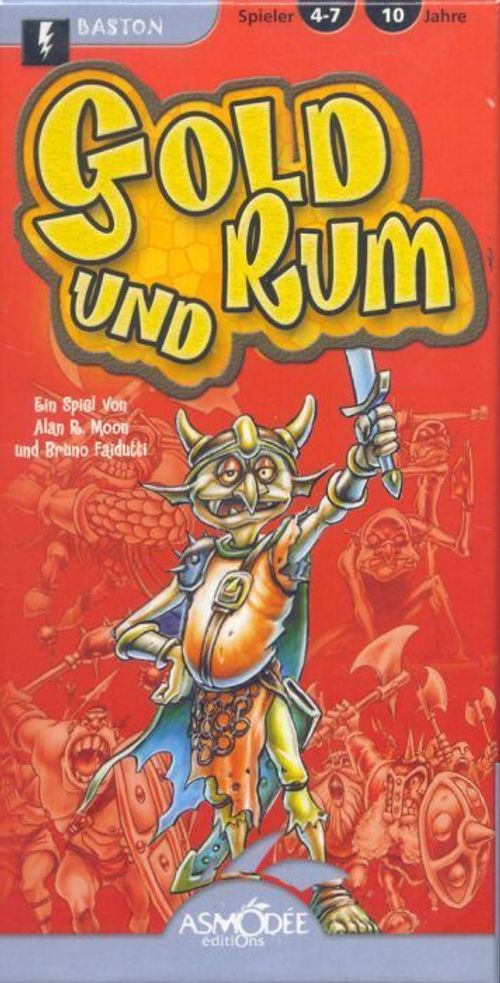
Gold und Rum
Gold und Rum Rulebook
Table of Contents
Table of Contents
Components
80 Army Cards:
- 13 Barbarians (seven value 2, four value 6, 2 leaders)
- 13 Orcs (seven value 2, four value 6, 2 leaders)
- 13 Skeletons (seven value 2, four value 6, 2 leaders)
- 13 Dwarves (seven value 2, four value 6, 2 leaders)
24 Mercenary Cards:
- 8 Goblins (value 1)
- 6 Giants (value 10)
- 4 Trolls (value 5)
- 1 Goblin Flying Machine (value 4)
- 4 Goblin War Machines (value 9)
- 1 Goblin Commando
4 Spies (numbered 1-4)
Each type of army card has a different back, depending on its tribe.
25 Player Cards:
- 14 Enlistment Cards (2 per player)
- 10 Desertion Cards
- 1 Start Enlistment Card
7 Cog Wheels and their Marker (1 per player). The Cog Wheels are used to keep track of the score and to remind players which character they play. Each player puts the Cog Wheel in front of himself and inserts his marker (blank side up) in the zero space. The +10 side is used when a player reaches 10 points.
A Wizard pawn.
The Wizard
The game is played in Rounds. Each Round, one player will be the Wizard, who will deal for that round, and will not get to play his Player Cards. Decide who will be the dealer for the First Round. After the first round, the role of Wizard passes clockwise around the table.
Sequence of Play
Each round is played in two phases: Enlistment and War. During the Enlistment phase, players will choose the cards that will form their respective armies. During the War phase, players will fight battles with the cards they have just chosen.
Enlistment
-
Each player should take 2 Enlistment Cards of the same symbol as their character, and 1 (with 6 or 7 players) or 2 (with 4 or 5 players) Desertion Cards.
-
The Wizard thoroughly shuffles the 80 Army Cards and places the "Start Enlistment" card somewhere one third of the way from the bottom of the shuffled deck.
-
The Wizard slowly deals the Army Cards, face up, one at a time, to form a set number of piles (see below) in a circle around the center of the table. He places one card on the first pile, one on the second pile, and so on around the circle of piles. When the Wizard has formed all of the piles, he places another card on the first pile, another on the second, etc. In this manner, the piles will slowly grow on the table. The number of piles depends upon the number of players in the game (including the Wizard):
- 4 players: 9 piles
- 5 players: 11 piles
- 6 players: 13 piles
- 7 players: 14 piles
-
During the dealing, and without interfering with it, the other players can, at any time, play their Desertion Cards face up on any pile. This does not stop the dealing, and the Wizard simply continues to place cards on piles in the same order. The Desertion Cards can be played until the last Army Card has been dealt.
-
When the "Start Enlistment" card appears in the deck he is dealing, the Wizard announces it, discards this card, and resumes dealing. From now on, players can also, at any time, lay their Enlistment Cards face up on any pile. As with the Desertion Cards, this does not stop dealing, and the Wizard simply continues to place cards on piles as before.
-
When the last Army card is dealt, players who still have Enlistment Cards in their hands can play them on any pile they choose. Unplayed Desertion Cards are lost and cannot be played after the last Army Card has been placed on the last pile.
War
Now begins the War. The War is made up of four successive battles. Each player will send a portion of his army, a tribe, to every battle. Each battle plays as follows:
A Battle
-
The Wizard announces which single Tribe (Orcs, Barbarians, Dwarves or Skeletons) will fight in the first battle. Each player must send ALL of their cards of the requested tribe to the battle, and place them face down on the table so that all players can still count how many cards there are. Before revealing these cards, the players may wish to add mercenaries.
-
For the first battle, the player to the left of the Wizard chooses the Mercenary Cards (Goblins, Goblin Machines, Trolls and Giants) he will add to the tribe requested by the Wizard. He then plays them (face down and all backs visible) next to his requested tribe cards. Other players then, in turn, play their Mercenary Cards in the same way.
For the second battle, the mercenaries will be played starting with the second player to the left of the Wizard, and so on.
-
After all the requested and selected Army Cards have been placed, but before they are revealed (at the request of the Wizard), the player who has the Goblin Commando Card (if any) may, if they choose, play this card. He must announce it before the other players reveal their selected Army Cards. When played, the Goblin Commando Card is discarded, and the player who plays it draws a card at random (well, half random, since he sees the back of the cards but not their front) from the cards played in this battle by one of his opponents. The chosen card is shown to all players then discarded.
-
All players simultaneously reveal the troops (Tribal Cards and / or Mercenaries) they have sent to the battle and count their values.
- Leaders double the value of all cards of the same race (not mercenary cards assigned to the tribe). However, if a player had both Leaders of the same race, the value of this entire unit is 0 (including mercenary cards!) as the leaders fight for control of the Tribe.
- Each Goblin War Machine Card is worth 9 points, but only if each is supported by a single Goblin Card (value 1). A single goblin can only support one War Machine. Unsupported Goblin War Machines are worth 0.
-
After all cards have been revealed, and the value of the armies checked, the player who has the Goblin Flying Machine (if any) may, if he chooses, play it from his hand and add it to his tribe. The Flying Machine must be played together with one or more Goblin Cards (taken from the player's hand at the same time), and has no value if not played with at least one Goblin Card. When used properly, the Flying Machine itself has a value of 4. The value of the Flying Machine, plus any Goblins it flew in with, is added to that player's tribe in battle.
End of the Game
The game ends if, after the end of a round, one or more players have reached a score of:
- 4 or 5 players: 8 points
- 6 players: 7 points
- 7 players: 6 points
Highest score wins. In the case of a tie, the tied player who was the last to win a battle is the winner.