Goko no Saikoro
Goko no Saikoro Rulebook
Table of Contents
Table of Contents
Turn Structure
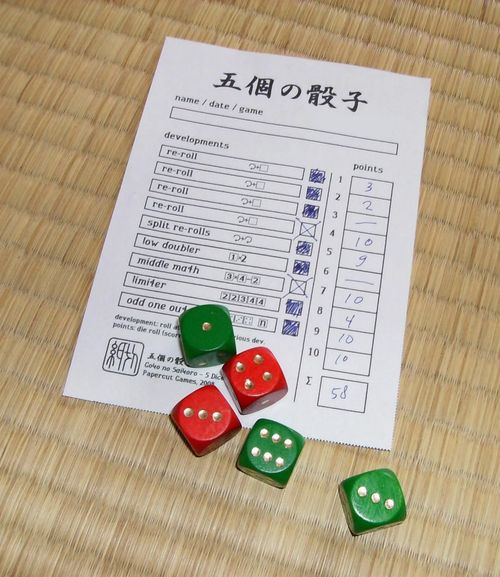
[0] The game proceeds in turns. When it is a player's turn, he/she follows the rules and options explained below:
[1] A player chooses one of nine developments (left side of the score sheet - note that the development 're-roll' occurs four times). After choosing, he or she rolls all 5 dice. The base score (without applying any developments) is the sum total of the scores of the 5 dice. Developments achieved previously in the game may result in a different score. Depending on the score, the player can choose from the following options:
[1.1] If the score is 17 + 1 per previous development achieved, or higher, the player achieves the development chosen, and marks that by filling in the square to the right of that development completely.
[1.2] If the score is 21 or higher, it can be converted into points by subtracting 20. The maximum number of points that can be scored for any die roll is 10, even if the score rolled is over 30 because of developments achieved previously. Points are filled in in the topmost open space of the point track on the right of the score sheet. In this case, the player puts a cross in the square to the right of the development rolled for. This means that that development was not achieved, and that that player can not try to roll for that development in the same game again. (Hence, converting a score into points permanently deletes developments from the game.)
[1.3] If neither [1.1] nor [1.2] applies, a player has two options:
[1.3.1] Fill in 0 points in the topmost open space of the point track; or
[1.3.2] Put a cross in the square to the right of the development rolled for (as in [1.2], meaning that that development was not achieved, and that that player can not try to roll for that development in the same game again).
Source note: the source reads "the he topmost open space" in [1.3.1]; "the topmost" is transcribed here.
Explanation: Let's assume that player Saiko has achieved the 'low doubler' and one 're-roll' in previous turns. That means that the threshold for a new achievement is 17 + 2 = 19. Saiko rolls 2, 3, 4, 5, 5. The base score would be 19, but because of the 'low doubler' the 2 counts twice (see [4.2.1]). Hence, the score is 21. That means that Saiko could score 1 point (21 - 20 = 1) according to rule [1.2] or achieve the development chosen at the beginning of her turn. However, because she has a 're-roll' achievement, she can re-roll one die. She re-rolls the 2, and it is now a 4. That means that the base score would be 21, and the score after applying the 'low doubler' is 24. So the choice is now to score 4 points or to achieve a new development. If the result of the re-roll would have been a 1, her score would have been 19 instead, which would still be sufficient for the development but not enough to get points. If - with a different die roll - the end result would have been below 17, then there would be neither points nor a development as in rule [1.3].
[2] If a player has achieved all 9 developments before the end of the game, he/she can only roll for points. Every roll is converted into points as in [1.2]. If the score is 20 or lower, the player scores 0 points.
[3] If a player filled in the tenth space of the point track, all other players that had one less turn still get one more turn, but after that, the game ends. The player with the highest point total wins the game.
Developments
[4] There are nine 'developments' in the game, although four of these are the same. Developments affect rolling and scoring.
Rolling Developments
[4.1] There are two types of rolling developments:
[4.1.1] Re-roll. For each development 're-roll' achieved, a player can re-roll one die.
[4.1.2] Split re-rolls. With this development, a player can split his/her die rolls.
Explanation: Without 'split re-rolls', after the initial die roll, a player can re-roll 1 or more dice once, depending on how many 're-roll' developments he/she achieved. Hence there is a single re-roll that may contain multiple dice. With 'split re-rolls', a player can re-roll the same dice multiple times up to a maximum (dice times re-rolls!) equal to the number of 're-roll' developments he/she achieved. Hence, there may be multiple re-rolls with the same dice (or a decreasing subset). For example, if you have 3 re-roll developments and the split re-roll development, you can re-roll 1 die 3 times, or 3 dice once, or 2 dice once and then 1 of them again.
Scoring Developments
[4.2] There are four types of scoring developments. If a player achieved multiple scoring developments, he/she must choose which one applies after the initial die roll, but before any re-rolls. (One, and exactly one, of the scoring developments achieved must apply.)
[4.2.1] Low doubler. The lowest die counts double.
[4.2.2] Middle math. Discard the lowest and highest dice. Multiply the score of the 2nd highest die (the 4th die from low to high) with that of the middle die (the 3rd die from low to high). From that, subtract the 2nd lowest die (the 2nd die from low to high).
[4.2.3] Limiter. Discard the lowest and highest dice. The 2nd and 4th die (from low to high) count double.
[4.2.4] Odd one out. If 4 dice have sequential values, the score of the remaining die is the point value of that roll. Deviating from [1], even if the score is below 21, that number of points is scored (unless the die roll is used to achieve a development).