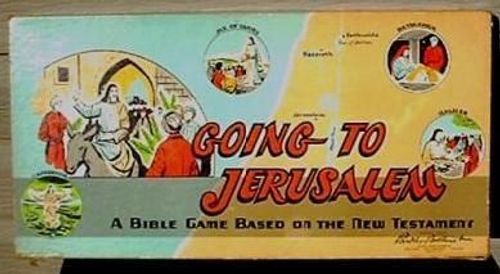
Going to Jerusalem
Going to Jerusalem Rulebook
Table of Contents
Table of Contents
Rules
For 2, 3 or 4 Players
Object
The object of the game is to be the first player to move three Apostles from the starting space, along the track, to the circle marked "Jerusalem." [All Apostles must reach the Jerusalem circle by exact count.]
Equipment
Equipment consists of the following:
- A beautiful folding board showing a map of the Holy Land on which are depicted Biblical scenes. These scenes do not necessarily appear in geographical or chronological order but are arranged in such a way as to make the game play well. The geographic locations are shown on the map which serves as background for the game.
- A Pack of Gospel Cards. On the face of each of these cards is printed a well-known verse from one of the four Gospels in the New Testament, with the identifying chapter and verse numbers. (Blue Backs)
- A Pack of New Testament Cards. On the face of each of these cards is printed a reference to a verse in one of the four Gospels in the New Testament. (Red Backs)
- The Twelve Apostles — which are the playing pieces. These are divided into four color groups of three pieces each.
- An envelope containing colored rings.
- A copy of the Revised Standard Version of the Four Gospels.
Preparation
Each player selects three Apostles of one color as his playing pieces. The Gospel cards and the New Testament Cards are shuffled separately and placed face down in separate piles on the table. [If either pack should be used up during play, the cards are reshuffled and used again.] One player is selected to start the game.
The Play
The starting player draws the top card from the pack of Gospel Cards, reads the verse aloud and, beginning at the place marked Start, moves one of his Apostles the number of spaces indicated by the red numeral at the bottom of the card. He then places the card face up alongside the pack of Gospel Cards to start a discard pile.
Other players follow in turn, moving their Apostles as directed by the Cards which they draw. Each square of the track and each of the illustrated circles count as one space. Each player may have all three of his Apostles in play at once and he may, on his turns, move any one of these Apostles. The player who first moves all of his Apostles to Jerusalem, by exact count, wins the game.
Transcriber's note: in the scan, a pen-like stroke runs across part of the line "he may, on" and "all of his"; the words are transcribed as legible.
Example: A player drawing the card shown at right would move his Apostle forward three spaces.
Example card (as printed): "Watch therefore, for you know neither the day nor the hour." — Matthew 25:13
A player may not start a second Apostle until his first Apostle has reached the circle marked "Mount of Olives." At any time thereafter he has the choice of starting his second Apostle or of continuing to move his first Apostle. When his second Apostle has reached the Mount of Olives he may start his third.
A player may never start an Apostle when another of his Apostles is already on the track but has not yet passed the Mount of Olives circle. It is usually wise for a player to start all of his Apostles early in the game in order that he may have a wider choice of moves. All Apostles must reach Jerusalem by exact count and if a player draws a Gospel Card which would advance one of his Apostles beyond the Jerusalem circle, he may not move that Apostle.
The Good Samaritan Rule
No two Apostles may rest on the same space on the track at the same time but any number of Apostles may come together on the illustrated circles. A player becomes a Good Samaritan when one of his Apostles lands on a space on the track already occupied by an opponent's Apostle. The Good Samaritan's Apostle remains on the space on which it lands and the opponent's Apostle moves forward three spaces. The opponent makes this move immediately, even though it is not his turn, and completes any further action that may result from this move.
For example, it is possible that the move of three forward will place the opponent's Apostle on a New Testament space, in which case he draws his card immediately and completes the move. A player may not be a Good Samaritan to one of his own Apostles and he may not move an Apostle which would land on a space already occupied by another of his Apostles. A player may not be a Good Samaritan to any Apostle who cannot make full use of the move of three spaces. The story of the Good Samaritan is found in the Gospel according to Luke, Chapter 10, Verses 30-37.
New Testament Cards
New Testament Cards are drawn under the following circumstances:
- Whenever a player lands on a space marked "Draw New Testament Card."
- Whenever a player is unable to move any one of his Apostles for either of the following reasons: (a) Because he would land on a space already occupied by another of his own Apostles or (b) Because he would land on a space already occupied by an opponent's Apostle which cannot move the three spaces required under the Good Samaritan Rule.
- Whenever he draws a Gospel Card marked "Choice" and he elects to draw a New Testament Card rather than move the number of spaces indicated on the Gospel card.
When a player has two Apostles already in the Jerusalem circle and cannot move his third Apostle because the number on the Gospel Card which he has drawn would move him beyond the Jerusalem circle, he does not draw a New Testament Card, but forfeits the move.
When a player draws a New Testament Card he looks up in the copy of the Four Gospels the Verse referred to on the Card and reads it aloud. In the Verse he will find a reference to one of the places indicated on the board by the illustrated circles. He then moves one of his Apostles to the location referred to. If he drew the New Testament Card because he landed on a space marked "Draw New Testament Card," he must move the Apostle which landed on that space. If he drew the New Testament Card for any other reason he may move any one of his Apostles, but he must decide which Apostle he will move before he draws the New Testament Card.
Transcriber's note: in the scan, a stroke runs through the words "Draw New" of the phrase "Draw New Testament Card" in the sentence beginning "If he drew the New Testament Card because he landed on a space marked." The rest of the phrase is legible and is transcribed as printed.
Winning the Game
The first player to reach the Jerusalem circle by exact count with all three of his Apostles wins the game.
Special Rates for Sunday School Class Play
For more than 4 Players
There are ten colored rings included with the game. These are used when more than four wish to play. For example, if five or six play, four of the players use two each of the regular Apostles. The fifth player places the two green rings over the tops of two of the Apostles not being used. The sixth player places the two yellow rings over the two remaining Apostles. When more than six play, each player uses only one Apostle. Four of the players use one each of the regular Apostles and each of the other players selects a colored ring which he places over the top of his Apostle to identify it.
There are only two variations from the regular rules:
- If a player draws a New Testament Card directing him to either Bethany or Jerusalem, he must move to the Wilderness Circle instead.
- The Good Samaritan Rule does not apply after a player has reached the Wilderness Circle. Whenever an Apostle moving from the Wilderness Circle lands on a space which is already occupied by an opponent's Apostle, he forfeits his move.
It is suggested that the teacher assign Verses to be memorized a week before the game is to be played. Whenever a player reaches the Bethlehem circle, the teacher asks him to quote one of the Verses that he has learned. If he can do this correctly, he immediately advances his Apostle to the Galilee Circle. If he quotes the Verse incorrectly, his turn ends and on his next play he must follow the regular track. If a player is sent back to Bethlehem the teacher may again ask him to quote a Verse from memory and follow the same procedure as above.
In these variations of the regular game the first player to reach Jerusalem by exact count wins the game.