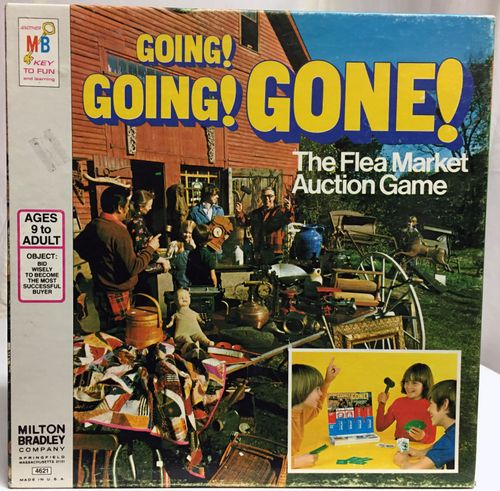
Going! Going! Gone! The Flea Market Auction Game
Going! Going! Gone! The Flea Market Auction Game Rulebook
Table of Contents
Table of Contents
Preparation
(a) Follow the instructions on the back of the Display panel to set up the panel and tray.
(b) Separate the playing cards by color. There are 32 green (ARTICLE) cards; 8 red (COLLECTOR) cards; 8 blue (ANTIQUE BUYER) cards.
(c) Appoint one player as Banker. He separates the money into $1s, $5s, and $10s and puts the bills into the designated tray pockets. The Banker gives each player, including himself, $30 (five ones, three fives, and a ten). The remaining money is the Bank and is placed in the designated tray pockets.
(d) The Banker takes the gavel and becomes the auctioneer for the first round.
(e) The red COLLECTOR cards are shuffled and the Banker places the top 4 cards, one card to a slot, on the RED band of the Display panel. These cards are placed face down against the panel and the rest of the cards are dropped into the "CARDS" pocket unrevealed. (So that no one knows what the Collector and Antique Buyer have decided to purchase.)
(f) The blue ANTIQUE BUYER cards are now shuffled and the top four of these cards are put against the BLUE band of the panel. The rest of the cards are dropped unrevealed into the "CARDS" pocket.
(g) The green cards are shuffled and dealt face down to the four players so that each has 8. Players now examine their cards in their hand.
Rules (For 4 Players)
Round 1
-
At a signal from the auctioneer (Banker, for the first round), each player puts one green card face down in the center—making a 4-card mystery "Lot" to be bid on.
-
Next, the auctioneer calls for the bidding on that lot, and after getting the highest bid, he yells: "Going! Going!" and bangs the gavel down saying, "Gone!"
-
The highest bidder pays the amount to the Bank the first round and gets the four green cards he has bought. He also gets the gavel signifying he will be next auctioneer. (If the Banker made the highest bid, he keeps the gavel).
-
Everyone is shown the four articles purchased. They cannot be auctioned again.
-
The first COLLECTOR card on the Display Panel is turned around. A duplicate of this article is held by one of the players. If the duplicate is one of the 4 cards just purchased, it may be exchanged for the COLLECTOR card and displayed face out on the panel. NOTE: Articles bought at auction may be redeemed for cash before any round of bidding.
-
Players may not bid more than they can pay. Players may be challenged at any time and must prove they have enough money to pay for a bid.
Rounds Two Through Four
These rounds are similar to the first round except that the new auctioneer for the round receives the money. (Note: Any time the auctioneer is the highest bidder, he pays the money to the Bank, not to himself).
Here are the steps for Rounds 2-4:
-
Players place one green card out face down to make a 4-article "Lot".
-
Auction takes place.
-
Highest bidder pays money to auctioneer or Bank and gets gavel.
-
The 4 cards bought are shown to all.
-
The next COLLECTOR card is turned around ... duplicates exchanged and redeemed as in Round 1.
-
At the end of Round 4, all articles the Collector was going to purchase have been shown.
Rounds Five Through Eight
Play is as in previous rounds except ANTIQUE BUYER cards are revealed on Display panel, one after each auction.
Exchange and cashing in of these cards is the same as for the Collector's articles. (Only articles bought at auction may be exchanged or cashed).
The Winner
After all rounds are completed, the player with the most money both in cash and face value of cards bought at auction is the winner.
2, 3, and 5-Player Games
For Two Players
Set up Display panel as for the 4-player game, however ...
(a) Give $60 to each player.
(b) After each player receives 8 green cards, the balance of the green deck is placed face down. For each auction, two additional cards are drawn from this deck to make a 4-card "Lot" (as if two more people were playing).
For Three Players
Set up Display panel as for 4-player game.
(a) Give $40 to each player.
(b) Deal each player 8 green cards and place the balance of the green deck face down. For each auction, one card is drawn from this deck to make a 4-card "Lot".
For Five Players
Set up Display panel as for 4-player game.
(a) Give $25 to each player.
(b) Deal 6 green cards to each player and put the remaining 2 cards aside.
(c) Since each player only has 6 articles, you can only have 6 auctions.
(d) Each auction will have a 5-card "Lot" except for the Sixth (final) round. The two green cards put aside are added to the lot in this round to make a 7-card "Lot".
(e) In rounds 1 through 3, turn 3 red COLLECTORS—skip to the blue ANTIQUE BUYER row for rounds 4 and 5.
(f) At the end of the 6th round, turn the 4th COLLECTOR card and the last two ANTIQUE BUYER cards around.
Cards Dealt
| Number of Players | Money per Player | Cards per Player | "Collector" Rounds | "Antique Buyer" Rounds |
|---|---|---|---|---|
| 2 | $60 | 8 | 4 | 4 |
| 3 | $40 | 8 | 4 | 4 |
| 4 | $30 | 8 | 4 | 4 |
| 5 | $25 | 6 | 3 | 3 |
Bidding Strategy
If you can buy the first "Lot" cheap ($10.), by all means take it because it will put you in line to receive the money for the Second Round as auctioneer when, the chances are, higher value cards will be discarded and the bidding will be higher.
The higher the round, the higher the bidding—so bid "smart" in the earlier rounds to make a killing on the rounds at the end.
Helpful Points
-
Use whole dollars in bidding. Do not bid, or accept bids in lesser amounts.
-
Article cards (green) bought at auction should be shown to all players. They may then be put aside. It is up to each player to remember what was bought and what may come.
-
If no one bids on a "Lot", the lot stays in place and becomes part of the next auction lot for double the amount of cards.
-
Cards bought at auction or exchanged for those on panel, may be cashed in to obtain money for bidding. Cards are worth face value only. Green cards still in your hand may not be cashed in.
-
At the end, include the face value of the cards bought with the money you have left for final total of dollars.