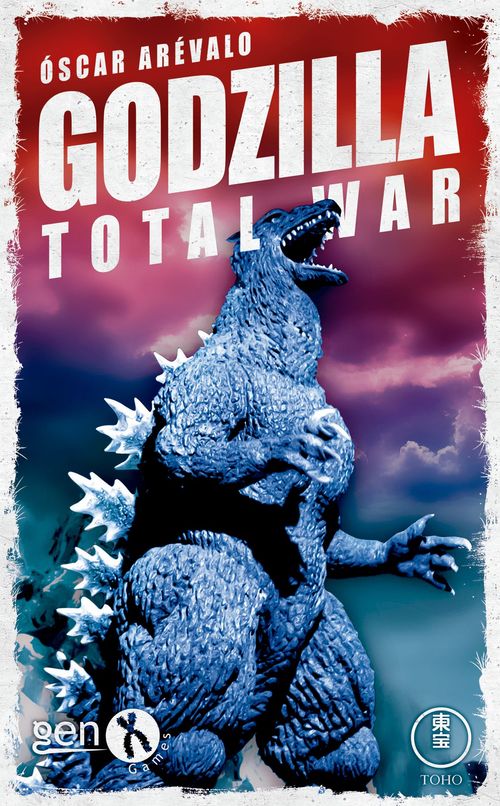
Godzilla Total War
Godzilla Total War Rulebook
Table of Contents
Table of Contents
Summary
During a game of Godzilla Total War players will take on the role of a Kaiju and will play cards from their hand to make attacks and strike other Kaiju. To do this, each player must play a Numeric Card equal to or higher than the card of the previous player, or a Special Action Card to dodge the damage.
If at any time a player cannot respond to a value of a card, he will receive damage. He will take one of his Numerical Cards and place it next to his Kaiju. Once a Kaiju takes damage his opponent can increase the power of the blow by using buildings and Additional Damage Cards. If a blow leaves a Kaiju with 0 Life Points, the Kaiju goes into rage and the player turns his card around. From now on he will play with his furious Kaiju (red side). The player who has launched the devastating blow receives Victory Points. The first player to reach the necessary Victory Points is proclaimed "King of Monsters"!
Components
12 Kaiju Cards
There are 12 different Kaiju in the game. All Kaiju Cards have a normal state and a furious state (red side). On a Kaiju Card you can find:
- Name and image
- Life: the number indicates how many wounds it can take
- Power: this is a special value that can be used as an Innate Power
- Victory Points: Victory Points granted to the player who defeated this Kaiju
- Victory Point Counter: with this players can keep track of their collected Victory Points
Prepare Your Kaiju for Battle
Before the first game, you must separate the Kaiju Cards and the Victory Point Markers. Take special care not to break or tear it. Once you have the Kaiju Card and the Marker place the Marker in the slit of the Kaiju Card. From now on, all you have to do is move the marker every time you successfully attack a Kaiju to keep track of your Victory Points.
12 Victory Point Markers
These Victory Point Markers allow players to keep track of the points they get for defeating other Kaiju. The clips are inserted through the slit and can be moved along the Victory Point Counter.
90 Playing Cards
Use these to strike blows and injure other Kaiju. They have an orange back and there are two kinds: Numeric and Special Action.
The values of Numeric Cards represent the force of the blow. They are divided into three types: Regular, with Additional Damage and with Buildings.
- Regular Numeric Cards: comprise values from 0 to 10, and -3.
- Additional Damage Cards: they are played like Regular Numeric Cards, but they can also be played to add extra damage to a Kaiju that took a blow (see page 4). They have a heart to differentiate them.
- Numeric Cards with Buildings: they are played like Regular Numeric Cards, but when a card is played a Building Card (blue back) is placed face up in the center of the table (see Building Cards). They are differentiated by the building icon.
Special Action Cards allow you to perform different actions. There are 4 types.
- Change Direction: The game changes its direction and is played in that new direction until someone changes it again.
- Choose a Target: The player chooses a target to which he passes the round and the game continues from there, maintaining the direction of play.
- Wound: This card represents direct damage and can only be responded to with Special Action Cards such as Change Direction, Choose a Target, another Wound or Double Wound card.
- Double Wound: The effect of this card cannot be omitted and the player must take the damage. There is only one of this card in the game.
9 Building Cards
When a player plays a Numeric Card with a Building he takes the upper card from the Building Cards deck and places it face up in the center of the table. The next player to take damage must take one of the open Building Cards from the table as additional damage. If more than one card is available on the table, the player chooses which one to take. If the Building Cards run out, they are put back into the box. They won't be used on again in this game.
1 King of Monsters Card
The "King of Monsters" Card is awarded to the winner of a game. Consult the END OF THE GAME to find out how it works.
Game Set-Up
Godzilla Total War is prepared very quickly.
- Separate cards by type. Put the Kaijus on one side, and the Playing Cards (orange back) and the Building Cards (blue back) on the other. Place the "King of Monsters" Card on the table, too.
- Shuffle the Playing and the Building Cards separately and form two decks in the center of the table.
- Each player chooses the Kaiju with which he will play, and makes sure that the Victory Point Marker is in its slot pointing at zero points. Each player places his Kaiju Card in front of him with the normal side up. Put the remaining Kaiju back into the box.
- Three Playing Cards are dealt to each player at random. These are the players' hand cards and must remain secret.
- Choose who will be the starting player of the first round. If you can't agree, the player who throws the best rays or imitates Godzilla's scream the best starts the game.
You are ready to join the battle!
How to Play
The starting player chooses a card from his hand, discards it face up in the middle of the table and draws a new card from the deck of Playing Cards. This card represents a strike. The next player, following in clockwise order, must discard a card in response and take a new Playing Card from the deck. If a player forgets to draw a new Playing Card before passing his turn, he will continue to play with one card less until the round is over. The round continues until a player cannot respond to a card. Then, the round ends and the Kaiju is injured (see Taking Damage).
All players replenish their hand until they have three cards and the player whose Kaiju took damage starts a new round.
The game ends when there is only one player left with a standing Kaiju or when any player gets the necessary victory points.
Which Card to Play?
In his turn, players may play a single card which may be:
- Numeric Playing Card with a value equal to or higher than the last card played.
- Special Action Card. In that case, players will resolve its effects immediately.
As already seen in the component description, there are three types of Numeric Cards:
Regular: with numbers from 0 to 10, and -3.
The card with a value of -3 serves to reduce the value of the hit being played and is the only card that must not be equal or higher than the value of the former card.
Example: Mothra just played a card worth 10 and says "Ten!" Godzilla plays the card worth -3 and says "Seven!" The game continues normally and the next Kaiju has to respond to a 7.
Additional Damage: can be played as Regular Numeric Cards in response to a hit, but the player who uses it, can straighten his Kaiju if he had previously used his Innate Power (see The Innate Power of Your Kaiju). In addition, it serves to further injure a wounded Kaiju. If you wounded a player because he has not been able to respond to a card you just played, he must be dealt damage with a card from his hand, but if you have an Additional Damage card, you can place it next to that player's Kaiju as extra damage. In other words, that player receives two cards as wounds in that round.
Example: Zilla cannot respond to the value 7 that Godzilla just played, so the round is finished and Zilla must choose a Numeric Card from his cards and take it as damage. He takes a value 3 card and places it next to his Kaiju. Godzilla has an Additional Damage Card of the value 2 and gives it to Zilla to add as damage. In addition, Godzilla can straighten his Kaiju (which he had spun) because he has played an Additional Damage Card. All players replenish their hand until they have 3 cards and Zilla starts a new round.
Numeric Cards with Buildings: When a player plays a card from his hand containing a building he must draw a Building Card from the deck and place it in the center of the table visible to all players. The next player to take damage must add the Building Card in the center of the table to his damage.
Example: Rodan just played a Numeric Card with a Building of value 5, to match the value of the former card. Then he takes the first card from the deck of Building Cards and puts it face up on the table. At last he draws a new Playing Card and finishes his turn. Later on during that round Kumonga is not able to respond to the value of a hit and puts one of his Playing Cards damage next to his Kaiju Card. In addition to that, he must take one Building Card from the table.
In this way a player who receives damage can receive consecutively up to three cards as damage: the one he takes from his own hand cards, an Additional Damage Card used by the player who attacked and one of the Building Cards from on the table.
Special Action Cards
There are 4 types of Special Actions Cards and they can be played as a response to any Numeric Card:
Change Direction: Throughout the game, the direction of the game can change depending on how these cards are played. If a player changes the direction of the game, it must be played in counterclockwise direction until it is changed again. Even if a round is over, the new round is played in the same direction as before.
Example: Anguirus plays an 8 and draws a card to end his turn; the next player to his left, King Ghidorah, plays the Change Direction Card and draws a card. Anguirus plays again, and responds to the hit with a 9. Now, the game continues counterclockwise.
Choose a Target: Allows the player to choose who has to play next.
Example: Rodan cannot respond to the 9 with any Regular Numeric Card and has already used his Innate Power. He decides to play the Choose a Target Card and chooses Godzilla who is 4 players away from him. Rodan draws a card to finish his turn. Then Godzilla plays a 10 to respond.
Wound: These cards can ONLY be answered with Special Action Cards; never with a numeric card.
Double Wound: This card CANNOT be answered with any card. A Kaiju who is attacked with this card cannot avoid the damage. There is only one copy in the game.
Remember that after using any card as damage, playing an Additional Damage card and before finishing your turn you must draw a card so that throughout the round you always have 3 cards on your hand. If you forget to draw a card and the next player continues playing, you must play with less cards until the round is over and all players' hands are replenished.
Note also, that after playing a Change Direction or Choose a Target Card, the next player to play a card must respect the rule of playing a card equal to or higher than the value of the last Numeric Card.
Example: Manda plays a card worth 7 and draws a card. Mothra plays a Change Direction Card and draws a card. It is Manda's turn again and he plays a Choose a Target Card, chooses King Ghidorah and draws a card. King Ghidorah plays a 7 and thus equals the value of the hit being played.
The Innate Power of Your Kaiju
All Kaiju have a Power value that represents extra power they can add to their hits. This value, indicated on the Kaiju Card, can be used during the game to boost a Numeric Card you just played. To do this, rotate your Kaiju Card for 90 degrees to indicate that you have used it and add your power to the Numeric Card: your hit now has a value that is the sum of both numbers. From now on the Kaiju Card stays spun. As long as it remains like this, it will not be able to use his power again.
The Kaiju of all players regain their Innate Power, i.e. they straighten their cards when:
- the deck of Playing Cards in the middle of the table is empty. Shuffle the cards that have been played and form a new deck. Leave the last card played in the middle of the table face up and remember its value to continue the round when you are ready.
- an Additional Damage Card is played, as a Numeric card or to add additional damage.
In this way, you can use the power of your Kaiju several times per game.
Example: Kaiju Ebirah must respond to a card that is on the table, worth 8, but the highest card he has is a 6. Ebirah plays that card and spins his Kaiju Card. His strike is now worth 6 + 2 = 8. He manages to avoid taking the damage.
Some Advice
Throughout the game it will occur that the card in play is a non-numeric card, such as the Special Action Cards Choose a Target or Change Direction, or even that the card just played on the table does not represent the actual value of the hit, so we recommend playing with the following GOLDEN RULE.
Golden Rule
Each time a player plays a card he must say aloud the value of the strike it represents.
Example: Following the previous example, when playing the 6, and using the power of Ebirah, the player must say in a voice high "Eight!" which is the real value of the hit.
Example: Mothra starts the round with a 6, says loudly "Six!" and draws a card. The next player, Rodan, plays a special card Change Direction, says loudly "Six!" which is the value of the hit that is being played. He draws a card and returns the turn to Mothra who plays a -3 and says "Three!" and draws a card. The game continues with the changed direction.
Taking Damage
If a player cannot play a card from his hand in response to what is on the table, he is wounded and must choose a Numeric Card from 0 to 10 of his hand and place it as damage next to his Kaiju Card.
If he has no Numeric Cards in his hand, he draws Playing Cards from the deck until he gets one from 0 to 10 and places it next to his Kaiju Card as damage. You cannot use a negative card (-3) as damage.
If the sum of the wounds equals or exceeds the Life Points of the Kaiju, the player discards all damage and turns the Kaiju Card around. From now on he will play with his furious Kaiju with different strength and life values. If the Kaiju was turned (see Innate Power of your Kaiju), it is straightened. The player who has defeated the Kaiju (the one who played the last card) wins the Victory Points indicated on the card of the defeated Kaiju (see below Modes to know what happens when a Kaiju is defeated again).
Remember that when a Kaiju takes damage, the round ends, all players replenish their hand until they have three cards. The new round is started by the Kaiju who received the damage.
End of the Game
When a player gets the necessary Victory Points or is the only player left, the game ends and is that player's Kaiju proclaimed "King of the Monsters". This player receives the "King of the Monsters" Card for the next game. Depending on the number of players, the necessary Victory Points are the following:
- 3 to 4 players: 12 points
- 5 to 6 players: 10 points
- 7 to 8 players: 8 points
- 9 to 12 players: 6 points
In the next game, the player with the "King of the Monsters" Card can discard it in order to perform one of the following actions during his turn:
- Convert any card on his hand into a Special Action Wound Card.
- Use the card as an Additional Damage Card of value 4.
- Heal, i.e., remove a card that has been placed as damage of value of 4 or less.
- Draw 3 cards and play with 6 cards until someone takes damage and the round is finished. Then he must discard cards until he has 3 and continue with 3 as usual.
Modes
To play you must choose one of the following game modes. Make sure that all players agree on which way to play before starting.
- The King of Monsters: When a Kaiju is playing on the furious side, because he's already lost all his lives before, and is defeated a second time his Kaiju cannot re-join the battle. The player discards his cards and puts his Kaiju back into the box.
- Immortals: When a Kaiju is playing on the furious side, because he's already lost all his lives before, and is defeated a second time, the card is turned around again to its normal side. No Kaiju dies and the game continues until a player has enough Victory Points.