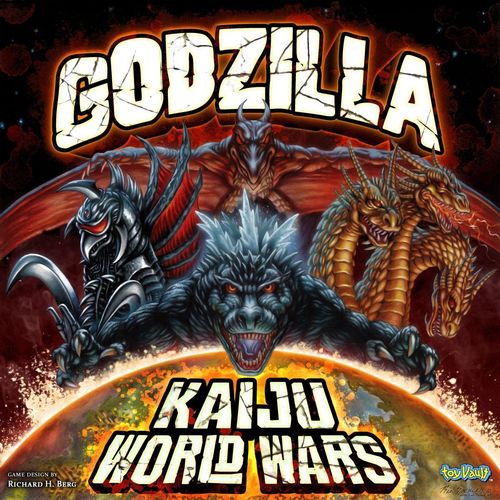
Godzilla: Kaiju World Wars
Godzilla: Kaiju World Wars Rulebook
Table of Contents
Table of Contents
Components
- 1 Board
- 4 Plastic Kaiju miniatures
- 90 Plastic stackable building tiles
- 4 2-sided Kaiju Status cards
- 33 Event cards
- 22 Combat cards
- 25 Action cards
- 11 Info cards
- 19 Kaiju Condition cards
- 2 6-sided dice
- 1 Rule & Scenario book
Assorted cardboard tokens (Turn Order tokens, Tanks, Personnel Carriers, Gardens, Ponds, Fire, Radiation Zone markers, 1-Story Buildings, and Destruction, Health & Energy status markers).
The Gameboard
The Gameboard contains 176 one-inch squares, which regulate movement as well as placement of buildings.
The Kaiju
The game contains four Kaiju: Godzilla, King Ghidorah, Gigan, and Rodan, each represented by a plastic miniature.
The Building Pieces
Godzilla: Kaiju World Wars contains 90 plastic building pieces. The building pieces are stacked, as shown below, to make buildings up to 4 stories.
The reverse side of each piece represents Rubble, which happens when a building is destroyed. Only one rubble piece is needed to represent this state; no stacking is necessary.
Note: For best stacking, each tile should be rotated 90° from the tile below it.
The Cards
There are five separate decks of cards:
Info Cards - For quick reference to some important rules and game mechanics.
Action Cards - Show what actions that Kaiju can do, and how much energy it costs to do so. (The number of action cards vary per Kaiju.) The cards marked Basic Game are not used in the Advanced Game.
Combat Cards - These are used in the Advanced Game. Each card shows the Combat capabilities for each Kaiju, how to use them, and when. The number of Combat Cards vary per Kaiju. Comparing one Kaiju's card to another (Attack/Defense) is how Combat is resolved in the Advanced Game.
Event Cards - Provide outside factors over which players often have little control (but are all based on events from the Toho films), as well as providing players with Power Up cards that can be claimed in order to use their Kaiju's Special Abilities.
Kaiju Condition Cards - Used to indicate a Kaiju has been Knocked Down or Stunned.
The Kaiju Status Cards
Each Kaiju is represented not only by his plastic piece but his Kaiju Status Card. Each Kaiju Status Card is two-sided. One side is for the Basic Game, and is not labeled. The other side is for the Advanced Game and it is labeled Advanced.
Each Kaiju Status Card contains the following information:
- Health Track (Damage), indicates how many "hits" a Kaiju has taken.
- Energy Track, indicates how many energy points the Kaiju has used. The Advanced Game side also has Special Abilities that Kaiju has when Powered Up.
- Advanced Special Abilities
The Dice
The game provides 2 six-sided dice for use in resolving Combat.
The Tokens
The game uses cardboard pieces to represent non-Kaiju participants, including Tanks and Armored Personnel Carriers (APCs), which are numbered to determine their in-Game-Turn-order. Some cardboard pieces represent relatively flat pieces of "terrain", such as Ponds, Gardens, Fire, extra 1-Story Building Tiles, 2 Special Restaurant Buildings and Nuclear Fallout Tokens. There are also Informational markers to use so that players can keep track of what has been happening on their Kaiju Status Cards.
The Combat pieces (starred 'special' side used only when called for by an Event Card) include:
- 20 Tanks
- 20 Armored Personnel Carriers (APC)
The Terrain pieces include:
- 5 Ponds (with 3 Garden and 2 Fire backs)
- 5 Gardens (with 3 Fire and 2 Pond backs)
- 5 Fire (with 3 Pond and 2 Garden backs)
- 20 1-Story Building Tiles (3 varying face styles)
- 2 Special Restaurants (denoted with red border and "FOOD" text)
- 8 Nuclear Fallout Tokens (used only when called for by an Event Card)
The Informational pieces, corresponding to each player include:
- 4 Energy Markers (Blue)
- 4 Health Markers (Orange)
- 4 Destruction Point Trackers (Bearing each Kaiju's image)
- 4 Player Turn-Order Tokens (Numbered 1-4)
Some Important Definitions
The following expressions and abbreviations are used throughout the rules:
Kaiju: The Japanese word for monster.
Turn: A full turn of the game. Starting with assigning Energy Points (Step A), to the determine victory step (Step F).
Player Action Round: One player's series of actions during step C of the turn.
Powered Up: A Kaiju that has played the "Power Up" Event card on his Kaiju Status Card.
Step: A part of a turn.
EP: Energy Points. These are the points each player has that determine what he may do during his Player Action Round.
DP: Destruction Points. These points, accumulated by destroying buildings and combat pieces, are used to determine who has the upper hand as the game progresses. They are used to determine which Kaiju goes first, whether a Kaiju is Enraged, and, frequently, for Victory Conditions. Destruction Points are charted on the numbered track bordering the Gameboard.
Enraged: A Kaiju is considered Enraged if their Destruction Score is at least twice as high as the individual Destruction Score(s) of all other opposing Kaiju.
Melee Attack: Melee Attacks are between Kaiju who are orthogonally (diagonals do not count) adjacent to each other.
Ranged Attacks: Ranged attacks are limited by the distance between the attacker and the defender. Each attack has a Range Value and if the distance between the two Kaiju is greater than this number, the attack cannot be used. To determine the range of an attack, count the squares orthogonally from the attacking Kaiju to the target. You may not count diagonally only orthogonally. You count the target's square but not the attacking Kaiju's square.
You may not perform a ranged attack on an orthogonally adjacent Kaiju.
Most destructive Kaiju: The Kaiju with the highest amount of DPs. This status is immediately lost when another Kaiju has more DPs. At the start of the game, the first Kaiju to move is considered the most Destructive Kaiju if tied with other Kaiju.
Line of Sight: Additionally, Ranged Attacks require Line of Sight. Line of Sight is an imaginary line drawn from the center of one Kaiju's head to the center of another Kaiju's head. If any part of the imaginary line touches or crosses a Kaiju or three or four tile tall building, the Line of Sight is blocked.
Health Meter: All Combat damage is tracked through each Kaiju's Health Meter. Each Kaiju has a Health Marker which is placed on this track to show how much health they currently have, and is moved up this track when the Kaiju takes damage.
Getting Ready to Play
First, select a Scenario from the Scenarios section located at the back of this book. Setup the board according to the rules of the Scenario. Some Scenarios will allow players the ability to customize their own maps. Keep in mind that each Building Tile represents one level of a building, up to a maximum of four. Pond and Garden counters may also be used. Players do not have to fill up all the Lots, but the fewer buildings the game has, the fewer Destruction Points will be available. You can use the building tokens to represent 1 story buildings.
Place all the Tanks and APCs to the side unless the scenario calls for them to start on the Gameboard. They do not have to be placed in any numerical order. Decide whether to play the Advanced Game or the Basic Game.
Next, each player should select which Kaiju they wish to use in the game, taking the appropriate miniature, Status card, Action cards, Destruction marker, and Status card markers. If playing using the Advanced Game, they should also take the Combat cards for that Kaiju, flip their status card to the Advanced side, and remove the two basic combat cards from the game.
Unless the selected Scenario rules say otherwise, you should then:
- Basic Game: Remove the six Power Up event cards from the event deck.
- Shuffle the deck of Event Cards and, randomly deal out, face up, one card to each of the six spaces on the Game board's Event Row. Place the remaining deck face down for later use in the designated spot on the Game board.
- Place the Destruction Marker for each active Kaiju on the 0 space of the Destruction Track around the edge of the Game board.
- Place the Health Marker for each Kaiju on the highest numbered space on the Health Meter on that Kaiju's Status Card. Place the Energy Marker on the 10 on the Energy Track.
- Refer to the Scenario for the placement of the Kaiju, Terrain and Military pieces.
With everything in place, you are now ready to start play.
Playing the Game
The Game-Turn
Step A. Assign Energy Points (EP). At the beginning of each of turn, each player receives their Energy Points. Normally, they simply move their Energy marker to the space marked "10" on their status card. If a Kaiju is Enraged (see below) however, they move the marker to the "11" space instead.
A Kaiju is considered Enraged if their Destruction Score is at least twice as high as the individual Destruction Score(s) of all other opposing Kaiju. Note that, in some scenarios, multiple Kaiju are on the same "team." Team members are not considered to be in opposition to each other.
Example: King Ghidorah is playing against Gigan. King Ghidorah's Destruction Score is 21, while Gigan's is 10. King Ghidorah is Enraged, because his Destruction score is at least twice as high as Gigan's.
Step B. Determine Turn Order: Players determine turn order by comparing their Destruction Score on the Destruction Track. The most destructive Kaiju taking the first turn, the second most takes 2nd, etc... Any players tied for Destruction roll off using dice. During the first turn, the scenario rules will dictate which Kaiju goes first – otherwise, roll to determine order as if tied.
Step C. Player Action Round. The Player who goes first now expends some, all or none of his EP to undertake Actions (listed under Actions). To take an action, they simply place the action card face up in front of them, pay the relevant Energy cost, and follow the text of the card.
When that Player has finished undertaking the Actions he wishes (he does not have to use all of his EP in his Round) the Player with the next highest DP now undertakes his Player Action Round.
Advanced Game: Any Energy Points you don't spend this Action Round may be spent in defense during another player's Action Round.
Unused Energy Points do carry over to future Player Action Rounds, but do not carry over to next turn.
Step D. End of the Player Action Rounds: Play continues in the above fashion until either
- No player has any EP remaining, or
- All Players Pass - use no EP – in succession.
Step E. Event Card Phase: The player who went first in the Player Action Rounds rolls one die and consults the Event Row. The result indicates which Event card is resolved, and the selected Event card is disposed and replaced with a new card for the next Turn.
Step F. Victory? Players check to see if anyone has won, according to the Victory Conditions of the Scenario. If not, the game continues another Turn, starting with Step A.
Actions
Actions are the heart of the game, each Kaiju can perform actions during his Player Action Round Period. As players perform Actions, they must spend EP to do so, they keep track of how many EP's they have left on their Kaiju Status Card.
What Actions Are Available
The Actions available during a Player's Action Round are shown on the Action Cards that Kaiju has. The Energy Point costs are listed on a Kaiju's Action Card as well directions for using that action. The action cards vary from Kaiju to Kaiju.
- Some cards are discarded after use (e.g., the Gigan Flight card), which means they are not available for the rest of the game.
- Advanced Game: engaging in Combat requires no Action card. Combat uses the Kaiju Combat cards (different for each Kaiju). The cost to Attack (in EP) is listed on each card.
- Buy Event Card. A Player may buy one Event Card from those on display when available. He may do so only once per PLAYER ACTION ROUND, per Kaiju, and he may never have more than two Event Cards, regardless of how many Kaiju he controls. The cost to do so is 3 EP for the "Brace Yourself" cards and 1 EP for a "Power Up" card. When an event card is bought, it is replaced, face up, immediately from the deck. These cards are indicated by the Purchasable symbol.
The Purchasable symbol indicates which Event Cards may be purchased once placed on Event Row.
Movement
Each Kaiju has a movement Action card. Design Note: Ground Movement includes not only "walking" but the ability of some Kaiju to "fly" very short distances. Thus King Ghidorah, who is very slow and clumsy using his "feet" moves over ground pretty much the same as other Kaiju.
All such movement is orthogonal; no unit may move diagonally.
Kaiju pay costs to enter certain squares, as listed below.
| Empty Space | 1-Story Building | 2-Story Building | 3-Story Building | 4-Story Building | Ponds & Gardens | Rubble | Fire* | |
|---|---|---|---|---|---|---|---|---|
| EP cost | 1 | 2 | 3 | 4 | 5 | 2 | 2 | 2 |
*When entering a Fire space, Kaiju takes 1 Hit.
Stacking
Kaiju, Tanks and APCs may never occupy the same square. A Kaiju that moves into a square occupied by Military destroys the vehicle, taking the appropriate damage (see Military Units) as the soldiers flee to safety. Note that opposing Kaiju cannot move through each other, although friendly Kaiju (Kaiju described as being on the same team by the Scenario rules) may. Once on the Gameboard no unit may move off the Gameboard. If it does so, it is eliminated.
Facing
Facing is the direction a Kaiju, Tank or APC is pointing toward. You may face your Kaiju in any direction at any point of your Player Action Round. Kaiju always turn to face Melee Attacks, but see below (Tails).
Tails
Some Kaiju figures have tails that extend into an adjacent square. The Kaiju is NOT considered to be in the square which its tail occupies. If a Kaiju moves into a square that has a Kaiju tail and announces he is going to attack, the Kaiju with the tail is moved, turned around, so that he is facing the attacker.
The tail end of the Kaiju may be used to knock down Buildings.
- If a tail would enter a Building square because of voluntary movement or face change by that player he must pay the EP cost to do so. Otherwise, it may not be so placed.
- If a tail end must be moved due to facing an attacker, or through a combat card result, and it causes a Building knock down, the Kaiju does not pay the EP cost to do so, but he does not get any Destruction Points for knocking down the Building (even if he wants to pay the EP cost to do this).
Terrain
- Buildings: Only Kaiju may move into squares with Buildings. In doing so, it destroys the Building, turning it into Rubble. Rubble is represented by flipping it to the reverse side of the Building piece. Three or four story Buildings will potentially block line of sight. Refer to the movement chart to find out the cost of moving into a building in EPs. Destroying buildings are a primary way of obtaining DPs, refer to the Destruction! part of the rules (Page 11).
- Ponds/Gardens: Tanks and APC may not enter. Costs 2 Energy for Kaiju to enter. Does not block line of sight. Consult the Ponds & Gardens Info card.
- Rubble: Rubble may not be removed; if a Kaiju uses Rubble as a Thrown Object the Rubble piece remains where it is. APCs cannot enter. Costs 2 Energy for Kaiju to Enter. Does not block line of site. Consult the Rubble Info card.
- Fire: Buildings destroyed by Fire are replaced by "Fire" markers (not Rubble), indicating these buildings are burning intensely. No Tanks or APCs may enter these squares, and any Kaiju that moves into such a square incurs 1 Hit in doing so. No Kaiju may ever end movement in a Fire Square. Consult the Fire Info card. Fires cannot be put out, nor do they spread.
Special Movement
All Kaiju have a special movement Action Card. These allow the Kaiju to move to any square on the board. Their Action cards will indicate if they are allowed to do so, and what the EP cost is to perform their special movement. All Special Movement cards are removed from the game when used, limiting the amount of times each Kaiju can use Special Movement. A Kaiju may only use one Special Movement card per TURN.
When a Kaiju wishes to use his special movement, simply pick him up from his location and place him where he is to land. He can land only on an empty space, Garden or Rubble square and not in a square occupied by another Kaiju, Building, Fire or Military units.
Combat
Combat occurs when a Kaiju attacks another unit. There are two types of Combat in the game: Melee, in which the two pieces engaging in combat are in adjacent squares and Ranged Combat, in which the attacking unit is more than one orthogonal space away.
Basic Game Combat
Using Basic Combat, each attack is simply either a Ranged Attack or a Melee Attack.
Basic Combat Melee Attack: A kaiju must be adjacent to it's target to use a melee attack. A Kaiju spends the amount of EP listed on his Melee Attack Action, and rolls the amount of dice listed on the attack card. The attack does damage as listed on the attack card. For each point of damage the Health of the Target is decreased by one.
Basic Combat Ranged Attack: A Kaiju cannot be orthogonally adjacent to use its Basic Combat Ranged Attack action. A Kaiju must be within RANGE of its target. To be in Range means that its target is no further in squares than the range listed on your Basic Combat Ranged Attack Action counting orthogonally, not counting the square the Kaiju occupies. If a Kaiju is in Range, it must spend the required amount of EP as listed on the card. A Basic Combat Ranged Attack allows you to roll 1 die and potentially inflict the amount shown on the die as damage, refer to the Kaiju's Basic Combat Ranged Attack Action card.
Advanced Game Melee Combat
Using Advanced Combat, each Kaiju has several cards usable for either Attack or Defense (or both): these are referred to as Combat cards. When resolving a Kaiju on Kaiju Melee combat The Attacker must be orthogonally adjacent to the target. If the attacker is follow the following sequence:
- Attacker Selects a combat card and places it face down onto the Combat Attack spot on the game board. The attacker may only attack with each combat card once each Player Action Round.
- Defender selects a combat card and places it face down on the combat defend spot on the game board. The defender may choose any unused combat card in defense, He may only reuse a defensive combat card if he has played all of his defense cards this Player Action Round. Once the current Player Action Round is complete, all of his Defense Cards become available for use again.
- Both players reveal their cards and place them side by side lining up the Attacker's red attack side, vs. the Defender's blue defense side.
- The Attacker pays for his Attack with his Energy. If the attacker cannot pay for his energy he pays as much as he can, and the combat is canceled.
- The attacker may then modify the die roll based on the combat card that is used. Refer to the played card.
- The defender may then modify the die roll based on the combat card that is used. Refer to the played card.
- The Attacker rolls one die, adding or subtracting from the result by the modifiers determined by the above step. Results lower than one use the "one" result. Results higher than a six use the "six" result.
- Compare the die roll to the row on the attacker and defender cards to find out the results.
- Icons on the Attacker's Combat Card are applied to the Defender.
- Icons on the Defender's Combat Card are applied to the Attacker.
The possible Combat results are:
- Stunned - Place a Stunned card on the affected Kaiju's Status card. Stunned Kaiju may not use Size & Strength or Aerial Slam attack cards. In all Combat with a Stunned Kaiju, opponents may modify the die roll by 1. Stunned Kaiju must pay 1 extra EP to attack. If a Stunned Kaiju is Stunned twice or more, it must pay 2 extra EPs to attack. Remove one Stunned card after the Stunned Kaiju's next attack. If the Kaiju was already Stunned, he loses 1 Health for each Stunned card currently on the Kaiju's Status card, not including the one just placed.
- Cuts - Roll the die. The affected Kaiju receives half that amount of damage, rounded up.
- Knocked Down - Place a Knocked Down card on the affected Kaiju's Status card. If attacking, the affected Kaiju's Player Action Round ends. If defending, the affected Kaiju takes 1 point of damage. If already Stunned, the opposing Kaiju's owner may move the affected Kaiju into an orthogonally adjacent Building, inflicting 1 point of damage, reducing the Building to Rubble; the opposing Kaiju does not gain Destruction Points for this. Knocked Down kaiju may not Attack or use EP bonuses on any combat card used in defense. Knocked Down kaiju may not move other than to stand up.
- Grappled - Both the Attacker and the Defender take 1 point of damage. Neither Kaiju can move into another space for the remainder of this turn. When Kaiju are Grappled, they cannot do anything other than Melee Combat: no Ranged Attacks, no Move, no Heal. The Grappled Kaijus may move freely again at the beginning of the next Turn (not Player Action Round).
- Combo Strikes and Weakpoints - Some cards have a combat icon with white stars in them - these are called Combo Strikes. When a Combo Strike is lined up with a Weakpoint, treat it as the corresponding Combo Strike Effect on the Combo Strike's card. Otherwise, treat it as the icon pictured.
Example: In this example, because Rodan's WEAKPOINT lines up with Godzilla's COMBO STRIKE STUNNED icon, this means the COMBO STRIKE effect of that icon is used (in this case, GRAPPLED, because the icon possesses 3 stars).
- Retreat - The defender may move away from the attacker 2 spaces, unless Grappled. Retreats always affects defender not attacker. This breaks the rule that the defender's card affects the attacker.
- Blank – A blank space means that there was no effect for that Kaiju, but they are still subject to their opponent's Combat Icon. If neither side shows an icon for the number rolled, the Attack misses entirely, and no Combat result is applied.
Advanced Game Ranged Combat with Throw Objects Card
Throwing objects requires a Throw Objects card play (allowing a single throw).
If a Kaiju is orthogonally adjacent to an opposing Kaiju, he may use the Throw Objects card just like a Melee attack, and it is resolved as a Melee attack. Otherwise it is treated as below:
The Attacker must be adjacent to a rubble square, or a military unit to use a Throw Objects card. The Attacker plays his throw object card.
The Attacker spends the required EP for the attack. If the Attacker doesn't have enough EP then he spends all his remaining EP and the Attack is canceled.
The Attacker then checks the range to the target. He must count the squares orthogonally. If the Attacker is out of range, or if the attack is blocked by an object that blocks Line of Sight, then the attack is canceled. Refer to the Line of Sight rules to determine what blocks Line of Sight.
The Attacker resolves a military attack if his thrown object is a Military unit.
The Attacker then rolls a Die and refers to the Thrown Object card for the results. The Defender has no opportunity to defend.
Special Abilities (Advanced Game)
Each Kaiju has Special Abilities (see his Kaiju Status Card, Advanced side). He can use his special abilities only if a Power Up Event Card has been played on his Status card, and it hasn't been discarded.
Special Ranged Attacks are a Kaiju's unique attack; e.g. Godzilla's Fire Breath or Gigan's Cluster Beam.
To use a Special Ranged Attack from his Special Abilities, the Kaiju must not be orthogonally adjacent to the target unit. He may be adjacent diagonally.
Kaiju may use their Special Ranged Attack only once per Turn.
The Attacker spends the required EP for the attack. If the Attacker doesn't have enough EP then he spends all his remaining EP and the Attack is canceled.
The Attacker then checks the range to the target. He must count the squares orthogonally. If the Attacker is out of range, or if the attack is blocked by an object that blocks Line of Sight, then the attack is canceled. Refer to the Line of Sight rules to determine what blocks Line of Sight.
A Special Ranged Attack allows you to roll 1 die and potentially inflict the amount shown on the die as damage, refer to the Kaiju's Advanced Status Card for the exact effects of that Kaiju's Special attack.
Example: Godzilla has just acquired a Power Up card from the event row, and decides to use his Atomic breath, Godzilla pays 3 EP to do so. His target, Gigan, is two squares away, meaning he is within range of Godzilla's breath. The player, having paid all the costs rolls one die; getting a '3', thus inflicting 3 hits on Gigan. (Had he rolled a '5' he would have missed.) He now discards the Power Up Card.
Damage and Healing
Hits: Combat – both Melee and Ranged – produce Hits, injuries to the unit in question. Each player/Kaiju keeps track of the Hits it has incurred on Health Track on his Kaiju Status Card. If a Kaiju's Hits reach the "0" box, that Kaiju is too weak to continue fighting and must retreat to Monster Island. This will eliminate the player from the game if it is his last Kaiju.
Heal: Each Kaiju has a Heal action card. Kaiju may reduce the number of Hits they have incurred through Healing. To use a Healing action, the Kaiju may not be adjacent to another Kaiju. It costs 2 EP to remove hits. In addition a kaiju must meet the Health requirement on the Heal Action Card.
The player rolls one die, the result is how much the Kaiju's Health increases. Kaiju may initiate a Heal action only once per Turn.
Example: Godzilla has incurred 8 Hits. His Health Meter is now at 2. He needs to Heal! He looks at his Heal Action Card and sees he can play it if he has five health or less. He plays his Heal Action Card for 2 EPs and rolls one die. He rolls a six! His Health goes up to 8! Now he's ready to battle again! However, he is done healing for the turn, as he can only heal once per turn.
Event Card Step
After all players have finished their Player Action Rounds an Event is resolved. Roll one die and select the card matching the number shown. Follow the directions printed on the card. Once a card is selected it is removed from the Event Track. It is then resolved immediately and returned to the bottom of the deck.
If a Purchasable card is selected by the dieroll, discard it without any effects/Event taking place and draw a new card to replace it.
End of Turn
Check the Scenario's rules to see if any player has won the game. Check the scenario for any effects that happen at the end of the turn. Start a new turn with Step A: Assign Energy Points.
Destruction
Many Scenarios in Godzilla Kaiju Wars involve accumulating Destruction Points. Destruction Points are earned in two ways, destroying buildings, and wrecking military units.
Destroying any Building or Military Unit scores Destruction Points:
| 1-Story Building | 2-Story Building | 3-Story Building | 3-Story Building Caught on Fire | 4-Story Building | 4-Story Building Caught on Fire | APC | Tank | |
|---|---|---|---|---|---|---|---|---|
| DP | 2 | 3 | 4 | 5 | 6 | 8 | 1 | 3 |
Destroying Buildings
Buildings can be destroyed by moving into the building square. It costs extra EP to move into a building, as outlined in the movement rules. Once a Kaiju moves into a building, that building is destroyed and replaced by a Rubble Tile.
Kaiju can also use a Combat Card to destroy a building, under the following circumstances:
- Basic Game: A Kaiju must use one of his attack cards and pay the appropriate amount of EP. If the Kaiju manages to inflict any damage, the building is destroyed.
- Advanced Game only: A Kaiju must play a Size & Strength Combat Card (Gigan, however can also use his Ariel Slam) and they must pay the EP to use the card. The destruction of the Building is not automatic; you still have to roll the die as per the card. If you get any Combat result (red box on card) the Building is reduced to Rubble.
Kaiju can also use their Special Ranged Attack to destroy buildings, however when destroying a 3 or 4 story building with a Special Ranged Attack, it is replaced with a Fire token instead of a Rubble Tile. to destroy a building with a Special Ranged Attack, simply spend the appropriate amount of Eps, no die roll is necessary, bnt it does use up the Power Up event card.
Using the Throw Objects Combat card has no effect on Buildings.
Destroying Military Units
Tanks and APCs are automatically eliminated when either of the following happens:
- They get hit by Kaiju Ranged Attacks, including Thrown Objects.
- A Kaiju enters the same Square they are in (and automatically crushes them)
When Tanks or APCs are crushed by a Kaiju they open up fire one last time before they are removed from the board. This is done using a single die for each vehicle, and inflicts 1 point of damage on each roll of 6.
Restaurant Buildings
Two special, visually distinct Restaurant Buildings may also occupy the map (as described by the scenario setup). These are treated as regular 1-story Buildings, but will give your Kaiju a boost of Health of up-to 3 points. When you've moved into one of these Buildings, roll a die. Your Kaiju recovers half the rolled number (rounded down) in Health points, up to their maximum health.
A Kaiju must enter a Restaurant Building space for its trait to be applied. Attacks (Melee or Ranged) will not supply this benefit.
Z-Pizza and Tony S's Bar & Restaurant serve delicious and nutritious foodstuffs for all creatures, great and small!
Military Units
Tanks and APCs are used by the city's military forces to defend the city against attacks. These units aggressively maneuver to block and damage the battling monsters.
During a player's action round, it is the responsibility of the other player or players to monitor and move the Military Units. Any time the most destructive Kaiju moves while visible to a Military Unit, that Military Unit will move two spaces towards that Kaiju. Buildings and other Kaiju block Military Line of Sight. Ponds, Gardens, Fire, Rubble and other Military Units do not. If the Kaiju moves out of view of a Military Unit, that unit will not continue to pursue the Kaiju. Military Units will only move during the most destructive Kaiju's action round.
As soon as another Kaiju scores a higher Destruction Point total, the Military Units will immediately begin targeting the new "most destructive" Kaiju.
The numbers on the Military Units are solely for purposes of determining which Unit moves first and has the right of way in the event that two Units are moving towards the same square. If this occurs, they move in numerical order with the lowest numbered vehicles moving first.
Tanks are capable of firing on Kaiju from a distance of 3 squares. APC's have a range of 1 square. Just like Kaijus, they may count range diagonally. While in range of a Kaiju, they will fire once during every movement made by that Kaiju. Military units attack with a single die each. On each roll of 6, they inflict 1 point of damage.
Important Note: Although Military Units will only move to pursue the most destructive Kaiju, they will attack any Kaiju – both when a Kaiju moves while in range, and when a Kaiju steps on the Military Unit.
| Terrain | Tank Movement | APC Movement |
|---|---|---|
| Buildings | May Not Enter | May Not Enter |
| Ponds/Gardens | May Not Enter | May Enter |
| Rubble | May Enter | May Not Enter |
| Fire | May Not Enter | May Not Enter |
Kaiju Fire Defense Strengths
| Kaiju | Fire Defense Strength |
|---|---|
| Rodan | 0 |
| Godzilla | -1 |
| King Ghidorah | -1 |
| Gigan | -2 |
Recommended Optional Rule: Each Kaiju has a Fire Defense Strength. This rating is used solely to reduce the number of Hits inflicted by a Special Ranged Attack. Thus, a fire Defense of –1 would reduce a 3 Hit dieroll to 2 Hits.
- Fire defense Strength is not used against attacks by Tanks/APC.
Example: Godzilla pays 3 EP to use his Atomic Breath Ray (Power Up), Strength of '1-4' against Gigan. Godzilla rolls a '4', inflicting Hits on Gigan. But Gigan's Defensive Fire Strength of –2, representing his being encased in diamond, adjusts his Hits to '2' (not the '4' that would have been inflicted if unadjusted). If Godzilla's dieroll had been a '5' there would be no Hits.
Scenarios
MONSTER LAW!
Recommended for first-time players. Players: 2 - 4.
It's every monster for himself in this Battle Royale! The Kaiju World Wars have raged across our planet leaving nothing but destruction in their wake.
Victory Conditions: The first Kaiju to score 35 Destruction Points OR the last Kaiju standing wins, whichever comes first. This means you must be smart and tough! Use Melee Attacks to smack your opponent around a bit, but don't be afraid to run away when the action gets too intense!
Setup: Evenly divide buildings, ponds, gardens, fire and rubble amongst each player. Each player rolls two dice, the two highest rolls determine which player gets to place the special Restaurant buildings. Then take turns placing 4 markers on the board at a time, starting with the oldest member of the group.
A player may choose to stop adorning the board anytime, relinquishing his extra markers to the group pot which any other player may exchange for one of their pieces in their turn. Players may build upon any player's buildings (excluding Restaurants) up to a maximum height of 4, but may not otherwise modify an occupied space.
When all city block spaces have been occupied or when all players have agreed upon the layout, each player may select 2 military units and place them, one at a time, in turn, on the map.
Who Goes First: For the first turn, roll the dice to determine player turn order. Each Kaiju must start in a different corner of the board, with the first player choosing their corner first, and so on.
Special Rules for this Scenario: In 3 or 4 player games, defeating a Kaiju scores 10 Destruction points.
THE END OF TOKYO!
Players: 2 to 4 (all four Kaiju are used).
The Xiliens are trying to destroy downtown Tokyo, and have sent Gigan and King Ghidorah to take care of the task. It's up to Godzilla and Rodan to save the city from destruction!
Victory Conditions: Gigan and King Ghidorah win as a team by destroying all the buildings of 4 height, all the ponds/gardens and at least five height-3 buildings OR by defeating both Godzilla and Rodan.
Godzilla and Rodan win as a team by defeating both Gigan and King Ghidorah.
Set Up: The Godzilla/Gigan team may place 3 tanks and 5 troop carriers on the board in any open spaces.
Who Goes First: Gigan or King Ghidorah starts the game, roll to determine which and select a corner in which to enter. Next, Godzilla/Rodan does the same. The remaining member of team Gigan/King Ghidorah goes third and lastly, the remaining Godzilla/Rodan.
Special Rules for this Scenario: With three players, one player plays both monsters for either the Godzilla/Rodan team or the King Ghidorah/Gigan team. If only two players are playing, both players control two monsters of one team.
Ponds and Gardens can be attacked, but only with a ranged attack. Once destroyed, they are removed from the board.
GIGAN HUNGERS!
Players: 2 (Gigan and Godzilla).
Gigan has awoken after years of slumber, and his appetite needs to be sated. His fierce hunger has brought him to the seaside town of Charleston, SC and its thriving fishing industry.
All the 2-story buildings on this map have Fish Restaurants in them. Drawn by the smells of cooking fish, Gigan will attempt to gorge himself on those buildings.
It's up to Godzilla, with a little help from the local Military forces, to take down Gigan and his Kaiju-sized appetite.
Victory Conditions: Gigan wins if he stomps ten of the fifteen 2-story buildings on the map or reaches 60 Destruction Points. Godzilla wins if he defeats Gigan.
Who Goes First: Gigan goes first, entering on the left side of the board (see map). Godzilla enters the game through any Street Square on the edge of the gameboard at least 10 squares from where Gigan is at the time.
Special Rules for this Scenario: Gigan cannot attack any of the 2-story buildings. He must move into their spaces.
Godzilla cannot be defeated either by Gigan or Military Units. If Godzilla's Health would be reduced to zero, he instead starts his next turn with 2 less Energy.
Note: The Restaurants described in this Scenario do NOT act as Restaurant Buildings with the ability to restore Health.
Note: Players may alter this Scenario to have involve any two Kaiju, with the Kaiju replacing Gigan starting first.
ENTER KING GHIDORAH!
Players: 4 (All four Kaiju).
In downtown Manhattan, Godzilla, Gigan, and Rodan have fought a pitched battle with no clear victor. The city is devastated and the monsters have all suffered injuries. While toying with the Kaiju's abilities from afar, the Xiliens choose to send their terrifying agent, King Ghidorah, to finish them all off!
Victory Conditions: Godzilla, Gigan, and Rodan win by defeating King Ghidorah.
King Ghidorah wins by defeating all other Kaiju - He must be the last monster remaining on the board.
Who Goes First: The Kaiju with the highest Destruction points starts the game. (See Special Rules) That monster picks a corner on the board in which to enter, remaining players pick by Destruction Points, each choosing a corner.
Special Rules for this Scenario: Godzilla, Gigan, and Rodan cannot use their Flight or Leap actions for this scenario. If playing using Advanced Combat, King Ghidorah starts with one Power Up card.
Godzilla, Gigan, and Rodan potentially start this scenario with damage. Each Kaiju rolls 1 die and adds 4 to determine their starting health.
Godzilla, Gigan, and Rodan also start with Destruction points. Each Kaiju rolls a die and scores that number of destruction points. Keep rolling until each Kaiju has at least 10 Destruction points.
The Xiliens have disabled all of the monsters' flying/leaping abilities. Godzilla, Gigan and Rodan may only use their Heal card once in the game.
King Ghidorah scores 25 Destruction Points for each Kaiju he defeats.