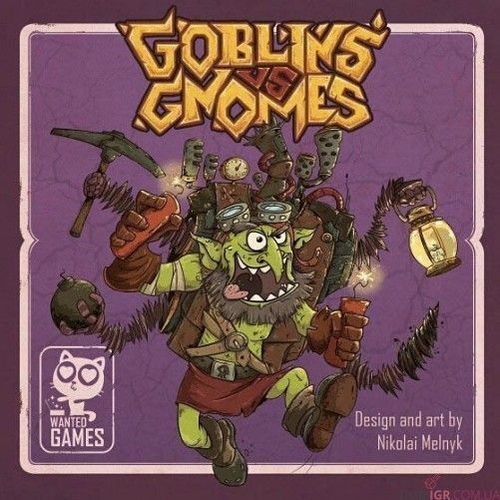
Goblins vs Gnomes
Goblins vs Gnomes Rulebook
Table of Contents
Table of Contents
Setup
- To begin, take the tiles out of the box (70 pieces) and sort them by type:
- path cards: 50 pieces;
- start card (with the ladder): 1 piece;
- role cards (Goblins and Gnomes): 8 pieces;
- target cards (Gold, Dynamite and Dragon): 3 pieces;
- counter cards (one per player): 8 pieces.
-
Deal each player one counter card. This is where the number of prize points won in each round is marked, so place the card on the table in front of you. The first player to reach the "9" mark becomes the winner and takes all the gold, laurels and honours.
-
Place the start card on the playing field.
-
Shuffle the three target cards and place them on the field as shown in the diagram. Target cards are placed face down, at a distance of eight conditional cards from the start and one conditional card apart from each other. This gives you the ready playing field.
-
Distribute the role cards. Role cards are taken according to the number of participants: if the number of players is even, take an equal number of Goblins and Gnomes for the game; if the number of players is odd, take one Goblin fewer. Shuffle the role cards and deal them face down to the participants. The remaining ones must be put back in the box. Nobody may show their role card; it is known only to its owner.
Next to the playing area (usually behind the targets), place a stack of path cards face down, and give each player three path cards face down to start.
Now everything is ready and you can begin!
Each player is dealt a role card face down. It is either a Gnome (blue background) or a Goblin (green background). Depending on the role, you have different tasks. The task of the Gnomes is to reach the card with gold. The task of the Goblins is to hinder the Gnomes, or to reveal the Dragon card.
A round ends if:
- all players have passed their turn;
- no target has been reached, and all path cards have been laid out on the field;
- the "Gold" or "Dragon" target card has been revealed.
The number of rounds is unlimited.
Possible Actions
The first to move is the player with the longest beard. If there are no bearded players, settle the question by playing rock-paper-scissors.
On their turn, a player may do one of three things:
- Play a card from hand. Cards with path elements are placed only next to cards already on the field, and must extend the existing route. Cards without a path picture are discarded as soon as their effect takes effect (see the card effects below).
- Discard one card to the bottom of the common path card deck and take another card from the top of the deck.
- Pass the turn, if there is no possibility of placing a path card.
If a player does not want to place a card, they may pass the turn by replacing any of their cards with one from the deck. But if the deck has no cards, they must move, even if this harms the team. If there is nowhere at all to place a card, they must show their cards to the other players so that everyone is convinced of this, after which they pass the turn.
Opening Target Cards
To open a target card, you must lay a path from any of its four sides to it. The path must be unbroken and unobstructed, connected to the start card, and must abut the target card from any side.
A target card is opened immediately after the adjoining path card is placed on the field.
After a target card is opened, the round either ends, or the effect of the "Dynamite" card is played (if that is the card opened) and the game continues.
If a road is laid so that two target cards must be opened at once, the player who laid it chooses which target to open first. If the "Dynamite" card is opened first, its effect should be applied immediately, without opening the second target card to which the road is adjoined. If, after the effect of the "Dynamite" card, the path between the start and the target remained intact, the player may open the second target card as well.
Object of the Game
The goal is to collect 9 victory points (carts of gold on the counter card).
The game ends when one of the players has collected 9 victory points.
Role Cards
Role cards have two kinds of rules: basic and advanced.
In the basic game, only the race matters: Goblins or Gnomes. Players who receive Gnome cards try to lay a path from the start card to the "Gold" target card. Players who receive Goblin cards try to hinder them and/or bring about the opening of the "Dragon" target card.
Using the advanced rules, each character is endowed with personal, unique abilities which allow them to gain more points at the end of a round, once a condition predetermined by the role card is fulfilled.
- Master of Transformations: Gets +1 victory point if in the round they took part in an exchange of roles (using a "Potion" card).
- Demolitionist: Gets +1 victory point if the "Dynamite" target card was opened in the round.
- Greedy One: Steals +1 victory point from any player of their choice at the end of the round if the "Dragon" was opened.
- Driver: Gets +1 victory point if the path to the "Dragon" or "Gold" target card does not pass through a door.
- Pedant: Gets +1 victory point if the path card deck is empty at the end of the game.
- King: Gets +1 victory point if there are at least 3 "Ale Mug" cards on the path to the "Gold" target card.
- Keymaster: Gets +1 victory point if the path to the "Dragon" or "Gold" target card lies through open doors.
- Jeweller: Gets +1 victory point if the "Gold" target card is opened.
Path Cards
- Map: Take any one of the three target cards, look at it, and without showing it to anyone, put it back face down.
- Explosion: Remove any tile from the game, except: the start card, the card with the lantern icon, or a target card.
- Potion: You must swap your role card with any player, without showing it to the other players.
- Bomb: The card explodes if the path is completed by opening the "Dynamite" card. Exploded cards are removed from the playing field.
- Lantern: This card cannot be moved or exploded.
- Ale Mug: When you play this card, name which player will skip their next turn.
- Cave-in: Placed on the field alongside the other path cards, it blocks the passage. It can be removed with an "Explosion" card.
- Doors: Block the path and count as a dead end. To unblock the path and open the door, you need a key of the same colour.
- Key: Must be placed at any distance in front of a door, so that the door is open.
- Passage: A standard path card, placed next to a path already on the field.
Target Cards
"The smart gnome digs crooked passages; ordinary heroes always go round!" (flavour caption printed on the page)
Gold
If the players (regardless of role) manage to lay a path to the gold card, the game ends and all Gnomes receive +1 victory point. The Gnome who actually opened the target card receives +1 more victory point. If the gold card was opened by a Goblin, all Goblins receive -1 victory point.
Dragon
If the Goblins (or the Gnomes) manage to lay a path to the Dragon, the game ends and all Goblins receive +2 gold.
Dynamite
If any player lays a path to the dynamite, all cards with the bomb icon are removed from the table, BUT the game continues.
Important! If no target has been reached, the Goblins win and each receives +1 victory point. If a Goblin is forced to subtract a victory point from themselves while having 0 victory points, they do not go into minus and remain at zero.
Counter
Each player is dealt a counter and keeps it for all rounds until the end of the game. The nine carts of gold are the points track. Move the counter each time you gain (or, conversely, lose) victory points as a result of a round.
Scoring in each round takes place in turn, starting from the player who opened the "Gold" card or the "Dragon" card; or, if no target cards were opened by the end of the round, starting from the player who first ran out of path cards.
The first player to place the counter on the value "9" is the winner.
Instead of a counter, use any small handy item, for example a coin.