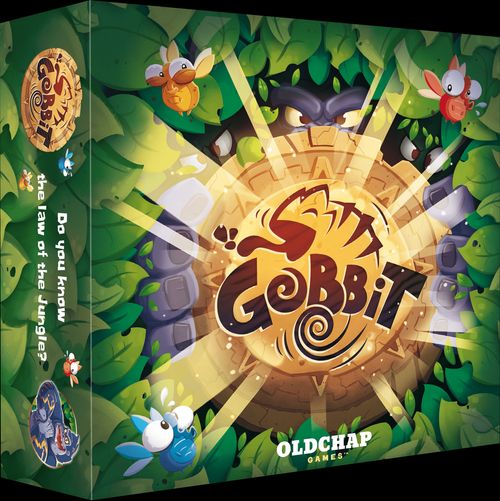
Gobbit
Gobbit Rulebook
Table of Contents
Table of Contents
The Food Chain
The Chameleon
It attacks the mosquitoes.
The Mosquitoes
They don't attack anyone. Since they appear in pairs, they must defend against predators of each color shown.
The Snake
It attacks the chameleons. Watch out: it never attacks the mosquitoes.
The Gorilla
It is the king of the jungle. There is only one per color. It attacks snakes, chameleons, and mosquitoes.
How to Play
Setup & Turn Order
Everyone keeps their own cards, and no peeking! Deal the cards out evenly and choose a first player.
Taking Turns
In Gobbit, players take turns clockwise. On your turn, flip the top card of your deck toward the other players, without looking at it, and place it face up in front of you. If you already have cards in front of you, this card goes on top of them. Over the course of the game, a pile builds up in front of you.
Only the Last Card Counts
It is always the last card you played that counts. As long as it is visible, it is active. Watch out for surprise attacks...
Note: the turn order never stops. It is always the turn of the player after the last one who played a card to play a card.
Here We Go!
Player 1 (P1) and Player 2 (P2) have flipped their first card one after another. Nothing happened. It's Player 3's (P3) turn to play.
Note: the player who plays the first card is chosen randomly.
First Conflict
The blue snake can eat the blue chameleon. P2 can attack P3's chameleon by tapping it. To defend, P3 must tap their own chameleon. P1 can't do anything; they aren't involved.
Note: you don't need to wait for a full turn before attacking or defending — as soon as your prey or predator is visible, you can tap!
The Attack
If P2 taps first, the chameleon is eaten. P2 takes the chameleon (and any cards beneath it) face down and adds them to the bottom of their own deck.
Note: after attacking, you do not take back your own cards on the table — only your opponent's.
The Defense
On the other hand, if P3 taps first, the chameleon is protected. P3 puts their chameleon (and any cards beneath it) face down under their own deck.
Note: you can tap several piles at the same time (or one after another) to attack multiple piles, or to defend while also attacking.
Faults
It's P1's turn again, and they play a red chameleon on top of their previous card. P2 then attacks P1. But attacking a different color is a fault. P2 therefore loses their snake (along with any cards beneath it).
Note: defending without reason is also a fault. If P1 had tapped their own red chameleon first, they would have committed a fault too.
The Graveyard
Every time a player commits a fault, all of the cards they had previously played (i.e., face up in front of them) are discarded face down to the middle of the table. P2's blue snake is therefore sent face down to the graveyard. No one may ever take cards back from the graveyard.
Note: tapping the graveyard is a fault and causes you to lose the cards in front of you (except during a "Gobbit," see next section).
The "Gobbit" Rule
Once there is a graveyard, whenever all three mosquitoes — yellow, blue, and red — appear on the table, as happens in this example thanks to P1 and P3, every player still in the game may tap the graveyard while shouting "Gobbit!" The first to tap takes all of the piles on which mosquitoes are visible.
Note: during a "Gobbit," attacks and defenses cannot be carried out, and faults do not count.
The Poltergeists
When a player has no cards left (none in their draw pile, none in their play pile), they have lost. However, they become a Poltergeist. They can then attack cards that appear as a matching pair. Here, P1 can attack P2 and/or P3. Attacked players who do not defend must discard their card (along with any cards beneath it) to the graveyard.
Note: two mosquito cards are identical if the two mosquitoes on the first card are the same colors as the two mosquitoes on the other.
End of the Game
The game ends when only one player still has cards (in their draw pile and/or in front of them). That player wins the game. Here, P2 has won.
Note: if no player has any cards left to draw, the player with the most cards in front of them wins. The game can end in a tie.
Expert Variant
Warning: reserved for the boldest players!
In expert mode, you must pay attention to the illustration on the back of the card on top of the graveyard. This card indicates an additional constraint to respect as long as the card is visible.
This constraint changes every time the graveyard grows. Be careful, because any failure to follow the current rule counts as a fault (and therefore causes you to lose your pile).
The 6 Variants
- Snake token: Snakes attack mosquitoes, the same as chameleons.
- Triangle token: The food chain order is reversed. Mosquitoes attack chameleons, which themselves attack snakes (gorillas remain their predator).
- Circle-of-dots token: The food chain loops around. Mosquitoes attack snakes.
- Different-colors token: Conflicts no longer happen between animals of the same color, but only between animals of different colors.
- Explosion token: Mosquitoes are explosive. Do not touch them, no matter what!
- Poltergeist token: All players may attack pairs as if each of them were also a Poltergeist. Attacked piles that are not defended are sent to the graveyard.
Optional Rules and Clarifications
Optional Rules
-
Sudden Death: when a player has no cards left in their draw pile, they must absolutely succeed on their next attack. If they miss an attack, they put their cards in the graveyard and lose the game.
-
Minimum Penalty: if you commit a fault while you have no cards in front of you, you discard one card from your draw pile to the graveyard.
Clarifications
-
If a player has no draw pile left but still has cards in front of them, they wait for a chance to attack or defend without drawing a card on their turn.
-
If a player commits a fault and then lands a successful attack, their attack doesn't count. They simply discard their cards.
-
If a player commits a fault and then lands a successful defense, they deny their predator the cards that could still have been attacked, and simply discard their own cards.