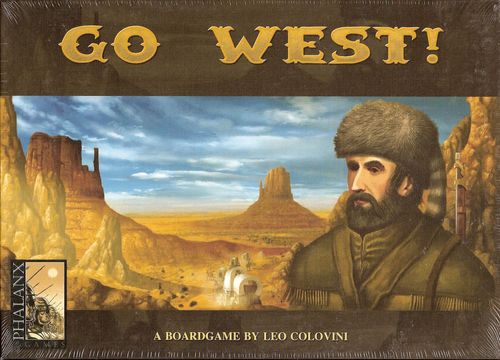
Go West! (2005)
Go West! (2005) Rulebook
Table of Contents
Table of Contents
Components
Each copy of Go West! contains:
- 1 game board
- 80 playing cards (56 action cards, 24 scoring cards)
- 20 wooden wagons
- 120 tokens (in 4 colors)
- 4 scoring pawns (in 4 colors)
- 4 double move pieces (in 4 colors)
- 4 partition pawns
- 1 rules booklet
Starting Play
The Game Board
The game board depicts the United States, divided into six regions (from east to west): New England, the East, the Great Plains, the Midwest, the West and California.
New England is the starting "space" for all settlers/wagon pieces. The four central regions are the ones the settlers move through on their way to California (the western region). Each of these regions is colored differently and has a track in the same color above it.
The Region Tracks
The region tracks consist of 8 circles each. However, a partition pawn is placed in the top-left circle of each track. During the game the other circles will be filled with player tokens. There may be only one token per circle; therefore a maximum of 7 player tokens may be put in here. For details, see 5.1 and 5.2.
The Scoring Track
The scoring track is situated on the edge of the game board. Here the players adjust the number of victory points with their scoring pawn.
The Playing Pieces
The game includes 20 wagons representing the settlers and their treks, 120 tokens (30 per player), 4 double move pieces (1 per player), 4 partition pawns (for the region tracks, see 3.1.1), and 4 scoring pawns (for the scoring track, see 3.1.2).
The Playing Cards
The game includes 80 cards, 56 action cards and 24 scoring cards (6 per player). The scoring cards are numbered 1 to 6 and have a symbol listing their costs – either 1, 3, 6, 10, 15 or 16 tokens.
The action cards have symbols for their costs (the number of coins at the bottom), for the total number of movements a player may conduct with the card (the number of wagons in the center), and a colored region of the game board with sometimes a number or a + in front of the number (at the top of the card). Not all cards have all symbols!
Prepare for Play
The game board is placed on the table.
- The 20 wagons are placed in New England (the eastern region).
- Each player selects a color and receives 30 tokens, a double move piece and 6 scoring cards in the chosen color.
- All scoring pawns are placed on box "10" of the scoring track on the game board. (Each player starts with 10 victory points.)
- The action card pile is shuffled and each player receives 7 cards, face down. The other cards form the draw pile which is placed near the game board.
- One partition pawn is placed into the top left position of each region track of the game board.
General Course of Play
Go West! is played in game turns. The oldest player starts. Afterwards, play continues in clockwise fashion.
During a player turn a player may play one of his action cards (paying its costs), then move some of the wagons and then occupy circles on the region track in question. Alternatively, he could claim a score with one of his scoring cards or sell an action card. All this is explained in detail later.
Sequence of Play
In a player turn, a player conducts one (see 6.0) of three possible actions. He may
- play an action card
- claim a score
- sell an action card.
A player cannot simply pass; he has to conduct one of these three actions.
Then the next player conducts his turn.
Playing an Action Card
When a player plays one of his action cards, he does the following, in this order:
- He pays the cost of the card. The cost is in coins at the bottom of the card. The player pays the shown number of coins to the bank, in tokens. There are cards that cost nothing to play. The highest cost is six tokens.
- He occupies circles on region tracks. This is the top symbol of the card. Not all cards allow this. The number determines the number of tokens a player may place; the colored region shows in which region track the tokens are to be put. If there's no number printed, the player must put one token in the colored region.
Examples: A "2" in the West means that you have to place 2 tokens on the corresponding region track. If there is a "+1" you put one token on the region track matching the color plus one token onto any other region track (but not the same one!).
The circles of a region track are filled in clockwise order, starting from the partition pawn. When the 7th token has been placed, the region track is "full". If a new token is placed into a full region track, the partition pawn is moved (clockwise) by one circle. The token occupying that circle (the "oldest" token) is removed and handed back to its owner. The new token is put into the former position of the partition pawn. In this way, the composition of player tokens in a region changes frequently. A returned token may be immediately reused by the player.
- He moves wagons. The center of the card shows the number of wagons he may move. Some cards do not show any wagons and therefore do not allow any movement. One movement is moving one wagon from its current region to the adjacent one. A wagon may only move west, never back east! The total amount of movements a card allows may be divided as the player sees fit. Example: A player has 3 movements. He could move 3 wagons to an adjacent region, 1 wagon three regions, or 1 wagon two regions and another just one.
As soon as a wagon reaches California (the leftmost region), it is out of the game.
If you play an action card, you have to follow the instructions fully. You may not skip any part. Example: If a card allows a player to move wagons and place tokens, he has to do both. Exception: If a player does not have any tokens left, he may skip that part.
It is not allowed to incompletely fulfil a part of one of the card's actions. Example: A card allows the movement of 2 wagons. The player may not move only one wagon.
- Finally, the player takes the top card from the action card pile, adding it to his hand.
Claiming a Score
Instead of playing an action card, a player may play one of his scoring cards. The settlers pay their fees to the landowners and the players get corresponding points. In order to do so, he plays his lowest numbered scoring card and pays the required number of tokens. Example: A player pays 1 token for his first score and 6 tokens for his third score in the game.
After playing a scoring card, it is returned to the game box. Each scoring card may only be used once. Although all players may receive victory points, only one player pays for playing the scoring card.
When there is a score, victory points are adjusted in all regions, starting from east to west.
When a player plays a scoring card, all players get victory points: each circle on the region track occupied by a token may bring its owner 1 victory point (but see below). Two situations may arise:
- If the total number of wagons in a region is equal or higher than the total number of tokens in the corresponding region track, each circle is counted and each player receives 1 point per occupied circle.
Example: In the East there are 5 wagons. 5 circles on the region track are occupied by player tokens. Each player receives 1 point per circle. Therefore, the red player gets 3 points and the green and blue players 1 point each. There would be no difference if there were 6 or more wagons instead of 5.
- If there are more tokens on the region track than there are wagons in the corresponding region, the player who occupies the most circles on the region track receives victory points first (1 point per token). Afterwards, the player with the second-most circles occupied on the region track receives points. This continues in decreasing order of occupied circles. However, the number of wagons in the region limits the number of victory points that may be given (if there are 4 wagons, only 4 victory points may be given). If there is a tie regarding the number of occupied circles on the region track, the players get victory points according to chronological order (i.e., the order in which the tokens have been placed; in clockwise order from the partition pawn. See example 2 below.).
Example 1: There are 4 wagons in the Great Plains. 6 circles on the region track are occupied by player tokens. Green occupies more circles than the other players, therefore green gets 3 victory points. The fourth and last victory point is received by red because he occupies more circles than blue. Blue does not get any points.
Example 2: In the Midwest there are 5 wagons but the players occupy 7 circles on the region track. Red and green both occupy 3 circles. The tied players receive victory points according to when they placed their tokens onto the region track. Starting from the partition pawn, they determine victory points in clockwise order. The first point is scored by green, the second, third, and fourth points are scored by red and the final one by green again. Blue does not get any victory points (there are not enough wagons).
All victory points are immediately registered with the scoring pawns of the players.
Selling an Action Card
When it is his turn, a player may sell an action card instead of playing it.
The player discards the action card of his choice and receives the number of tokens the card would cost (see the coins on the card) from the bank. He adds them to any tokens he has left.
If a player would get more tokens than there are in the bank, the surplus is forfeited.
After he has sold a card, he may draw the top card from the action card pile, finishing his player turn.
Paying with Victory Points
If a player wants to play an action or scoring card but does not have the necessary amount of "money" (tokens), he may use his victory points as payment. 1 victory point pays for one coin on the card. The scoring pawn is moved back the required number of boxes. It is possible to pay for a card partly in tokens and partly in victory points. However, a player may only use victory points for payment as long as he has them (i.e., if a player does not have any victory points, he cannot pay in them).
Shuffling the Action Card Pile
When the action card pile is depleted, all played or sold action cards are shuffled to form the new action card pile.
The Double Move Pieces
Each player receives one double move playing piece. At the start of any of his turns, the player may use it (putting it back into the game box). In this turn, the player may do 2 actions instead of 1. Any combination of actions is possible, even conducting the same action twice.
Note: First playing an action card (moving wagons and occupying circles on the region track), then playing a scoring card is a particularly good strategy.
When all players have used their double move piece, they are returned to them to be used again. They are returned after all have been used a second time etc.
Note: Using the double move piece is announced at the start of a player turn. This prevents players from using it twice in one turn.
Winning
The game ends when:
- One or more players reach 50 victory points or more at the end of a score; or:
- There are neither any wagons in New England (the starting region) nor in the East. In this case, a final score in all regions is conducted, after all wagons have been moved and tokens put into region track circles. This score is free and is handled just like a "standard" score (see 5.2).
Winner of the game is the player with the most victory points. If there is a tie between two or more players, the player with the most tokens in his possession wins. If there is a tie again, the game ends in a draw between these players.