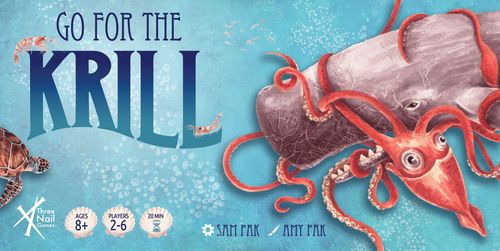
Go For The Krill
Go For The Krill Rulebook
Table of Contents
Table of Contents
Game Overview
In Go For The Krill, players will be competing to consume the most food over a set number of rounds. They will do so by playing cards from their hand that represent ocean predators trying to eat swarms of plankton and krill.
Players' actions are carried out simultaneously to determine who will feast and who will go hungry. At the end of the game, the player with the highest point total from Food Cards will be named the winner of the deep and the most voracious ocean predator!
Base Game Components
- 148 Food Cards (118 Plankton, 27 Krill, 1 Loggerhead Sea Turtle, 1 Orca Whale, and 1 Scuba Diver)
- 72 Hand Cards (60 Numbered Whales, 6 Giant Squids, and 6 Emperor Penguins)
- Rulebook
Component photos: Krill Cards, Numbered Hand Cards, Specialty Hand Cards, Specialty Food Cards, Plankton Cards.
Setup
-
Thoroughly shuffle the deck of Food Cards (darker-colored cards), which consist of all Plankton, Krill, and Specialty Food Cards, and place them in the center of the play area within reach of all players.
-
Separate the Hand Cards (lighter-colored cards) into stacks based on their different icons in the bottom left corner. Give one stack to each player. Each player should have exactly one of each card: Whales numbered 1-10, one Giant Squid card, and one Emperor Penguin card.
-
Begin the setup for the first round by drawing a number of cards equal to twice the number of players, and place them in the center of the play area into stacks associated with their numbers, 1-10 (example layout shows setup for four players). Krill and Plankton cards of the same number get added to the same Food Stack. Be sure to leave gaps between stacks in the play area for numbers that haven't been drawn yet.
NOTE: If you draw a Specialty Food Card (Sea Turtle, Orca Whale, or Scuba Diver) during the first round of setup, set it aside and finish drawing until there are cards equal to twice the number of players (these should only be Plankton and/or Krill for the first round). Then, shuffle any , , and back into the .
Diagram: Initial setup for four players (labeled "2x four players = 8 Food Cards"; the numbered markers show the setup steps).
How to Play
Go For The Krill is played over twelve rounds. Each round follows the same four steps: "Replenish," "Selection," "Reveal," and "Collection."
Diagram: Mid-game example on Round 5, showing Food Stacks, Food Deck, Food Deck Discard Pile, Personal Hand, Personal Discard Stack, and Personal Food Collection Pile.
1. Replenish
(Skip this step for the first round, as it was already taken care of during setup.)
Assign one player to be the dealer for the game. This player will draw cards from the Food Deck equal to twice the number of players at the beginning of each round. They will then reveal them one at a time and place each card in its respective numbered Food Stack in the play area.
If a Specialty Food Card (Loggerhead Sea Turtle, Orca Whale, or Scuba Diver) is ever revealed, resolve its effect immediately and then continue revealing the remainder of the cards.
Tip for Beginners: New players might consider ignoring the effects of the Sea Turtle, Orca Whale, and Scuba Diver for their first game, as they add an aspect of unpredictability.
2. Selection
Each player now simultaneously selects one card from their hand secretly and places it in front of themselves facedown. Players may at any time freely look at other players' Personal Discard Stacks to know what cards each player has played in previous rounds. Personal Discard Stacks should be arranged so that all cards are viewable by all players.
NOTE: Players are allowed to select a card from their hand that corresponds to a Food Stack that has no cards currently in the play area.
NOTE: No matter the circumstance, each player must play a card from their hand every round.
3. Reveal
Once all players have selected a card and placed it facedown on the table, everyone simultaneously reveals their card. Any players that played the same card (other than the Giant Squid) immediately cancel each other and do not get to take part in the collection step this round. Any canceled cards will be placed in their owner's Personal Discard Stack as normal.
The one exception to canceling is the Giant Squid card. Giant Squids remain in play even when played by multiple players during the same round and can never be discarded by way of a conflict.
If multiple players play the same number card, causing them to cancel each other, the Food Stack of that corresponding number is now classified as "Spooked" for the rest of the current round.
Example of "Reveal" step in a 5-player game: All players that played a 5 are canceled and do not collect anything this round. The 5 Food Stack remains and may not be collected by the Emperor Penguin. The 3 and the Emperor Penguin both resolve normally and collect Food Stacks this round. (The example labels the 5 Food Stack as "Spooked.")
4. Collection
Any player who played a card that did not get canceled by another player now collects their winnings by performing their selected card's action in the resolution order of A, B, C, D, E, F, G and H. Each card's resolution order letter can be found in the bubble at the top right corner of the card. If there are multiple cards that have the same resolution letter, then those cards will resolve simultaneously (This will only happen with Giant Squids).
NOTE: The base game only contains cards that resolve during steps C, E, and H of the resolution order. The other letters are utilized in the Darker Waters expansion.
Each player should place all Food Cards collected facedown in their own Personal Food Collection Pile.
The action of each card is described in the Card List starting on page 15.
After collection, all players place their selected/played card into their own Personal Discard Stack.
Example: discarded card at the end of round 4.
Now, begin the next round with the "Replenish" step!
Game End and Scoring
The game ends after the twelfth round, at which point every player will have one card remaining in their hand. Players then total the number of Plankton and Krill in their Personal Food Collection Pile, and the player with the most points is the winner!
NOTE: The Krill cards are worth twice their face value.
Example: A 4-value Plankton is worth 4 points, but a 4-value Krill is worth 8 points.
In the event of a tie, the tied player with the most total Krill cards (regardless of value) is the winner. If still tied, the tied player with the most 1-value Plankton cards is the winner. Continue comparing successive Plankton number values this way until a winner is determined. In the bizarre scenario that players are still tied after considering all of the above, the first tied player to eat shrimp is the winner. If they happen to eat shrimp at the same time, then they are taking this too seriously. Tell them to calm down and play again!
2-Player Variant
This variant creates some interesting interactions that players must consider when choosing their cards. For this reason, although it is not entirely necessary, it is highly recommended to play one game with 3-6 players first.
(Designed by Rusty Lumpkin.)
Setup Changes
Set up the game as if it were a 4-player game. Each player will have two hands of cards, a "Right Hand" and a "Left Hand," they will play with. Each hand will have its own separate Personal Food Collection Pile and Personal Discard Stack.
Gameplay & Scoring Changes
The players will "Select" cards and "Collect" cards with each hand separately as if each hand at the table was its own player. The game will be played exactly like a 4-player game with one major change. At the end of the game, only the Food Cards collected by your RIGHT Hand will score. This means the Left Hand will be played defensively, attempting to cancel the other player's Right Hand card. It also causes your Right Hand cards to be played offensively, trying to collect precious points! All cards collected by the Left Hand are placed in the Left Hand's Personal Food Collection Pile but are worth 0 points at the end of the game.
During the "Replenish" step, be sure to reveal 8 new Food Cards every round as if it were a 4-player game.
Game End Changes
The game is played over 9 rounds instead of 12. This means that if any hand plays its Giant Squid card, it should have 4 cards left when the game ends rather than the usual 1. If the hand has not played its Giant Squid card, it should have 3 cards left.
Darker Waters Expansion
In the darkest reaches of the sea lie the ocean's fiercest and most deadly creatures. As the commotion overhead signals it's time to feed, they come up from their slumber to join the fray. Likewise, beasts of the air dive deeper than ever so they, too, can fill their bellies with krill.
NOTE: This section of the rulebook covers all of the rules needed for the Darker Waters expansion for Go For The Krill. The contents for the Darker Waters expansion are sold separately.
Expansion Overview
Go For The Krill: Darker Waters expands the base game's options by adding more interactive creatures to players' hands, Mission Cards that raise the stakes by adding new avenues to gain points, and even a way to break ties when cards cancel. Additionally, components to support a seventh player are provided, making games of Go For The Krill even more exciting.
Expansion Components
- 38 Food Cards: 32 Plankton and 6 Krill.
- 61 Hand Cards: 10 Numbered Whales, 1 Giant Squid, 1 Emperor Penguin, 7 Great White Sharks, 7 Krill Nets, 7 Black-Browed Albatrosses, 7 Whale Sharks, 7 Leopard Seals, 7 Tie-Breaker ✔ cards, and 7 Tie-Breaker ✗ cards.
- 11 Mission Cards.
Setup & Game End Changes
Each player's hand will consist of the number cards 1-10, Giant Squid, and any TWO other Hand Cards that the players collectively agree upon for that game (all will have the same 13 cards in their hands).
NOTE: Every game is played with the Giant Squid. (The printed example shows the Giant Squid and two other Hand Cards.)
Additionally, the game may now be played with up to 7 players with the inclusion of a seventh set of Hand Cards, denoted by an anchor symbol.
The game is now played over 13 rounds instead of 12. At the end of the game, players should still only have one card remaining in their hand.
The effect of each card can be found described in the Darker Waters Card List starting on page 17.
Tie-Breaker Module
(This is an optional aspect of the game that can be added if you choose.)
Give each player their two Tie-Breaker cards. Every round the players will now play two cards. One will be their usual Hand Card and the other will be one of the Tie-Breaker cards.
Tie-Breaker ✗: Play this card during turns that you don't want to use your Tie-Breaker ✔ card. Return this card to your hand after every round.
Tie-Breaker ✔: Breaks Ties (Remove from game after use). Play this card in place of your Tie-Breaker ✗ card during a round in which you expect to play the same card as another player but would like to win the tie. If there are multiple players that played the same card and only one player that played the Tie-Breaker ✔ card, they are the player that gets to collect while the other players' cards get canceled. If there are multiple players that played the same card and the Tie-Breakers, nobody wins the tie, and everyone is canceled. This card is removed from the game after use. This card is never placed in your discard pile and, therefore, cannot be returned to your hand with a Giant Squid.
Example 1: Players 1, 2, and 3 all play the Emperor Penguin card. Player 1 was the only one that played their Tie-Breaker ✔ card. Player 1 will be the only player to collect this turn while Players 2 and 3's cards are canceled.
Example 2: Players 1, 2, and 3 all play the Emperor Penguin card. Player 1 and 2 both played their Tie-Breaker ✔ cards, while player 3 played their Tie-Breaker ✗ card. All three players are canceled this round.
2-Player Variant Changes
The Darker Waters 2-Player Variant will start with 13 cards and play over 10 rounds (1 extra round than the base game variant due to the extra card). It will still have the same game-end conditions as the base game 2-Player Variant.
Mission Card Module
(This is an optional aspect of the game that can be added if you choose.)
During setup, shuffle the Mission Cards. Randomly select 4 Mission Cards and place them on the table for everyone to see. Return all the other cards to the box.
Mission Card Rules
Competitive Missions: Each Competitive Mission will only be awarded to a single player. If multiple players tie for a Competitive Mission, nobody will get it. Some Competitive Missions are determined at the end of the game, but others can be collected the moment the mission is completed. It will then be totaled with that player's score at the end of the game.
Noncompetitive Missions: These are missions that any number of players can score at the end of the game as long as they meet the missions' criteria! Each player can only score each Noncompetitive Mission once.
Each Mission Card can be found described in the Mission Card List starting on page 18.
Plastics Mini Expansion
(Designed by Rusty Lumpkin.)
Shuffle the Plastic cards into the Food Deck (the cards with the dark background). Whenever a Plastic card is revealed during the "Replenish" step, add it to the matching numbered Food Stack.
Example: A minus 4-value Plastic card will be added to the same Food Stack as the 4-value Plankton and 4-value Krill cards.
The Plastic cards are collected in the same manner as any other Food Cards in the game. If a player collects the number 4 Food Stack and it has any Plastic cards in it, those cards will be added to their Personal Food Collection Pile as normal. At the end of the game, the Plastic cards are calculated as negative points.
Components: 10 Numbered Plastic Cards.
Card List
Base Game
LOGGERHEAD SEA TURTLE: Discard the Food Stack currently in play with the FEWEST cards. If tied, discard the higher-numbered stack. This card, along with all cards discarded this way, should be placed face up beside the Food Deck and are now considered out of play.
Example: If the 2s Food Stack has 1 card in it and the other available stacks have more, the entire 2s Food Stack is discarded. If the 2s and 3s Food Stacks are tied for the fewest number of cards in their stack, then the 3s Food Stack will be discarded because the 3 is a higher number than the 2.
ORCA WHALE: Discard the Food Stack with the MOST cards currently in play. If tied, discard the lower-numbered stack. This card, along with all cards discarded this way, are placed face up beside Food Deck and are now considered out of play.
Example: If the 2s Food Stack has 10 cards in it and the other available stacks have fewer, the entire 2s Food Stack is discarded. If the 2s and 3s Food Stacks tie for the most cards, the 2s stack will be discarded. This is because 2 is lower than 3.
SCUBA DIVER: Discard all Food Stacks in play. Continue revealing Food Cards as normal. This card, along with all current Food Stacks currently in play, should be placed face up beside the Food Deck and are now considered out of play. Depending on when the Scuba Diver is revealed, it is possible that there will remain very few Food Stacks to pick from (possibly none if it were the last card to be revealed). No matter the case, the round will continue as normal, and all players are still expected to play a card from their hand as usual.
WHALES 1-10: (Resolution Order C) Collect the entire Food Stack of the corresponding number.
Example: An uncanceled Narwhal will collect the entire 1-value Food Stack.
EMPEROR PENGUIN: (Resolution Order E) Collect any food stack that has not been spooked or already collected.
An uncanceled Emperor Penguin may collect any Food Stack of their choosing that is left on the table as long as multiple other players had not played the same card targeting that stack earlier that round.
Example: Player 1 plays an Emperor Penguin, and Players 2 and 3 play a number 10. Player 1 can not collect the number 10 Food Stack because it became spooked when Players 2 and 3 canceled.
GIANT SQUID: (Resolution Order H) Return any card from your Personal Discard Stack to your hand (Giant Squid can never be canceled).
The card that you return to your hand does not trigger this round and instead can be selected to be played in future rounds. You will not collect any Food on a round that you played a Giant Squid. If multiple players play their Giant Squid, each of them should privately select which card to return to their hand so as not to influence other players' decisions.
A Giant Squid cannot be canceled by any means, including by the Great White Shark from the Darker Waters expansion.
A Giant Squid may not be played during the first round of the game since there are not yet any cards in your Personal Discard Stack.
Darker Waters
BLACK-BROWED ALBATROSS: (Resolution Order F) Steal one random Food Card collected this round from each player.
If a player had been canceled this round, the Black-Browed Albatross cannot collect from them. Food that was collected in previous rounds cannot be stolen.
In the 2-Player Variant, because each hand is collected separately and considered a different player, a Black-Browed Albatross played by your Right Hand WILL steal from your Left Hand's collection and vice versa.
GREAT WHITE SHARK: (Resolution Order A) Cancel one player's card.
Cannot cancel a Giant Squid. An uncanceled Great White Shark will select one player at the table that has not been canceled this round and will cancel them. (The Great White Shark does not collect anything from the Food Stacks.)
KRILL NET: (Resolution Order B) Collect all Krill from all the Food Stacks in play.
LEOPARD SEAL: (Resolution Order G) Steal half of the Food Cards collected this round from one player (rounded down and randomly).
After choosing a player that you are going to steal from, that player takes the Food that they will collect this turn, shuffles them, and then begins to deal out the cards, facedown, back and forth between the two players, starting with themselves.
If a player had been canceled this round, the Leopard Seal cannot choose to steal from them. Food that was collected in previous rounds cannot be stolen.
In the 2-Player Variant, because each hand is collected separately and considered a different player, a Leopard Seal played by your Right Hand may steal from your Left Hand's collection and vice versa.
WHALE SHARK: (Resolution Order D) Collect a Food Stack that was spooked this round.
An uncanceled Whale Shark may only collect a stack that had previously been canceled over. If all other players played unique cards, then the Whale Shark would have nothing that it is allowed to collect.
* TIE-BREAKER CARDS are described in detail in the "Tie-Breaker Module Rules" on page 12.
Mission Card List
Noncompetitive Missions
THIRD TIME'S A CHARM: If your card was canceled three rounds in a row (20 pts)
NOTE: can only be scored once per player.
It is recommended that when you discard your selected/played card, you turn it sideways in your Personal Discard Pile to differentiate between the cards that had been canceled and those that had not.
THE COLLECTOR: 3 points for each uniquely numbered card you have at the end of the game
NOTE: a 2-value Plankton, 2-value Krill, and 2-value Plastic are all considered to be a 2 when resolving this.
Plastic is a mini expansion and is not contained in the base game. Since there are only 10 different numbers, the maximum number of points that can be scored by this card would be 30 points.
It is recommended that if you play a Giant Squid, have it take the exact same place and orientation in the discard pile as the card you are returning to your hand to keep track of this.
THE PERFECTIONIST: If you played three cards in ascending or descending order (ex: 4, 3, 2 or 7, 8, 9) (15 pts)
Note: can only be scored once per player.
LEFTOVERS: At the end of the game, add the value of the Hand Card left in your hand to your score.
Note: numbered Hand Cards are worth their face value, all other cards are worth 12 points.
SLIM PICKINGS: Have no more than five of each numbered Food Card in your score pile at the end of the game (30 pts).
Competitive Missions
HASTY: If you are the first person to collect any 10s (10 pts)
ONE AND DONE: Have the most 1s at the end of the game (25 pts)
THE PLANKTON PURIST: If you have the fewest Krill cards at the end of the game (25 pts)
RESERVED: At the end of the game, if you have the highest value card in your hand (20 pts)
Note: special cards count as 12 when determining the highest card value.
THE MINIMALIST: If you collected the fewest number of cards (30pts) This is based on the number of cards, not point values or scores.
THE KRILL KING (Promo Card): Have the most Krill cards at the end of the game (10 pts)
Game Summary
1. Replenish: (pg. 6) Draw cards equal to twice the number of players. One at a time, reveal and place each card into its appropriate Food Stack. Specialty Food Cards should be resolved immediately.
2. Selection: (pg. 7) Each player selects a Hand Card and places it in front of them face down.
3. Reveal: (pg. 7) Reveal selected cards and resolve each card following the card resolution order. Identical cards are canceled (except for the Giant Squid).
4. Collection: (pg. 8) Non-canceled Hand Cards now collect Food Stacks following the card resolution order. All played cards are then discarded. Proceed to the "Replenish" step.
Game ends when all players have one unplayed Hand Card left (see changes for 2-Player Variant on pg. 10).
Card Order of Resolution
- A - Great White Shark
- B - Krill Net
- C - Numbered Cards (1-10)
- D - Whale Shark
- E - Emperor Penguin
- F - Black-Browed Albatross
- G - Leopard Seal
- H - Giant Squid