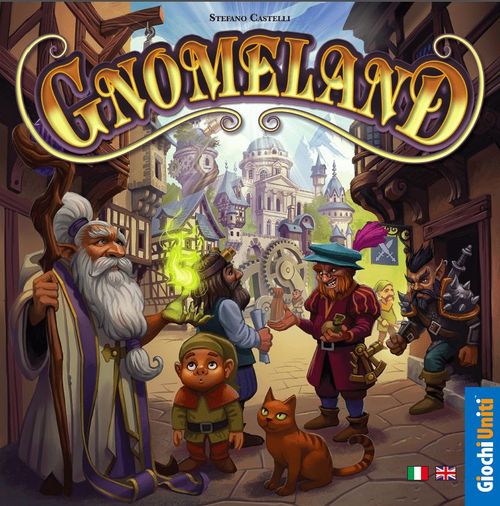
Gnomeland
Gnomeland Rulebook
Table of Contents
Table of Contents
Components
- 1 game board
- 4 Village boards, 1 per player
- 20 Normal Building cards, 5 per player
- 20 Special Building cards, 5 per player
- 27 Mercenary cards, divided into: 9 Traders, 9 Soldiers, 9 Wizards
- 10 Mission cards
- 10 Action cards
- 9 Spell cards
- 12 coloured dice, 3 per player
- 4 neutral dice
- 24 Gnome tokens, 6 per player, one of which is used as the Score marker
- 4 Magic markers, 1 per player
- 1 First Player marker
- 40 Resource markers, divided into: 16 yellow cubes for Coins, 12 blue cubes for Mana, 12 red cubes for Weapons
- This rulebook
Object of the Game
Score the most victory points at the end of the five rounds of play, by constructing buildings and completing missions.
Setup
Place the game board in the centre of the table.
Shuffle the Mission deck and place it beside the game board, with the cards' Base side facing up, next to the Missions area on the game board. Take the first two cards and place them with the Base side facing up on the two spaces marked with the Base icon on the game board.
Shuffle the Action deck and place it face down beside the corresponding area on the game board (the Tavern), then draw two cards and place them face up in the corresponding spaces.
Shuffle the Spell deck and place it face down beside the corresponding area on the game board (the Wizard's Tower), then draw one Spell card and place it face up in the corresponding space.
Form the three Mercenary decks, each made up of 5 cards in a two-player game, 7 cards in a three-player game, and all 9 cards in a four-player game. Place the three decks thus formed near the game board, face up. Mercenary cards that are not used are returned to the box.
Each player has in front of them a Village board, which is made up of 6 spaces: 3 in the lower part, dedicated to Normal Buildings, and 3 in the upper part, dedicated to Special Buildings.
Each player chooses a colour, takes the Village board of that colour and places it in front of them. Then they take the 3 dice of their colour and keep them near their Village board. Then they take the Magic marker of their colour and place it beside their Village board. Finally, they take 5 of the 6 Gnome tokens of their colour and place them on the Gnome House building of their Village board, so that they are clearly visible to all.
Each player takes the remaining Gnome token of their colour and places it on space 0 (zero) of the Score track on the game board.
Finally, place the Resource markers on the table next to the game board, so that they are reachable by all.
All players roll their 3 starting dice: the player with the highest score is the First Player (re-roll any ties) and takes the First Player marker, placing it in front of them. Play then proceeds clockwise.
Important Rule: in Gnomeland, dice are considered "circular": an effect that would increase a die's value beyond 6 would turn the die's value into 1, and vice versa.
Playing the Game
A game of Gnomeland is structured into 5 rounds. During each round, the players roll their dice to obtain resources to spend on hiring mercenaries, constructing buildings, upgrading the buildings they already own, and completing missions. In addition, during each turn a player may send one (and only one) of their gnomes to perform one of the two special actions present on the game board. Moreover, during a player's turn, the others may decide to use one of their own Gnomes to copy an action and gain additional resources.
The Village Board
Each player has in front of them a Village board, which is made up of 6 spaces: 3 (in the lower part) dedicated to Normal Buildings and 3 (the upper ones) dedicated to Special Buildings.
Each of the 3 Normal Buildings corresponds to a pair of die results (1-2, 3-4 and 5-6, printed under the building).
The Village board shows 3 predefined Normal Buildings: two Kiosks (Chioschi), which provide 1 Coin resource when activated, and one Guard Post (Guardiola), which provides 1 Weapons resource when activated. During the game these buildings may be replaced by Normal Building cards from each player's personal deck.
Likewise, in the upper part of the Village board there is space for 3 Special Buildings: these buildings are not linked to die results. They are always active, but their special effects can only be activated once per turn. The game begins with two Warehouses (which allow each of them to keep 1 Resource at the end of the player's turn) and one Gnome House (which holds the Gnome tokens). Like Normal Buildings, Special Buildings may also be replaced during the game by other Special Building cards from the player's deck. The abilities of each Special Building card may be activated only once per turn.
N.B. When a card is placed on the Village board, it replaces the building already present: the buildings so replaced lose their powers and are no longer available. Moreover, any marker (Resource or Gnome) placed on them is immediately discarded.
The Round
All players simultaneously roll the dice of their colour and leave them visible in front of them, near their Village board.
Then, starting with the player who holds the First Player marker and proceeding clockwise, each player performs their turn.
When all players have taken their turn, the round ends.
The Turn
During their turn, a player must spend their dice by pairing them with the Normal Building cards on their Village board. For example, a die with a value of 2 will be used to activate the Normal Building card in position 1-2 of their Village board.
In addition, at any moment during their turn, a player may place one and only one of their Gnome tokens on one of the two Action cards available in the round on the Tavern, and immediately gain its benefits. Gnome tokens played in this way are removed from the game at the end of the round.
When a player has completed their actions and spent all their dice, their turn ends. Resources left unused must be discarded, unless the player is able to keep them, by using one of the two Warehouses initially present on each Village board. Each Warehouse can keep only one resource. The turn then passes to the next player clockwise.
N.B. It is not necessary to spend all dice at the same time. For example, it is possible to spend 1 die to obtain the resources needed to buy a new Normal Building card, and immediately afterwards spend another die to activate the newly built card.
Actions
During their turn, a player may perform as many of the following actions as they wish:
- Hire Mercenaries: it is possible to obtain Mercenary cards by paying the resource cost shown at the top of the card. Mercenary cards so bought are placed beside your Village board, and may be discarded at any moment to immediately gain the corresponding resource shown on the card itself. Spent Mercenary cards return to their respective deck. If at some moment there are no Mercenary cards of the desired type available, it is not possible to buy one until one of them is used, thus returning to its pile beside the game board.
N.B. Besides being spent to obtain resources, Mercenary cards may sometimes be used to complete some Mission cards, which expressly require them.
-
Build Normal Buildings: by paying the quantity of resources shown in the top left of the Base side of a Normal Building card, it is possible to build it and place it in one of the three spaces in the lower part of your Village board. Any Normal Buildings already present in the spaces will be covered by the new ones and will no longer be usable.
-
Upgrade Normal Buildings: Normal Building cards are always built with the Base side facing up. During their turn, a player may pay the cost shown in the top right of the Base side of a Normal Building card to upgrade the building. In this case the card is flipped over to its Advanced side and its new characteristics immediately become available. The Advanced Normal Building card remains in the same position on the Village board.
N.B. Remember that a player may also spend dice on a Base-side Normal Building, use the resources to upgrade it, and then spend any other dice on the Advanced building, all within the same turn.
Example: the player pays the 5 Coin resources shown at the top right of the Shop (Bottega) card and flips it over, turning it into the Bank (Banca), while keeping the same position on the board.
N.B. As described on each player's Village board, Advanced Normal Buildings are worth an additional 1 victory point each at the end of the game.
- Build Special Buildings: by paying the quantity of resources shown in the top left of the Base side of a Special Building card, it is possible to build it and place it in one of the three spaces on the upper part of your Village board. Any Special Buildings already present on the board will be covered by the new ones and will no longer be usable. Note that, unlike Normal Buildings, Special Buildings are not affected by their position on the board, as their effects are continuous and are not activated by rolling dice.
N.B. As described on the Village board, Base-side Special Buildings are worth an additional 1 victory point each at the end of the game.
- Upgrade Special Buildings: Special Building cards are always built with the Base side facing up. During their turn, a player may pay the cost shown at the top right of Base-side Special Building cards to upgrade them. When a Special Building card is upgraded, it is flipped over to its Advanced side and its new characteristics immediately become available. The upgraded Special Building card remains in the same position on the Village board.
N.B. As described on each player's Village board, Advanced Special Buildings are worth an additional 2 victory points each at the end of the game.
- Complete Missions: by paying the quantity of resources and/or Mercenaries indicated on the Mission cards present on the game board, it is possible to immediately obtain the related rewards. Each Mission card provides a certain number of victory points, to be recorded on the Score track by advancing your marker, and possibly bonuses such as extra resources and/or Mercenaries. Each Mission card may be completed only once by each player, during their turn.
Example: to complete the Embassy (Ambasciata) Mission (left), you must pay 1 Coin and 1 Mercenary (of any type) to gain 1 victory point; for the Dragons' Lair (Covo dei Draghi) Mission (right), you must pay 2 Weapons and 2 Mana to gain 3 victory points and 1 Mana resource (this last one immediately available).
- Activate an Action card: the player takes a Gnome token from their Village board and places it on one of the two Action cards present on the Tavern, that is, the corresponding area of the game board. The player then gains the bonus described on the chosen card. Each player may spend only one Gnome token per turn in this way. At the end of the round, the Gnome tokens spent on Action cards are removed from the game.
Example: in this case the player immediately gains two Coin resources.
- Cast a Spell: to cast the Spell available in the current turn, the player places their Magic marker on the Spell card present in the Wizard's Tower area of the game board, pays the cost indicated on the card (1 Mana), and immediately gains its effects. At the end of a round of play, the Magic markers return to the players. This means that during each round, every player may use the available Spell only once.
Example: to cast the Spell present in the Wizard's Tower, the player places their Magic marker on it and pays the indicated cost (1 Mana); they then immediately gain its effects (in this case, they roll an additional die, using one of the neutral dice).
End of the Turn
When the player whose turn it is can no longer perform actions, or decides not to, they declare their turn concluded, and the game passes to the next player clockwise.
Using Gnomes Outside Your Own Turn
When a player spends a die on one of the Normal Building cards present on their Village board, the move may be copied by the other players. In clockwise order, each player may declare that they wish to copy the action, spending 1 Gnome token, which is removed from the game, to obtain exactly the same quantity and type of resources received by the active player. A player who spends their Gnome token to copy an action places the resources thus obtained near their Village board and may use them on their next turn. In this way it is possible to obtain exclusively the resources (Coins, Mana and Weapons). It follows that it is not possible to obtain extra dice, Mercenaries or victory points by copying the actions of others.
N.B. For the purposes of this rule, the rules on storing resources in Warehouses do not apply. It follows that it is possible to keep one or more resources obtained through this rule until the player's next turn, even if all the available space in their Warehouses is already full.
End of the Round
When all players have taken their turn, the round ends and another begins.
The 2 Mission cards present on the game board with their Base side facing up are flipped over to their Advanced side and placed in the place of those currently present (which, in turn, if present, are discarded). Then 2 new Missions with their Base side facing up are drawn from the Mission deck and placed in the 2 free spaces on the board.
Translator's note: the printed sentence above is ambiguous as to exactly which cards are discarded; the translation follows the wording of the Italian original.
The 2 Action cards on the Tavern are discarded and 2 new ones are drawn from the corresponding deck and placed on the two spaces of the Tavern. The Gnome tokens played on the Tavern are removed from the game. If the deck runs out, shuffle the cards already used to reform it.
The Spell card present in the Wizard's Tower is discarded and another is drawn in its place from the Spell deck. Any Magic markers played return to their respective owners, unless specific Spells indicate otherwise.
The First Player marker passes to the player furthest ahead on the Score track. In case of a tie, the marker passes to the player who first reached the space on the Score track that they now occupy (stack two or more markers lying down on the same space to keep track of this).
A new round begins.
End of the Game
At the end of the fifth round, the game ends.
Each player adds to the total indicated on the Score track the victory points deriving from the Building cards present on their Village board, remembering that each Advanced Normal Building card is worth 1 victory point, each Base-side Special Building card is worth 1 victory point, and each Advanced Special Building card is worth 2 victory points.
The player with the highest score is the winner. In case of a tie, the winner is the tied player who has more points on the Building cards of their Village board. If there is still a tie, victory is shared.
The Cards
The following details the effects of some of the cards in the game. Apart from special instructions, which are described on the card itself, when a card shows the icon of some resources, it means that the card allows the player to obtain those resources when activated.
Important: the symbol "/" on a card means "or". For example, the Inn (Locanda) card shown here indicates that, once activated, it is possible to obtain 1 Weapons resource or 1 Mana resource.
Similarly, the "/" symbol may appear in the cost of a card to indicate that it can be paid with two different sets of resources, as in the case of the Mercenary cards of the Soldier and Wizard types.
Building Cards
- Hotel: when activated, provides 1 Weapons or 1 Mana, or allows the player to take 1 Mercenary card of their choice.
- Castle (Castello) and Temple (Tempio): the player rolls 1 additional die during their turn (use the neutral dice).
- Pier (Molo): once per turn, allows the player to obtain 1 Weapons by paying 2 Coins.
- Town Hall (Municipio): once per turn, allows the player to modify the result of 1 die not yet spent, increasing or decreasing its value by 1.
- Palace (Palazzo): once per turn, allows the player to pay 1 Coin to roll 1 additional die (use a neutral die).
- Port (Porto): once per turn, allows the player to spend 2 Coins to obtain 1 Weapons or 1 Mana.
- Sanctuary (Santuario): once per turn, allows the player to re-roll one die not yet spent.
- Court (Tribunale): once per turn, allows the player to increase the result of one die not yet spent by 1.
- Obelisk (Obelisco) and Monument (Monumento): once per turn, allow the player to immediately obtain the resources indicated on the card, regardless of die rolls.
Spell Cards
- Abundance (Abbondanza): allows the player to roll 1 additional die (use a neutral die).
- Gnome Recall (Chiamagnomo): allows the player to recover 1 Gnome token previously removed from the game. This is the only possible way to recover spent Gnome tokens. It cannot be used if the player still has all of their Gnome tokens.
- Summoning (Evocazione): allows the player to obtain 1 Mercenary card of their choice from those available.
- Hex (Fattura): place your Magic marker on a Mission card present on the game board, instead of on the Spell card. That Mission card gives 2 fewer victory points (minimum 0) for the entire remainder of the round. The Magic marker returns to its owner at the end of the current round.
- Curse (Maledizione): allows the player to obtain 1 Coin or to steal 1 Coin or 1 Weapons from the Warehouses of another player.
Action Cards
-
Little Folk's Fortune (Fortuna del piccolo popolo): allows the player to roll 1 additional die (use 1 neutral die).
-
Favour of the Gods (Favore degli dei): allows the player to re-roll one or more dice not yet spent (including any neutral dice).
-
Brawl (Zuffa): if at the end of a round there is one or more Gnome tokens on this card, a Brawl takes place. All players, clockwise starting from the player holding the First Player marker (including those who have not placed a Gnome token on the card), roll their dice trying to obtain as many Weapons as possible. It is possible to use Building cards, add the resources in your Warehouses and spend Mercenaries to obtain further Weapons. It is not possible to play Gnome tokens to copy the actions of others during a Brawl. Players who have placed 1 Gnome token on this card increase their total Weapons by 1.
Once the count is finished, in a 2-player game each player gains 3 victory points for each other player with a total of Weapons lower than theirs. In a 3-player game each player gains 2 victory points for each other player with a total of Weapons lower than theirs. In a 4-player game each player gains 1 victory point for each other player with a total of Weapons lower than theirs.
At the end of the count, the Weapons spent for the Brawl are discarded. It is not possible to keep in the Warehouses any resources obtained during a Brawl.
-
Magic Challenge (Sfida di Magia): if at the end of a round there is one or more Gnome tokens on this card, a Magic Challenge takes place. All players, clockwise starting from the player holding the First Player marker (including those who have not placed a Gnome token on the card), roll their dice trying to obtain as many Mana as possible. It is possible to use Building cards, add the resources in your Warehouses and spend Mercenaries to obtain further Mana. It is not possible to play Gnome tokens to copy the actions of others during a Magic Challenge. Players who have placed a Gnome token on this card increase their total Mana by 1.
Once the count is finished, in a 2-player game each player gains 3 victory points for each other player with a total of Mana lower than theirs. In a 3-player game each player gains 2 victory points for each other player with a total of Mana lower than theirs. In a 4-player game each player gains 1 victory point for each other player with a total of Mana lower than theirs.
Rules Clarifications and FAQ
The following is the official English "FAQ 1.0" document published by the publisher as a separate PDF addendum to the Italian rulebook, transcribed as printed.
Rules Clarifications
- R1 – During setup, every player takes one of the 10 building card decks.
- R2 – The game ends after 5 rounds, when there are no more Mission cards to put onto the game board.
- R3 – Besides 20 Building cards, the game includes 10 x Action cards, 10 x Mission cards, 8 x Spell cards and 27 x Mercenary cards.
Translator's note: the component list in the Italian rulebook gives 9 Spell cards; the FAQ's R3 gives 8. Both are printed as they appear in their sources.
Frequently Asked Questions
Q1 – How many dice with the same result can be matched with 1 building?
A: There are no limits. For instance, if a player rolls the same result thrice, it is possible to trigger the same building 3 times.
Q2 – Once used, the white dice belong to the player who uses them?
A: White dice never belong to any player. When a player can roll a white die because of special buildings or other actions, he/she just takes the die from the common pool. Then, after use, white dice go back to the common pool.
Translator's note: the FAQ calls the neutral dice "white dice".
Q3 – What Mercenary cards do?
A: Mercenary cards are of 3 kinds (Trader, Soldier, Wizard). These cards can be bought and discarded anytime, even during a scuffle or a magic challenge, in order to get the corresponding resource (indicated on top right of the card itself).
DQ4 – How much does a Mercenary card costs??
A: Cost can vary, according to the card's type. A Trader costs 2 coins. A Soldier costs either 2 coins or 2 weapons. A Wizard costs either 2 coins or 2 mana.
Q5 – Can player keep the resources that have been generated during a brawl or a magic challenge?
A: No, these resources have to be discarded at the end of the round.
Q6 – Can I trigger the Gnome recall spell card when I still have all my gnome tokens?
A: No.
Q7 – Even though the score track has 55 steps, we never collect so many VPs during games. Is that normal?
A: Yes. It is normal. The VPs score track is longer than needed in order to help integrate future expansions.