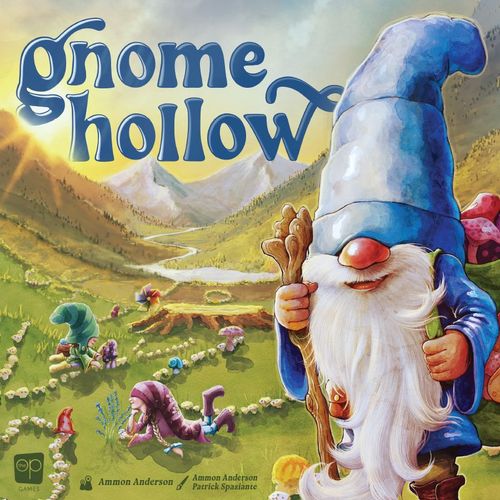
Gnome Hollow
Gnome Hollow Rulebook
Table of Contents
Table of Contents
Game Objective
Begin your journey to Gnome Hollow and join the meadow gnomes in celebrating their Hollow Harvest where they work together to cultivate Mushrooms and gather the magic needed to keep their village hidden for another year.
Players take on the roles of a gnome and their partner as they shape magical mushroom circles, collect wildflowers, and gather the fungal components needed to maintain the enchantment that conceals their humble home. The gnomes that are the most diligent in their duties not only receive the fanciest trinkets, doo-dads and whozits, but they also get to wear the coveted Red Cap until the next year's harvest!
How to Score Points
In Gnome Hollow, you will score points for:
- Creating a variety of Mushroom rings
- Collecting unique Flower Tokens
- Selling sets of Mushrooms to acquire Treasures
More details on scoring on page 15.
Components
- 1 Stump Tile
- 1 Sunset Tile
- 92 Garden Tiles — In Gnome Hollow, all tiles have the mirrored image of the tile on the back.
- 8 Wildflower Tiles & 32 Flower Tokens in 8 Colors
- 8 Gnomes
- 7 Signposts
- 57 Treasure Tokens (15 Bottle caps, 10 Buttons, 12 Feathers, 10 Crystals & 10 Keys)
- 110 Mushroom Tokens (28 Red, 27 Yellow, 20 Pink, 20 Teal & 15 Purple)
- 4 Double-Sided Player Boards
- 32 Ring Markers in 4 colors
- 21 Pinwheel Market Tokens (5 Red, 5 Yellow, 4 Teal, 4 Pink and 3 Purple)
- Pinwheel Market Board
- Garden Tile Board
- 4 Player Aid Cards
- Mushroom Trade Board (VARIANT PLAY - See p. 17)
- Drawstring Bag
- First-Player Red Cap Token
Setup
- Stump Tile — Place the Stump Tile in the center of the table.
- Pinwheel Market — Place to the side, with the Pinwheel Market Tokens stacked beside the corresponding Mushrooms.
- Garden Tile Board — Place the Garden Tile Board within reach of all players. Put the 92 Garden Tiles into the drawstring bag. Draw out 8 at random and place them onto the spaces of the Garden Tile Board.
- 3a. Randomly draw 2 more tiles per player (e.g. 6 tiles in a 3-player game). Without looking at them, set these tiles aside in a stack with the Sunset Tile on top.
- Treasures and Mushrooms — Create a general supply of Treasure Tokens, and Mushroom Tokens.
- Flower Tokens and Tiles — Collect a number of each color of Flower Token equal to the number of players. Stack each color onto its matching Wildflower Tile. For example, in a 3-player game each tile will have 3 Flower Tokens of the same color on it. Place the Wildflower Tiles and Flower Tokens into a supply near the Pinwheel Market Board. Return any unused Flower Tokens to the box.
- Signposts — Place near the Garden Tile Board.
- Player Setup — Each player chooses a color and takes a Player Aid Card, two Gnomes, Player Board and 8 Ring Markers of that color.
- Ring Markers — Place the 8 Ring Markers onto the designated spaces below the score track of your Player Board.
- First Player Token — Give the Red Cap Token to the player who most recently won a game of Gnome Hollow, or the player who taught the game.
Tip: Leave a lot of space around the Stump Tile.
Tip: Seasoned players can play without the Player Aid Card.
Setup Variations
The Pinwheel Market Board and Garden Tile Board do not need to be connected. You are free to move these components around to better fit your playing area.
In one example, the Mushroom Trade Board is being used. See VARIANT PLAY on page 17 for more information.
2-Player Game
Flower Tokens and Tiles — In a 2-player game, choose two Flower colors at random. Return their tiles to the box, and then place the tokens in the Flower Market spaces on the Pinwheel Market Board.
Pinwheel Market Tokens — In a 2-player game, return 1 token of every color except purple to the box.
Meet the Gnomes
Gourd & Peanut — The pair of gnomes that I have named Gourd and Peanut appear to bicker about nearly every action the other takes. If one harvests a mushroom, the other points to the wild flowers and skips away, and vice versa with little rhyme or reason. I believe them to be siblings, for no matter the argument, at the end of the day they head home together and their bond seems unbreakable.
Holly & Poppy — There are two gnomes with the rosiest of cheeks that I have grown quite fond of. Holly is the younger of the two and her face remains flush due to constant giggling. The other I very cleverly named Poppy, as he clearly plays a paternal role. Who but a parent could laugh through allergic reactions caused by all the wild flowers Holly gathers?
Sour Jack & Sweet Jane — Despite their matching woodland attire, Sour Jack and Sweet Jane couldn't have more disparate personalities. Jack has a singular focus to complete his perfectly planned mushroom rings, and Jane loves to haggle and chat at the market. Luckily for these love birds, their talents work in complete harmony, much like the sweet smelling sour apple tarts that they bake for all their friends.
Betty & Beatrice — Despite all appearances to the contrary, the two elderly golden gnomes seem to have the easiest time tending to the gardens and quickly moving through the meadows. Clearly, gnomes must age in reverse. I have named them Beatrice and Betty after my dear sweet aunties, but were I a gambler, my money would surely be on them to finish first.
It took a few more days for me to see any more gnomes, but the longer they remained visible, the more accustomed I grew to seeing them. I began to notice they came in pairs to grow and harvest the magical fungi, yet it seemed that each and every one of them was always happy to see the others. I found myself longing to join them, to be part of this world where they rejuvenated the land and worked together in harmony for the betterment of them all.
Gameplay Overview
Beginning with the First Player, players take turns in clockwise order until one of the End Game Conditions is met. (See Game End Conditions on page 15). Each turn consists of 3 steps, in order:
1. Place Tiles — Choose and place 2 Garden Tiles. (+ up to 2 stored tiles)
2. Resolve — Resolve any gained Mushrooms, Ring Marker bonuses, and cascading effects.
3. Move a Gnome — Move one of your Gnomes to take 1 of 4 actions (optional): Reserve a path, Collect a Flower, Access a Signpost, or Sell at the Market.
1. Place Tiles
Choose 2 Garden Tiles from the 8 available on the Garden Tile Board and place both into the Garden. Then draw 2 new Tiles from the bag to refill the Garden Tile Board. When placing tiles, your goal is to form mushroom rings.
When Placing Tiles:
A. They must be adjacent to the Stump or another tile in the Garden.
B. White Mushroom paths on Garden Tiles must connect to other paths, and green grass edges must line up to green grass edges.
C. If your tile placement extends a ring claimed by another player's Gnome, you must obtain that player's permission to place the tile.
Garden Tiles have a mirror image of the same paths on the back side - so if a tile doesn't quite fit how you'd like, try flipping it over!
IMPORTANT: Two unfinished paths that both have Gnomes on them cannot be combined into one.
During this step you may also place up to 2 additional tiles from your storage. These tiles must be placed following the same placement rules and may be placed before, between or after the two tiles taken from the Garden Tile Board (see Player Storage on page 12 for more information on stored Garden Tiles).
When picking your tiles consider that there are 3 types of paths:
- Those with ends that connect to two adjacent sides of the tile
- Those with ends that have one side of the tile in between
- Those that go straight across a tile
Each tile has 1 or more of these path types. When choosing a tile consider what your ring(s) need to form the right connection.
Completing a Ring
The magical mushrooms that emerge from a completed ring are similar to what we would see in a standard market, but also unlike anything I have ever seen. They almost appear alive, and bursting with some energy I can not quantify.
Rings can create any shape as long as they eventually reconnect. Rings can include any type of Mushroom and be made of any number of tiles. The most basic rings are formed with 3 or 4 tiles. Larger rings of 5 or more tiles will reward you with bonuses!
After placing 2 tiles, if a ring is formed, you will immediately do 2 things:
- If you have a Gnome on the ring (see Claim a Mushroom Path on page 13), collect all Mushrooms in the ring. If an unclaimed ring is completed, place the Mushroom Tokens into the center of the ring instead. Any player may collect them later using a Gnome Action.
- If you have a Gnome on the ring or if it is unclaimed, move the leftmost Ring Marker on your Player Board to the column that matches the number of tiles in your ring. For example, if you created a 6-tile ring, choose one of the 4 rows on the Player Board in the 6 column. You immediately claim any bonuses on the space where you placed your Ring Marker. (See: Ring Marker Bonuses on page 12). If you have already filled all of the spaces for the matching ring size, you may still collect the Mushrooms, but do not move a Ring Marker or collect a Bonus.
Don't forget the Stump Tile! It counts as one tile in your ring. If your ring passes through the Stump Tile multiple times, it is only counted once.
IMPORTANT: If you complete a ring reserved by another player, you cannot collect Mushrooms or move a Ring Marker. The ring is scored by the reserving player at the beginning of their next turn. Lay the Gnome on its back as a reminder to score the ring at the beginning of that player's next turn.
One thing I would like to clarify now that I have had time to analyze their behaviors, gnomes seem to use the standard button mushrooms to craft their preferred patterns. Some gnomes are methodical, making precise shapes, while others seem to let the fungi find their own path. The end result is always the same though, once these mushrooms connect in a ring, the larger and more colorful fungi spring forth immediately almost like magic.
Ring examples:
- A path cannot connect into a grassy edge.
- A path that connects to two Wildflower Tiles but does not close a loop is NOT a ring.
- The Stump Tile is where Gnomes gain access to the Pinwheel Market.
- A 3-tile ring is the most basic ring formation.
- A 5-tile ring can have 6 paths if 2 paths use a single tile.
- A 6-tile ring can be completed by a Wildflower Tile, which counts toward ring size.
- A 7-tile ring gives no additional benefit for creating rings larger than this in the Garden.
- A 10-tile ring: the Stump Tile is only counted once, even if the ring passes through it multiple times.
2. Resolve
Ring Marker Bonuses
Whenever you move a Ring Marker to any empty space in reward columns 5, 6 or 7+, you will immediately receive the bonus next to the space you chose. Planning the building of rings to gain specific Rewards is an important consideration while working in the Garden. There are 5 possible Rewards:
Add and use a new Signpost OR use a Signpost already in the Garden without moving your Gnome. Choose any Signpost that has not been placed. You will place it into the ring you just created and take the bonus action, OR you may choose to use any Signpost already placed into the Garden. Once a Signpost is placed, any player may visit the Signpost as an action.
Select one of the available Garden Tiles and store it beside your Player Board for use on a future turn. You may take 1 Garden Tile from the Garden Tile Board. That tile is stored for a future turn. If you already have 2 tiles stored, including Wildflower Tiles, you must discard one of your stored tiles until you have only 2. Draw a new tile from the bag to refill the Garden Tile Board.
Take a Flower Token. Take an available Flower Token that you do not have from the top of the Pinwheel Market Board and add it to the leftmost open space in your Flower Collection.
Harvest additional Mushrooms from the ring just completed. Gain the additional number of Mushrooms from the ring you just completed. The bonus Mushrooms taken must match Mushrooms in the ring, and each Mushroom in the ring may only be duplicated once with this bonus. For example, if the ring had one pink Mushroom, then this bonus would only allow you to harvest a single additional pink. Any additional bonus Mushrooms would have to match other colors from the completed ring.
Move 1 additional Ring Marker (size 7+ tile ring). When you select a Bonus with this icon, you will move a total of 2 Ring Markers to the row instead of one.
Wildflower Tiles
When you create your second, fourth and sixth ring and move Ring Markers beside the Wildflower Tile symbol, you will immediately receive a Wildflower Tile, following these steps:
- Place one of the Flower Tokens on the tile into your Flower Collection.
- Stack the remaining tokens in an available Flower space in the Flower Market above the Pinwheel Market.
- Place the tile into your storage area. If you already have 2 tiles stored, including Garden Tiles, you must discard one of your stored tiles until you have only 2.
If no Wildflower Tiles are available, instead take one Flower Token from the market.
Wildflower Tiles are WILD tiles. You may place them as an additional tile on your turn. You may place them anywhere into the Garden, including into other players' rings without permission. Rings connect through them, and they may border any tile in the Garden regardless of edges.
The Flower Collection
Each time you gather a unique Flower Token, place the token in the leftmost empty spot across the top of your Player Board. At the end of the game, you will receive the point value shown below the rightmost Flower Token.
Player Storage
You may store any number of Mushroom and Treasure Tokens. You may store up to 2 tiles you gain throughout the game here but at most only one may be a Wildflower Tile. If you gain a tile, but do not have storage space available you may discard the new tile or a previously stored tile, in order to make space. If you discard a Wildflower Tile, the matching Flower Tokens are not effected - they remain in play.
3. Move a Gnome
Moving a Gnome is optional, but actions ONLY occur when you move a Gnome to a different location.
To take any action, select one of your two Gnomes and move it to a new location.
There are 4 actions available:
- Claim a Mushroom path
- Visit the Flower Market
- Visit a Signpost (once available)
- Visit the Pinwheel Market
Curiosity eventually got the better of me and I approached the Hollow one evening after the gnomes had gone to ground for the night. As I got closer, the mushrooms seemed to shrink at my approach, and some even ducked under ground of their own accord. I decided it must be some alert for the gnomes underground and decided to leave before breaking the unwritten trust we shared.
1. Claim a Mushroom Path
To claim a Mushroom path, move your Gnome to any unoccupied Mushroom path. As long as your Gnome remains, no other Gnome is allowed to claim that path. If you claim an incomplete ring, no other player is allowed to add tiles to that ring without your permission.
As your action you may choose to claim a previously completed, but unclaimed ring, to collect the Mushrooms that were placed in the center when the ring was completed.
2. Visit the Flower Market
To collect a Flower Token, you must move your Gnome to the Flower Market at the top of the Pinwheel Market Board. You may then collect any one available Flower Token that you do not already have, and place it into the leftmost empty slot of the Flower Collection track on your Player Board. The Flower Market is a single space and any number of Gnomes can visit it at any time.
In the example, Holly has collected 2 Flowers and now has 3 points in Flowers. Each time a new unique Flower Token is docked into the Player Board, the end game score increases to the number below the rightmost Flower Token.
3. Visit a Signpost in the Garden
To visit a Signpost, place your Gnome in the center of a completed ring that has a Signpost in it. You immediately collect the Reward listed on the sign.
Signposts are placed into the Garden when selected as the bonus for the completion of a Mushroom ring.
The Signpost rewards are: +3 red Mushrooms, +3 yellow Mushrooms, +2 pink Mushrooms, +2 teal Mushrooms, +1 pink + 1 teal Mushrooms, +1 purple Mushroom, +1 Garden Tile.
April 4 — One bizarre aspect of gnome culture revolves around the apparent market they have set up on an old tree stump. They deliver stacks of mushrooms there and leave with buttons, bottle caps, crystals and more. It seems like nonsense, but they take great pride in their work and it seems like a way to tidy the forest and show their standing within the village. It is clear that the gnomes value some colors of mushrooms over others.
4. Visit the Pinwheel Market
The Stump, in the center of the Garden, is where you will move a Gnome to access the Pinwheel Market to sell Mushrooms for treasure! Each time you move a Gnome to the Pinwheel Market, you may sell up to 2 sets of Mushrooms. If you sell 2 sets they must be different types. Columns list the number of Mushrooms required to make that sale. Rows show the type of Mushroom. The first column always allows a player to sell Mushrooms in pairs for the value indicated. When using this column to sell Mushrooms, a Pinwheel Market Token is NOT placed on it.
After any other sale, place a Pinwheel Market Token matching the color of the Mushroom on the space to cover the sale you just completed. This sale space is no longer available to players. Once all the Pinwheel Market Tokens for a color are used, players may only sell pairs of that Mushroom type using the first column.
REMINDER: At the end of the game, Mushrooms are worth nothing. Players will want to sell them before the end of the game and before all the best spaces are covered by Pinwheel Market Tokens!
In the example, Beatrice moves to the Stump in the center of the Garden. Beatrice sells 3 red Mushrooms and places a red Pinwheel Market Token on that sale space to block it. She also sells 5 pink Mushrooms and places a pink Pinwheel Market Token to block that sale. At the end of her action, Beatrice collects treasures equal to 9 Victory Points as noted on the Pinwheel Market Board. She takes 1 Crystal (5), 1 Feather (3), and a Bottle cap (1).
April 7 — At first I noticed that some were rare and only grew when large rings were completed, but it seems as if they hold great value at their market as well. Each time the purple caps are delivered there is much fanfare and excitement. Perhaps the purple magic is used for healing. That may explain my almost uncontrollable draw to them!
Game End Conditions
Gameplay continues until one of the following game end conditions are met:
- A player gathers their 8th Flower Token
- A player moves their 8th Ring Marker
- The bag runs out of tiles.
If any of the above conditions occur, place the Garden Tiles below the Sunset Tile into the bag. Finish the current round so that each player has had an equal number of turns. Once each player has completed their final turn, tile placement ends. Each player then gets 1 additional final Gnome action in turn order. Players must still move a Gnome in order to take this final action.
After each player completes their final action, scoring commences.
Curiously, I have come to understand that there is some form of competition going on between the gnome pairs. They never purposefully interfere with each other, yet it seems as if something drives them to work harder and deliver more mushrooms than the others. Perhaps it is merely a sense of pride, or maybe those trinkets mean more to them than I originally thought? I shall leave out a handful of bottle caps and buttons just in case.
Scoring
Total your points from the following 3 scores:
- Flower Score: This is the point value shown below the rightmost Flower Token. (e.g., if you collect 3 flowers, your total flower score will be 6 points.)
- Ring Score: This is the point value shown above the rightmost empty Ring Marker space. (e.g., if you have completed 5 rings, your ring score will be 14 points.)
- Treasure Score: Total value of treasures you have collected by selling Mushrooms in the Pinwheel Market. (The treasure you collect will equal your treasure score.)
IMPORTANT: Mushrooms are worth zero points at the end of the game.
The Gnome with the most points wins and claims the Mayoral Red Cap Token! If there is a tie, the Gnome with the most unsold Mushrooms wins.
Years later, I would meet someone that seemed lost the way I was before finding the gnomes. We spoke for a time about how the world had lost its magic. I told them of my experience with the gnomes. I was not surprised in the least that they did not believe me. That is, until I handed them the red Gnome cap that I believe to be associated with the mayor of the Hollow. Upon seeing it they felt the truth of my wondrous story, but that is a tale for another time…
Breakdown of a Cascading Turn
As your ring building skills increase, you will begin to see huge and satisfying turns coming into reach! Aren't you just a clever little Gnome?
Through careful planning, you can build into larger strategic turns. Below is an example of a huge cascading turn. Hold on, this can get intense!
Holly is on a roll! It is early in the game, but she just placed 2 tiles and finished a 7-tile ring! Since Holly was reserving the ring, she will receive 1 purple Mushroom, 1 pink Mushroom, and 2 teal Mushrooms.
Next, on her Player Board, she will move her leftmost Ring Marker to select a bonus in the 7+ ring bonus column. In this example, she chooses the top bonus. Since there are 2 Ring Marker spots, she moves 2 Ring Markers and immediately places a Signpost (her bonus Reward) into the ring she just created. Also, note that her second Ring Marker granted her a bonus Wildflower Tile and matching Flower Token. The token is added to her collection, and the tile is added to her Storage.
As you know, Signposts offer instant Rewards. Holly chose to place the +2 teal Mushroom Signpost so she collects her 2 bonus teal Mushrooms and then uses the Mushroom Trade Board (VARIANT PLAY) to select an available trade. She chooses to trade a teal Mushroom for a purple Mushroom.
Holly now takes her single movement action (See: Move a Gnome on page 13). She chooses to move to the Flower Market (at the top of the Pinwheel Market Board) to collect her second Flower Token to her board.
At the end of Holly's turn, she has collected:
- Mushroom Ring Reward: 1 purple Mushroom, 1 pink Mushroom, 2 teal Mushrooms
- Sign Post Reward: 2 teal Mushrooms, traded via the Mushroom Trade Board for 1 purple Mushroom
- Wildflower Tile Reward (underneath ring marker): 1 Wildflower Tile, 1 matching purple Flower Token
- Flower Reward (collecting the white Flower Token): 1 white Flower Token
Variant Play Options
As your skill working in the Hollow grows, you may want to add additional difficulty. Try out these VARIANT PLAY options to enhance your gameplay.
The Mushroom Trade Board
This Variant allows a Gnome to make one Mushroom trade each time they visit a Signpost. After collecting the Reward on the Signpost, you may make one of the two trades shown below that Signpost on the Mushroom Trade Board. Using the Mushroom Trade Board is advanced play and recommended only after learning the basic gameplay.
In the example, Peanut visits the +2 Teal Mushroom Signpost. After collecting the Mushrooms, Peanut chooses to trade 1 of his teal Mushrooms for 1 purple Mushroom.
The Advanced Player Board
Flip over the Player Board and you will find a more limited set of options for players. In this variant, players will only be able to score random shaped rings once for each of the following ring sizes: 3-tile, 4-tile, 5-tile, 6-tile & 7+ tile rings. All other rings must match the ring shapes shown to qualify for scoring them and obtaining bonuses.
Mushroom Guide
Bearded Red Cap (Tricholoma russula) — When I look at the red mushrooms, I get the sense that they serve as wonderful distractions for anyone seeking out the gnomes. If a gnome stood very still near a group of them, you could hardly tell the difference other than a few spots! It is a bit strange for a fungus to grow a beard, but I imagine the gnomes are tickled by the thought and named them Bearded Red Caps.
Lemon Scented Puffer (Helvella citrina)
Blue Snail Shells (Leotia aeruginosa cochleatus)
Pink Pixie Parasols (Cortinarius rosea)
Spotted Troll Thumbs (Gomphidius maculata)
One morning, as I approached my usual lookout spot, I spotted a small satchel of mushrooms laid out for me. Clearly, I was not as clever as I thought, and the gnomes wanted to let me know it. The fungi were magnificent to see up close, but they had lost most of their color and weight. It did allow me to study them up close and paint them as they appear in the hollow. I dared not eat them… the books clearly state the folly in ingesting strange fungi. Although…
Flower Guide
Wild Clover (Trifolium pratense)
Camas Lily (Camassia)
Lark Spur (Delphinium)
Wild Yarrow (Achillea millefolium)
Wild Daisy (Leucanthemum vulgare)
Wild Rose (Rosa)
Wild Geranium (Geranium maculatum)
Indian Paintbrush (Castilleja coccinea)
Considering their obsession with mushrooms, it was interesting to see how much attention the gnomes gave to the flowers that grow wild in this forest. I began to wonder if they collected them merely for their beauty, or if there was some other magical aspect to them.
I tried collecting them myself and discovered that by the time I got home I forgot where I took them from. If not for my journal, I imagine their secrets would have been lost to me! I will not make that mistake again.
Tile Reference
On tiles you will find 8 unique Wildflower Tiles, 25 red Mushrooms, 25 yellow Mushrooms, 18 teal Mushrooms, 18 pink Mushrooms and 14 purple Mushrooms.
Every tile is hand-painted and unique. Tiles above represent how many of each path type are in the game. Mushroom type on individual tiles vary.
Symbol Guide
- Treasure Points. Total Treasure value listed in the center of the symbol.
- On the Player Board: the number in the middle of this symbol indicates the number of tiles in a completed ring needed to move a Ring Marker into the column below the symbol.
- Harvest 2 or 3 additional Mushrooms visible on the Mushroom path from the completed ring.
- Player takes any tile from the Garden Tile Board and stores it beside their Player Board for use in a future turn.
- Player adds any one Flower Token they do not have from the Flower Market to their Player Board.
- Player adds a new Signpost to the ring just completed and uses the action immediately, OR immediately uses the action of a Signpost already in the Garden without moving their Gnome.
- Player receives a Wildflower Tile to store for a future turn and earns one Flower token from it. The remaining Flower Tokens go to the Flower Market.
Turn Sequence
1. Place Tiles — Choose and place 2 Garden Tiles. (+ up to 2 stored tiles)
2. Resolve — Resolve any gained Mushrooms, Ring Marker bonuses, and cascading effects.
3. Move a Gnome — Move one of your Gnomes to take 1 of 4 actions (optional): Reserve a path, Collect a Flower, Access a Signpost, or Sell at the Market.