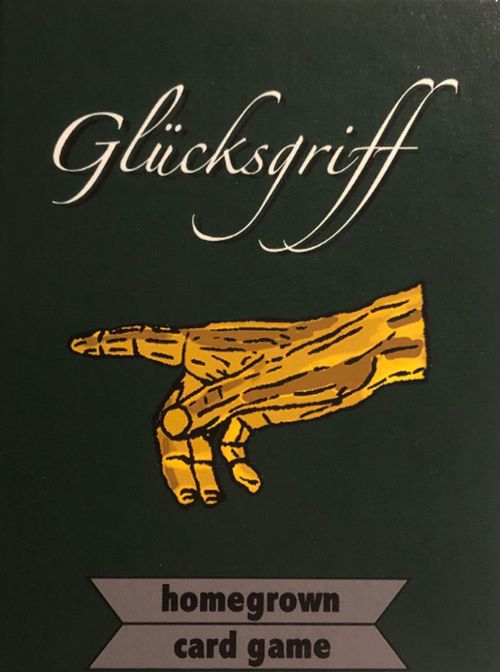
Glücksgriff
Glücksgriff Rulebook
Table of Contents
Table of Contents
1. The Cards
Card values run from 0 to 14. The cards 0 to 14 are each contained four times in the card deck.
Special cards:
- 4 x Juggler of Trickery (see section 7)
- 4 x Hourglass of Patience (see section 7)
- 1 x Magic Hand (see section 7)
- 7 x Blank cards (see section 10)
2. Course of Play
Setup: At the start of the round, seven cards are dealt to each player. The player to the left of the dealer is the first to play. Shuffling and dealing are done clockwise. The rest of the cards are placed face down in the middle of the table, and one card is turned face up from the face-down pile. This forms the first card of the discard pile and play can begin.
Goal of the game: At the end of each round, have as few points as possible in your hand (see section 8).
Laying down and drawing: A regular turn begins with laying down one or more cards (see section 3) and ends with drawing a new card (see section 4). A special case is knocking. If it is possible, no card needs to be drawn (see section 5).
Calling: If a player has fewer than seven points in hand, they may call "Glücksgriff" and initiate the end of the round (see section 6).
Special cards: These are played according to their meaning (see sections 7, pp. 13-18).
3. Laying Down
A player may lay down a single card (for example a 5), cards with the same number value (for example a 6 and a 6), or a number sequence. A number sequence must consist of at least three consecutive numbers (for example 7-8-9).
4. Drawing
After a player has laid down one or more cards, they must draw a new card. When drawing, a card may be taken from the face-down pile or the top card of the discard pile.
If the previous player laid down a number sequence, the next player may, at the end of their turn, draw one of the two outer cards of that sequence. For example, if the previous player laid down the sequence 8-9-10, the next player may draw the number 8 or the number 10. Alternatively, drawing from the face-down pile is possible.
A player may not draw from the discard pile a card they laid down themselves. Special cards may never be taken from the discard pile.
5. Knocking
Knocking is the option of laying down cards without drawing another card. Knocking is possible under the following conditions.
1. Knocking with single cards If a player has a card with the same number value (see section 1) as the card lying on top of the discard pile, they may lay that card on the discard pile, then knock on the playing table, and thereby do not need to draw a new card. If the previous player laid down one or more sevens, the next player may likewise lay down one or more sevens on the discard pile and knock.
2. Knocking with number sequences If a number sequence lies on the discard pile, the following player may extend that sequence and knock. The condition is that they can lay at least two matching cards. Sequences may be extended from both sides. Laying more than two cards is also possible. As long as the sequence lies on top of the discard pile, it may be extended. If the cards 4-5-6 were played, the next player may extend the sequence with the cards 3 and 7. That player may knock. The player after them could, for example, knock with the matching cards 8, 9 and 10.
3. Knocking when drawing If at the end of a turn a card is laid down and the same card is then drawn, it may also be laid down with a knock. If a player has laid down a number sequence and then draws a card matching the sequence, that card may be laid down onto the sequence and then knocked.
4. Special cases Laying down a card and then taking that same card back from the discard pile in order to knock with it is not permitted. For example, if a player lays down the cards 3-4-5 and the previous player had placed a 6 on the discard pile, that 6 may not be drawn and laid onto the sequence.
If the knocked card is the last card in a player's hand, the round ends immediately and the points are added up (see section 8).
For experienced players If a knock is made only after the next player has already laid down, the knocking player must draw a penalty card from the face-down pile. For adult players, a little imagination opens up new possibilities here.
6. Ending a Round
If a player has fewer than seven points in hand, they may call the end of the round with the magic word "Glücksgriff". This is a turn of its own. The player may not take any further action.
Once the magic word has been called, every other player gets the chance to make one last turn.
After that, each player adds up the points of the cards in their hand. If a player has fewer or equal points compared with the player who called "Glücksgriff", the call was wrong. This is penalised with penalty points (see section 8).
7. Special Cards
Juggler of Trickery The Juggler of Trickery is a joker. It may take on any number value from 0 to 14. Knocking on special cards is not possible; knocking on any other card is. When laying down several cards, Jugglers may not lie next to each other.
Hourglass of Patience The Hourglass teaches patience and has the function of a skip card. It may be assigned to any player. This is done by placing the card face up in front of the chosen player. After the Hourglass has been assigned, the player who assigned it must draw a new card. As soon as the affected player is on turn, they must lay the card on the discard pile without any further action.
If the affected player plays anyway, they must draw a penalty card from the face-down pile and skip again in the following round.
Defending is possible. If the affected player is on turn and has the same card in hand, both Hourglasses may be knocked on the discard pile. Nobody skips. Having a player skipped in two consecutive rounds is not possible.
Magic Hand When a player lays down the Magic Hand, every other player must place their lowest card face up in front of them. The player of the Magic Hand may choose one of these cards, or alternatively draw. The cards not chosen are placed on the discard pile. The Magic Hand is placed on top of the discard pile. The other players then each draw a new card from the face-down pile, one after another. The turn is then over and the next player is on turn.
Drawing from the discard pile in the following turn is not allowed. If the magic word has already been spoken, the Magic Hand may only be played as a regular card with the number value 20. It must then be drawn accordingly.
For experienced players If the player of the Magic Hand doubts that a fellow player laid down their lowest card, they may look at that player's cards. If the lowest card was in fact not laid down, the deceiving player must refill their hand to seven cards. In addition to the face-up cards, the player of the Magic Hand may choose one of the deceiving player's seven hand cards. Once this has been done, all face-up cards are placed on the discard pile. The Magic Hand is placed on top. All other players then draw one after another, and the next player is on turn. If the player of the Magic Hand wrongly accuses a player of deceiving, that player must draw two cards from the face-down pile. The other players may keep their cards, and the next player is on turn.
8. Scoring
At the end of a round, the number values of the cards left in each player's hand are added together and recorded as points on the scoreboard.
Note: special cards are scored as follows:
- Juggler of Trickery: 15 points
- Hourglass of Patience: 15 points
- Magic Hand: 20 points
A wrong use of the magic word "Glücksgriff" can occur. This is the case when another player has equal or fewer points in hand than the caller. The caller is penalised with 30 points. All other players have their points recorded according to their hand cards. If "Glücksgriff" is used correctly, the calling player has no points recorded. If a player says "Glücksgriff" but does not have fewer than seven points in hand, that player is penalised with 50 points. No points are recorded for the other players.
9. The Scoreboard
Points are recorded and added up on the scoreboard. First a point limit is set, up to which the game is played, for example 100 points. If a player reaches exactly 50 points, they may halve them and so have 25 points. The same applies to 100 points, 150 points, 200 points, and so on. The winner is the player who has collected the fewest points once a player has exceeded the maximum point limit of, for example, 100 points. For a longer game, the point limit may be varied as desired.
The scoreboard shows the labels "Wrong call" (Falsches Ansagen) and "Halve points" (Punkte halbieren).
10. The Blank Cards
The blank cards are for developing the game further, and this is where you come in. You can let your own creativity run free. Visit the publisher's website for more. In the publisher's forum you can upload your own motifs and rules and exchange ideas with other players. The best ideas may be included in a special edition.