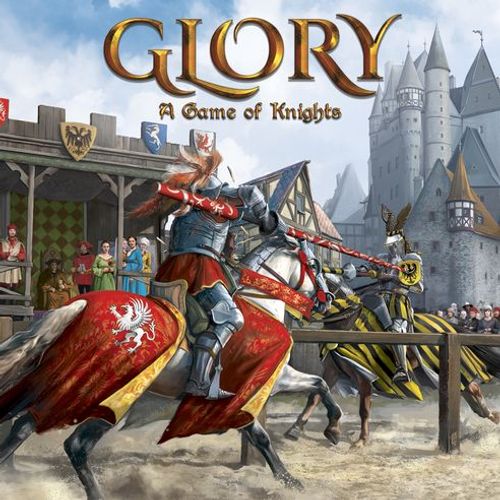
Glory: A Game of Knights
Glory: A Game of Knights Rulebook
Table of Contents
Table of Contents
I. Game Overview
The game is played over 3 rounds. Each round, players visit the various districts of the town and its surroundings, acquire advantages, and prepare for the next great tournament. Let's start with the main concepts.
Winning the Game
The player with the most glory points at the end of the game is declared champion.
Scoring Glory Points
Every knight not controlled by a player (called a "knight," as opposed to a "player") has a Glory Value. The strongest knights yield more glory points if you manage to defeat them. Knight tiles also show an Attack Value and a Prestige Value.
Support tiles, Journey cards, and events can also let you score more glory points.
Title cards are end-of-game bonuses that award additional glory points. 3 of them will be visible and available to everyone, but others may remain hidden in your hand during the game as personal objectives.
At the end of each round, a tournament takes place. This is where you will put your equipment and resources to the test, competing in a series of duels.
- Whichever tournament you choose, you will have the opportunity to fight up to 3 duels.
- A duel consists of a series of clashes. Mount up, lower your lance, and charge!
- Each clash requires you to roll dice and modify the results to get the best attack value.
- Your supports and relics improve your attack, but don't use everything on your first clash!
Important icons: Glory Point, Attack Value, Prestige, Strength, Shield, Faith.
See p.23 to 27 for detailed iconography of all tiles and cards.
What Every Good Knight Should Know
- There's nothing like training to hit harder. Strength tokens can be converted into Strength dice (red dice), the most powerful dice in the game.
- Journeys are rich in lessons. After placing your pawns during the action phase, the journey phase lets you explore the countryside and play up to 3 Journey cards.
- Improving your equipment is essential. You will roll more Mount dice with a proud steed than with a broken-down nag. Likewise, sturdy armor lets you roll more Armor dice.
- Relic tokens can be earned through Journey cards, and are without doubt the most precious items! Make sure to collect a few so that luck accompanies you when you charge toward victory at full gallop.
- Faith is the knight's ally. Faith tokens give you more than welcome rerolls.
- Surround yourself with supporters. During a tournament, your supports can be activated to increase your chances in many ways, and to improve your attack.
- Finally, cover yourself in prestige to win over the judges. Traditionally, victory goes to the most prestigious knight when combat fails to decide between them.
II. Components
In this box, you will find:
- 1 main board
- 1 double-sided Tournament board
- 24 Action pawns
- 36 dice
- 4 score markers
- 1 phase marker
- 16 Coat of Arms tiles
- 24 coins (écus)
- 28 Strength tokens
- 20 Faith tokens
- 7 Attack Modifier tokens
- 3 Dice Result tokens
- 4 Glory tokens
- 8 Advantage tokens
- 1 Prestige Modifier token
- 4 Player boards
- 17 Prestige tokens
- 74 Journey cards
- 4 Trophy tiles
- 1 rulebook
- 16 Relic tiles
- 26 Romance cards
- 19 Market cards
- 29 Challenge cards
- 13 Solo Mode cards
- 48 Support tiles
- 16 Equipment cards (Mount and Armor)
- 32 Knight tiles
- 9 basic Character cards
- 2 Warrior Character cards
III. Game Setup
Choosing the Tournament Type
Before setting up the game, you must decide which type of tournament you will play during the first round. You can then change tournament type between rounds if you wish.
The Joust à Plaisance is an elimination tournament. You must win the first duel to advance to the next stage, and so on. Players may eventually end up facing each other. The winner of the third stage is crowned champion and wins the tournament trophy: either the standard reward of 1 glory point and 1 coin, or a random reward.
The Pas d'Armes lets you avoid direct confrontation between players. Each player fights duels in up to 3 towns: Florence, Paris, and Munich. Non-player knights (simply called "knights") wait for players to challenge them. Even if you lose a duel, you can still fight in the other towns, as long as you are registered there.
Note: The word "pas" in "pas d'armes" refers to a "passage" to be defended — a knightly challenge held at a bridge, gate, or crossroads — not to an absence of weapons. Otherwise the tournament would be a simple brawl. That would be less noble.
Setup Steps
Resolve the following steps in order:
-
Place the main board and the Tournament board on the table, taking care to place the Tournament board on the side matching your choice (Joust à Plaisance or Pas d'Armes).
-
Shuffle the Title cards and place 3 of them face up near the board. Each player can try to complete these 3 Title cards before the end of the game.
-
Each player receives 3 random Character cards (one of each level) and chooses the character they wish to play. Unchosen cards are returned to the box.
Tip: For your first game, we recommend playing with Level I characters. This ensures a symmetrical start, since these cards are identical. You may choose any of the three Character cards and gain the starting resources shown at the bottom of the card. You will also gain the income shown at the top of the card during the maintenance phase of each round. Level III cards grant a special support, but fewer resources. If not all players are the same level, experienced players may choose to take a Mount and Armor lower than the level indicated on their card, for fairness towards beginners.
-
Each player receives the following:
- 1 Player board, 6 Action pawns and 4 player coats of arms in the color of their choice, plus 2 Advantage tokens.
- A Mount card and an Armor card of the level indicated on their Character card.
- The coins and Faith and Strength tokens indicated in the starting conditions of their Character card (you do not collect the income yet).
Note: For a Joust à Plaisance, you will only use a single coat of arms. For a Pas d'Armes, the same player may have up to 3 coats of arms on the Tournament board.
-
Players place their score marker on the score track, at the position indicated by their Character card.
-
Determine turn order randomly. Then, one by one, players place their coat of arms on the initiative track, from left to right. Players who are not in first position on the track each receive 1 glory point + 1 random Challenge card (black cards) for each place separating them from the first player.
IV. Tournament Setup
At the end of each round, players can measure their combat skill by taking part in a tournament. This is also where they can cover themselves in glory! Depending on the tournament type chosen, players will fight only against knights, or against knights and other players. Players know their opponents from the start of the round.
During game setup, and after the tournaments of the 1st and 2nd rounds, resolve the following steps:
Choose a tournament type. Take a Tournament card matching that type and your player count, that has not yet been played. The card is divided into 3 sections, one for each of the game's 3 rounds. Be sure to use the setup for the current round.
Tournament card overview: tournament type, number of players, round symbol, knights to place, knights to add after players place their coat of arms. You must place Knight tiles face up — the illustration shows the backs of the tiles only to indicate which type of tile to place.
The card also tells you which types of knights will take part in the tournament. There are 5 types of knights, recognizable by their backs: Champions, Veterans, Kings, Nobles, and Polish Nobles.
Pas d'Armes: Randomly take Knight tiles of each type indicated by the card for this round, then place them face up in the 3 towns. Leave an empty space next to each knight so players can place one of their coats of arms there. In each town, rank the knights from the one worth the most glory to the one worth the least.
Joust à Plaisance: Randomly take Knight tiles of each type indicated by the card for this round, then place them face up in the spaces indicated on the Tournament card, on the lower row of the Tournament board. Only place the knights marked as "knights to place." The empty spaces will receive the "knights to add after players" during the registration phase.
Take a random unused trophy and place it on the space reserved for the trophy. Then reveal it to all players. For your first games, ignore this step and consider that every tournament awards a standard trophy — one coin and one glory point — as shown on the board.
V. Round Structure
Each round is divided into five phases, resolved in this order:
- Action Phase
- Journey Phase
- Maintenance Phase
- Registration Phase
- Tournament
Two additional phases occur after the tournament of the third round: 6. Final Journey 7. Title Phase
"To every thing there is a season, and a time to every purpose under heaven." (Ecclesiastes 3:1)
This is just as true in this game.
The game takes place over 3 rounds during which you will live the life of a knight: traveling, surrounding yourself with followers, equipping yourself, challenging other knights, and taking part in tournaments. You will surely need to train hard, and even pray, to win divine favor!
Each round is divided into several phases. The symbols for these phases are shown on the phase track on the board. Use the dedicated marker to track the progress of the game.
Action Phase
Events
During setup, you drew 3 Event cards. The active event is placed face up on the board, while upcoming events sit next to the board, letting you plan ahead. For example, during round 1, you already know what round 2's event will be (though round 3's remains hidden).
When an event is in play, it affects the current round. Some modifications apply from the very start of the action phase. Others add a new action space to the board for that round. Players may place a pawn there to use this special action. See p.22 for the list of Event cards.
Example Event card (round 1): Bountiful Harvest — each player receives 2 additional coins.
Player Actions
One by one, players take an action, in the order of the initiative track (left to right). To take an action, place one of your Action pawns on the Action space of your choice and resolve the corresponding action. Then it's the next player's turn to take an action. Repeat this process until you have used all your Action pawns.
All actions require 1 pawn. If an action also requires a payment, you must pay the required resources by discarding them to the supply. You are not allowed to take an action you cannot pay for.
Some actions have a limited number of spaces (action circles). During each round, there can only be one pawn per circle: first come, first served.
Some Action circles are marked with a special symbol. They are only available with the indicated player counts (3-4 players and 4 players, respectively). If there are fewer players, cover these circles with an Advantage token or a gold coin.
Action circle available at 3 or more players.
Finally, some Action spaces are open zones where the number of Action pawns is not limited. All players can place a pawn there, even several, without blocking others. That said, some of these actions are physically limited by the number of cards or tiles available for that round (see next page).
Explanation of Actions
- Training — You train with a veteran. Receive 3 Strength tokens.
- Prayer — You meditate and pray. Receive 3 Faith tokens.
- Service — You join the king's army. Receive a wage of 3 coins.
- Initiative — Place a pawn on the first free space under the initiative track, then receive one coin from the supply. Players' coats of arms do not move yet, but during the maintenance phase, they will be reordered based on the Action pawns placed here. Note: each player may only take this action once per round. If no player places a pawn on the initiative track, turn order stays the same.
- Travel Plans — You may choose 2 Journey cards of any type(s): Romance, Market, and/or Challenge. You may take them face up or draw them blind from their respective deck. Do not refill the face-up cards after your action. If there are no more face-up cards of a given type, you may still draw cards of that type blindly. If even the deck is exhausted, cards of that type simply become unavailable.
- Patrol — All work deserves its wage. Receive 2 coins.
- Warm-Up — You train alone. It would be better to have an opponent, but you can't go to the tournament unprepared either. Receive 2 Strength tokens.
- Market — You buy a better mount or better armor. Keep in mind that you normally start with a level II mount and armor, so check prices carefully. Pay the required number of coins to the supply and upgrade your mount or armor to the next level. You must pay the full price of the upgrade, not just the difference. With one action, you may only upgrade one item by one level.
- Support — Take a Support tile from the support track, paying the cost indicated below the chosen space. Place the support near your Player board. Do not refill the tiles after your action. More details on supports p.23.
Journey Phase
In the order of the initiative track, each player plays one Journey card from their hand, then the next player, and so on, until everyone has played up to 3 cards. You may also decide to play this phase simultaneously, which saves considerable time. Then discard the cards to your personal discard pile.
If a card's rewards are separated by a slash, you must choose one of the two.
Journey cards are divided into several types:
- A. Romance cards — discard the card and receive the indicated resources. These noble ladies offer you many gifts, and pray for you!
- B. Market cards — discard the card and pay the required number of coins to buy the indicated resources.
- C. Challenge cards — face a knight in a duel following the standard rules (see Duel Between a Player and a Knight). If you win, you receive the indicated reward and discard the card. If you lose, you keep the card and may replay it later, while still respecting the limit of 3 Journey cards per Journey phase.
You must resolve all effects of the previous Journey card before deciding to play a new one (or to stop).
Note: if a card offers you a Prestige token, remember that you may not have two of the same color. You may still play the card to gain its other rewards.
Note: if a card offers you an armor or mount upgrade, you may not skip a level (for example, going from level II to level IV).
Example Market card: for 3 coins, this player can gain 3 glory points and a brown Prestige token (if they don't already have it).
Example Challenge card: this player challenges a knight with an attack value of 8 and 1 prestige. If they win, they can gain their opponent's armor (upgrade to level III) or 3 coins.
Maintenance Phase
First, players who placed Action pawns on the initiative track temporarily remove their coat of arms from the track (without touching the pawns).
Players who placed no pawn on this track shift their coat of arms to the right, leaving as many free spaces as there are Action pawns placed by others.
Finally, each player who placed an Action pawn on the track puts their coat of arms back on the space matching their pawn (above it). In other words, players who placed a pawn gain initiative, while the others are subject to it.
Example: A. Black and Red placed their pawn on the initiative track. They therefore remove their coat of arms from it. B. White and Blue shift their coat of arms to the right. C. Black and Red place their coat of arms above their pawn.
- Each player now takes back all their Action pawns.
- Flip all your supports, relics, and Prestige tokens back to their active side.
- Receive the income shown on your Character card.
- Remove from the game any Support tiles still on the support track. Depending on player count, as during initial setup, draw as many Special Support tiles as needed to replace the one(s) you removed. Then, in the same way, refill the support track from right to left, starting with the special-support pile, then the next pile once that one is exhausted, then the next once that one is exhausted.
- Remove from the game the Journey cards still face up. Then reveal the top 4 cards of each stack and place them in the corresponding columns beneath each stack. If there aren't enough cards, reveal as many as you can.
- Remove from the game the current round's Event card and place the upcoming round's Event card in its place. Then reveal the last Event card face up (only during round 1).
Registration Phase
During this phase, you declare your participation in the tournament. In the order of the initiative track, each player must place one of their coats of arms on the Tournament board.
Pas d'Armes: In the order of the initiative track, each player places one of their coats of arms next to a Knight tile (not a player's coat of arms) on the board, to challenge it. You may only challenge one knight per town. A given knight may only be challenged by a single player.
Then, each player may place a second coat of arms in another town. You cannot do this if there is no knight left to challenge, or if you have already placed a coat of arms in every town.
Reminder: the Herald action space lets you challenge a knight before the registration phase. To fight in all three towns, you must use it at least once during the round.
Once placed, coats of arms stay in place until the end of the tournament. A player may neither remove nor move their coat of arms.
Joust à Plaisance: Each player may only have a single coat of arms in this tournament. In the order of the initiative track, each player places a coat of arms on any free space in the lower row of the board, or passes to see what the others do. The player with the lowest initiative (the rightmost one who has not yet placed their coat of arms) may not pass and must place their coat of arms. Repeat this process until all players are registered.
Any spaces in the lower row still free are then filled with the knights indicated on the Tournament card ("knights to add after players," see p.9).
Depending on the configuration, there may be direct confrontations between players.
Example for 2 players: White used the Herald action space during the action phase (A), immediately followed by Red (B). During the registration phase, White, who was the 1st player, places a coat of arms in the 2nd town (C). Red also registers there (D). White cannot place their last coat of arms because they have already registered in the first two towns and there is no available opponent in the last one. Red finishes the phase by placing a coat of arms in the 1st town (E).
Example for 3 players: Red and Blue decide to pass. Black, who has the worst initiative, must therefore register somewhere (A). Red passes again, which forces Blue to register in turn (B). Finally, Red registers (C). The empty spaces will be filled with new knights and the tournament can begin.
Note: even though he didn't, Red could just as well have challenged Blue to combat by registering in the neighboring space.
Tournament
A tournament consists of a series of duels played according to the rules given in section VI. Tournaments and Duels, on the next page.
Final Journey
This phase only occurs during the third round, just before the end of the game, and is resolved like a normal Journey phase.
Title Phase
This phase only occurs during the third round.
During setup, you revealed 3 Title cards, which have remained face up near the board. Each player has been trying to complete them. During this phase, each player may score points for each of the 3 cards, if possible. Players may also reveal their personal objectives if they are able to complete them.
To receive the points for a Title card, you must fulfill the stated conditions. You cannot use the same resource to fulfill the conditions of two different cards. Then record your glory points on the score track.
You only score the points of a completed Title card once, even if you have enough to fulfill its conditions two or three times.
See the list of Title cards on p.25.
Example Title card: Influential — Have 5 supports (worth 4 glory points). Supports counted for this card do not count toward other titles.
VI. Tournaments and Duels
A clash represents a pass of arms between two combatants.
Duels and Clashes
Each tournament gives you the opportunity to fight 3 duels (see Duel Order p.17 to know in which order to play them). These duels can pit a player against a knight, two players against each other, or two knights against each other (Joust à Plaisance only, for these last two cases).
A duel is played as a best-of-three clashes. There can therefore be up to 3 clashes per duel. Once a player or knight has won 2 clashes, they win the duel.
Attack Value
For each clash, you will roll up to 3 red dice, 3 black dice, and 3 white dice, according to your Strength, Mount, and Armor levels. However, you will only count the highest value of each color: the sum of your best dice gives your attack value.
You may use Faith tokens to reroll up to 2 dice at the same time, and try to increase your attack value. You may use supports or relics to modify this value further. It will then be compared to your opponent's to determine the winner of this clash.
Dice Values
There are three types of dice in the game:
- Red dice (Strength), with values from 1 to 5
- Black dice (Mount), with values from 0 to 4
- White dice (Armor), with values from 0 to 3
Each die also has a special symbol. Once your armor or mount reaches level IV, it activates the corresponding die's symbol. Spending 4 Strength tokens activates the red die's symbol. Once a symbol is activated, you may treat it as the best available value for that die (turn it to its opposite face). An unactivated symbol is worth 0 (or 1 on the red die).
The special symbols and the value they take once activated.
Knights
A knight's total attack value is shown in the upper left. If your attack value is higher, you win the clash.
The number shown in the upper right is the amount of glory points you earn if you win the duel (i.e., two clashes).
The number of stars indicates a knight's prestige. If both opponents have the same attack value, the more prestigious one wins.
Example: Attack Value 8, Glory Value 2, Prestige Value 1.
Polish Nobles have a variable attack value. When you face one in a clash, roll a white die and add it to the knight's attack value for that clash (place the rolled die or a Result token next to its Knight tile to remember it).
Example: 9+3 (Armor die) = an attack value of 12 for the 1st clash. You'll need to roll again for the 2nd.
Veterans are cunning rogues who have seen it all. They are able to counter your advantages by reducing the number of dice you will roll against them. Be careful!
Example: if you face this veteran, you roll 1 fewer Armor die (which may bring you down to 0 dice). Special symbols still apply.
Duel Between a Player and a Knight
The sequence of a duel is shown on each Player board and is resolved as follows:
- Before the first clash of the duel, you may use a support with a tent icon. Place it face down on your Player board to show it has been used.
- Then, at the start of each clash, you may spend Strength tokens to gain dice (up to a maximum of 4 tokens and 3 dice):
- 0-3 tokens: receive that many Strength dice.
- 4 tokens: receive 3 Strength dice and activate the Strength dice's special symbol. Place the spent Strength tokens on your Player board. The dice you gain remain available to you until the end of the duel.
- Now receive as many Mount and Armor dice as your mount and armor levels, respectively. Roll all the dice and resolve any activated special symbol.
- You may now use 1 Faith token (place it on your Player board) to reroll up to 2 dice at the same time. Note: you cannot use two Faith tokens during the same clash.
- After the roll, you may use a support with a lance icon. If you do, place it face down on your Player board to show it has been used.
- You may use a second support with a lance icon. If you do, place it face down on your Player board to show it has been used.
- Finally, you may use a relic. Place it face down on your Player board to show it has been used.
- Now compare the combatants' attack values to determine the winner of the clash. If this is their second win, the winner of the clash wins the duel. Otherwise, they receive an Advantage token to show they won this clash. Discard all Attack Modifier tokens and fight a new clash. Follow the yellow arrow, and resume from step 2.
Attack value is the sum of: best Strength die value + best Mount die value + best Armor die value + attack modifiers + relic modifier.
Determining the Winner of a Clash
- If your attack value is higher than the knight you are facing, you win the clash. Place an Advantage token on your Player board.
- If your attack value is lower than the knight you are facing, you lose the clash. Place an Advantage token on the knight.
If both attack values are equal, compare the combatants' prestige. To win, you must have at least as much (active) prestige as the knight you are facing. If you win a clash by prestige, flip one of your Prestige tokens face down (if possible) and place it on your Player board. If neither you nor the opposing knight has any prestige, you win the clash. As usual, the winner of the clash receives an Advantage token.
Note: a Prestige token only counts if it is active (star face showing).
Note: your relics, supports, and prestige are available to you throughout the tournament. Be careful — once used and flipped, these tokens cannot be used again in upcoming clashes and duels. If you lose a duel, however, you can recover part of them (see below).
Winning a Duel
If you win two clashes, you win the duel.
- Discard all used Strength and Faith tokens to the supply.
- Remove the relics, supports, and tokens (Prestige and Advantage) from your Player board and set them aside without flipping them back.
Joust à Plaisance: receive the glory points awarded by your victory and move your coat of arms to the upper row, following the lines.
Pas d'Armes: receive the glory points awarded by your victory and resolve the duels that remain for you.
Journey or Title card duel: receive the reward.
Losing a Duel
If your opponent wins two clashes, you lose the duel.
- You may recover some resources from your Player board: 1 Strength token, 1 Faith token, 1 support, 1 Prestige token, and 1 relic (flip them face up again).
- Then discard the Strength and Faith tokens you could not recover, and set aside the other resources without flipping them back.
Tournament: if you won one clash, you still score half the glory value of your opponent (rounded down).
Joust à Plaisance: you are eliminated from the tournament. Move the opposing Knight tile to the upper row. You may play Journey cards as indicated on the board.
Pas d'Armes: defeat does not prevent you from fighting a duel in the next town.
Journey card duel: you receive no reward, but keep the card and may replay it later.
Title card duel: your single attempt fails. You do not score the reward.
Joust à Plaisance: if you are defeated in your 1st duel, you may play 2 additional Journey cards (only 1 if you are defeated in the 2nd duel). Since you are no longer taking part in the tournament, you have time to scour the countryside, if not to beat an opponent. These cards may be played while the other players resolve the rest of the tournament.
Note: at the start of a clash, each player begins with an attack value of 0. Each step can modify this value in real time, which directly affects the resolution order of the next step.
The situation at the start of scoring determines a player's glory point value (7 or 9 points): the winner scores the glory value of their opponent; the loser scores half of the winner's value if they won one clash. See the duel example on pp.18-19 on this subject.
Duel Between Two Players
A duel between two players is very similar to a player-versus-knight duel, with a few exceptions:
- In case of a tie, prestige determines the winner. If that isn't enough, the player better placed on the initiative track wins. In all cases, the winner must flip a Prestige token (if possible).
- During each step of the duel, the player who is behind (in attack value) must act first. This will be the player with the lower attack value, or the lower prestige in case of a tie, or the lower initiative if prestige isn't enough to break the tie (resolving these ties does not consume prestige).
- A player's glory value is 7. If they have more glory points than their opponent, it is 9.
Duel Between Two Knights
A duel between two knights is resolved automatically: the winner is the one with the highest glory value, then the highest prestige value. If there is still a tie, the knight on the left wins.
Tiebreak order: winner by glory, then winner by prestige, then winner by side.
Duel Order
-
In Pas d'Armes, resolve the duels of Florence first (upper row), then Paris, then Munich. Within each row, duels may be resolved left to right, or simultaneously. The tournament ends once all duels have been resolved.
-
In Joust à Plaisance, resolve the duels of the lower row first, left to right, or simultaneously. Winners advance to the next level (middle row) and fight a new duel, and so on up to the final duel, which pits the two best combatants of the joust against each other. The grand winner receives the tournament trophy or a standard reward (1 glory point and 1 coin). Any player who loses a duel is eliminated from the tournament and may play 1 or 2 Journey cards, depending on the stage at which they were eliminated, while the others continue.
Once all the tournament's duels have been fought, players take back their coat(s) of arms from the Tournament board, discard the others, and prepare the new tournament of the type of their choice (see p.9).
See pp.18-19 for a detailed example of a duel between two players.
Prestige
Prestige lets you break ties in particularly close duels. You can acquire prestige by using Journey cards, calling on supports, or winning trophies.
You may have up to 6 different Prestige tokens, but only 1 of each type (color). If you are due to receive a Prestige token of a type you already have, you receive nothing.
When prestige lets a player win who has the same attack value as their opponent, that player must flip a Prestige token if they can. An already-flipped Prestige token cannot be used to break a tie.
- Charmer — The courteous knight knows how to win the ladies' favor.
- Overlord — Men of power wield a certain influence.
- Warrior — Martial prowess strengthens the hearts of men.
- Royal — Who would dare speak against the king's favorite?
- Chamberlain — Such a high position has its merits.
- Champion — What is more prestigious than winning a tournament?
VII. End of the Game
At the end of the three rounds, the winner is the player who has amassed the most glory points. In case of a tie, the player with the most prestige (active or not) among the tied players wins. If the tie persists, victory is shared.
VIII. Duel Example
Red is the first player on the initiative track. White has one active prestige. Their starting attack value is 0 (as always), so Red goes first, since prestige favors White. This is the second duel of the tournament, and these players have already used some resources.
Table columns: Step | Players' decisions, in turn order | Attack value at the end of this step
- Red plays a Rogue, which inflicts a -1 attack modifier on White, at the cost of one glory point. White uses no support. (Attack value: Red 0, White -1)
- White, weakened by the Rogue, must act first at this step of the duel. He spends 2 Strength tokens. Red spends 4, which activates the special symbol of his red dice. (Attack value: Red 0, White -1)
- Both players roll the dice. White rolls 10, giving him a total attack value of 9 (sum of the best value of each color, minus the Rogue's effect). Red rolls 9, thanks in part to the red die's special symbol. (Attack value: Red 9, White 9)
- Red spends a Faith token, which lets him reroll up to 4 dice thanks to the Bishop. He decides to reroll 4 and manages to improve his result on a Mount die (thanks to his level IV Mount, which activates this special symbol).
- White responds by also spending a Faith token. He decides to reroll his two Mount dice (whose special symbol is not activated). (Attack value: Red 11, White 7)
- White now uses his Squire to turn a Mount die to its best value. (Attack value: Red 11, White 11)
- Red has a Weapons Master, but his Strength die is already at maximum: he decides not to use it. Red passes. White decides to pass as well. (Attack value: Red 11, White 11)
- Red passes again since he has no relic to use. White knows he's going to win, so he also passes. (Attack value: Red 11, White 11)
- Both players end with the same attack value, so White's prestige makes the difference. He flips his Prestige token and receives an Advantage token. They discard all attack modifiers, then the second clash begins. (Attack value reset: 0/0)
Second clash:
- White acts first because he is considered behind due to initiative. He adds 2 Strength tokens to the 2 already on his Player board, which activates the special symbol of his red dice. Red passes since he is already at 4 Strength tokens. (Attack value: 0/0)
- The players roll their dice. White gets 9. Red gets 5. (Attack value: Red 5, White 9)
- Red decides to play a Faith token. The Bishop, still active, lets him reroll 4 dice. Note that he decides to reroll only one red die, not wanting to risk losing the 3 he already had. (Attack value: Red 9, White 9)
- White doesn't want to use Faith and so doesn't reroll. White uses his second Squire to turn a Mount die to its best value.
- Red responds with his Weapons Master to turn the Strength die to its best value. (Attack value: Red 11, White 11)
- White passes. So does Red. (Attack value: Red 11, White 11)
- White plays a relic to avoid ending in a tie: initiative would make him lose the clash. Red has no relic to respond with. (Attack value: Red 11, White 12)
- With a higher attack value, White wins this second clash. (reset to 0/0)
The duel is over. White scores 7 glory points (not 9 — Red had more glory points at the start, but lost one to play his Rogue). White now has 31 points, so he places his Glory token on the board, on the "30" side, and his marker on 1.
Red recovers 1 Strength token, 1 Faith token, and flips his Rogue or his Weapons Master back to its active face. He does not flip his Prestige token, since it was not spent in this duel.
Red did not win a single clash, so he does not score half of White's glory value (which would have been 3 points: 7 points, because White did not have more glory points than Red at the start of the calculation, divided by 2, rounded down).
IX. Solo Mode
You face an automa (which we will call Otto). At the start of the game, choose a mode (Champion, Score, or Rivalry) and a difficulty to define the victory condition.
1. Champion: Joust à Plaisance only. Win all 3 tournaments. Glory points do not matter.
- Easy — Start with your normal equipment.
- Medium — Start with a level I mount.
- Hard — Start with a level I mount and armor.
2. Score: score 65/75/85 glory points (Easy / Medium / Hard).
3. Rivalry: win the game against Otto by scoring more points than him. Choose his attack and prestige values below to set the game's difficulty (Easy / Medium / Hard).
Take the corresponding Knight tile from the stack and place it in your opponent's area to represent Otto's attack and prestige values.
After choosing a game mode, set up the game for two players. You are the first player. Otto needs his Action pawns, a Player board, and a coat of arms (for initiative). In Rivalry mode, he also needs a score marker, all his coats of arms, and a single Title card that will be his (hidden) personal objective. Otto has no Character card but starts with 10 glory points.
Build the Automa deck: you may use just the 9 Solo cards, or add 2 Character cards (either the two red-striped Warrior cards or the two blue-striped Pious cards) to form an 11-card Automa deck. This choice will affect how Otto makes decisions. Place the deck next to his Player board.
Action Phase (Solo)
At the start of each action phase, shuffle all the cards in the Automa deck. Whenever Otto must take an action, reveal the top card of this deck. Resolve Action I if it can be fully resolved. Otherwise, resolve Action II. If Action II cannot be fully resolved, resolve Action III. Otherwise, draw a new card and repeat the process until he has taken an action.
If the Automa deck runs out, reshuffle the cards. Place one of Otto's Action pawns on the resolved Action space.
Note: Otto does not collect tokens or tiles. He mainly seeks to block Action spaces or discard available tiles or cards.
-
Support — Otto discards 1 support from the support track, ignoring the one that costs 2 coins. Resolve the card's illustration from left to right and discard the first matching support on the track (e.g.: discard the Weapons Master if he's on the track; otherwise, the Squire; otherwise, the Sister). Rivalry: Otto scores points if he discards the Minstrel.
-
Special Support — Otto discards the special support. Rivalry: Otto may score points depending on which special support is discarded.
-
Travel Plans — Otto removes the 4 available cards of the indicated type: Romance, Market, or Challenge. If there are fewer than 4 cards, choose the next action on the card instead.
-
New Objective — Otto discards 2 titles from the Titles deck and takes a third as his personal objective.
-
Event — If possible, Otto performs the action linked to the event. Rivalry: Otto may score points on this occasion.
-
Initiative — Otto places an Action pawn on the first space of the initiative track.
-
Training, Prayer, Service — Otto occupies the Action space.
-
Herald — move to the next action, except in Rivalry mode (Otto then joins the tournament if he can — see Registration Phase below).
Joust à Plaisance:
Journey Phase (Solo)
Otto does not collect Journey cards, and therefore does nothing.
Maintenance Phase (Solo)
Otto does not use resources and has no supports, but takes back his Action pawns. Initiative may change at this point.
Registration Phase (Solo)
Otto only registers if you are playing in Rivalry mode. In that case, apply the rules above when Otto places his Knight token (also if he takes the Herald action).
Tournament (Solo)
If Otto has registered for a tournament (Rivalry mode), he resolves his duels like a knight, using the values on his Knight tile. If he faces you, however, he must be treated as a normal player for the purpose of awarding glory points (7 or 9; ignore his Knight tile's glory value in this case). In case of a tie in attack value and prestige, whoever is better placed on the initiative track wins the clash. Otto gains glory for his victories and for the tournament trophy if he wins a Joust à Plaisance.
Title Phase (Solo)
Otto only scores titles in Rivalry mode. He automatically scores all revealed Title tiles, and is considered to succeed at all his personal objectives, even if it would have been impossible to complete them.
X. Additional Information
Event Cards
If an Event card shows an Action space, then the first player to place an Action pawn there may perform the described action, at the cost shown to the right of the space.
If an Event card does not show an Action space, its effects apply to all players at the start of the action phase.
Event effects:
- Crusade — Action: pay 1 coin to receive 3 glory points and 3 Faith tokens.
- Bountiful Harvest — Each player receives 2 coins.
- Royal Wedding — Each player receives 2 Strength tokens.
- Recruitment — Place the special support from the top of the stack on this card. Action: pay 1 coin to receive this support.
- Journey — Action: pay 1 coin to draw 3 Journey cards (face up or blind).
- To Arms! — Each player places an Action pawn on this card. Players play this round with 1 fewer Action pawn.
- War — Each player loses 2 coins (or 1 coin, if they only have one).
- Recruitment — Place the special support from the top of the stack on this card. Action: pay 1 coin to receive this support.
- Loot — Action: pay 2 Strength tokens to upgrade a mount or armor to level IV (from level III).
- Siege — Action: pay 2 Strength tokens to score 5 glory points.
- Wandering Knight — Action: pay 1 coin to receive 5 Strength tokens.
- Volunteer — Place the special support from the top of the stack on this card. Action: receive this support.
Supports
After using a support, you must flip it to its inactive side, unless it is marked with a one-time icon. Those supports give you a permanent bonus as soon as you acquire them. You may have several identical supports, and their bonuses can stack. The icons on the center band indicate the moment (phase or duel) during which you may use the support. The one-time icon indicates a single bonus, triggered the moment you receive the support.
- Hermit — Reactivate one of your relics at the start of a duel.
- Minstrel — Immediately receive 4 glory points.
- Rogue — During the 1st clash of a duel, lose 1 glory point and inflict a -1 attack modifier on your opponent.
- Veteran — During a clash, increase your attack by 1.
- Squire — During a clash, turn your Mount die to 4.
- Weapons Master — During a clash, turn your Strength die to 5.
- Chronicler — Each completed Title card earns you 1 additional glory point.
- Sister — When you use Faith, you may reroll 1 additional die.
- Queen — When you take the Travel Plans action, take 1 additional Journey card.
- Armorer — During a clash, turn your Armor die to 3.
- King — Immediately receive a Royal Prestige token.
- Bishop — When you use Faith, you may reroll 2 additional dice.
- Emissary — You may play 1 additional Journey card from your hand during the Journey phase.
Journey Cards
Journey cards are generally played during the Journey phase, or sometimes during a Joust à Plaisance.
Romance cards offer immediate bonuses. Market cards offer advantages if you have the means to pay their cost. Challenge cards let you trigger duels that grant rewards if you win them. If you lose, you may keep these cards to replay them later.
There is no limit to the number of cards in hand. Be sure to discard the cards you play to your personal discard pile (visible to everyone), since some Title cards refer to it.
Example Romance cards:
- The Game — Receive 2 coins.
- Courtly Love — Receive 1 glory point or the Charmer Prestige token.
- The Keepsake — Receive a Ring Relic tile.
- The Quest — Draw 2 Title cards, keep one as a personal objective and discard the other.
Example Market cards:
- Fencing Lessons — Pay 1 coin to receive the Weapons Master support from the stack.
- Golden Fleece — Pay 3 coins to receive 3 glory points and the Chamberlain Prestige token.
- Rosary — Pay 1 coin to receive a Rosary Relic tile.
- Destrier — Pay 4 coins to exchange your level III mount for a level IV mount.
Example Challenge cards:
- Rescue — Triumph over this opponent (Attack 7) to receive the Sister support or 3 Faith tokens.
- Louis of Gruuthuse — Triumph over this opponent (Attack 8, Prestige 1) to upgrade your armor to level III or receive 3 coins.
- Louis II of Brzeg — Triumph over this opponent (Attack 10, Prestige 1) to upgrade your mount to level IV (from level III).
- Riccio of Parma — Triumph over this opponent (Attack 10, Prestige 1) to upgrade your armor to level IV (from level III).
Relics
There are 4 types of relics. They let you win divine favor during duels. You may have multiple copies of the same relic, but during each clash, you may only use a single relic.
After using a relic, flip it to its inactive side.
The relic will become available again after the maintenance phase, or if you lose a duel and decide to recover a relic you had used during that duel.
Relic effects:
- Medallion — +1 to your attack value.
- Amulet — +2 to your attack value.
- Ring — Reroll up to 4 dice.
- Rosary — Turn your Armor die to 3.
Title Cards
Title cards let you score additional points at the end of the game, during the final phase. Each Title card has a requirement and a reward in glory points. Any resource, Support tile, or relic used to complete a Title card cannot be reused for another. Any inactive element (support, prestige, or relic) still counts toward titles. To complete a card, you must meet or exceed its requirements. You only score the points of a completed Title card once, even if you have enough to fulfill its conditions two or three times.
Title card requirements and rewards:
- Strong — You must have played 5 Challenge cards (and won the associated duels).
- Charming — You must have played 5 Romance cards.
- Traveler — You must have played 5 Market cards.
- Influential — You must have 5 supports.
- Noble — You must never have used a Rogue, and must have a Minstrel, a Queen, and a Squire.
- Dreaded — You must have 2 Weapons Masters and 2 Rogues.
- Pious — You must have a Sister, 3 relics, and 3 Faith tokens.
- Religious — You must have 4 relics and 2 coins.
- Patron — You must have 2 Minstrels and 3 coins.
- Fortunate — You must have 3 coins and 3 Strength tokens.
- Wealthy — You must have 6 coins.
- Prestigious — You must have 4 Prestige tokens.
- Brave — Resolve a single duel against a knight (Attack 11, Prestige 1).
- Equipped — You must have a level IV mount and armor.
Knight Coats of Arms
- Jacques de Lalaing — The "Good Knight," considered the best tournament knight in Europe.
- Zawisza Czarny — The most famous knight of Poland, a military leader and diplomat who served two kings.
- Jean II Le Maingre — Known as "Boucicaut," Marshal of France.
- Jaroslav Lev of Rožmitál — A Bohemian knight, particularly skilled at jousting.
- John Talbot — Earl of Shrewsbury and Waterford, Baron Talbot, the most feared military commander of England.
- Federico III da Montefeltro — One of Italy's most famous condottieri, Lord of Urbino, Knight of the Garter.
- Francesco Sforza — An Italian condottiere who became Duke of Milan.
- Suero de Quiñones — Nicknamed "El del Paso" (The One of the Pass) after organizing a pas d'armes on a bridge over the Órbigo river.
- Pierre Terrail — The famous knight Bayard, one of the most gifted commanders of his time.
- Álvaro Vaz de Almada — Count of Avranches, Admiral of Portugal, and Knight of the Garter.
- Pál Kinizsi — A Hungarian general who never lost a single battle.
- David Mathew — Lord of Llandaff and Grand Standard-Bearer of England.
Armor and Mounts
You normally start the game with level II armor and mount, meaning you will roll 2 Armor dice (white) and 2 Mount dice (black) for your duels. However, as the game progresses, you will be able to upgrade your equipment and roll more dice.
This must be done gradually: with one action, or one Journey card, you may upgrade your armor or mount by one level.
This means you can never acquire level IV armor (or mount) if you do not already have level III armor (or mount).
When you acquire new armor or a new mount, take the corresponding card (or flip your card, as appropriate) showing your new level.
If you are playing with beginners and/or want to handicap yourself, start the game with level I armor or mount (or even both).
Note that level IV does not give you an extra die. It does, however, let you activate the corresponding die's special symbol and obtain its best result.
Points to Remember
- Every fight is a duel. A duel is won by winning two clashes.
- The Strength tokens you spend for the first clash serve for the entire duel. You may add more between two clashes of the same duel (max. 4).
- Faith tokens let you reroll up to 2 dice at the same time, but only once per clash at most (if you reroll during the first clash, then during the second, you must pay 1 token each time). If you reroll a die and get a lower result, the previous result is lost.
- During a duel, always place the elements you spend on your Player board, so you can recover some of them in case of defeat.
- If you lose a duel, you may recover: 1 Strength token, 1 Faith token, 1 support, 1 Prestige token, and 1 relic (flip them back to their active side). If you won one clash out of the three, receive half your opponent's glory value (rounded down).
- There is no limit to the number of cards in hand.
- Always discard your cards to your personal discard pile, since some Title cards refer to it. Individual discard piles are visible to all players.
- Always place Knight tiles face up on the Tournament board.
- During a duel between two players, the player behind in attack score (prestige if tied) speaks first at each step.
- Level I armor and mounts exist to let veterans play with a handicap when facing beginners, and make victory all the sweeter!
- If the Title card deck runs out, shuffle the discard pile to form a new deck. Discarded Journey cards, however, do not return to play.
- If no player places an Action pawn on the initiative track, turn order does not change.
- You are allowed to choose a different tournament type for each round.
XI. Game Aid
Duels
Before the first clash, once per duel: use a support with a tent icon.
Each clash:
- Add 0 to 4 Strength tokens (max. 4). Prepare the Strength dice (total up all Strength tokens played since the start of the duel).
- Roll all dice. Flip special symbols if activated.
- You may spend 1 Faith token to reroll up to 2 dice at the same time.
- You may use 1 support with a lance icon.
- You may use 1 support with a lance icon.
- You may use 1 relic.
- Determine the winner.
Clash tiebreakers: the highest attack value wins. If tied: the highest prestige wins. If tied: a player wins against a knight. If tied: the best initiative wins. If a player wins by prestige or initiative, they flip a Prestige token (if possible).
Winning a duel: Receive the reward / glory points (a player's glory value = 7, +2 if they have more glory points than you before the calculation). Discard the Strength and Faith tokens used. Remove the relics, supports, and Prestige tokens from the board (without flipping them back).
Losing a duel:
- Tournament: receive half the opponent's glory value (rounded down) if you won one clash.
- Journey: keep the card.
- Title: the card is not completed. You do not earn the associated glory points.
- Recover from your board: 1 Strength token, 1 Faith token, 1 support, 1 Prestige token, 1 relic (flip these tiles back to their active side). Discard the remaining Strength and Faith tokens. Remove the relics, supports, and Prestige tokens from the board (without flipping them back).
Round Summary
Action Phase — Resolve the event. Take actions.
Journey Phase — You may play up to 3 cards.
Maintenance Phase — Check initiative, take back your Action pawns, reactivate supports, relics, and prestige, and collect your income. Refill the support track and the Journey cards, and reveal the next event.
Registration Phase — Pas d'Armes: 2 coats of arms. Joust à Plaisance: 1 coat of arms.
Tournament — Fight duels. Prepare the next tournament.
Title Phase (round 3 only) — Public titles. Personal objectives.
The winner of the game is the player with the most glory points. In case of a tie, prestige (active or not) makes the difference.