Glonk Le Choc des Aliens
Glonk Le Choc des Aliens Rulebook
Table of Contents
Table of Contents
Components
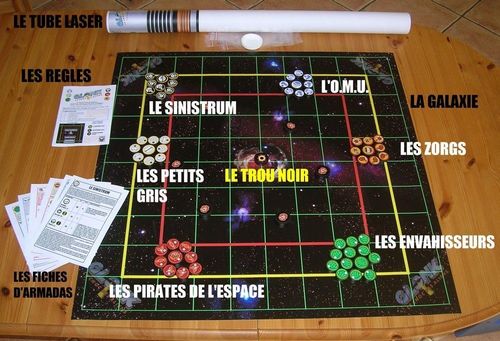
- The Laser Tube (the packaging)
- The Galaxy (the play mat)
- One rulebook
- 6 Armada sheets
- 1 Black Hole token
- 6 Asteroid / Molten Mass tokens (double-sided)
- 6 Armadas, each of 9 or 13 pieces
Assembly: stick the stellar object stickers onto the tokens as shown in the rulebook, and stick the ship stickers onto the pieces as shown on the Armada sheets.
Galaxy note: to keep the Galaxy flat, roll it up so that the printed face is on the outside.
The Galaxy is divided into a Centre, an Inner Ring, a Middle Ring and an Outer Ring.
Pieces
1) Stellar Objects
- The Black Hole (1): this anti-matter opening transforms or sucks in anything that touches it. The Black Hole does not move by itself, but it can be moved by collision with other pieces.
- Asteroids / Molten Masses (6): Asteroids (front face) are harmless at the start. But when they touch the Black Hole, they turn into Molten Masses (back face), explosive stellar bodies.
2) Armadas
The Armadas represent the different species fighting around the Black Hole. Each is made of two kinds of pieces:
- The Base: the largest ship in the Armada. As a general rule, Bases do not move, but they can be pushed by other pieces. All Bases have special powers that distinguish them from one another. Some Bases have two faces: these use a special power that can be used once per turn. The main job of Bases is to bring back Flying Saucers lost in Space.
- Flying Saucers: the Armada's fighters. They are characterised by a Speed, expressed as a number of spaces, and possibly by one or more special powers. All Flying Saucers can be moved.
Galactic Glossary
Terms: Active Player, Active Pieces, Passive Pieces, Activation, Deactivation, Reactivation, Parsec.
- The player whose turn it is is the Active Player.
- Flying Saucers (and some Bases) have two faces: an Active face and a Passive face. A piece with its active face visible is an Active piece. A piece with its passive face visible is a Passive piece.
- When the player decides to have a piece perform an action, that piece is Activated. At the end of the action, the piece is turned over to its passive face: it is Deactivated. At the end of the turn, the active player turns all of their passive Flying Saucers back over: they are Reactivated.
- A Parsec is a space. For example, fast ships that move at a speed of 2 parsecs can make a standard propulsion up to a distance of 2 spaces from their starting point.
Setup
-
Place the Black Hole at the centre of the Galaxy.
-
Take one Flying Saucer from each Armada. Each player draws an Armada at random from the pile of pieces. Determine the first player: in your first game, it is the youngest player; afterwards, it is the player who won the previous game.
-
Then, starting with the first player and going clockwise, each player places their Base and all of their Flying Saucers on a single space of the Middle Ring, more than 2 Parsecs (that is, spaces) away from another Base.
Note: pieces may extend beyond the edges of a space, provided that they touch the lines of the space.
-
Then, in the same order, each player places one Asteroid outside the spaces of the Bases, in the Middle Ring or the Inner Ring. The players who placed their Armada last share the remaining Asteroids and place them.
-
The first player begins.
Turn Structure
Each player takes a turn, then passes the turn to the player on their left.
Turn summary: 1) Hyperspace Return; 2) Actions; 3) Stellar Objects Phase.
On their turn, the active player:
1) Hyperspace Return
- First, the player reactivates all of their inactive pieces in play.
- Then, if they control a Base that is Lost in Space (out of play), the player returns it to play by placing it on a space of the Outer Ring. They may place their Base on any empty space more than 2 Parsecs (spaces) away from any enemy Base. The Base so placed is Active.
- Then, if they have Flying Saucers Lost in Space (out of play), the player returns them to play by placing them against their Base. A Flying Saucer must touch the Base. In practice, up to 6 out-of-play Flying Saucers may be placed against one Base. Flying Saucers so placed are Active.
2) Actions
One after another, the active player activates each of their pieces (Bases and Flying Saucers), in the order they choose. Each piece performs an Action, then is Deactivated. When the player has finished their Actions, they reactivate all of their passive pieces.
3) Stellar Objects Phase
- Recovery: the player takes back the Black Hole if it is out of play, and the out-of-play Asteroids / Molten Masses. In addition, they remove the Black Hole from play if it is entirely outside the Inner Ring (that is, in the Middle Ring or the Outer Ring), and they remove Asteroids and Molten Masses if they are entirely in the Outer Ring.
- Return to play: the active player then places the Black Hole at the Centre of the Galaxy. If this is not possible because a piece is there, the player places the Black Hole on the empty space closest to the centre of the Galaxy, taking care that the Black Hole does not touch any other piece.
- Then the player places the out-of-play Asteroids / Molten Masses on any empty spaces of the Middle Ring or the Inner Ring. They must be placed so that the Asteroid face is visible.
When the active player has placed the last Asteroid, it is the turn of the player on their left.
Note: if an active player forgot to reposition Asteroids (or did not have time, in Chrono Mode), the next player may do so in their own Stellar Objects Phase.
Optional Rule: Chrono Mode
This optional rule will suit players who want to increase their adrenaline level, or who despair of playing against opponents known for their slowness. It requires a stopwatch.
- The active player has ONE MINUTE to take their turn. The player to the left of the active player holds the stopwatch and signals the end of the turn.
- As soon as the minute has passed, the active player must immediately stop their turn, ceasing to touch any piece. They must nonetheless finish their turn outside the time limit by replacing the Black Hole (but not the Asteroids) if it is outside the Inner Ring.
- The player holding the stopwatch then passes it to the player who has just finished their turn. The latter starts the stopwatch for the next player.
Actions
There are 3 possible actions: Standard Propulsion, Hyper-Propulsion, and Special Action. At the end of its Action, the piece becomes Passive.
Note: only pieces that have a Speed value can perform a Standard Propulsion or a Hyper-Propulsion. Pieces without a Speed value cannot be propelled, but they can be pushed by impact with another piece.
1) Standard Propulsion
GLONK is a flicking game. Flying Saucers (and sometimes Bases) are propelled by flicking them with the tip of a finger.
Note: the player performing a "Propulsion" action may touch with a finger only the piece they wish to propel. Breaking this rule causes the immediate disintegration of the offending player. (This is a joke.)
Standard Propulsion Table. The speed of a ship is the number printed on its active face.
- Example: a Flying Saucer is located on space X.
- A Flying Saucer with Speed 1 can perform a Standard Propulsion up to 1 parsec from its starting parsec (up to one space from its starting space).
- A Flying Saucer with Speed 2 can perform a Standard Propulsion up to 2 parsecs from its starting parsec.
- A Flying Saucer with Speed 3 can perform a Standard Propulsion up to 3 parsecs from its starting parsec.
VERY IMPORTANT RULE: a piece on a line is considered to be part of the 2 parsecs (spaces) it occupies. A piece on an intersection is considered to be part of the 4 parsecs it occupies.
Note: a ship on an intersection therefore has a larger range of movement in every direction than the same ship not touching a line.
Only the movement of the active piece is considered when determining whether speed has been exceeded. Pieces other than the active piece, moved by impact, may exceed their movement without ending the active player's turn.
Boarding
During the player's turn, before being activated, OR at the end of a Standard Propulsion, a Base or a Flying Saucer that touches one or more enemy pieces may perform a Boarding.
- The boarding piece must be stationary and must actually touch the enemy piece or pieces.
- Effect of a Boarding: the enemy pieces are Atomised, and the boarding piece is Deactivated.
- Warning: placing a sticky substance on the edge of a Flying Saucer is strictly forbidden. The sanction is the immediate disintegration of the offending player. (This is a second joke.)
Heroic Assault
This Action is a special kind of STANDARD PROPULSION (it does not work in HYPER-PROPULSION; see below).
- Before propelling a piece, a player may ANNOUNCE aloud to the other players that they are putting their piece in "Heroic Assault" mode, and designate an enemy piece (Base or Flying Saucer) within its range of movement.
- If the piece touches the designated target first, both pieces are Atomised.
- If it does not touch the designated target first, or if the result of the movement is a Hyper-Propulsion (see below), only the piece that launched the Heroic Assault is Atomised.
- A Heroic Assault always ends the active player's turn, even if the piece that performed it survives (thanks to the DESTRUCTOR or TORPEDOES abilities, for example).
Note 1: a Heroic Assault cannot be combined with a Boarding.
Note 2: some less heroic species prefer to call this action a "Suicide Attack".
2) Hyper-Propulsion
A piece may be propelled further than its speed allows, intentionally or by mistake: it is said to have entered HYPER-PROPULSION. Hyper-Propulsion ends the active player's turn.
- Note 1: a piece in Hyper-Propulsion cannot perform a Boarding at the end of its Action.
- Note 2: only the movement of the active piece is considered when determining whether there has been a Hyper-Propulsion. If the active piece does not exceed its permitted movement, and pushes another piece which does exceed its permitted movement, this does not end the active player's turn.
3) Special Action
Some Bases and Flying Saucers have a Special Action, listed in their description (Special Rule column) on the Armada sheet. The player simply deactivates the piece and performs the Special Action.
Note: a piece that performs a Special Action during its turn cannot be propelled.
Actions summary: there are 3 Actions: Standard Propulsion, which may include a Boarding or be a Heroic Assault; Hyper-Propulsion; and Special Action.
End of Turn
The player's turn ends after one of the following events:
- One of their pieces has launched a HEROIC ASSAULT.
- One of their pieces has entered HYPER-PROPULSION.
- One of their pieces has just been ATOMISED (destroyed).
- One of their pieces is LOST IN SPACE (completely out of the Galaxy).
- All of their pieces are deactivated.
- At the end of an Action, the player decides to end their turn.
Stellar Events
What happens when:
- A Base or Flying Saucer collides with, or touches, the Black Hole: it is Atomised.
- An Asteroid collides with, or touches, the Black Hole: once it has come to rest, it is turned over and becomes a Molten Mass.
- A Base or Flying Saucer collides with, or touches, a Molten Mass: it is Atomised. When the Molten Mass comes to rest, it is taken out of play. It can be returned to play as an Asteroid in the Stellar Objects Phase.
- A Base or Flying Saucer is ejected from the Galaxy: it is said to be Lost in Space. Take it out of play. It may return to play against the player's Base at the start of their next turn.
Annihilation of an Armada
A player who no longer has any piece able to move in the Galaxy, at any moment of the game, is annihilated. The game stops for that player.
- Note 1: a player who has only an inert Base left, or only Flying Saucers deactivated by the ANAESTHETIC RAY power at the start of their turn, is annihilated. Remove that player's pieces.
- Note 2: out-of-play pieces return at the start of the player's turn, but only if the player still has at least one piece able to move on the Galaxy when their turn comes.
The player who caused the annihilation of another player is that player's Dominator.
- The Dominator of a player takes possession of that player's Base if it was out of play. The Dominator may now bring their own Flying Saucers back against this additional Base.
- In addition, the out-of-play Flying Saucers of the annihilated player come back to fight for the Dominator! At the start of their turn, the Dominator may bring the enemy's out-of-play Flying Saucers back against the Base they have just taken, or against their own Base.
- Flying Saucers taken from the annihilated opponent keep all of their original characteristics (speed and special rules).
Scoring
A player scores points for enemy ships destroyed during their turn, according to the value of the piece:
- Base: 2 points
- Flying Saucer: 1 point
To keep track of the points scored, the player collects the enemy pieces they destroyed during their turn and stacks them in front of them.
- Exception: pieces destroyed by the destructive power of an enemy piece (such as LETHAL, EKSPLOSIF and SHIELD) count for the owner of that piece, not for the active player.
- If the active player destroys one or more of their own pieces during their turn (through a Heroic Assault or a contact with the Black Hole, for example), the lost pieces are returned to the game box: they count for nobody.
Victory
Species fighting around the Black Hole tend to bow down before the most violent Armada.
- The player who first reaches 7 points is declared the winner.
- If 2 or more players reach this victory condition in the same Action, the winner is the one who first reaches 8 points.
- If nobody reaches 7 points, the winner is the last player still in play.
Damage
A Base or Flying Saucer that is turned over "accidentally", for example after being violently struck, cannot be activated again during that turn.
Galactic Convention
To tell them apart:
- Out-of-play pieces are placed active face up beside the Galaxy.
- Atomised pieces are placed passive face up beside the Galaxy.
Armada Sheets
The Armada sheets include the following information:
- DESIGNATION: the appearance of the spaceship: its active face, then its passive face. The name of the spaceship. In parentheses, the number of ships of that kind in the Armada.
- TYPE: the type of spaceship. BA = Base, SV = Flying Saucer.
- SPEED: the speed of the spaceship in Parsecs (spaces).
- SPECIAL RULE: all Special Actions and particular rules that apply to the spaceship.
The Sinistrum
| Designation | Type | Speed | Special Rule |
|---|---|---|---|
| Death Satellite (1) | BA | 0 | LETHAL: this Base atomises any enemy Base or Flying Saucer that touches it, during the Sinistrum's turn or during the opponent's turn. |
| Disciple (6) | SV | 2 | — |
| Master (2) | SV | 1 | TELEKINESIS (Special Action): deactivate the Master, then propel any enemy Flying Saucer located 1 Parsec or less from it. The enemy Flying Saucer cannot perform a Boarding or a Heroic Assault on behalf of the Master. Consider this Flying Saucer as a Sinistrum piece when determining whether its Action ends the turn. |
The Zorgs
| Designation | Type | Speed | Special Rule |
|---|---|---|---|
| Kabane (1) | BA | 0 | FABRIKER (Special Action): deactivate the Kabane to fabricate an atomised Kiboom. Place the Kiboom against the Kabane. It is Active. |
| Kogneur (4) | SV | 1 | — |
| Kasseur (2) | SV | 1 | DESTRUKTEUR: a Kasseur is not Atomised when it performs a Heroic Assault (successful or not). |
| Kiboom (2) | SV | 1 | EKSPLOSIF: an active Kiboom atomises the first enemy Flying Saucer that collides with it during the opponent's turn. The Kiboom is atomised at the same time. FLYING OBJECT: the Kiboom does not count as a Flying Saucer; if the player has only Kibooms left, they are annihilated. In addition, a Kiboom cannot perform a Boarding or a Heroic Assault. |
The Little Greys
| Designation | Type | Speed | Special Rule |
|---|---|---|---|
| Great Saucer (1) | BA | 0 | TELEPORTATION (Special Action): deactivate the Great Saucer, then recover one of your Flying Saucers: take a Flying Saucer (active or inactive) and place it against the Great Saucer. METEORIC FISSION (Special Action): deactivate the Great Saucer, then propel an Asteroid located 1 Parsec or less from the Great Saucer. The Asteroid may be propelled any distance. When it comes to rest, the Asteroid becomes a Molten Mass. |
| Small Saucer (4) | SV | 2 | — |
| Jumper (4) | SV | 1 | JUMP (Special Action): an active Jumper may be picked up and placed anywhere on the Galaxy. Turn the Jumper over at its new location. The Jumper cannot perform a Boarding at the end of a Jump. |
The Space Pirates
| Designation | Type | Speed | Special Rule |
|---|---|---|---|
| Galleon (1) | BA | 1 | PROPULSION: this Base can be propelled. DESTRUCTOR: the Galleon is not Atomised when it performs a Heroic Assault (successful or not). |
| Corsair (4) | SV | 2 | — |
| Sloop (4) | SV | 3 | — |
The Organisation of United Worlds (O.M.U.)
| Designation | Type | Speed | Special Rule |
|---|---|---|---|
| Sanctuary (1) | BA | 0 | SHIELD: during the opponent's turn only, deactivate the Sanctuary when an enemy piece (Base or Flying Saucer) touches it. The enemy piece is Atomised before it can affect the Sanctuary. The Shield has no effect against the Black Hole or a Molten Mass. |
| Torpedo Boat (4) | SV | 2 | TORPEDOES: a Torpedo Boat is not Atomised when it performs a Heroic Assault (successful or not) against an enemy Base, even if that Base has the LETHAL power. |
| Corvette (4) | SV | 1 | ANAESTHETIC RAY: deactivate the Corvette at the start of any opponent's turn, to deactivate an enemy Base or Flying Saucer located 1 Parsec or less from it. At the start of the O.M.U.'s turn, reactivate the Corvette that used its Anaesthetic Ray. |
The Invaders
| Designation | Type | Speed | Special Rule |
|---|---|---|---|
| Hive (1) | BA | 0 | HIVE: the Hive can accommodate as many Larva Ships as possible around it. Place Flying Saucers that cannot touch it against other Flying Saucers that do touch it. |
| Larva Ship (12) | SV | 1 | CONTAGION: a Larva Ship that completes a Boarding may turn its victim or victims into Larva Ships. Treat the target as Atomised and replace it with an atomised Larva Ship. This new Larva Ship comes into play inactive. It no longer counts towards the opponent's score. |