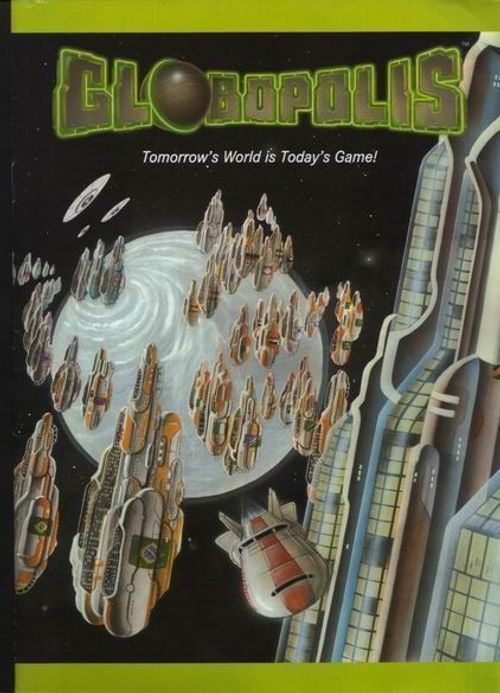
Globopolis
Globopolis Rulebook
Table of Contents
Table of Contents
- Background: The Guilds and the O.R.S.S.
- Game Contents
- Introduction to Game Pieces and Setting Up
- Cards
- Title Cards
- EU Currency
- QRCs (Quick Reference Cards)
- The Board
- 10 Step Quick Start Guide to Globopolis Gameplay
- Getting into the Game
- QRC Side 1: Options on Each Turn (page 14)
- QRC Side 2: Landing on Fields (page 15)
- QRC Side 3: Network Infiltration Agents and Special Fields (page 16)
- QRC Side 4: Aggression (page 17)
- Possible Rule Variations
- Play with SMA!
- Adjust the length of the game
- Play 'till the Bitter End
- Play with teams
- Deal out more OPs, INFLUENCE and/or MISSION cards at the beginning of the game
- Expand the possibilities of the O.R.S.S. rules
- Use the Cleaning House Rule to protect Guilds from takeover
- Allow Governors to be advanced clockwise or counterclockwise on every turn
- Email Correspondence Globopolis (ECG)
- Globopolis Glossary or The Globopolis Acronym Guide (GAG)
- Frequently Asked Questions
Background: The Guilds and the O.R.S.S.
The Core Energy Guild
The Core Energy Guild (CEG) was established in Ecuador in 2037 upon completion of an ambitious national project to develop a unique type of geothermal power plant near volcanically active regions. These enormous facilities pump water into existing geothermal reservoirs approximately three kilometers deep beneath the surface. Natural and man-made vents guide super heated steam under tremendous pressure back to the surface to power the plants' generators. One facility alone can generate over 100 billion kilowatt hours annually. Approximately 20% of the electricity generated is used to power adjacent electrolysis plants that separate hydrogen from water. The hydrogen is subsequently pressurized and exported by pipeline and a fleet of huge zeppelins.
Core Energy Guild Franchise Territories: Canada's northernmost territory, Nunavut, home of the Inuit, established its independence from Canada in 2075. In 2081, Iceland became part of the Nunavut nation-state in what appeared to be a "peaceful annexation". Shortly thereafter, the CEG established a new facility in Iceland in the highly geothermal region near Reykjavik. Today, this Guild facility exports electricity throughout Europe and almost all the hydrogen consumed on the European continent is produced by the Nunavut CEG electrolysis plant.
Alaska finally achieved independence from the United States in 2086 after years of strife over land rights. In 2091 the CEG chose Alaska to be its second Franchise Territory and began construction of two more facilities in the Katmai region and on Unimak Island, both part of the Aleutian archipelago. Today, these plants supply 90% of North America's hydrogen. Collectively, the Core Energy Guild's facilities account for about 30% of the world's energy production.
The Solar Satellite Guild
By 2025 oil reserves had become vastly depleted and the governments of Saudi Arabia and Iran invested to develop infrastructure and technology to exploit solar energy. Their laboratories experienced a revolutionary breakthrough in ion-plasma beam technology in 2094, making possible the efficient transfer and storage of energy between two points as far as 1,500 kilometers apart.
In 12 AGD the two nations jointly founded the Solar Satellite Guild after the completion of their first superstructure in space. Today the Guild has five such satellites, each with a 30 hectare surface area of super-efficient solar radiation collection panels. These satellite complexes transport energy by way of the extremely dense ion-plasma beam to reception-storage and transfer facilities on the planet surface. Today the Solar Satellite Guild services the Wind & Wave Guild's energy transport needs with its ion-plasma beam technology, whereby the energy generated at the tidal-wave and wind facilities is beamed to a Solar Satellite Guild complex and reflected back down to the reception-storage facilities on the surface.
The Wind & Wave Energy Guild
The Wind & Wave Energy Guild was established in 2028 with the completion of three superstructures in the Indian Ocean jointly built by Tanzania and South Africa. Today, the Guild supplies all of Africa's energy needs as well as export to Europe and Asia in cooperation with the Solar Satellite Guild. The Tanzanian facility in the Indian Ocean spans over 220 km in three sections (see map left). The South African facility extends southward off the Cape of Good Hope. Combined, these power plants can produce over a billion kilowatt-hours daily. In the AGD era, the Guild adopted its facilities to desalinize water internally and is now the provider of drinkable water to all of Africa and Asia.
The Fresh Water Guild
The excessive volcanic activity of the era has also tainted the rain and snow almost everywhere on the planet due to the high sulfur content of the ash. PH values generally range from 4.1 to as low as 3.5. The increasing scarcity of drinkable water led to the creation of the Fresh Water Guild by Sweden and Norway, taking advantage of their extensive and still pure aquifer reserves and uncontaminated water in the form of ice.
The Orbital Rocket Shuttle Service
The Orbital Rocket Shuttle Service – commonly referred to as the O.R.S.S. – was developed in the later part of the 21st century. The shuttles carry over 1,000 passengers each and can fly from New York to Paris in just 18 minutes or from London to New Zealand in just 28 minutes in near parabolic trajectories reaching altitudes of up to 100 kilometers. Sadly, this is the only way for surface-dwellers to capture sight of the sun in this era, other than virtual reality chambers. Today most of the shuttles remain in orbit, transporting resources and passengers between complexes in Globopolis.
Game Contents
This complete Globopolis game set includes:
- The Globopolis game board
- Two handy Quick Reference Cards (QRCs) that neatly summarize all game rules
- This supplementary 24 page book
- 1 twenty-, 1 twelve-, 1 ten-, 1 eight- and 12 six-sided pearl effect dice
- A 90-second timer, 5 Governor playing pieces, 5 CRF pieces, 25 double and 50 single Agent pieces in five colors each
- 36 Title, 21 OPs, 12 MISSION, 32 INFLUENCE and 120 Currency cards
- 75 Base Plates in 5 colors which depict Territory ownership
- 275 stackable Resource and 44 Economic Development pieces
Three Stage Introduction – Globopolis Gameplay Easy as ABC
It is not necessary to read or understand all the rules to Globopolis before starting to play. Instead, follow the three steps below to be playing and enjoying the game as quickly as possible.
- A: First, read pages 8–9 Introduction to Game Pieces and Setting Up aloud while reorganizing the box as shown at the bottom of page 8. This serves to acquaint all players with the game's various pieces, cards and elements right away.
- B: Follow the Ten-Step Quick Start Guide to Globopolis Gameplay on pages 10–12.
- C: After Teleporting to begin the game, read the final stage of the introduction on page 13, Getting into the Game. Then, during gameplay, refer to pages 14–17 and/or the Quick Reference Cards (QRCs) to look up the rules for the game's various scenarios as they arise. These four pages correspond to the four QRC sides, yet are more detailed and thorough, with elaborations not on the QRCs in blue text or blue text boxes.
Introduction to Game Pieces and Setting Up
Each player has four different types of pieces in their color:
- The Governor, which is advanced along the Field Ring.
- The CRF (Counting Ring Figure) "keeps the score" along the 1–100 numbered Point Counting Ring.
- Base Plates indicate Territory possession.
- One- and two- Agent pieces infiltrate opposing players' territorial networks and neutralize opposing players' infiltration on domestic Territories.
Dice:
- Red Aggressor dice set: Aggressors roll the 8-sided die and up to six red 6-sided dice when attempting to take over another Territory.
- White Defender dice set: Defenders roll the 10-sided die and up to six white 6-sided dice when defending Territories against hostile takeover attempts.
- Blue 20- and 12-sided dice: These dice are used for various scenarios throughout the game, including Diplomacy and Teleporting.
Resources and Economic Development:
- Resources or R-Units are stacked upon Base Plates and are necessary to develop Territories. The five Resource types are Water, Food, Energy, UCP (Infrastructural Resources) and NS-Units (Defense).
- EDs: Economic Development Pieces are stackable pieces that indicate Economic Development (1 ED) or Super Development (2 EDs).
The 90 second timer helps keep the game moving along at a set pace and encourages players to think ahead by limiting their time to execute transactions in the Option Phase of their turn.
The box before setting up (as shown on page 8 of the printed rulebook) holds: 275 stackable R-Unit pieces, 44 black and white Economic Development pieces, 75 Base Plates in 5 colors, 5 Governor and 5 CRF pieces, one 20-, one 12-, one 10-, one 8- and twelve 6-sided dice, 10 one- and 5 two- Agent pieces in 5 colors each, 120 EU Currency cards, 32 Territory and 4 Guild Title cards, 32 INFLUENCE, 21 OPs and 12 MISSION cards, and the timer.
The box after setting up has the 120 EU Currency cards in four denominations in their compartments, the Title cards and the INFLUENCE, OPs and MISSION cards in their places, the five Resource types in five compartments, and a compartment for storing extra Agent, CRF and Governor pieces (when playing with less than five players).
Cards
- MISSION cards generally elicit a spontaneous victory for the player fulfilling the Mission.
- OPs – Operations and Opportunity cards expand players' aggressive takeover possibilities and offer covert tactical advantages against opponents in Aggression Scenarios.
- INFLUENCE cards offer advantages that can be strategically used against opposing players, either immediately, or retained for later play.
Title Cards
32 Territory and 4 Guild Title Cards:
- The front side of all Territory and Guild Title cards has a Territory Point Value and a Resource Allocation Table. The number of R-Units a Territory has assigned is proportionate to its point value.
- The front side of each Territory Title also has Development Premiums to be paid to the Administration when investing in Economic Development.
- The backside of each Territory Title has a table of Conference Cost rates, which are paid by opposing players to Title holders when landing on the corresponding Territory field of the board (and deciding to not attempt an aggressive takeover).
- The backside of Guild Title cards has rates Guild operators may charge for R-Units.
EU Currency
The currency in Globopolis is called EU (Economic Units). It is used to purchase R-Units, invest in Economic Development, pay Conference Costs and can also be exchanged for CR points.
QRCs (Quick Reference Cards)
These two cards are handy summaries of the game's rules. The printed rulebook reproduces the Quick Reference Cards as facsimiles; their text is the same rule text transcribed in the QRC Side sections below.
The Board
The Globopolis board consists of two rings. The inner ring has 64 spaces and is referred to as the Field Ring. The outer ring is numbered from 1 to 100 and is referred to as the Point Counting Ring, which keeps track of the score.
The Field Ring is divided symmetrically as follows:
- 32 acquirable Territories divided into 12 different color groups
- 16 card fields divided into two categories: there are 8 OPs-MISSION and 8 INFLUENCE fields
- 4 non-aquireable Independent Territories which supply Globopolis with Food, UCP (Ultra-light Component Production, a.k.a. Infrastructural Resources) and NS-Units (Network Security Units, a.k.a. defense)
- 4 Guilds which control the greatest supply of the other two major resources on the planet – drinkable water and energy
- 4 O.R.S.S. (Orbital Rocket Shuttle Service) bases from which players can "fly" across the board from one base to another
- 4 "Special" Fields: NSA (Network Security Academy), NIA (Network Infiltration Academy), TELEPORT! and MOONSHOT!
10 Step Quick Start Guide to Globopolis Gameplay
Object of the Game
The ultimate goal in Globopolis is to establish Superior Network Control over the Global City. This is achieved through the acquisition and development of Territories, which enable players to earn points and/or fulfill a Mission. The player to reach 100 points (in a four player game) or fulfill their Mission first will be the Victor and new ruler of Globopolis!
Note: the victory mark is adjusted to 150 points for two players, 125 points for three players and 75 points for five players. See also additional note regarding winning the game on page 12.
Territorial development is the primary way to earn points in Globopolis. This requires acquisition of the five necessary resources through trade, INFLUENCE, aggressive takeover of opponents' Territories and/or purchase from the Independent Territories. Strategy, luck, planning, good business sense, cooperation and even ruthlessness all contribute to players' success in achieving their goals.
Step 1
After setting up the box as shown at the bottom of page 8, refer to the Glossary on Page 19, read aloud the duties of the Administrator and then appoint an Administrator.
Step 2
The Administrator assists with the allocation of Governor, CRF, Base Plates and 9 one- and 3 two- Agent pieces to all players, according to their color choice. Governor pieces are placed on the TELEPORT! field and CRFs are stacked at 00. Any pieces not distributed should be stored in the small compartment under the Title card stack, as illustrated at the bottom of page 8.
Diagram notes: Governors are placed on the TELEPORT! field. CRFs are stacked at 00.
Choose to play with or without Agents. Gameplay with Agents significantly expands the strategic aspect of the game, giving players multiple pieces in their color to tactically deploy to Territories, both domestic and foreign. Players may prefer to play without Agents until they have played the game at least once. For details on Network Infiltration Agents, their significance and how they are used in the game, refer to page 16 and QRC side 3.
When playing without Agents, the top two sections of page 16 (left side of QRC side 3) simply do not apply. Several INFLUENCE cards pertaining to NI-Agents should be placed at the bottom of the card stack whenever they "pop up" and players may pull another card. The only rules that change are the third criteria in the Assessment of Strength for Aggression Scenarios on page 17, QRC side 4 and the rule for the NIA field on page 16, QRC side 3.
Step 3
The Administrator distributes the currency – EU (Economic Units) – to players according to the following table:
Currency Allocation: Economic Units (EU)
| Players | 1 EU | 5 EU | 10 EU | 20 EU | TOTAL |
|---|---|---|---|---|---|
| 2 PLAYERS | 5 | 7 | 7 | 7 | 250 EU |
| 3 PLAYERS | 5 | 7 | 6 | 5 | 200 EU |
| 4 or 5 PLAYERS | 5 | 5 | 4 | 4 | 150 EU |
Step 4
The Administrator deals out one MISSION, three INFLUENCE and three OPs cards to each player. He/she should then mix the remaining MISSION cards with the remaining OPs cards to form the OPs-MISSION card stack, which is placed on a corner of the board, along with the stack of remaining INFLUENCE cards.
Step 5
The Administrator shuffles and deals out Title cards according to the following table:
| Number of players | Title cards dealt to each player |
|---|---|
| 2 | 10 |
| 3 | 7 |
| 4 | 5 |
| 5 | 4 |
Note: Players may trade Title cards at any time during the game.
Step 6
The Administrator places the box in the middle of the board. Players take R-Units for Territories and Guilds according to the allocation table on the front of each Title card. Players stack R-Units for each of their Territories on their color-coded Base Plates (see illustration right). Note: Players are not required to allocate more than two of each R-Unit to any given Territory. If more than two units of any resource are allocated to a Territory, players should retain such 'extra' R-Units for their Personal Stock (PS), from which they can be transferred to other Territories on any subsequent turn.
When the allocation process has been completed, the Administrator removes the box from the board and players position their Base Plates in front of the appropriate Territories. Note: From their second turn on, players may freely transfer R-Units among their Territories. Guild resources must be stacked together and held separate from a player's PS in what is known as a Guild Stock or GS (see image left).
Resource Allocation Table, a.k.a. "da RAT": the example below shows the Australia Title card held by the Green player (Energy 0, Food 1, H2O 1, UCP 0, NS-Units 1; Territory Point Value 1; Development Expenses: Developed 5 EU, Super-Developed 10 EU). Extra R-Units for PS are kept beside the Title card.
Example Title cards printed on page 11 (Venezuela, Turkey, Japan and Poland) show the same Resource Allocation Table layout. Venezuela: Energy 0, Food 2, H2O 1, UCP 0, NS-Units 2; Territory Point Value 2; Developed 10 EU, Super-Developed 15 EU. Turkey: Energy 1, Food 0, H2O 1, UCP 2, NS-Units 2; Territory Point Value 3; Developed 15 EU, Super-Developed 20 EU. Japan: Energy 1, Food 1, H2O 0, UCP 3, NS-Units 2; Territory Point Value 3; Developed 15 EU, Super-Developed 20 EU. The Poland card's figures are not recoverable from the text layer of the source PDF; see printed page 11.
Step 7
Players now add up all Territorial Point Values according to their Title cards and advance their CRFs the corresponding number of points along the Counting Ring.
Example: Total Territory Point Value 4 + 3 + 1 + 3 = 11. The CRFs have been advanced from 00.
Step 8
Each player rolls a 6-sided die to determine who will go first. The roller of the highest value goes first and turns change in a clockwise direction thereafter.
Important note regarding winning the game: Players should take note of who went first, as all players must later have the chance to complete the final round whenever any player claims victory, either through points or fulfillment of a Mission. Should two or more players claim victory by virtue of fulfilling Missions, the winner is the player with the highest point score. If a tie still exists, the Sudden Death rule applies, whereby the player with the highest score at the end of any subsequent round is the winner.
Step 9: TELEPORT! – Entering the World of Globopolis
The player to go first will now TELEPORT! to begin the game. Refer to page 16 or QRC side 3 on how to TELEPORT!
Step 10
Congratulations, your first round of Globopolis has begun! The final step is to refer to page 15 or QRC side 2 for the rules of all possibilities after Teleporting – except when landing on one of the four special fields of NSA, NIA, MOONSHOT! or TELEPORT! – in which case, refer to page 16, QRC side 3. Players each TELEPORT! and follow the appropriate rules for the type of field landed upon. After all players have Teleported, the player who went first will begin the Option Phase of their second turn. Refer now to page 13: Getting into the Game.
The printed page 12 also reproduces a reduced facsimile of QRC Side 1, whose text is the same as the QRC Side 1 transcribed below.
Getting into the Game
Second and Subsequent Turns
The second round begins after all players have Teleported. From now on, each player's turn consists of two phases.
The Option Phase: Planning, Development and Trade. During this phase players may execute as many options as possible within 90 seconds (or within a "reasonable amount of time" when playing without the timer). Possible options are outlined on page 14 and QRC side 1. See Tips for Better Globopolis Gameplay below for things to consider during the Option Phase.
The Event Phase: Advance, Acquire, Conquer! When their time is up, players choose to roll one, two or three 6-sided dice to determine how many fields to advance their Governor. Note: Players may also decide to advance their Governor counterclockwise for the price of 3 CR points, per roll. One of a number of different scenarios will arise when a Governor lands on a new field. Again, refer to page 15 or QRC side 2 for rules regarding landing on all field types, with the exception of the Four Special Fields, which are on page 16 and QRC side 3.
Note: When playing with Agents, players position or re-position Agents at the end of every turn while the next player is in their Option Phase. For details on NI-Agents, refer to page 16 and QRC side 3.
Note: Players may agree to place the timer on its side when negotiating business transactions during the Option Phase.
Tips for Better Globopolis Gameplay
- Begin to develop a strategy to achieve your Mission and/or earn points right away
- Plan ahead before your turn to best utilize your time in the Option Phase
- Consider transferring R-Units among your Territories in your Option Phase
- Purchase water and energy from Guild owners while supplies last (Refer to Guilds on page 15 or QRC side 2)
- Guild owners should not forget to transfer three R-Units from their GS to their PS for each Guild they own, each time it is their turn
- Consider strengthening particular Territories with NS-Units and/or NI-Agents in order to improve your odds in an Aggression Scenario
- Think about where it may be best to try to land your Governor when choosing to roll one, two or three 6-sided dice (see pages 15 and 16 for all possibilities)
Example considerations are:
- Attempting to land on a Territory not yet under the control of another player. Territory acquisition earns CR points, and often more importantly, R-Units
- Attempting to land on an Independent Territory in order to purchase resources, or a Guild, in order to take it over, along with its remaining Guild Stock
- Aiming for a particular Territory owned by another player, or a domestic Territory, in order to attempt an aggressive takeover (Refer to page 17 or QRC side 4 – Aggression – Players may attempt an Aggressive Takeover)
- Don't forget, every time you pass TELEPORT! (in a clockwise direction) you collect 40 EU from the Administration
- Remember to review your OPs, INFLUENCE and MISSION cards throughout the game – they can greatly expand possibilities and improve competitiveness
Good Luck und "Viel Spaß!"
QRC Side 1: Options on Each Turn (page 14)
Options on Each Turn
- Allocate R-Units from PS (Personal Stock) or transfer R-Units between Territories.
- Invest in Economic Development (E-D) (Note: one level of E-D may be established for several Territories per turn). See examples below.
- Advance Governor counterclockwise for one roll: cost = 3 CR points per roll. Players must forfeit 3 CR points every time they want to move counterclockwise. Otherwise, players must advance their Governor in the clockwise direction for every roll to advance.
- Roll one, two or three 6-sided dice on each turn. Refer to page 13 for some considerations when deciding how many dice to roll on your turn.
- Cash in EU for up to 5 CR points (1 point = 5 EU) per turn or when in need of currency, exchange points for EU at the same rate.
- Guild owners may transfer three R-Units from each Guild Stock (GS) they control into their PS each time it is their turn.
- Make business propositions: purchase or barter R-Units (1 R-Unit = approx. 5 EU). Business propositions can include anything that two players may agree upon, including the trade of Territories and/or OPs, MISSION or INFLUENCE cards. ED pieces must be purchased from the Administration and may only be given to another player WITH a Territory and its Title, provided the ED was on the Territory traded, with the necessary full set of R-Units. Tip: Savvy planning of enticing propositions can often prove to be the difference between winning and losing.
Earning Points
- 1–4 points for each Territory or Guild acquired, according to assigned value. (Note: when players lose a Territory or a Guild points previously earned are forfeited to the new owner)
- 4–8 point BONUS for ownership of an entire color group. The bonus is equal to double the number of Territories in the group. Note: The bonus must not be remitted whenever losing one or more Territories.
- 5 points for each level of Economic Development established on domestic Territories.
- CR points may also be purchased at a rate of 5 EU per point. Players may cash in EU for maximum 5 points per turn. This can only be done up until 25 points before the set mark for victory. Example: in a four player game to 100 points, a player with 74 points may still purchase up to 5 points (not just 1) on their turn. Only after going over the 75 point mark (in this example) are players barred from purchasing points.
- There is no limit to how many points may be traded for EU when in need of currency.
R-Units & E-D (Resources and Economic Development)
- E-D raises the Conference Cost Rate other players must pay when landing on a Territory.
- One complete set of all 5 R-Units is necessary to qualify for Economic Development.
- Two complete sets are required for Super Development.
- Development Premiums – to be paid to the Administration – are on the front of Territory Titles. Players may only develop one level per Territory, per turn. A Territory must therefore already be Developed and have two complete sets of R-Units before it can be Super Developed.
Note: Territories with lower point values cost less to develop, although 5 points are still earned for Development and Super Development. Conference Costs are however correspondingly lower.
The "base price" for R-Units revolves around 5 EU per Unit, yet prices fluctuate according to supply and demand.
Regarding militarization/adding Network Security (NS): Players may add one additional NS-Unit for each complete set of R-Units (see Aggression, page 17, QRC side 4 for details on NS-Units).
Diagram captions: one complete set of all five R-Units = 1 E-D (Economic Development); two complete sets of all five R-Units = 2nd E-D (Super Development); Territories may have up to 2 NS-Units when undeveloped, up to 3 NS-Units when developed, up to 4 NS-Units when super developed (3rd and 4th NS-Unit). Choose to use black or white for Developed or Super Developed status as desired.
Side note: Whenever losing R-Units for any reason, such that Development or Super Development is no longer "justified", players must temporarily set their CRF back 5 (or 10) points, remove the ED piece(s) from their Base Plate and place them on the Territory field until the R-Units have been replaced. Until then, players may not collect the increased Conference Cost Rate from Visitors. Likewise, such Economic Development cannot be considered in the Assessment of Strength for an Aggression Scenario.
QRC Side 2: Landing on Fields (page 15)
Card Fields
When landing on OPs-MISSION and INFLUENCE card fields:
- Players draw a card and may roll again.
- When landing on a card field after having already rolled twice on a turn, players may pull another card, but not roll a third time.
- Players may hold up to 3 OPs, 3 INFLUENCE and 3 MISSION cards in their hand at once. When pulling a 4th of any card sort, one card of that sort must be returned to the bottom of the stack.
O.R.S.S. (Orbital Rocket Shuttle Service)
When landing on an O.R.S.S. base, players may choose to "fly" immediately to any of the other three bases and/or roll again immediately.
Sidebar: Don't forget to collect your 40 EU when crossing TELEPORT! Consider the Governor to be advanced clockwise.
Landing on Your Own Territory or Another Player's Territory
Land on your own Territory?
- Draw a card from the OPs-Mission stack, attempt to Clean House if necessary (See page 16 and QRC Side 3 – Cleaning House) and choose to either:
- Roll again to advance further OR
- Attack another Territory in the same quadrant, from the Territory landed upon, or in another quadrant, when permitted by an OPs card. (See page 17 or QRC Side 4 – Aggression – for details.)
Land on another player's Territory?
- Pay Conference Costs and turn ends OR
- Attempt to take-over the Territory (from a Territory you control in the same quadrant, or from another quadrant, when permitted by an OPs card). (See page 17, QRC Side 4 – Aggression – for details.)
Independent Territories
When landing on ISRAEL, RUSSIA or INDIA, players may purchase resources. Players roll two 6-sided dice to determine R-Unit availability. Example: roll a 9, player may purchase up to 9 R-Units at 5 EU apiece. A player's turn ends with the conclusion of business. Players may also choose to roll again instead of purchasing R-Units. When using the Off to the Market Shuttle INFLUENCE card, players may roll to advance their Governor after purchasing R-Units from the Independent Territory.
Players may choose to combine types of R-Units when purchasing from India or Russia. Example: Land on Russia, roll a 6 – purchase 4 NS-Units and 2 UCP.
When Landing on Switzerland
- Players automatically receive 10 EU and 5 CR points.
- Players may purchase R-Units from an Independent Territory of their choice and must roll the dice for market availability, as explained above under Independent Territories. Player's Governor figure remains on the Switzerland field.
Guilds
When landing on a Guild not yet owned: Players receive 4 points, the Title to the Guild and its R-Unit stock.
When landing on a Guild already owned: Players become the Guild's new operator, receive 4 points, and all remaining R-Units in the Guild Stock (GS) from the previous owner, who loses 4 points. (Note discrepancy with QRC here!)
- Guild owners are required to keep the GS separate from their Personal Stock (PS).
- Guild owners may transfer up to 3 R-Units from their GS to their PS or Territories they own, each time on their turn.
- Guild operators must sell up to 3 R-Units remaining in the GS to any player wanting to buy on their turn. Rates are on the back of the Guild Title. R-Unit rates increase when Guild owners also control one or more Associated Territories (in the same color group as the Guild), or any other Guild dealing in the same resource (water or energy).
Guild Stock examples: the G-Bank acts as broker for the Independent Territory markets.
Landing on Territories
Land on a Territory not owned? Receive Title and resources – advance CRF the number of points earned – allocate resources to Territory's Base Plate – turn is over. Note: Players are not required to stack more than 2 of each R-Unit on a Territory. Surplus R-Units may be stored in Players' PS and allocated to other Territories on any subsequent turn.
Land on your own Territory? See above under Landing on Your Own Territory or Another Player's Territory.
QRC Side 3: Network Infiltration Agents and Special Fields (page 16)
Network Infiltration Agents
Players strategically position and/or re-position NI-Agents on domestic, as well as opposing players' Territories at the end of each turn. Agent Superiority (AS) increases strength in Aggression Scenarios (see page 17, QRC side 4, Assessment of Strength). Agents deployed to domestic Territories "neutralize" opposing Agents' infiltration.
- Smaller counters = 1 Agent
- Larger counters = 2 Agents
- Players may have maximum 3 Agents on any given Territory.
Examples of Agent Superiority:
- Blue owns England and Green owns Japan. In this example, the blue player with three Agents on Japan has Agent Superiority (AS) against the green player with just two. Neither player has AS in England. Blue would receive one extra die in an Aggression Scenario.
- Here, the blue player with just one Agent on Sweden still has AS against the green player, due to the presence of Red's Agents.
- On Nunavet (printed as such), although the blue player has three Agents vs. green's two, one of blue's Agents is occupied by yellow's Agent. Result: Neither player has AS in Nunavet.
- In an Aggression Scenario between green and blue, blue would receive one extra die.
Regarding Third Party Agents: Agents on either Territory during an Aggression Scenario belonging to players other than the two parties involved are called Third Party Agents. Third party players may immediately remove Agents from such Territories before an Aggression Scenario gets underway, as ALL Agents on a losing Territory are captured by the Victor. Despite this risk, a player may decide to leave Agents on a Territory in order to help, or hinder, another player, for tactical reasons or a "payoff". This also applies with the complete absence of engaging players' Agents. When assessing Agent Superiority, Third Party Agents always contribute to infiltration, thus occupying Territory owner's Neutralization Agents.
Diagram key: Neutralization Agents (see Glossary); Third Party Agents (see Note).
Cleaning House Rule
Whenever landing on a Territory they control (domestic Territory), players may attempt to capture any/all foreign Agents present on that Territory as well as any other Territories they control within the same color group. Players "cleaning house" roll against each player with Agents present separately, for each Territory they control within the color group landed upon. Refer to the table for which dice to roll, dependent on the number of Agents present. The player rolling the higher value two out of three times is the winner.
If the player cleaning house wins, foreign Agents are captured. If the infiltrating player wins, Agents may stay.
Cleaning House (rolling for best 2 out of 3):
| Agents present | 0 | 1 | 2 | 3 |
|---|---|---|---|---|
| Infiltrating Player rolls | n.a. | 8-sided | 10-sided | 12-sided |
| Territory Owner rolls | 8-sided | 10-sided | 12-sided | 12-sided |
Network Security and Infiltration Academies
When landing on the NSA or NIA fields players roll one 6-sided die to determine how many NS-Units or NI-Agents to receive from the Administration as follows (thereafter, players may roll again):
| Value rolled | NS-Units or NI-Agents |
|---|---|
| 1 or 2 | 1 |
| 3 or 4 | 2 |
| 5 or 6 | 3 |
When playing without Agents, the NIA field should be treated as a second NSA field.
The Four Special Fields
TELEPORT! The TELEPORT! field serves as the starting position for all players at the beginning of the game. The rules for the TELEPORT! field are:
- Players roll the red 8-sided and blue 20-sided dice together.
- The number on the 8-sided die determines the number of O.R.S.S. bases to advance in a clockwise direction from the TELEPORT! field.
- The 20-sided die determines the number of fields to advance further from the O.R.S.S. base landed upon.
- Players collect 40 EU each time they pass the TELEPORT! field in a clockwise direction, but not a second time after having crossed it going backwards. This also applies when flying over the field with the O.R.S.S., but not when Teleporting, as in the beginning of the game.
MOONSHOT! The lucky player landing on the MOONSHOT! field earns 10 CR points immediately for their fantastic vacation at the Hotel Resort MOONSHOT!, however, their turn is immediately over and they must use the opportunity to get up and serve all co-players drinks and snacks.
QRC Side 4: Aggression (page 17)
Players May Attempt an Aggressive Takeover
- Against a foreign Territory landed upon – from a Territory they control (domestic Territory) in the same quadrant (between the same two O.R.S.S. bases).
- When landing on their own Territory – against a foreign Territory in the same quadrant (from the Territory landed upon).
- When landing on either a domestic or a foreign Territory, and aggression is made possible from another quadrant through use of an OPs card. EXCEPTION: USA and Canada can attack one another without use of an OPs card!
If necessary, refer to the Opportunity Card Color Chart on page 22.
Sample Opportunity Card: The card shows "Network Infiltration in" three colors (yellow, purple, red) and "By Agents from" three colors (blue, green, purple). Territories that may be attacked are those of the colors shown under "Network Infiltration in"; Territories which may attack are those of the colors shown under "By Agents from".
Sidebar: Land on any Territory in the top row color groups and attack from any Territory you control in the bottom row color groups, OR land on any Territory in the bottom row color groups that you control and attack any Territory in the top row color groups (from the Territory landed upon). Opportunity cards can only be used if a player controls a Territory in one of the color groups in the bottom row.
Assessment of Strength
The Aggressor automatically receives the red 8-sided die and one 6-sided die. The Defender receives the white 10-sided die and two 6-sided dice.
Sidebar: the 0 = 10!
Players receive additional 6-sided dice to roll according to the following three criteria:
- NETWORK SECURITY UNITS: Players receive one additional 6-sided die for each NS-Unit on their Territory involved in an Aggression Scenario.
- ECONOMIC SUPERIORITY: The player with the greater level of Economic Development on their Territory receives one extra die. If players have an equal level of E-D, then the player with more R-Units (excluding NS-Units) on their Territory receives an extra 6-sided die to roll. If a tie still exists, BOTH players each receive an extra die to roll. 3a. NI-AGENT SUPERIORITY: Players receive one extra 6-sided die when they have Agent Superiority on one of the Territories involved and two extra 6-sided dice when they have NI-Agent Superiority on both Territories involved. See page 16, QRC side 3 for details. 3b. TERRITORY SUPERIORITY: Only when deciding to play without Agents: The player whose Territory has the higher point value receives an extra die. If both Territories have the same point value, both players receive an extra die to roll.
Engagement
The Aggression Scenario begins with both players rolling all of their dice together after the Assessment of Strength. Each roll of the dice is called a Battle Round.
- The loser of each round loses one 6-sided die to roll in the subsequent round.
- Players continue to roll round for round until one player has lost all of their dice, including a final roll of the polygon alone, and consequently their Territory Title and its Point Value to the Victor.
- The loser of the engagement must also remit all R-Units (except NS-Units) and EDs present to the Victor. NS-Units and Economic Development are assumed destroyed and must be returned to the Administration.
- An Aggressor's turn ends whenever losing an Aggression Scenario. A victorious Aggressor may always immediately attempt to take-over any other Territories in the same color group as the Territory defeated, from the same Territory, even if an OPs card had been used. When continuing aggression, the Governor figure remains on the Territory it originally landed upon.
Winning Battle Rounds: The winner of a Battle Round is the player with the higher Roll Value, determined by the number on the 8 or 10-sided polygon, which may be doubled, tripled, quadrupled or quintupled according to the result among the 6-sided dice (see examples below).
- Rolling doubles among the 6-sided dice serves to double the polygon figure. Example: Result = 2 x 4 = 8 (by virtue of the double sixes), as printed.
- Rolling triples triples the figure. Example: Result = 3 x 8 = 24 (by virtue of the triple fives).
(Four of a kind and two pair serve to quadruple the polygon figure. Five of a kind and a full house serve to quintuple the figure.)
Tie Rule: When the Roll Values are equal, the player having rolled fewer 6-sided dice in the Battle Round wins the battle. If the number of dice rolled was also equal, the Defender is the Victor.
Luck running out rule: When a player has just one 6-sided die left and apparently no chance to roll doubles, the polygon figure may be doubled when its value is the same as that of the 6-sided die. Example: Result = 8.
Possible Rule Variations
As is the case with most games as complex and multi-faceted as Globopolis, we expect players will wonder "why not...?" here and there. Obviously there has to be one fixed set of rules to play by, but that does not mean that you have to stick to them! Get creative! Make up your own rules and share them with us. Here are some suggestions to consider:
Play with SMA!
The question often arises, "can I help my neighbor when he/she is being attacked?". This is one of the best instances in Globopolis gameplay to make up your own rules, for what we at the Munich Headquarters refer to as SMA: Spontaneous Military Assistance. A simple rule for SMA is to add a fourth criteria to the Assessment of Strength called Common Defense/Common Aggression. Defenders and Aggressors each receive one extra die for each Territory they control in the same color group as the Territory in the Aggression Scenario. Players can decide to play with Common Aggression alone, Common Defense alone, or with both. Players may also decide whether or not it shall be required that an NS-Unit be immediately transferred to the Territory in the Aggression Scenario, from the Territory contributing the SMA.
An expansion on the concept of SMA would be to allow contribution or purchase of NS-Units from Territories within the same color group as a Territory in an Aggression Scenario, even if the Territory belongs to another player. Get creative, make up your own SMA rules and share them with us!
Adjust the length of the game
There are numerous ways to shorten or lengthen gameplay. For example, players can choose to:
- lower or raise the number of points to achieve victory
- play until a set time, and the player in the lead at that time would be declared the victor
- distribute more, fewer, or no Territories at all, at the beginning of the game
- determine a set number of Territories to control in order to claim victory
Play 'till the Bitter End
True fans of Globopolis who often play with the same people can avoid going through the set-up process every time by extending the game's requirements for victory. This can obviously mean, until all other players give up. We at Globopolis are interested in how long your struggle took. Send us an email.
Play with teams
When playing with teams, again, you can get creative and make up your own "format" or just follow this suggestion. Each team shares a CRF, which is advanced every time any player on a team earns points. (Set marks for victory can remain the same). Each player has their own Governor and takes their turn independently. Team players share all cards, R-Units, Agents, currency, etc. When there are more than five people playing with this suggested team format, you will quickly remember that there are only five Governor pieces in the game set. If you have more than five people playing, we suggest you use a coin, a ring, a piece of carrot or simply any old miniature cast-iron shoe or West Highland terrier that you may be able to find somewhere in your home.
Deal out more OPs, INFLUENCE and/or MISSION cards at the beginning of the game
Instead of limiting OPs, MISSION and INFLUENCE cards to maximum three, the number of cards allowed could be, for example, five.
Expand the possibilities of the O.R.S.S. rules
For example, instead of only being able to fly to another O.R.S.S. Base and roll again, players may prefer to also be able to fly directly to the nearest, or any, Independent Territory. Yet more liberal would be to allow flight to any Territory on the board.
Use the Cleaning House Rule to protect Guilds from takeover
Players may use NI-Agents to protect and/or infiltrate Guilds. In this case, we suggest using the Cleaning House Rule to determine whether a hostile takeover may occur, or not, when Governors land on an opposing player's Guild.
Allow Governors to be advanced clockwise or counterclockwise on every turn
Allow Governors to be advanced clockwise or counterclockwise on every turn, without the three CR point fee.
Email Correspondence Globopolis (ECG)
Wanna' make some friends in Germany? Visit www.globopolis.net for our ECG hub to help you find other Globopolis fans, including our random dice generator providing Documented Roll Result Reports (DR2 Reports) to insure "trustworthiness".
Globopolis Glossary or The Globopolis Acronym Guide (GAG)
Administration and Administrator. An Administrator (a.k.a. Banker) oversees all duties of the Administration (a.k.a. the Bank). These duties include the distribution of playing pieces, R-Units, EU currency, and EDs to all players, whenever necessary. As the Administrator invariably has considerably less time to concentrate on his/her own gameplay, he/she should be the game's most experienced player and as 'compensation' may demand a "bribe" of 10 EU from each player – once per game. Players may agree that an even higher sum is more appropriate.
Agent Superiority (AS) is the third criteria in the Assessment of Strength during Aggression Scenarios. Players receive one extra 6-sided die to roll with AS on one of the two Territories in an Aggression Scenario and two extra dice when having AS on both Territories. Refer to page 16 and QRC side 3 for details.
Assessment of Strength. This is the process which determines how many additional dice an Aggressor and a Defender receive in an Aggression Scenario. There are three criteria involved in this assessment: NS-Unit presence, Economic Superiority and NI-Agent Superiority (or Territorial Point Superiority, when playing without NI-Agents). Refer to page 17, QRC side 4 for details.
Associated Territory (AT). Each Guild belongs to a color group that also includes two Associated Territories. Guild operators may charge higher rates for R-Units when they also control one or more of a Guild's Associated Territories. Likewise, R-Unit rates also increase whenever a Guild operator controls another Guild offering the same resource (water or energy).
Axis, The. Refers to three powerful entities which exude significant influence over the Governors and Administration of Globopolis from "behind the scenes". It is also the name of the expansion to Globopolis, in the form of a 36-spaced ring/board designed to be placed in the middle of the original board during gameplay.
Base Plates are color-coded pieces which match each player's Governor and CRF and are used to indicate Territory ownership. Players stack R-Units and EDs on their Base Plates and place them in front of appropriate Territories.
Battle Round. During Aggression Scenarios, players roll dice against one another in a series of Battle Rounds. The player with the lower Roll Value in each round loses a 6-sided die to roll in the subsequent round. Battle Rounds continue until one player has lost all of their dice, and consequently, their Territory, all R-Units present and Territory Point Value to the Victor. Refer to page 17, QRC side 4 for details.
Cleaning House. This term refers to the capture of foreign NI-Agents on domestic Territories. Whenever landing on a Territory they control (a domestic Territory), players may attempt to Clean House on that Territory and/or any and all other Territories under their control within the same color group. Refer to page 16, QRC side 3 for details.
Conference Costs are paid to Title card holders by players landing on foreign Territories – unless the player wants to attempt an Aggressive Takeover. Conference Cost rates are listed on the back of each Territory Title.
Counting Ring Figure (CRF). Each player has a color-coded CRF which keeps track of their score on the Point Counting Ring.
Development Premiums must be paid to the Administration for Developed or Super Developed status. Rates are listed on the front of each Territory Title.
Developed Territory. Any Territory with minimally one complete set of all five necessary R-Units may be granted Developed status by the Administration upon payment of a Development Premium.
Economic Development (E-D) refers to a territorial development status which is achieved when Territories have minimally one complete set of all five necessary R-Units allocated to it and a Development Premium has been paid to the Administration. Players earn five CR points for achieving each Developed and Super Developed status for every Territory they control.
Economic Units (EU) is the name of the currency in Globopolis, which is used to pay Conference Costs, invest in Economic Development and purchase R-Units. EU can also be exchanged for CR points at a rate of 5 to 1.
Event Phase refers to the second part of a player's turn when dice are rolled and the Governor is advanced, eliciting one of a number of possible scenarios.
Field Ring is the 64-spaced inner ring of the Globopolis Board. Players advance their Governors along the Field Ring during gameplay. Refer to bottom of Page 9 for details on the Field Ring.
G-Bank. Originally named The Swiss Bank, this powerful financial institution was established in Switzerland in 2048 through the consolidation of all Swiss bank assets. By 2089, 95% of all worldwide assets were linked to the G-Bank in one form or another. Today, the G-Bank functions as a broker for the Independent Territories of India, Russia and Israel. Only the Axis has a comparable degree of influence to that of the G-Bank in Globopolis.
Globopolis. Globopolis is the Global City in space – established in the 4th decade AGD with the use of UCP technology.
Globopolize. "Globopolize" is a neologism, meaning "to dominate" within the world of Globopolis.
Globopoly. Might have been the name of this board game, had Globopolis not been recognized as the more original name and concept.
Governor refers to one of five oligarchs vying for Superior Network Control over Globopolis. The Governor piece is a player's main figure in Globopolis, which is advanced along the 64-spaced Field Ring.
Guild. Four Guilds control the world markets for fresh water and energy in Globopolis. They are: the Fresh Water Guild, the Solar Satellite Guild, the Wind & Wave Energy Guild and the Core Energy Guild.
Guild Stock (GS) refers to resources that are still available from a Guild. Guild owners must keep their GS separate from their Personal Stock (PS), and may transfer up to three R-Units from their GS to their PS each time it is their turn. Guild resources are not available for players to purchase unless the Guild is owned.
Hotel Resort MOONSHOT! Luxurious accommodation, succulent delicacies, silvery cocktails and melodic music from the Lunis Symphony Orchestra all await weary inhabitants of Globopolis at the Hotel Resort MOONSHOT! Hotel guests may take advantage of a long list of activities including stargazing, crater diving, dark side excursions, moon buggying, lunar leaping – to name just a few.
Independent Territories. India, Switzerland, Russia and Israel have a special status in Globopolis and are known as the four Independent Territories. These Territories are not acquirable and serve as markets which provide Globopolis with Food, UCP and NS-Units.
National Space is the air space directly above respective Territories on the planet's surface to a distance of 2000 km.
Network Infiltration Agents – a.k.a. NI-Agents are spies whose purpose it is to infiltrate and corrupt opposing players' Network Security as well as to neutralize foreign Agents' network infiltration when deployed to domestic Territories.
Network Infiltration Academy – a.k.a. The NIA. NI-Agents are recruited and trained at the NIA. Players landing on this field are granted up to three NI-Agent graduates for their network by the Administration.
Network Security Academy – a.k.a. The NSA. The NSA trains Network Security Agents in the latest network defense tactics and technology. Players landing on the NSA field are granted up to three NS-Units by the Administration.
Network Security Units – a.k.a. NS-Units. Each NS-Unit represents a force of one thousand NSA graduates. These units serve to increase strength in Aggression Scenarios. Refer to page 17, QRC side 4 for details.
Neutralization Agent refers to any NI-Agent deployed to a Territory controlled by the same player/color, whose job it is to "neutralize" opposing NI-Agents' infiltration.
Option Phase refers to the first part of a player's turn when various options can be exercised within 90-seconds.
Orbital Rocket Shuttle Service – a.k.a. O.R.S.S. The O.R.S.S. can transport over 1,000 passengers at a time from New York to Paris in 18 minutes and provides convenient shuttle service between territorial complexes in Globopolis.
Personal Stock (PS) refers to a player's inventory of R-Units that have not yet been allocated to one of their Territories.
Quick Reference Cards – a.k.a. QRCs are handy textual and graphical summaries of the rules to Globopolis.
Quadrant refers to the group of fields between any two O.R.S.S. bases on the Globopolis game board.
Resource Units – a.k.a. R-Units is the generic term for the five types of necessary resources in Globopolis: Food, Water, Energy, UCP and NS-Units. A full set of all five R-Units is required for a Territory to qualify for Developed status, and two complete sets are required for Super Developed status.
Super Developed. This term indicates the development status of a Territory, after it has two complete sets of R-Units and has paid two Development Premiums to the Administration. Super Developed Territories are powerful, more difficult to take-over and require payment of higher Conference Costs.
TELEPORT! is the field from which the game is started. Each time players land on this field, they roll the 8- and 20-sided dice together to determine to which field they must advance their Governor. Players receive 40 EU from the Administration every time they pass TELEPORT!
Ultra-light Component Production – a.k.a. UCP or Infrastructural Resources refers to the technology and industry which supplies prefabricated resin components for the construction of Globopolis. Specially designed for efficient robotic assembly, these components are made of a highly advanced and extremely strong and light resin. Tremendous demand for UCP in the 4th decade AGD spawned a global economic revival.
Frequently Asked Questions
Do I just have one Mission? Not necessarily. You are given one Mission at the beginning of the game. However, you may pick up more MISSION cards along the way. Players are allowed to have up to three MISSION cards.
What if I get a bad "hand" at the beginning of the game? As with just about any board game, and life itself, luck plays a significant role in Globopolis. The initial Title card distribution can also be deceiving. Strategy, ability and change of luck usually contribute more considerably towards success than the initial Title card distribution. Players can also try to trade Territories with other players, especially at the beginning of the game.
What if I acquire a new Territory with more than two Units of a particular resource? Can I put those resources on other Territories immediately or must I wait for my next Option Phase? Players are not required to allocate more than two R-Units of any resource to any Territory. Extra R-Units may be retained for Personal Stock but can only be allocated to another Territory on the player's next turn. Resources can only be transferred, bought and allocated between Territories during the Option Phase of a turn. See example bottom of page 11.
Can I have more than 2 Units of any resource on a Territory? Yes. In fact, you may want to strengthen your territories by adding NS-Units, whenever and wherever possible. See page 14 QRC side 1 for details. You can also have more than 2 of other R-Units on your Territories (without necessary complete sets of R-Units) which could increase strength in an Aggression Scenario according to the Economic Superiority criteria. Remember, however, that if you lose your Territory in an Aggression Scenario, you lose your R-Units as well.
Can I move my EDs from one Territory to another? No. ED pieces must stay with the Territory for which they were granted by the Administration.
I'm broke! How can I get more EU? Players may purchase EU by sacrificing CR points. The Administration grants 5 EU for every CR point forfeited. Players also receive 40 EU whenever crossing the TELEPORT! field in a clockwise direction. 10 EU are also awarded whenever landing on Switzerland.
Opportunity Card Color Chart
Color groups on the Opportunity Card Color Chart (color as printed):
- North America – green
- South America – orange
- Australia/New Zealand – purple
- Southeast Asia – red
- Southern Africa – yellow
- Central Africa – magenta
- North Africa/Turkey – dark green
- Saudi Arabia/Iran – brown
- Eastern Europe – blue
- Western Europe – amber
- Scandinavia – light blue
- Alaska/Nunavut – pink
Pages 1, 2 (contents list) and 23–24 are not transcribed: they carry the designer's account of the game's development, the credits and special thanks, the author biography, and promotional material for other products. Page 12's reduced facsimile of QRC Side 1 is not repeated; its text matches QRC Side 1 above.