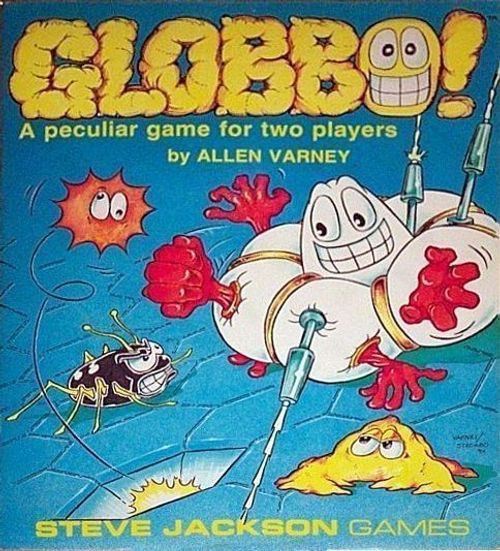
Globbo!
Globbo! Rulebook
Table of Contents
Table of Contents
The Kids
These are THE KIDS.
- BITERS are fiendish multi-legged brats that bite and explode.
- BLIPS are created when BITERS explode. BLIPS float around and reform into new BITERS. BLIPS can also explode, but they produce nothing (except damage).
- YEASTS are also created when BITERS explode. They are necessary catalysts for BLIPS to re-combine into BITERS. YEASTS do not move and really have no idea what's going on.
Moving
GLOBBO can flow like water. He starts out with his HEAD in the middle (always a good place for heads), surrounded by six BLUE ZAPS, with these in turn surrounded by twelve RED SLAPS. But he doesn't stay that way, nosirreebob. GLOBBO's HEAD can move up to three hexagons ("hexes") in any direction(s) on the map. Any other part of his body can move ANYWHERE on the map, SO LONG AS, when he's done moving:
a) each RED SLAP is next to at least one BLUE ZAP, and
b) each BLUE ZAP is next to another BLUE ZAP or GLOBBO's HEAD, and
c) no RED SLAP is next to GLOBBO's HEAD.
Simple, isn't it? Only one piece of GLOBBO allowed per hex, and GLOBBO can't enter hexes with kids in them. Any piece not connected to GLOBBO's HEAD at the BEGINNING of movement (say because a kid bit off something in between) cannot move at all that turn. Any piece not connected, however circuitously, to GLOBBO's HEAD at the END of movement is considered dead and removed from play forever.
Diagram captions: "THIS is OK." (a valid formation) and "THIS ISN'T." with these callouts: "These suckers aren't next to a BLUE ZAP." / "Whoops! RED SLAP next to GLOBBO's HEAD!" / "Uh-oh! BLUE ZAP not connected to the HEAD or another ZAP!" / "These befuddled parts aren't connected to GLOBBO's HEAD and therefore are dead and gone."
As for the kids, movement is simplicity itself:
- BITERS can move four hexes a turn. They can't move into hexes occupied by GLOBBO.
- BLIPS can float two hexes a turn. They can move through, and end up in, any hex they want, including hexes GLOBBO is in. But if they float over GLOBBO, he has a chance to destroy them before they can do anything.
- YEASTS don't ever move. Not very exciting, are they?
Any number of kids may occupy a hex at any time, but no kid except a BLIP can ever occupy a hex that GLOBBO is in.
The hexagons are the map of the Playroom of Death, where all this recreation is going on. The Playroom has some interesting (even unique) features.
The Playroom is inside its own little space-warp bubble, so that all the map-sides "connect up" with the opposite edge. Each lettered hex on the top edge of the map is the SAME as the "incomplete" hex with that same letter on the bottom edge. Each lettered hex on the left edge is the very same one with that letter on the right edge. A piece that is in one hex is ALSO in the other one at the same time! (There will be a test on all this in the morning.) What this means is that any kid or any piece of GLOBBO can move off the left edge and onto the corresponding hex on the right edge, and likewise with going off the top edge and sneaking up from behind on the bottom edge. (And all that left-to-right and top-to-bottom is vice-versa, too, but then you knew that, didn't you?) You can attack across edges, too.
The Playroom also has some "warp-holes" that the kids can use for speedy travel. If a kid lands on a warp-hole hex, it is sucked down and comes up (it hopes) somewhere else on the map. When a kid does try this (and only a kid would, right?), roll an ordinary six-sided die. The number that comes up is the number of the warp-hole it immediately pops out of. If it has any movement left it can keep moving (no movement cost for warp travel). "There's no warp-hole for #6," you observe. Well, when the kid rolls a six, it has been sucked away permanently into hyperspace. One less exploding kid to worry about. GLOBBO can't (or won't!) enter warp-hole hexes. Each kid can only try once a turn.
Sometimes, to keep the kids on what passes for their own side, the Playroom has WALLS (the spiky lines between hexes on the mapsheet). BLIPS can float over walls as if they weren't there, but nothing else can cross a wall at all. You and your opponent have to decide whether to use the walls or ignore them. (Decide BEFORE you start to play. Why borrow trouble?)
Killing Each Other
(The section you've been waiting for: KILLING EACH OTHER!)
Each kid (except YEASTS) and each piece of GLOBBO can attack once a turn. After all the pieces on a side have finished moving, each can attack any one enemy it's adjacent to. Now there are all kinds of exceptions to this rule, so forget everything I said. For one thing, whenever a BLIP floats over a piece of GLOBBO, that piece immediately gets a "free" attack on the offending BLIP. If the BLIP survives and has any movement left, it can keep floating on its merry way. The piece of GLOBBO that attacked can still attack as usual during its own turn; the BLIP attack is completely "free." Not only that, GLOBBO gets +1 to the strength of his free attack on a BLIP floating over him (see below)!
Second, GLOBBO can't attack a YEAST if there are any BITERS or BLIPS in the hex with it. He can't attack a BLIP as long as there are any BITERS in the hex with it. So his priority for attacking kids in the same hex is (1) BITERS, (2) BLIPS, (3) poor helpless YEASTS. (This could be GLOBBO's internal programming... or maybe he's just courteous, who knows?)
Third, kids can't attack if they're on a warp-hole hex. But GLOBBO can attack them!
Fourth (you paying attention still?), GLOBBO's HEAD and BLUE ZAPS can attack kids they're not adjacent to. ZAPS can attack any hex up to three hexes away if they can trace a clear path to it, free of kids, warp-holes, walls, other pieces of GLOBBO, cream cheese, toasters, etc. GLOBBO's HEAD employs a low-grade focussed-sound weapon known as a "burp." GLOBBO's HEAD can burp out to the staggeringly amazing distance of up to FIFTEEN hexes away, but only in a straight line of hexes from HEAD to target (as long as nothing is in the way, same as ZAPS).
Diagram: GLOBBO's HEAD can burp this BLIP. (It's a straight line of hexes.) GLOBBO's HEAD can't burp this BLIP. (Not a straight line of hexes.) Now ZAPS can attack this way, but in this example the BLIP is too far away for a ZAP to reach (four hexes instead of three), so never mind.
Fifth, BLIPS attack the hex they're in, not adjacent hexes. They move atop GLOBBO and try to blow him up directly. In a valiant sacrifice to benefit his fellow kids, the BLIP attacks by exploding. Whether or not the attack is successful, remove the BLIP from play after it attacks, leaving behind only a memory of unbounded devotion. (Cash contributions in sympathy for the departed BLIP may be sent to the author.)
Diagram: GLOBBO's HEAD and BLUE ZAPS can attack "around the corner," off the map and back on. Note how GLOBBO cleverly gets the drop on an unsuspecting BITER.
Now that we're all clear on exactly who can massacre when, let's learn how attacks are done. This is very easy.
It all depends on how many units are attacking and what kind they are. Each kid and each piece of GLOBBO has an "attack strength" it uses to annoy the other side. Here are the strengths. This is complicated, so PAY ATTENTION:
| THINGIE | ATTACK STRENGTH | WHERE IT ATTACKS |
|---|---|---|
| GLOBBO's HEAD | 5 | Up to 15 hexes away (clear, straight path). |
| BLUE ZAP | 1 | Up to 3 hexes away (clear path). |
| RED SLAP | 2 | Adjacent hexes only. |
| BITER | 2 | Adjacent hexes only. |
| BLIP | 3 | Same hex only. Remove after attack. |
| YEAST | 0 | Are you crazy? Yeasts can't attack! They can barely stay awake! Stop wasting time and go on! |
Got all that? Now, when you want to blow something away, you decide which kids or parts of GLOBBO will help in that attack. Total up their attack strengths and roll one 6-sided die. If you roll the total attack strength or LESS, you win. You've attacked successfully, trumpets sound and peasants cheer. Otherwise, you missed. For instance, if two SLAPS gang up on a kid, the total strength is 4. If you (as GLOBBO Player) roll from 1 through 4, you hit and the kid is destroyed. If you roll a 5 or 6, well tough, you missed and the kid will probably pulverize you next turn, you miserable failure.
When a piece has attacked, you should turn it sideways or something to show it can't attack again that turn. (But if you missed, and you have other pieces left that haven't attacked yet, you can have another go at the same target.)
IMPORTANT NOTE! GLOBBO's attacks against YEASTS are automatically successful! Don't even bother rolling the die, OK?
Exploding Children
So what happens when an attack is successful?
If kids are attacking GLOBBO, that's easy: the piece of GLOBBO that was hit is utterly destroyed, removed from play, and goes off to Machine Heaven to join the everlasting choir invisible. (Cash contributions in GLOBBO's memory may be sent to the author. Checks also gratefully accepted.)
Likewise, if GLOBBO gets a BLIP or a YEAST, they just bite the dust in ordinary fashion and are removed from play. BUT, if GLOBBO has managed to hit a BITER, things get complex! BITERS, you see, explode into BLIPS and YEASTS.
When a BITER is hit, it "fissions," producing up to six BLIPS and YEASTS. It's up to Kids Player to decide how many of each are wanted. A given BITER could produce 4 BLIPS and 2 YEASTS, or 3 of each, or 6 BLIPS and no YEASTS at all, or vice versa, or whatever. Kids Player doesn't have to decide until the actual moment of "fission." Some BLIPS and YEASTS will be destroyed immediately in GLOBBO's attack, but others will survive, to re-combine into new BITERS!
"Fissioning" works like this. The BITER that was hit is turned over. At the end of GLOBBO's attacks, Kids Player removes the BITER and places in its hex six BLIPS and YEASTS in whatever combination desired, FACE DOWN so GLOBBO Player can't see which is which. Then GLOBBO Player takes the face-down counters and (don't look!) moves each one two hexes straight out from the original hex, each in a different direction. Like this, see?
Diagram: The unfortunate ex-BITER is (or used to be) in the middle. The other counters are the BLIPS and YEASTS flying two hexes straight out from the explosion. They are face-down. They will be turned face-up when all have finished moving.
The face-down counters can move through or land on kids with no effect. They fly over walls. But when a counter enters a hex containing a piece of GLOBBO (and at least one almost certainly will), it must STOP immediately in that hex. After GLOBBO Player has finished moving all the pieces from the "fission," they are turned face-up. Now:
Diagram: BAM! If a BLIP from the explosion has entered a GLOBBO hex, both/all pieces in that hex are DESTROYED in the collision.
Diagram: OW! If a YEAST has entered a GLOBBO hex, the YEAST is destroyed (aww...) but GLOBBO is unharmed. (Contributions in the YEAST's memory may be sent to the author. All major credit cards honored.)
Remove all destroyed pieces and get on with the game. If a BLIP or YEAST from an explosion enters a warp-hole, it is sucked down. Roll the die in the usual fashion to determine where (whether!) it pops up again. If it still has a hex to go from the explosion, move it away from the hole in whichever direction Kids Player wants. (If it's a YEAST, move it away from the hole anyway. No sense letting the poor dumb thing block traffic.)
Re-Combining Children
The kids of Ticketa-Koo are troublesome not only because they explode, but because they tend to multiply at a tremendous rate. A BITER explodes into six BLIPS and YEASTS, but it takes only three BLIPS and one YEAST to re-combine into a new BITER! (Negative entropy!) Moving swiftly away from the many difficult moral and legal questions this creates, let's learn what happens in the game to make the kids proliferate:
Recombining requires 3 BLIPS and 1 YEAST. When there are three BLIPS and a YEAST in a hex at the end of movement, they immediately re-form into a BITER. The BITER cannot move or attack that turn because it's still disoriented (wouldn't you be?), but if GLOBBO hits it, it will explode into the full complement of six BLIPS and YEASTS, starting the whole unlikely cycle all over again. On its next turn the new BITER moves and attacks normally (if you call that normal).
GLOBBO Regeneration
But WAIT! Our saga is not over yet! GLOBBO can regenerate and grow like an amoeba, even in the thick of battle. At the end of each Kids turn, GLOBBO Player gets a "regeneration point," which he/she/it can save or spend as desired. GLOBBO spends points to buy new RED SLAPS, BLUE ZAPS, and even new HEADS.
| PRICE LIST | |
|---|---|
| A RED SLAP | costs 1 point |
| A BLUE ZAP | costs 2 points |
| A new HEAD | costs 4 points |
New pieces are placed adjacent to any existing piece, but must end movement subject to restrictions in section III.
If GLOBBO buys a new HEAD, he divides up like a cell, into two parts. Each part has a HEAD, but otherwise GLOBBO Player can divide up the SLAPS and ZAPS as desired. Each part moves independently, and each HEAD starts getting its own regeneration points, one per turn! Pretty soon we'd be hip-deep in GLOBBOs, if the kids weren't multiplying just as fast.
Parts can't be moved between one GLOBBO and another after the new GLOBBO has been created (except that if parts get cut off of one GLOBBO by the kids' attacks, another GLOBBO may move to link up with them next turn). At the end of GLOBBO movement, all the GLOBBOs have to be separate from each other, to avoid confusion of command control (or something like that). If two or more GLOBBOs end a turn connected, however circuitously, Kids Player gets to remove any connecting pieces before they attack! It has to be the absolute minimum number necessary to break the connection, but beyond that it can be any connecting piece(s) the kid wants! (Except for a HEAD, of course; I mean, let's not get silly here.)
Getting Started
I know by now you're champing at the bit to actually play a game of GLOBBO, so here's how you go about it:
First, pull out the map from the center of this rulebook (watch out for the staples) and cut out the cardboard playing pieces on the back cover flap. (There's a plastic bag glued inside the back cover that holds the cut-out pieces between games. If the pieces are already in the bag the first time you play, you have a USED GLOBBO and should go out and buy a new one immediately.)
GLOBBO Player gets 1 HEAD, 6 BLUE ZAPS, and 12 RED SLAPS. He sets up first. The HEAD starts in any hex at least four hexes away from a warp-hole. It's surrounded by the six ZAPS, and these in turn are surrounded by the twelve SLAPS, so that two concentric rings are formed around the HEAD.
Kids Player then gets 6 BITERS, which can be scattered around the map or lumped together as desired, at least three hexes away from GLOBBO and from any warp-hole.
The sequence of play goes like this:
- GLOBBO moves. At the end of his move, unconnected GLOBBO pieces die.
- GLOBBO attacks. He can do his attacks in any order he wants to.
- BITERS explode. Pieces of GLOBBO hit by BLIPS are removed, along with the BLIPS that hit them. YEASTS that hit GLOBBO are removed (aww...).
- KIDS move.
- KIDS attack. Kids, like GLOBBO, make attacks in any order.
- Each GLOBBO HEAD gets a regeneration point.
- GLOBBO builds new parts if he feels like it.
GLOBBO wins by destroying all the kids. The kids win by destroying GLOBBO's HEAD(s).
If the winning side has more pieces than it began the game with, this is a HUMILIATING TOTAL VICTORY, and the winner is allowed to jump up and down and laugh like a donkey at the loser.
Extras
Say you've played GLOBBO seventy-five or eighty times now and you're looking for new worlds to conquer. Fear not, here are some additional wrinkles to make your games fresh and invigorating.
Both GLOBBO and the kids get to pick certain advantages before the game begins. Each advantage is worth a certain number of "grades." Both players pick the same total number of grades of advantages. Kids Player picks from Column A; GLOBBO Player picks from Column B. In a 4-grade game, say, Kids Player might pick FREE WILL (worth 2) and YEAST MOBILITY (also worth 2), while GLOBBO Player could choose, oh, DOUBLE REGENERATION (worth 4 all by itself). Column A balances Column B. You don't have to reveal your choice(s) until both players finish choosing.
| COLUMN A (KIDS) | GRADES | COLUMN B (GLOBBO) | GRADES |
|---|---|---|---|
| TOUGH BLIPS | 1 | SLAP-HEAD INTERFACE | 1 |
| GUNK | 1 | SLAP-ZAP INTERFACE | 1 |
| FREE WILL | 2 | FLEXIBLE HEAD | 2 |
| JUMPING | 2 | CONNECTING | 2 |
| BITERS SPIT | 2 | GENETIC ENGINEERING | 2 |
| YEAST MOBILITY | 2 | FASTER | 2 |
| REFLEXES |
Explanations:
TOUGH BLIPS: BLIPS floating over a RED SLAP or BLUE ZAP are attacked normally instead of with GLOBBO's +1 strength advantage. But this doesn't apply to GLOBBO's HEAD, which still automatically destroys any BLIP dumb enough to float over it.
GUNK: BITERS may remain motionless for a turn and excrete a strong internally-produced adhesive. This sticky gunk can temporarily immobilize whoever enters that hex later on. At the end of kid movement, the motionless BITER removes to an adjacent hex, and places a "GUNK" marker on the hex it just vacated. Thereafter, any BITER (or mobile YEAST) or piece of GLOBBO that enters the gunked hex must STOP until it can pull loose on a later turn. Kids pull loose on a die-roll of 4 or less; GLOBBO pulls loose on a roll of 2 or less. If you fail to pull loose, you can't move that turn; roll again next turn. When you pull free, remove the "GUNK" marker and treat the hex normally again. Kids can't gunk a warp-hole.
FREE WILL: Kids entering a warp-hole can choose which warp-hole they emerge from.
JUMPING: BITERS can "jump" to another hex up to four hexes away... particularly useful to have when GLOBBO chose CONNECTING. Jumping BITERS can cross over walls, but when they jump over a piece(s) of GLOBBO, they get attacked at +1 (whether or not you chose TOUGH BLIPS!) by each GLOBBO piece jumped directly over.
BITERS SPIT: BITERS can attack targets up to two hexes away. Only one attack per BITER per turn, and only one target per attack. BITERS can't spit through walls, warp-holes, or occupied hexes.
YEAST MOBILITY: YEASTS move one hex a turn. Still can't attack, though.
REFLEXES: Newly-formed BITERS can move and attack on the same turn they form.
SHORT RANGE: BLIPS and YEASTS thrown from a BITER explosion move only one hex away, not two. Things can become tough for GLOBBO unless he chose SCORCH.
FEWER BLIPS: Only two BLIPS and a YEAST are needed to re-combine into a BITER, instead of three BLIPS and a YEAST.
PROLIFICITY: Fissioning BITERS produce, not six, but eight BLIPS and YEASTS. The two "extras" stay in the hex where the BITER blew up.
SLAP-HEAD INTERFACE: GLOBBO can finish movement with RED SLAPS adjacent to his HEAD if he wishes.
SLAP-ZAP INTERFACE: BLUE ZAPS can be adjacent to RED SLAPS (only) when GLOBBO finishes moving, instead of having to be next to the HEAD or another ZAP.
FLEXIBLE HEAD: GLOBBO's HEAD can burp any hex at any distance instead of having to trace through a straight line up to 15 hexes long. GLOBBO's "line-of-sight" to the target hex must be clear of obstacles and warp-holes and cannot "bend" around the edge of the map more than once.
CONNECTING: GLOBBOs controlled by separate HEADS can "link up" without penalty. All rules about "what can touch what" still apply.
GENETIC ENGINEERING: Before the game starts, GLOBBO Player can make Kids Player specify how many BLIPS and how many YEASTS every BITER will fission into during the game. If Kids Player chooses, for example, "4 BLIPS and 2 YEASTS," then that's how many of each every BITER explosion will produce that game.
FASTER: GLOBBO's HEAD can move up to four hexes a turn, instead of three.
ZAP HAPPY: BLUE ZAPS have an attack strength of 2 instead of 1.
RANGED SLAPS: RED SLAPS can attack at up to two hexes' distance, providing no obstacles are in the way of the target. (Very good against BITERS SPIT.)
SCORCH: GLOBBO has radio control of a concealed laser beam, usable three times in a game. GLOBBO must remain motionless, without attacking, during his turn to activate the Scorch. The Scorch will destroy all kids in a single hex. BITERS in that hex are not allowed to fission! Scorch can be used only once per turn, and GLOBBO may do nothing else that turn. Any hex can be Scorched (even a warp-hole) except those containing pieces of GLOBBO. But remember! Only three Scorches per game!
DOUBLE REGENERATION: GLOBBO gets 2 regeneration points per turn.
There is no section X! Good-bye!
Reference Table (printed on the map sheet)
The map sheet carries this summary table of the GLOBBO pieces. The "Depends where HEAD is." movement entry is printed as one merged cell spanning the BLUE ZAP and RED SLAP rows.
| THINGIE | MOVEMENT | ATTACK STRENGTH | RANGE | COST TO REGENERATE |
|---|---|---|---|---|
| GLOBBO's HEAD | 3 | 5 | 15 | 4 |
| BLUE ZAP | Depends where HEAD is. | 1 | 3 | 2 |
| RED SLAP | Depends where HEAD is. | 2 | 1 | 1 |