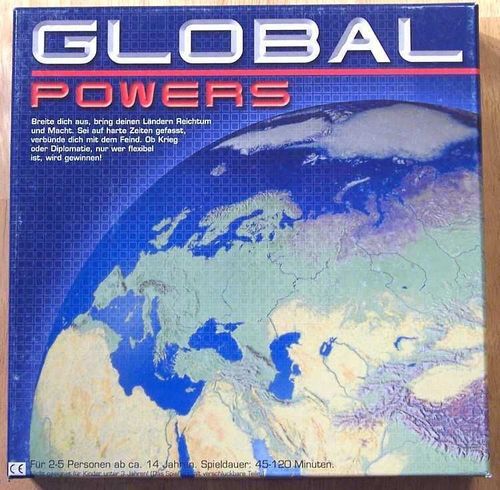
Global Powers
Global Powers Rulebook
Table of Contents
Table of Contents
Material
- 20 politicians each in 5 colors (red, yellow, green, blue, black)
- 20 black raw material chips
- 40 blue economy chips
- 30 red military chips
- 30 yellow diplomacy chips
- 5 decks of 16 player cards each
- 2 markers each for sanctions (indigo), disarmament (white) and protectorate (orange)
- 1 marker for dominance victory points
- 12 markers for chosen regions
- 2 dice (inscribed with numbers 1, 2 and 3)
- 1 map board
- 5 overview tables
- 1 rules booklet
The Goal
Gaining a sufficient level of global power by tactics, diplomacy and optimal use of resources.
To achieve this, every player represents a global party whose politicians (human shaped pieces) stand for influence in different regions of the world. The strongest party forms the government and controls resources (colored chips) within the region, wages war, uses diplomacy, trades goods and increases its influence in other regions. Having enough global influence at an evaluation, a party may win the game or otherwise improve its chances for the next evaluation.
Principle
Politicians are located either in the players base, in a region, as emissaries in the United Nations or have retired to Mauritius.
UN-politicians stay in the UN till the end of the game.
Retired politicians return to the base at an evaluation or may be rehabilitated deliberately.
The colors of the politicians are neither linked to the colors of the resources nor to the colors of the regions.
Resources are located in the regions or on the table.
Definitions & Explanations
- Neighbour regions have a common border or connecting line.
- Strongest party is the one having most politicians in the region, at a tie most in the UN, then least in Mauritius. The opposite is valid for the weakest party.
- The government is formed by the strongest party (parties) in the region at the moment. Taken actions and events that remove politicians from that region may cause an immediate change of government. An event that affects the government, affects all governing parties.
- Absolute majority belongs to the party having more politicians in that region than all the others. Relative majority belongs to the party having more politicians than every single other party in that region.
- Opposition is every party in that region that does not govern.
- Strength of government is the number of politicians of the strongest party in that region at the beginning of the turn. Do not add the numbers in case of more than one governing party!
- Adding and subtracting markers and resources are only possible if available.
- Owned region is any region where your politicians are part of the government.
- Current region is the region being activated by the player's turn.
- Any Tie that cannot be solved is solved by rolling dice.
Preparation
- Every player takes his 20 politicians and an overview table to his base.
- The resources are spread on the board as following:
| Sequence | 1 | 2 | 3 | 4 | 5 | 6 | 7 | 8 | 9 | 10 | 11 | 12 |
|---|---|---|---|---|---|---|---|---|---|---|---|---|
| Resources | North-America | Europe | Russia | China | Japan | India | Orient | South-America | Meso-America | Southeast-Asia | Australia | Africa |
| Raw material (18) | 2 | 1 | 3 | 1 |
-
The dominance marker is put on 12 minus number of players. It shows how many regions one needs for an extraordinary victory.
-
The markers for the 12 regions are put on "Steht noch aus" ("still to come").
-
All regions are being sold by auction following the sequence given by their number. The players offer secretly an arbitrary number of politicians but must leave one in their base. The player (all players at a tie) giving the highest offer places those politicians in that region and (except for a tie) another one from his base to Mauritius. If there is only 1 governing party, the second best offers are placed in that region as well, without adding more politicians to Mauritius. The other players take their offers back to their bases.
Example for an auction: Red offers 3, green and blue each 2 and black only 1 base politician for Europe. After revealing their offers, black returns his politicians to his base, whereas the other players put their politicians on Europe. Additionally, red has to send one politician from his base to Mauritius.
Tip: Generally, it makes sense to put as many politicians as possible into the regions, best as government. But it's a risk to pile up too many politicians on a single spot, and having a strong opposition may also be a first step for taking the government.
- Every player chooses 5 out of his 16 cards, which he keeps hidden on his hand.
Course of the Game
Starting with the weakest player (see definition above) the players make their turns in clockwise direction. They either play one of their cards or activate a region still to come.
Should any party ever govern as many regions as indicated by the dominance marker, it wins the game at once!
At the beginning of his turn a player may recall as many politicians as desired from the regions to his base and use them immediately. It is not possible to recall politicians from Mauritius or the UN.
Players playing a card follow the instructions given on it (see appendix for details).
Players activating a region put the marker on "erledigt" ("done"). The government of that region may now take as many actions (budget, war, diplomacy, migration, propaganda, rehabilitation, trade, purge) in arbitrary order as the strength of government is like. Empty regions are being ignored. It is possible to repeat the same action with several actions to be done.
Example for strength of government: In Africa there are 2 blue and 1 red politicians, so the strength of government is 2. If red gets one more politician, the strength of government is still 2, even though red is now part of the government.
Every action decided by the government must be confirmed by open ballot. Having an absolute majority, the government will automatically succeed. Having only a relative majority, the ballot may fail.
Any opposition party may interpose a veto upon a succeeded ballot by recalling a politician from that region to its base.
The government can force an action against a failed ballot or to counter a veto, also by recalling a politician of its own.
Governments sharing power in a region must agree on an action or force an action by recalling a politician. The other governing parties can counter that by recalling a politician as well.
Promises and threats need not to be kept.
Recalling a politician to the base is a symbol of losing influence by making unpopular decisions. Should the recall cause a change of government, any action in charge is finished first. Actions still to be decided can be used by the new government. The number of actions is untouched.
Example for actions in a region: "Africa" is activated. Blue has an absolute majority with 4 politicians, whereas Red having 2 and Yellow having 1 politicians form the opposition. Blue transforms 1 economy chip into 1 military chip, which Red and Yellow accept. Second action is declaring war on the Orient, which Red tries to prevent by veto, but Blue forces the action; Red now has only 1, Blue 3 politicians in Africa. Third action is migrating a blue politician to South America, which again decreases blue power in Africa. Suggesting their fourth action, an application for sanctions against India, the two blue politicians fail the ballot against the red and the yellow politician and decide not to recall another politician to force the sanctions.
Tip: To indicate the number of actions already done, put a governing politician on its side.
Government Actions for a Region in Detail
Budget
Transform a resource into another:
- 1 raw material => 3 economy (mining, cutting wood)
- 1 economy => 2 economy (measures to increase economy)
- 1 economy => 2 diplomacy (international influence, corruption)
- 1 economy => 1 military (production of weapons and troops)
The number of resources of a kind in a region must not exceed 5.
Roll a die when transforming raw material: On a 1, a politician of every governing party in that region is forced by environmentalists to retreat to Mauritius.
Migration
A governing politician moves into a neighbour region. That may cause a change of government in the home region.
Propaganda
A base politician is placed into the current region or a neighbour region. Another base politician is sent to Mauritius.
Rehabilitate politician
By spending 1 diplomacy chip a politician can be recalled from Mauritius to the base.
Trade
An arbitrary amount of resources may be exchanged for arbitrary resources of a neighbour region, if its government agrees or is intimidated.
Purge
The government may purge an oppositional politician back to base by spending a military chip. This action needs not to be confirmed by ballot.
War
The government can wage war against a neighbour region.
Both regions roll a die and add their military chips. The higher result wins. Even the attacker might lose!
The winner replaces as many (or less) politicians of the defeated government by his own base politicians as the difference of the results is. For a coalition decide the replacement in advance, e.g. split even or rolling dice. Replaced politicians return to their base.
The victorious region loses 1 military chip.
The defeated region loses 1 military chip and 1 economy chip.
At a tie or if an attacker having at least 2 military chips more rolls a 1 against the defender's 3, the score is drawn and both regions lose a military chip.
Empty regions may not be attacked.
Example for war: Red, having 3 military chips, attacks a neighbour where green and yellow with 2 politicians each form a coalition having 2 military chips. Both countries roll a 2. Thus Red won 5:4. Green and yellow lose each 1 politician to base which is replaced by 1 (not 2!) red base politician. If red had rolled a 3, both green and both yellow politicians would have been recalled and replaced by 2 red ones.
Diplomacy
The government spends 1 or more diplomacy chips for a diplomatic application on the table "Dafür" ("for"). The other governments (starting with those having most diplomacy chips, or lowest sequence number on a tie) spend an arbitrary number of diplomacy chips for or against ("dagegen") the application or abstain. In the end the UN-politicians vote for or against or abstain (1 vote per politician, strongest fraction first).
The application succeeds if there are more votes for than against. Then the diplomacy chips return to the pool on the table.
Applications in detail:
- Ban party: The banned party recalls as many politicians from the indicated region as the difference of votes.
- Disarmament: The affected region decreases as many military chips as the difference of votes and stays demilitarized (white marker, no increase of military chips) until next evaluation.
- Sanction: The affected region is unable to act until next evaluation and produces only half of normal victory points (indigo marker). Being activated, that region can only make an application for an end of sanctions. Actions that afflict a sanctioned region are still valid.
Example for a diplomatic application: The australian government makes an application for demilitarizing China by spending 3 diplomacy chips for it. North America as the momentarily strongest region in diplomacy spends 2 chips against, Russia as second strongest 1 for the application, Europe abstains etc. In the end, it's 9:7 for the application, so China must decrease its military by 2 and stays on that level until evaluation.
Evaluation
After every region has been activated once, an evaluation takes place. Every party counts its current victory points (VP); VP gained in former evaluations are lost. The party with the highest VP-score wins the game if it reaches a given number.
| Number of players | 2 | 3 | 4 | 5 |
|---|---|---|---|---|
| Necessary VP | 40 | 30 | 25 | 22 |
VP per region:
- 4 for being the only party in that region
- 3 for majority
- 2 for sharing government with another party
- 1 for opposition
Every UN-politician from former evaluations adds 2 VP.
Good economic conditions increase the VP of the government. Having 3 economy chips in a region gives 1 VP, 4 chips give 2 VP and 5 chips 3 VP.
Every politician in Mauritius subtracts 1 VP for his party.
Example for an evaluation: Red has got a majority in Europe with 3 politicians facing 2 yellow and 2 blue ones (3 VP), forms the opposition in Russia (1 VP), has to share power in Japan (2 VP) and is the only player in Africa (4 VP). The good economic conditions (4 chips) in Europe increase his score by another 2 VP, whereas the excellent russian economy is useless for Red. His 3 UN-politicians resulting from last evaluation add 6 VP. However, 2 politicians returning from Mauritius decrease the score by 2. Adding up, Red achieves 16 VP, which are compared to his competitor's VP to find out how many politicians everyone can send to the UN.
If nobody should have gained enough VP:
- The player with the lowest VP score sends 1 politician from base or from any region to the UN. The player having second lowest VP sends 2 politicians etc. Then everybody removes as many of his politicians from the game as there are players minus the number of politicians he just sent to the UN.
If there are no politicians left anymore in base and regions, the game ends and the player with the highest VP score wins.
- The marker for the regions is set back to "steht aus".
- The dominance marker is decreased by 1.
- A general amnesty removes all markers for sanctions, disarmaments and protectorates.
- Every player may keep or discard his unspent cards and fills up his hand cards to 5 from his deck of cards not used yet. As soon as his deck is empty, he may use his played cards again. Played cards that still wait for usage (e.g. enterprise) are discarded.
- The player that would have been in turn without evaluation continues.
Extended Rules
- As an alternative to the auction of regions, every player chooses a region as his home region and places 2 (North America), 3 (Europe, Russia, China) or 4 (other regions) politicians there. The die decides who will start. Then the players place clockwise as many politicians one by one to any region as indicated by the number shown in "Startrunden" on the mapboard.
- If the government renounces forcing an action after a failed ballot, the opposition may suggest an alternative action instead, which still has to be confirmed in a ballot. This counts as an action. Should all ballots fail, this action is lost.
- The regions (wealthiest first, or sequence number on a tie) may corrupt UN-politicians in diplomatic applications to make them abstain by paying 2 economy chips. To indicate this, place the affected politicians on their sides. Paying 3 economic chips makes the affected politicians vote for the corrupter's opinion. Different regions cannot add their chips.
- After every evaluation, the UN may decide in a ballot to send 3 UN troops to an arbitrary region. Use the rules for waging war, but on a defeat the UN will never lose politicians. In case of victory, the UN removes defeated politicians to their base without replacing them. Instead, the region is made a protectorate (orange marker). Until next evaluation, UN-politicians will take part in any ballot in the protectorate, but they cannot be recalled. Corruption is allowed. The strength of government in a protectorate equals the number of players. To determine VP, UN-politicians count as politicians of the protectorate.
Appendix: Details on Player Cards
Here, "player" means the one just playing a card.
- Attentat (assassination): The player tries to eliminate a politician in any region. Roll a die: On 1 the victim is removed from the game, on 2 the victim returns to base, on 3 the perpetrator has to escape to Mauritius.
- Diplomatische Initiative: The player can immediately suggest a diplomatic application getting 1 vote for free.
- Entwicklungshilfe (development aid): An arbitrary region gets 2 economy chips from a richer region chosen by the player.
- Expansion: The player can place 2 politicians from his base into any region.
- Friedensinitiative (peace initiative): Nobody can wage war until next evaluation. This card may be cancelled by warmonger.
- Kriegstreiber (warmonger): This card cancels peace initiative or non-aggression pact or is placed in front of the player to give him once +1 on his die roll in a military conflict (attack or defense). After evaluation this card is discarded.
- Nichtangriffspakt (non-aggression pact): An arbitrary region can not wage war with a neighbour region chosen by the player. Use this card as a marker. This card may be cancelled by warmonger.
- Putsch: The player may try a putsch in an arbitrary region. He secretly selects one or more base politicians and adds this and the number of his politicians in that region to his die roll. The government(s) of the afflicted regions can also select secretly base politicians and add this number to the strength of government and his die roll. If the player gets a higher result, he replaces the government by his own politicians. The putsch will never succeed on a 1 against a 3 of the government. Different governing parties may each add base politicians. All selected base politicians are sent to Mauritius after the putsch. Example: Red tries a putsch in India, where he already has 2 politicians. He secretly selects 2 base politicians for the task. The blue government of India (4 politicians) selects 1 base politician to counter this. Red rolls a 3, Blue a 1, so the result is 7:6. The putsch is successful, and the blue politicians in India are replaced by red ones.
- Rezession (recession): An arbitrary region and its neighbour regions lose all economy chips exceeding the strength of government.
- Revolution: An arbitrary region and its neighbour regions each roll a die to determine the number of governing politicians may stay. The difference returns to base.