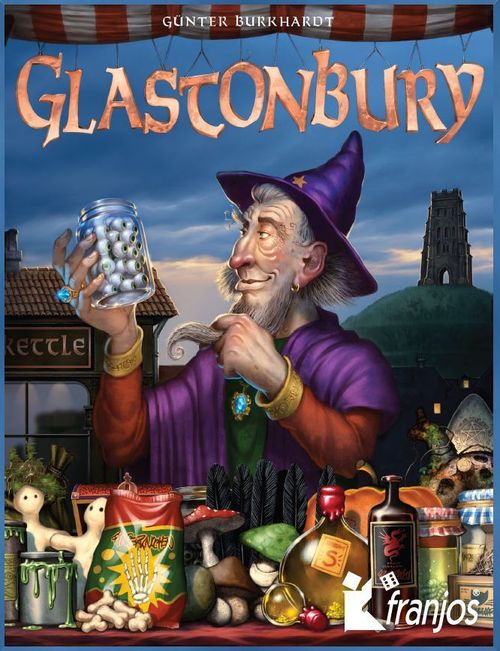
Glastonbury
Glastonbury Rulebook
Table of Contents
Table of Contents
Object of the Game
Players collect Ingredient cards for the magic potions in turn and put them on their discard piles, the "cauldrons."
In doing so, each player tries to collect as many cards of the same ingredient as possible. However, you always see only the top ingredient card in your cauldron. Therefore you have to keep in mind which ingredients you have already collected. Otherwise, you may be in for an unpleasant surprise at the end of the game because single Ingredient cards in your cauldron count minus points.
In the end of the game, players score for the ingredients they have collected, and the player with the most points wins.
Game Materials
- 72 Ingredient cards
- 2 Immuto (Shape-shifter) cards
- 10 Spell cards
- 4 Corner cards
- 4 Cauldron cards
- 4 Scoring Overview cards
- 10 Recipe cards
- 4 Player pawns
Set-up
The Ingredient cards are not used in the basic game.
Mix the Ingredient cards, the two Immuto cards and the Spell cards together and shuffle them well, face down. After that, turn over 32 cards, one after another, and lay them out face up to create a 6 x 6 card playing area, leaving the corner spaces initially empty. The remaining cards become a face-down draw pile.
Now place the 4 Corner cards in the corners so that a complete square area is formed (see illustration on next page).
Each player chooses one pawn and puts it next to a corner. In addition, give everybody a Scoring Overview card and the Cauldron card in his pawn color.
Lay down the Cauldron card face up in front of you. On this card you will put all future Ingredient cards that you will be collecting during the game. The pile that will be formed is your "cauldron."
The illustration shows the layout: the Scoring Overview card, a Corner card, an Ingredient card, a Spell card, and the Cauldron card.
Course of the Game
Decide in any way you like who begins the game.
Play proceeds clockwise.
On your turn, you must
- move your pawn,
- take a card,
- turn over another card.
Moving Your Pawn
You move your pawn clockwise, around the outside of the card display area. On your first turn, you have to move two steps (as per the number on your Cauldron card). From then on, you have to move your pawn exactly as many steps as indicated by the number on the top Ingredient card in your cauldron. Each card row and each Corner card counts as one step (see illustration on next page).
More than one pawn can stop next to the same row or the same Corner card.
The illustration shows the movement of the blue pawn to row "X."
Taking a Card
You have to take a card of your choice from the row next to which your pawn is now standing. If your pawn is next to a Corner card, however, you cannot take any card and your turn ends, unless you use a "Declinatio Spell" (see "The Spell Cards").
If the card you have taken is an Ingredient card or an Immuto card, you put it face up on top of your cauldron. You lay later cards always on top of cards that are already lying there so that a face-up discard pile is formed on the Cauldron card, with only the top card being visible.
Important: During the further course of the game, you may no longer look at Ingredient cards that are beneath the top card of the pile, unless you use a "Perluceo Spell" (see "The Spell Cards").
If you have taken a Spell card, you use it immediately or later, depending on its kind (see "The Spell Cards").
Turning Over Another Card
After taking a card from a row, you draw the top card from the draw pile and lay it face up on the now-vacant space. If the draw pile has been used up, no new card can be turned over so the space remains empty. After that, it is the next player's turn.
IMMUTO Card (Shape-shifter)
An Immuto card, like an Ingredient card, is put on top of the cauldron. The card shows a "0." Therefore, on your next turn, your pawn remains where it is and you have to take another card from the same row.
The card is used in the final scoring. A player may add it to any one kind of ingredient, e.g., to score for this kind or to receive the bonus (for 4 cards of the same kind). The Immuto card itself does not score any points.
The Spell Cards
There are 3 kinds of Spell cards with two cards each, and four "Vanesco Spell" cards. A Spell card allows you to use the respective spell, but only one per turn.
ACCIO (Conjure-Up Spell)
When you take such a card, you put it down in front of you with the "2x" side toward the top, and every time you use the spell, you turn it so it decreases one level.
This card allows you, twice in the game, to take (conjure up) any card from the playing area after you have moved your pawn; in this case you don't have to stick to the row next to your pawn. However, you may not take a "Vanesco Spell" card or a "Perluceo Spell" card.
If your pawn ends up next to a Corner card after your move, you may not use the spell.
After you have used the "Accio" spell twice, you put the card face down next to your cauldron.
DECLINATIO (Corner Spell)
When you take such a card, you put it down in front of you with the "3x" side toward the top, and every time you use the spell, you turn it so it decreases one level.
If your pawn lands next to a Corner card, you may move again immediately as per the number on the top card in your cauldron. In this case, however, you may not take a "Vanesco Spell" card or a "Perluceo Spell" card.
After you have used the "Declinatio" spell three times, you put the card face down next to your cauldron.
VANESCO (Poof-It's-Gone Spell)
You carry out this spell immediately. All other players have to remove the top card from their cauldron and put the card back at the bottom of the draw pile. If the draw pile has already been used up, the cards are completely removed from the game.
After that, you put the "Vanesco Spell" card face down next to your cauldron.
PERLUCEO (Eyeball Spell)
You carry out this spell immediately. You may look through all the cards in your cauldron once. The top card must stay in its position. After that, you put the "Perluceo Spell" card face down next to your cauldron.
End of the Game
When the draw pile has been used up, more and more gaps are created since no cards can be placed in the vacant spaces anymore.
The game ends when a player takes the last card from a row. This player can choose whether he wants to keep the card or not, but the game ends in any case. If this last card is a Vanesco spell, the player who has taken it still executes this spell.
Now players get points for the ingredients they have collected.
Scoring
All Ingredient cards collected in the cauldrons are scored.
Each player sorts his cards by ingredient and lays each ingredient down separately, overlapping, so that the number on each card is visible. This makes scoring very easy.
Single cards of an ingredient score minus points according to their value.
Two cards of the same ingredient score nothing (0 points).
Three cards of the same ingredient score plus points according to the number on each card.
Four cards of the same ingredient score plus points according to the number on each card; in addition, you get a bonus of 5 points.
Additionally, all point values of Ingredient cards in your own pawn color (yellow, green, red or blue) are doubled – also if they are minus points. Only the 5-point bonus (for four cards of the same ingredient) is not doubled.
Example: 2x(1+2+3+4)+5=25, 1+3+4=8, 0, 2x(-4)=-8
The blue player scores double for the blue ingredients. The bonus for 4 cards is not doubled. So the blue player scores 25 points overall.
If you have an Immuto card, you now add it to an ingredient of your choice.
This card turns a single ingredient into a pair and thus makes the minus points disappear.
It turns two Ingredient cards of the same kind into three, thus allowing the cards to be scored.
It turns three Ingredient cards of the same kind into four, thus giving you a bonus for this ingredient.
The Immuto card itself always counts 0 points.
If you have collected both Immuto cards, you can either add them to two different ingredients or just to one.
If you already have all four cards of the same ingredient, the Immuto card doesn't give you any additional points for this ingredient.
If the blue player in the example above additionally had an Immuto card, the result would be somewhat different.
If he added the Immuto card to the three orange cards, he would get the 5-point bonus for four cards of the same kind.
If he added the Immuto card to the two green cards, he would bring them into the scoring and get 3 + 4 + 0 = 7 points for this.
Actually, the blue player would add the Immuto card to the single blue Ingredient card. This way, he would change the 8 minus points into 0 points and bring his total to 33 points. With this, he would have made optimal use of his Immuto card.
Spell cards are disregarded in the scoring.
The player with the most points wins.
Variant for 2 Players
Players eliminate the 8 Ingredient cards of one of the colors of the pawns not being used; they remain in the box.
Variant with Recipe Cards
There are two sorts of Recipe cards, identified on the back.
The game set up is done as in the basic game. Before you start playing, you additionally separate the Recipe cards by sorts and shuffle each sort. Each player gets one card of each sort. The remaining cards are put back into the box unseen.
You look at your cards, keeping them hidden from the other players. Then you lay them face down in front of you. You may look at your Recipe cards again any time during the game.
The Recipe cards show special tasks. If you have fulfilled a task by the end of the game, you get additional plus points.
At the scoring, it is recommended to first score the Ingredient cards, as in the basic game, and then the Recipe cards.
The Recipe Cards, Sort A
These Recipe cards show the ingredient colors in the non-player colors.
Each of these cards depicts two Ingredient cards, both with labels in the same color.
If you have the most ingredients in your cauldron in the applicable ingredient color at the end of the game, you get 1 point for each ingredient in the two- or three-player game; in the four-player game, you get 2 points for each ingredient.
If you have an Immuto card, you add it to the ingredient color you have used it for in the normal scoring. If you have scored points for your Recipe card for this ingredient color, you get the point(s) for the Immuto card as well.
If two (or more) players have the same number of Ingredient cards, you don't get the points.
The Recipe Cards, Sort B
If the holder of this card collected fewer Ingredient cards overall than anybody else (including the Immuto cards) he gets 10 plus points.
If the holder of this card collected fewer Ingredient cards showing a "4" than anybody else he gets 10 plus points.
If the holder of this card used fewer Spell cards than anybody else he gets 10 plus points.
If the holder of this card collected more Ingredient cards showing a "1" than anybody else he gets 10 plus points.
If the holder of this card has ended the game he gets 10 plus points.
Special Situations
If you use a Declinatio spell and then your pawn lands next to a row with only Vanesco or Perluceo Spell cards there, you may not take any of these cards (otherwise you would be using two spells on your turn). The game ends immediately and the scoring takes place.
If your pawn is standing next to a Corner card and another player uses a Vanesco spell, it can happen that now an Immuto card is lying facing up on your cauldron.
In this case, you move as many spaces on your next turn as the number of the card underneath the Immuto card indicates.