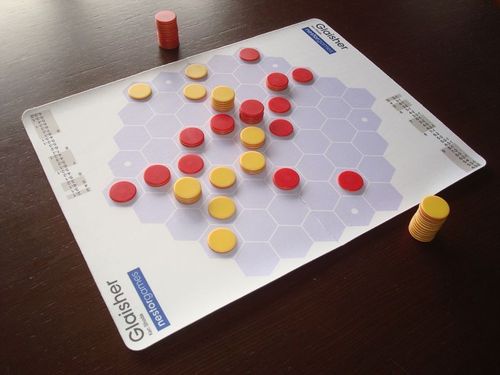
Glaisher
Glaisher Rulebook
Table of Contents
Table of Contents
Objective
Connect any pair of opposite sides of the board with a contiguous chain of stacks showing your colour.
A single piece is considered to be a stack of height 1 (1-stack).
Stacks on the game board are connected if they can be traced with series of edge adjacent friendly stacks.
The six corner hexes of the game board belong to both adjacent sides.
Material
- Hexagonal board with 5 hexes per side (total of 61 hexes)
- 75 double-sided pieces with one side red and the other side yellow
Preparation
Decide the colour (red or yellow) for each player.
Each player takes 18 pieces with his/her colour facing up.
Each player starts by making three 6-stacks, i.e., stacks six pieces high as shown in Figure 1.
Starting positions are marked with white dots.
The remaining pieces are kept in a shared reserve.
Figure 1: Starting position – The number indicates the height of each stack.
Game Play
Players take turns by taking two actions in the following order. The details of these actions are described below.
- Separate and move a stack.
- Place a new piece.
Passing is not allowed. If you cannot do the first action "separate and move a stack", then you lose immediately.
1. Separate and Move a Stack
Choose one of your stacks and separate it into two or more smaller stacks, called "sub-stacks", of different heights. You may not have sub-stacks of the same heights. Then, all sub-stacks must move straight in the same direction. Each sub-stack moves the number of hexes equal to its respective height (Figure 2).
Your sub-stacks may jump over any in-between stacks but may not move outside the game board.
Figure 2: Separate and Move – Three possible separations for a 6-stack.
If some of the destination hexes of your moving sub-stacks are occupied by an opponent's stack which is taller than your sub-stack, then you may not separate and move the stack this way and must choose a different stack, separation, and/or direction.
Now, flip your opponent's stacks which occupy the destination hexes of your moving sub-stacks. Flip them entirely so that they become your stack with your colour up. Then move all sub-stacks. Some sub-stacks may be on top of your other stacks, creating taller stacks, and even effectively capturing opponent's stacks. There is no limit for the height of stacks.
Figure 3 shows the possible separations of yellow's 6-stack on the left. Each row corresponds to the row in Figure 2. Notice that 4-2 separation in the third row is not allowed because red's 5-stack is taller than yellow's 4-sub-stack.
Figure 3: Separate and Move – 4-2 separation is not possible.
2. Place a New Piece
From the reserve, you must place one piece with your colour facing up on any empty hex on the board.
The newly placed piece is considered to be a stack of height 1.
End of the Game
When a player connects any two opposite sides of the game board, that player wins immediately (Figure 4).
Also if a player cannot separate and move any of his/her stacks, then that player loses immediately.
Figure 4: End of the game – Red wins.
Advanced Game
The board starts empty. At the beginning of the game, there is a set-up phase. Both players take turns to place their three 6-stacks, one stack per turn, on any empty hex on the board. After 6 turns (3 turns each), the initial set-up phase is over and players start the game as normal.
Notes
1- and 2-stacks cannot be separated. Thus, they cannot be moved.
3- and 4-stacks have only one possibility of separation, i.e., 2-1 or 3-1, respectively. Thus having 2- or taller stacks next to opponent's 3- or 4-stacks blocks its movement of that direction.
6- or taller stacks can be separated into three sub-stacks.
10- or taller stacks can be separated into four sub-stacks.
11- or taller stacks at the centre of the board are permanently immobile because any separation requires 5- or taller sub-stacks.
You can see a summary of Separate-and-Move for up to 9-stacks printed on the game board.