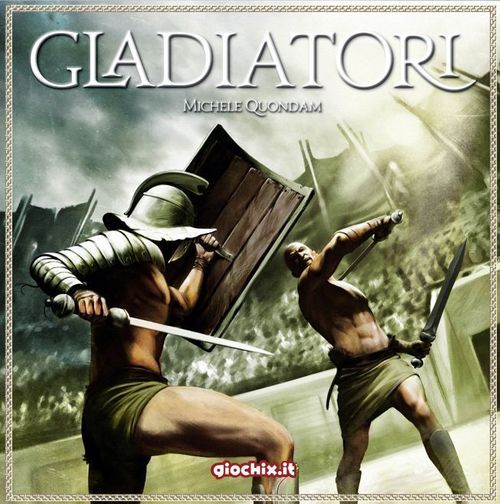
Gladiatori
Gladiatori Rulebook
Table of Contents
Table of Contents
Game Components
Cards with Green back: 16 Action cards (4 set), 8 Cover cards (4 sets).
Cards with Red back (Combat cards): 32 1-Energy cards, 32 0-Energy cards, 4 Feint cards, 32 Special Move cards.
Cards with Blue back: 18 item cards.
Tokens: 4 player VP makers (1 disc for each color), 18 status/animal markers (x9 gray and x9 white cubes).
Other components: 4 player aid cards, 4 player block notes (character sheets), 4 player screens, 8 metal miniatures, 1 game board, 1 rulebook, 3 dice (6 sides).
Game Setup
This setup is for a 4 players game, when playing in 3 or 2 players read also the Rules for different number of players section.
Determine the players' order. Each player chooses a color and a Gladiator from the Gladiator table. Then each player takes from the box:
- Green back cards: the 4 Action cards, 1 of each different type.
- Red back cards: the 1-Energy, 0-Energy, Feint cards of his Gladiator as shown in the Gladiator Table.
- Blue back cards: the 2 Items cards as shown in the Gladiator Table and places them face-up in front of him. Note: Sword 2-1 means Sword with Attack +2 and Defense +1.
- The 2 Cover cards depicting his Gladiator. The colored one will be placed over the Hit Point deck (HP), the black and white one will be placed over the Discard pile (see figure below).
- A record sheet to keep track of the Gladiator's Skills and Abilities (Powers are only used in Advanced Game): the player must writes on the first column (marked "0") the starting values of his Gladiator as shown in the Gladiator Table.
- A Cover screen of his chosen color to place it over the record sheet to keep it hidden from other players.
- A Victory Point (VP) marker disc of his color that he places on the 10 position of the VP track following the players' order (first player will be on top).
- A Gladiator miniature that he places on one of the Arena starting positions (marked by the Gladiator icon).
The Arena board must be placed in the center of the table.
Table organization
This is an example of the player organization on the table.
- Colored Cover card: placed over the HP deck.
- B/W Cover card: placed over the Discard pile.
- Item cards: placed face-up in front of the player.
- Character sheet: the player's record sheet, kept hidden behind the Cover screen.
Gladiator table
Players can choose among these 4 Gladiators:
| Secutor | Mirmillo | Thraex | Hoplomacus | |
|---|---|---|---|---|
| Endurance | 7 | 8 | 5 | 6 |
| Offense | 5 | 4 | 5 | 5 |
| Guard | 5 | 4 | 5 | 4 |
| Blood | 5 | 4 | 8 | 4 |
| Speed | 5 | 4 | 4 | 7 |
| 1-Energy |
Game concepts
Skills
Each Gladiator has 3 Skills: Offence (sword icon) and Guard (shield icon) that provide a bonus to Attack and Defense values respectively, and Endurance (fist icon) that is used to recover stat points during the Clean-up Phase of the game. Every time a Skill is used, its value must be decreased by 1 (down to a minimum of 0).
Example: A current Offense value of 5 gives +5 to the Attack score. After it's used, the value drops to 4.
Abilities
Each Gladiator has 2 Abilities: Blood (drop icon) allows to re-use Action cards on the table and to improve the Berserk Action. Speed (figure icon) allows to additional movement and to improve the Dodge Action. Every time an Ability is used its value must be decreased by the amount of used points (down to a minimum value of 0). Abilities differ from Skills because it is possible to spend multiple points at once.
Character Elements
Every time the rules state to spent 1 Character Element (crown icon) the Player must decrease by 1 a Skill or Ability at his choice (down to a minimum of 0) or remove 1 Card from his hand and put it to the Discard Pile. Every time the rules state to gain 1 Character Element (crown icon), the Player can increase by 1 a Skill or Ability at his choice (but not higher than the starting values) or take 1 Card from the Discard Pile and put it back to his hand.
Game Sequence
The Game is played in Turns. Each game Turn consists of 4 phases: Deck, (First) Action, (Second) Action, and Cleanup. The game ends when only one Gladiator is alive OR at the end of the sixth Turn.
Deck phase
All players take all their available cards (excluding those on the Discard pile and Items), choose any number of Red and/or Green backed cards they want to use for this Turn, and take them in hand. All the remaining cards are placed face down on the table in front of the Player under the colored cover card to forming the player Hit Points deck (HP deck).
First Action phase
During this Phase the players act one at a time in increasing VP order: The player with the least VP act first. Simply use the VP track on the Arena Board to visualize it. In case of a tie, the upper marker in the stack is the first in the order. Each Player performs all the Action steps before to let the next player play. The Action steps are:
A. Rebalance
The Player can remove 1 or more Unbalance tokens from the Gladiator by paying 2 Character Elements (crown icon) for each token removed. If the Gladiator was Face-down and the player remove ALL the Unbalance tokens, the Gladiator miniature is put back to a stand up position, facing as the player whishes.
B. Sprint
For each Speed point (figure icon) spent the Player can move the Gladiator miniatures of 1 Hex. For each Hex moved the Gladiator can be rotated by 1 hex side (60 degrees) at no additional cost. A Speed point can be used to freely rotate the Gladiator (up to 180°) instead to move 1 Hex.
It is possible to move into all hexes of the Arena, including partial hexes, but not in hexes occupied by other Gladiators.
C. Play Action Card
The Player chooses an Action card from his hand and plays it face-down and rotated by 90 degrees. If other his Action cards are already on the table, he must place it on their right.
Alternatively, the player can choose one of his face-up straight (not rotated) Action cards already on the table instead of playing a new one from his hand. In this case, this card but must be rotated by 90 degrees. To do this the player must pay 1 Blood point plus 1 more Blood point for each Action card already present on the table on the right of the chosen card.
If the Player can't or won't choose an Action card, the phase ends (go directly to the L. Discard Step).
Play Action Card example: The player can play a new Action card from his hand placing it on the right of other cards of his space. Alternatively the player can re-use a his not-rotated card already on the table. This costs 2 Blood points, as it is the second card from the right to the left.
D. Play Combat Cards
The Player can play any number of Combat cards (Red back) from his hand and places them face-down in front of him.
E. Action Resolution
The player declares the target of the attack. The attacking player must have played a Strength, Dexterity, or Berserk Action card, and must stay in the hex directly in front of his target as shown by the action diagram on the Action card (see figure on the right).
Alternatively the player can choose a different action resolution depending on the Action card he played:
- Recover - With any Action card - The player gains 3 Character Elements (crown icon). If not already face-down, turn the played Action card face-down. Go directly to the L. Discard Step and then ends the Action phase.
- Move - Only with Movement card - The Gladiator can be moved again up to 3 hexes (following the normal movement rules) without spending any Speed points. Turn the Action card face up. Go directly to the L. Discard Step and then the Action phase ends.
Attack from Behind
When a Gladiator is fronting one of the 3 Hexes of the back of an opponent, he can attack "from behind", see the example:
- The Gladiator A attacks from behind.
- The Gladiator B and the Gladiator C attack from behind if the yellow opponent is not able to defend with a Dodge (Move card): Dodge protects also from attacks coming from these 2 back Hexes.
A Gladiator Attacked from Behind is Surprised: he can only use Items and Guard Skill for his Defense Value.
Cooperate - With any card apart from Movement - The Gladiator coordinates his attack with another Gladiator that will attack the same target during his next available Action. Both Gladiators have to agree to have a Cooperation. To do this both Gladiators must attack the opponent on his defensive diagram. Calculate the Attack Value as specified in the H. Attack Value paragraph. For each 4 points of Attack Value the Attack Value of the helped Gladiator will have a +1 bonus. After the bonus determination, the player Action phase ends (go directly to the L. Discard Step).
The played Action card provides an Attack bonus:
- Strength: The Gladiator has +1 Attack value for each Combat card played with Energy value 1 (Purple bar on top).
- Dexterity: The Gladiator has +1 Attack value for any 2 cards (both Red and Green-backed) in the Player's hand.
- Berserk: The Gladiator gains +3 Attack value for every Blood point spent (up to a maximum of 3 Blood points).
Then add to the Attack Value the Attack bonus (sword icon) showed on the Gladiator's Item card on the table.
For example, in the Strength Attack below, the Attack value gains +2 for the Strength Action (two Combat cards with an Energy value of 1) and +4 for the Items.
Then the Attacking player can add to the Attack Value the current value of his Offence Skill. If he does, the Offence Skill must be decreased by 1 point.
For example, continuing from above, the attack is: +2 (Strength), +4 (Item cards), +3 (Offense score) = 9 Attack value.
The Player uses the Offence skill to add +3 to his Attack value. Then Offence score drops to 2.
If the Attack Value is not positive, go directly to the L. Discard step.
F. Defender Action Card
The Player owner of the targeted Gladiator (Defending player) can now choose an Action card from his hand or from those he had already played, following the same procedure described in step C. Play Action Card, but including also the rotated cards.
To be played, the Action card selected must include in the Defense Diagram the Hex from where the Attack is coming. This diagram on the card shows the Gladiator defendable position (there are two types, see figures on the right).
If the Defending player doesn't want to play any Action card, or he doesn't have any Action card available against the attack his Gladiator is considered Surprised: in this case he cannot play cards and go directly to step H. Attack Value. A surprised Gladiator can only defend using his Items and Guard Skill.
G. Defender Combat Cards
The Defending player can play any number of Combat cards (Red back) from his hand and places them face-down in front of him.
H. Attack Value
The Attacking Player turns face up his Action Card and all his played Combat Cards. If there are Special Move cards (Yellow bar on top) they take effect. Special Move Cards are described later in this rulebook. The Attack value is determined by the sum of the bonus made by the card Action, by the item cards, and (facultative) by the Offence Skill.
I. Defense Value
The Defending Player turns face-up his Action Card and all his Combat Cards. If there are Special Move cards (Yellow bar on top) they take effect. The Defense value is determined by the sum of the bonus made by the card Action, the Item cards, and (facultative) by the Guard skill. In addition, can be applied a matching card bonus.
The played Action card provides a Defense bonus:
- Strength: The Gladiator has +2 Defense value for each Combat card played with an Energy value of 1 (Purple bar on top of the card).
- Dexterity: The Gladiator has +1 Defense value for every 2 cards (both Red and Green-backed) in his hand.
- Berserk: The Gladiator gains +5 Defense value.
- Dodge (Movement): The Gladiator gains +1 Defense Value for every Speed point spent (up to a maximum of 3 points). In addition, the opponent's Attack Value is halved (rounded down).
Add to the defense Value the Defense bonus present on any Gladiator Item card on the table.
The Defending player can add (if he wants) to the Defense Value the current value of his Guard Skill (must then be decreased by 1 point).
Then, if the Defending Player's Action Card is the same of the Attacking Player (for example, they are both Dexterity cards) the Defense value is increased by +5 (matching card bonus).
The final Defense value on the example below is: +3 (for the Dexterity Action played with 7 cards in the hand), +4 (Item cards), +4 (Guard score) = 11.
The Player uses the Guard skill to add +4 to his Attack value [sic: the figure caption reads "Attack value"; the amount is added to the Defense value]. So his Guard score drops to 3.
Face-down Gladiator
A character becomes Face-down when he takes the second Unbalanced marker (white cube). This can happen using Special Move cards or suffering an Attack with Special moves. The player has to remove BOTH of these two markers to stand up and cancel Face-down status (see A. Rebalance phase). Until the Gladiator is face-down he suffers the following penalties:
- Attack and Defense values suffer -5 points penalties.
- While defending he can only use the Strength Action.
- He cannot move, but can change the facing by 60° for each Hex movement spent.
- The character cannot perform any Special Move or Power which requires Movement.
Note: It's not possible to add Unbalanced markers to a Face-down character.
J. Feint
The Attacking Player can now play from his hand a Feint Combat card, if he chooses to do so then also Defending Player can do the same. If a Feint Card is played the Action phase ends here (go directly to the L. Discard Step). The players that played a Feint Card take back in hand all the Action and Combat Cards played this Action phase and all the Character points spent during the H. Attack Value or I. Defense Value steps.
K. Damage
If the Attack Value is greater then the Defense Value, the attacker injures the defender. The defender receives a number of damage points equal to:
1 + 1 of each 2 cards the Attacker has played, including the Action card (even if re-used).
The defending Player must remove some cards from the game in order to pay for the damage he sustained. He can remove cards from his HP deck, and/or remove one or both of his Item cards: each card has an HP value, and the total of the cards' HP values must be at least as high as the total damage points received. No change is given, so if a player sustains 1 damage point, and he only has cards valued at 3 HP, he will have to remove one of those.
The character's color cover card is always the last card to be removed from the HP deck, and it is worth 1 HP. If the player has to remove it, no matter how many cards he still has in hand, his character is dead.
L. Discard
Unbalanced markers are placed in this step near the corresponding Gladiator miniature. If a Gladiator has 2 or more Unbalanced markers put the miniature Face-down on the board. Each Player places all the Combat cards played in his discard pile. The Action cards are not removed but stay in play until the Cleanup Phase.
Meaning of players' cards on the Table
- A) A card used as Defense.
- B) A card used in a Recover.
- C) A card used in a Cooperation, Move, or Attack.
- D) A card just played and still under use.
Second Action phase
A second Action phase is played and all the Players act in the new VP order: player VP scores are marked around the Arena board.
Cleanup phase
Each player moves any Action card he played this Turn into his discard pile. Then each player can decide to use his Endurance skill to recover Cards from his discard pile or used Guard/Offense skill points for a total of elements equal to the Endurance current value. If the skill is used, the Endurance value is reduced by 1 point.
Example: The Blue player has 6 cards in his discard pile and has 4 Offense points left over a maximum of 6. He has 4 Endurance points. He uses the Endurance Skill: he recovers 3 cards from the discard pile and increases his Offense by 1 point (back to 5). The player's Endurance Skill drops to 3.
Victory Points
Victory Points (VPs) are gained for damage honorably done to enemies in combat. VPs are lost for cowardly and dishonorable behavior. A player can surrender during his Action phase before using his Action card, simply by declaring it. In that case he stop to play and his miniature is removed from the Arena.
VPs which are awarded immediately during the game are:
- +2 VP for each attack done against one or more opponents on their front including attacks not causing damage with a positive Attack Value.
- +1 VP for each damage point done to an enemy on his front. Only effective damage points count and only if paid from the opponent with cards. Example: The yellow player has 3 Hit points left and no items. He suffers 7 damage points from the Blue player and dies. The Blue player scores 3 VP (+2 VP for the valid attack, +6 VP for the killing blow).
- +3 VPs to the Gladiator who causes the first damage (First Blood) in the game to an opposing Gladiator. This bonus can be awarded only 1 time per game.
- +6 VPs for inflicting a killing blow. If the killing blow is from behind the attacker loses 12 VPs instead.
- -3 VP for each dishonorable attack done against 1 or more opponents from behind (with or without damage).
- -2 VP for each dishonorable damage point done to an enemy from behind.
- -2 VP for fleeing: moving 2 or more hexes away from his current opponent without approaching another one.
- -3 VP for cowardice: Turning his back on an opponent without showing his front to another one.
VP bonuses:
- +5 VPs if you survive until the end of the game.
- -15 VPs if you surrender.
The Arena board
Place gameboard on the center of the table, as the players' miniatures will be moved on the grid.
The players' order is the reverse of the VP order: the player with fewest points acts first.
When a player has done is Action, move his VP marker just off the track, to make it clear that he already went (obviously move it also for the VP scored). At the end of the Action Phase, put everyone's markers back on the track.
In the example, the first player is Green, then Blue, then Yellow (Red already went): When two players have the same VP score the first player is the one with the VP marker on top.
Diagram labels: "Red done is Action"; "Starting position"; "VP track".
Special Moves
Special Moves cards are identified by an icon on the upper-right corner and by a number in the middle of the card. Each player receives in hand the Special Moves of his Gladiator as shown in the Gladiator Table. In your first game these cards must be given to the Players only at the beginning of the third Turn, after the players learned the basic game rule.
A Special Move Card can have some restrictions which limit his use: if any, these restrictions are shown by icons on the card placed under the Special Move icon. The restrictions are:
- Movement: Cannot be played if the Gladiator is face-down or trapped (see Advanced Rules).
- Attack: Can only be played by the Attacking Player.
- Defense: Can only be played by the Defending Player.
- Melee: Cannot be played if the Gladiator is throwing a weapon (see "Throwing Weapons" on Advanced Rules).
The Special Moves:
- Sweep: The Gladiator can attack 3 hexes at the same time but takes 1 Unbalanced marker during the step L. Discard. During the step E. Action Resolution the Player must show the card and decide the targeted hexes and the direction of the blow (see Figure). All targets, enemy or friendly, in the hexes are affected by the attack. All targets have to play Action and Combat card as normal to defend themselves. The player's Attack Value gains +1 bonus against the first target, -3 penalty against the second target, and -7 penalty against the third target. It is also possible to use this Special Move to attack a single target with a +1 bonus, and/or not directly in front of the player.
Sweep examples: White+Yellow are available as targets (A). Green target is available, Yellow player is not (B). Available: Green+Red player or Red+Yellow player or Yellow player alone (C).
-
Sacrifice: The Gladiator adds +3 to his Attack or Defense Value. Remove from the game 1 Card from your hand.
-
Acrobatic Strike: The Gladiator adds +3 to his Attack or Defense Value. Take 1 Unbalanced marker during the step L. Discard.
-
Overskill: The Gladiator gains up to +5 points in a Skill. This bonus expires at the end of the Turn, or when the Skill is used: at that point the Skill value drops to 0. The maximum number allowed is equal to three times the Gladiator's current value.
-
Rage: Choose a Combat card from the HP deck or Discard pile and play it immediately face up on the table with other Combat cards. The card is immediately effective as if it was played during the step D. Play Combat Card.
-
Break Item: in the step H. Attack Value the Player must immediately chose an Item Card of his target. During the step K. Damage any damage is inflicted to the Item Card and not on the Gladiator: If the damage equal or exceed the Item Card HP value or the Item was already damaged, the item will be removed from the game during the step L. Discard; if not, put a cube marker over the item card to show the item is damaged. Attack and Defense Values of a damaged Item are halved (rounded down).
-
Unbalancing Strike: at soon the card is shown the opponent has to spend 2 Character Elements or take an Unbalanced marker (white cube) during the step L. Discard.
-
Reflex: The player can move by 1 Hex after the step K. Damage. This movement works like the normal Movement. The player can move more than by spending Speed points. If both attacker and defender use this card, the attacker acts first. If there is a Sweep, and more than one defender plays this card, they move in the order they would be struck by the Sweep.
Rules for different number of players
The main rules are intended for a 4 players game; for a different number of players read this paragraph.
3 players
We strongly suggest to play 3-player game 2 vs. 1 instead of all against all. To do that read the Team rules below for the 2-players.
The player who plays alone must use a stronger Gladiator, shown in the following table:
| Provocator | |
|---|---|
| Endurance | 8 |
| Offense | 6 |
| Guard | 5 |
| Blood | 5 |
| Speed | 7 |
| Cards 1-En. | 5 |
| Cards 0-En. | 4 |
| Feint | 1 |
| Moves | 1-5-6 |
| Powers | 2-9 |
| Item 1 | Sword 3-0 |
| Item 2 | Arm 1-3 |
Teams rules
It's possible to play 2 vs. 2 or 2 vs. 1. With Teams, the game ends when the Gladiators of one team are still alive (or as always at the end of the 6th Turn). To determine the winner all the players of a Team add their VP at the end of the game. If the players are a team with 2 Gladiators against 1 single Gladiator, they will suffer a -10 VP penalty at the end of the Game.
- Damage points done to an ally do not provide VP.
2 players
We strongly suggest to use Beasts in a 2-player game. In that case, read the Beasts rules in the Advanced Rules section and 1 Dog, 1 Wolf, 1 Lion and 1 Bear will enter the Arena respectively at Turns 1, 3, 4 and 5.
1 player (solo game)
In a solo game Beasts are used. Read the Beasts rules in the Advanced Rules section. 1 Dog, 1 Wolf, 1 Lion and 1 Bear will enter the Arena respectively at Turns 1, 3, 4 and 5.
Advanced Rules
The following advanced rules can be used alone or mixed together at players' will.
It is also possible to mix all rules to create different scenarios: for example is possible to add Beasts to 3-4 players game or play all players in team against Beasts.
Beasts
The number of beasts used in a game and the Turn they will enter the Arena is decided by the players at the game Setup.
Note: Beast Special Powers can allow the entry of other animals. If miniatures in the box are not sufficient, players can provide additional pieces.
Modification to the game sequence
When using Beasts a Beasts Phase is played before the First Action Phase and before the Second Action Phase (so there are 2 Beasts Phases per Turn). The Beast Phase has 4 steps: Beast enters, Beast moves, Beast attacks, Gladiator defends. All Beasts in the Arena perform a step before start the next Beast step. The Beast nearest to a Gladiator acts first (distance is given by the shortest path). If one or more Beast are equally distant, roll a die to determine which one acts first.
Beast Enters
During this step, a Beast enters the arena. Roll 1 dice: with a result of 1-3, place the beast miniature at the Gate on the left of the Arena. With 4-6, place it at the Gate on the right.
Beast Moves
The beast moves 1d6 hexes towards the nearest Gladiator. If two or more hexes are at the same distance roll a die to determine which one it approaches. Beasts follow the same movement rules of Gladiators and the hex in which they stand can't be crossed by other Beasts or Gladiators.
Beast Attacks
If a Beast is in a hex adjacent to and facing a Gladiator, it will attack. The Beast's Attack Value is determined by rolling 2 dice and summing the result (or only 1 die if the Beast moved in the previous step).
Note: If you are using many Beasts, can be useful to Move each Beast and immediately Attack, if it reaches a Gladiator. By this way, is not necessary to remind which Beast moved and which not.
Gladiator defends
The attacked Gladiator player plays a normal Action Phase from the F. Defender Action Card. Obviously the step H. Attack Value must be skipped since the Attack Value of the Beast has been already determined in the previous step.
Example. A Wolf rolls 4 and move 4 Hexes towards a gladiator. As it becomes adjacent to him, the Wolf is able also to attack. It rolls 1d6 and does 5: The Attack Value of the Wolf is 5. The Gladiator uses his Shield (2) and his Guard (5) and avoid any damage.
Attacking a beast
During the Step E (Action Declaration) if a Player chooses to attack, the target of the attack can be a beast. In that case skip the following steps, since the Beasts do not play cards. To determine the Defense Value of the Beast roll 2 dice and sum the result. If the Gladiator Attack Value is higher than the Defense Value of the Beast, it is killed and removed from the arena. Since Beasts cannot be considered injured any other value has no effect at all.
Modified combat rules
Against the Beasts any Special Move card, Feint card, or Power can be used as a +2 bonus to the Defense or Attack Value instead of its normal function.
Victory Points modifications
Beasts do not provide First Blood bonus, but killing a Beast gives 3 VP.
Beast Special Powers
Each kind of Beast has different Special Powers that are always active (for example, rolling more dice for attack or defense) or can be activated by a 7 or a double during attack and defense rolls. Every time a Beast rolls for attack or defense, remember to check if a special power effect is activated.
Dogs
Doubles on Attack or Defense rolls: add 1 new dog to the Arena at the end of the Beast Phase. The new dog will act in the next Beast Phase.
Wolves
Doubles on Attack or Defense rolls: add 1 new wolf to the Arena at the end of the Beast Phase. The new wolf will act in the next Beast Phase.
7 on an Attack roll: add an Unbalanced marker to the attacked Gladiator regardless of the attack result.
Lions
Lions always attack with 2 dice, even when they move.
Doubles on an attack roll: doubles the damage points eventually dealt by the attack.
7 on an attack roll: add an Unbalanced marker to the attacked Gladiator regardless of the attack result.
7 on a defense roll: The lion always survives the attack.
Bears
Bears always attack and defend with 2 dice, even when they move.
Doubles on all rolls: add +2 to each die rolled.
7 on all rolls: the Gladiator (attacking or defending) has to remove an item or a card from his HP deck after the effects of the Bear attack.
Special Weapons
There are two kinds of special weapons: Throwing Weapons and the Net.
Throwing Weapons are identified by a (spear) icon. When the player wants to throw a throwing weapon, he proceeds with a normal attack, but doubles the attack bonus of the weapon. For Example a +3 spear worth a +3 bonus in melee combat, but +6 attack bonus when it's thrown.
- Once thrown, the thrown weapon has to be removed from the game.
- No throwing weapons, other than the Net, can be thrown if the Gladiator miniature has an adjacent opponent on his front.
- There is a penalty of -1 to the Attack (-2 if the player is using the Net) for each hex between the target and the attacker beyond the first one.
- It is possible to throw a weapon at any target that is in the attack area (see yellow zone in the example below), if there is a clear path available. To check it, draw an imaginary line between the center of the attacker hex to all sides of the target hex: if the line does not cross any occupied hexes a clear path is available. Ignore face-down Gladiators, dogs, and wolves.
Yellow Gladiator is available as target for the Blue player. Purple and the Grey are not: Purple is covered by the Yellow and the Gray is out of the Throwing Area. To target the Yellow Gladiator provides -2 penalty for the distance.
The Net does not damage the target, but immobilizes it (Trapped). If he wants to use it, the player must declare it during the step E. Action Resolution.
It can use against an adjacent opponent or as Throwing weapon. In the first case in a successful attack, the Gladiator has to remain adjacent to the trapped opponent until he is no longer trapped, otherwise the Net will be considered as thrown.
When used as Throwing weapon, if the attack is successful the Net is removed from the game after having its full normal effect on the trapped Gladiator; if the attack fails, the Net is immediately removed.
If the Net attack is successful, instead of taking damage, the target becomes "Trapped": 3 Trapped markers (gray cubes) are placed near the base of the target miniature. Check the "Trapped Gladiator" box to know the effect of the Net on the Target.
By the same way of the Unbalanced tokens, the Player can remove 1 or more Trapped tokens from the Gladiator by paying 2 Character Elements for each token removed. He must remove ALL the Trapped tokens to become free, facing as the player whishes.
Trapped Gladiator
-
Attack and Defense values suffer -3 points penalties.
-
While defending he can only use the Berserk Action.
-
He cannot move, but can change the facing by 60° for each Hex movement spent.
-
The character cannot perform any Special Move or Power which requires Movement.
-
A Beast Trapped attacks with 1 die less: if the attack die result is 5-6, a trapped marker is removed.
-
The Net cannot be used with a Sweep Move in order to attack multiple characters or with a Break Item Move.
-
With the Net, a new Gladiator becomes available:
| Retiarius | |
|---|---|
| Endurance | 7 |
| Offense | 3 |
| Guard | 6 |
| Blood | 5 |
| Speed | 4 |
| Cards 1-En. | 4 |
| Cards 0-En. | 4 |
| Feint | 1 |
| Moves | 4-5-7 |
| Powers | 6-8 |
| Item 1 | Net 2-1 |
| Item 2 | Spear 3-0 |
Powers
Available Powers are shown on Gladiator Table and must be marked on the Gladiator sheet with a dot over the power icon. Each Power can be used only once per game and gives an instantaneous bonus to the Gladiator, applicable to his characteristics, to his Attack/Defense, or to special cases. The player must announce its use. Cross the icon on the sheet when the power is used. Powers have the same type of restrictions as Special Moves (Movement, Attack, Defense, Melee).
- Lunge (Movement/Attack/Melee). During the step H. Attack Value you discard up to 3 cards from your hand without using them. Gain a +2 bonus to Attack for each card discarded.
- Stand up! Remove all markers (Trapped and Unbalanced markers) from your Gladiator. This power can be used at any time during the player's action phase.
- Unbeatable. When you receive a hit who is killing your Gladiator, you must announce this Power: you continue to play until you have the chance to play another full Action phase. Gain a +4 bonus to your next Defense or Attack Value (whichever comes first). If you take other damage you are immediately killed. VP are awarded only by the first Gladiator who kills you.
- Leap (Movement/Attack/Melee). This power must be declared during the Sprint Phase. Receive a +2 bonus to the Attack Value or +1 bonus to damage for each hex of distance (max 3 hexes) between you and the target at the beginning of your Action phase. It's possible to combine the bonuses: for Example, with 2 hexagons it is possible to gain +2 to Attack and +1 to damage.
- Deep Wounds (Attack). During the step H. Attack Value you receive a penalty to your Attack Value ranging from -1 to -3. During the step K. Damage you will gain a corresponding bonus to the damage points. You must declare the penalty/bonus amount during the H. step.
- Wrestling (Movement/Attack/Melee). This power can be declared ruing the step H. Attack Value. After the step K. Damage, you can move the target Gladiator to any unoccupied hex adjacent to it. The target receives 1 Unbalanced marker. This works independently from the attack result. It can only be used on not Face-down or Trapped targets.
- Adaptation. Swap up to 3 cards between your hand and the HP deck. You can use this power at any time also during an opponent's Action phase.
- Delay. You can use this power in two different ways: 1) Before the start of the Action Phase choose your order of play for the current Action Phase independently from your position in the VP track OR 2) At any time (also during an opponent's Action phase) you gain a +3 bonus to your Defense Value.
Gladiator Training
Instead of using the pre-generated Gladiators each player can use "coins" to train his own Gladiator Skills, Abilities, Energy cards, Feint cards, Powers and Special Moves.
Each Player has 55 coins to train a new Gladiator. If there is 2 vs. 1 fight, the single player can train 1 stronger Gladiator using 70 coins. The training is secret, so remember to keep the Gladiator stats hidden from other players at all time.
Skills and Abilities
The cost of each Skill or Ability is reported in the following table. The minimum value must be 3 the maximum is 9.
| Skill | Cost | Ability | Cost |
|---|---|---|---|
| 3 | 3 | 3 | 3 |
| 4 | 4 | 4 | 4 |
| 5 | 6 | 5 | 5 |
| 6 | 8 | 6 | 6 |
| 7 | 10 | 7 | 7 |
| 8 | 13 | 8 | 8 |
| 9 | 16 | 9 |
Example: 8 points in Endurance cost 13 coins, 5 points in Blood and 3 points in Speed cost 8 coins.
Action cards
Each Gladiator stars with 4 Action Cards, one of each type, for free. No other Action Card can be bought.
Energy cards
Energy cards cost 2 coins (1 Energy) or 1 coin (0 Energy). No more than 8 cards of each type can be bought (or maximum 10 for 70 coins Gladiators).
Feint card
It costs 5 coins. No more than 1 Feint card can be bought by a Gladiator.
Example: By spending 19 coins, it is possible to buy: Four 1-energy cards (8 coins), six 0-energy cards (6 coins), and one Feint card (5 coins).
Special Moves
Each card costs 2 coins. Break Item and Reflex costs only 1 coin while Acrobatic Strike costs 3 coins. No more than one card for each type can be bought.
Powers
Each Power costs 1 coin. Only 1 power of each type can be bought.
Item cards
Each Gladiator starts with exactly 2 Item Cards. The 2 Items must be of different types (check the symbol on the card: you cannot have two cards with the same symbol).
Example: It's not possible to have two helmets, two shields, two spears or a spear and a trident.
Items can be assigned using two alternative methods:
By Auction
Pick 2 random Item Cards for each player in the game without look at them and place them face-down on the table. One item card at the time is revealed and players bid for it. Each player makes a secret bid by placing some of his Energy cards (those just bought for coins) face-down on the table covering them with his hand (it's possible also to bid zero cards). The player who bid the most Energy total value wins the card. In case of a tie, the item card goes to the player who bid the greatest number of cards. In case of further ties, the item is not assigned, and is removed from the game.
The player who wins the auction puts the cards he used to bid in his discard pile (this means that the player will start the game with these cards in his discard pile). If a player has won more than 2 items he must remove from the game any excess.
By Selection
Two item cards per player in the game are laid face-up on the table along with one additional card. Starting from a randomly chosen player and going clockwise, each player selects a card and takes it. Once each player has received 1 card, the last player picks, then go counter-clockwise until all players have received 2 cards each.
Example: In a 3-player game, 7 item cards are laid face-up on the table. In choosing their first item card, the order will be player A, B, C. For the second item the order will be C, B, A.
Combat Example
Green Gladiator uses 1 Speed point (B. Sprint) and move near the Blue Gladiator. Then he plays a new Action card (C. Play Action Card) and 3 combat cards (D. Play Combat Cards). He declares to attack the Blue Gladiator (E. Attack Resolution).
Blue Player plays an Action card (F. Defender Action Card) and 1 combat card (G. Defender Combat Card).
Green player reveals his cards and determine his H. Attack Value. He done a Berserk attack, so he declares to use 3 Blood points to gain +9 to hit. The 3 Red cards with 0 energy don't have any effect in this step. He add +1 to hit from Items, and +4 from his Offence Skill (the skill value drops to 3). Final Attack value is 14.
Blue player reveals his cards and determines his I. Defense Value. He played a Strength defense with an Energy card of 1 value: so he gains +2 to defense. He add +4 to hit from Items, and +5 from his Guard Skill (the skill value drops to 4). Final Defense value is 11. Note: the player can also renounce to use the Guard Skill.
So the Green Gladiator hit the Blue one (14 vs. 11) and makes 3 damage points (1+half card played: he played 4 cards, so it's 1+2=3 damage points). The Green player has to remove some cards from his HP deck to pay these 3 damage points.
Let's examine a Beast Round: The Bear rolls 2 of Movement die (Beast Moves) and moves adjacent to Blue Gladiator (the nearest target). He attack immediately (Beast attack) rolling two dice: 5+2=7. The Blue Gladiator defends re-using the Dexterity Action (Gladiator Defends). He pays 2 Blood points for that. He has in his hands 4 cards, so he gets +2 for Dexterity, +4 for Items, and +4 for Guard Skill (the skill value drops to 3).
The Bear attack is unsuccessful (7 vs. 10), but the 7 result on Beast Attack actives the Bear Special Power: Blue player removes from the game a card from his HP deck.
Campaign
The Campaign rules must be used with the Gladiator Training advanced rule.
At the end of a game each Gladiator receives ½ Coin for each 10 VP gained. Winning the game (as single or as a team) gives the Gladiator another ½ Coin.
At the beginning of a new game each Player can train his Gladiator further using the earned coins.
Note: If a Gladiator's Hit Points during a match drop to -5 or less the Gladiator is considered permanently death and cannot be used again in a Campaign (the player must restart it with a new Gladiator).
New rules
From first printed rule version, there are some rule changes:
- Strength Defense gains now +2 for each Energy card with value 1 (instead of +1).
- Dexterity Defense gains now +1 for each Speed point used (instead of +2), but it's possible to spend up to 3 points in one time.
- Animals powers have been revised.
- Item assignation rules have been revised.
Tips from the Designer
- Beast variant is really fun, add it to all your games. Don't hesitate to create new beasts or, why not, monsters.
- Play Solo can also be useful to try out a new character or to learn the game. Fatigue is the most dangerous aspect of the game: don't forget to have a high score in your endurance Skill. However, don't disregard Blood and Speed points. Finding the right balance is the essential aspect of the game.
- The character creation (Gladiator Training) is the most interesting aspect of the game: A gladiator can be very strong against an opponent, but weak against another one. There are many combinations and variants, and explore them is really intriguing!
Card reference
Action card
- Defense diagram: in order to apply the Defense bonus, the attack must came from the hexes shown in the diagram.
- Defense type: Strength, Dexterity, Berserk. If there are no icon, it represents the Dodge (Move).
- Action card type number: there are 1-2-3-4 dots to easy identify the cards during the Setup.
- Attack diagram: It shows where the attack can be done.
- Attack type: Strength, Dexterity, Berserk. If no icon, it represents the Move Action.
- 90° Rotation memo: This icon reminds to the player to rotate the card when it's used.
- Hit Points: The card can be removed from the game to pay X damage points; X is the number shown.
Special move card
- Icon: it shows the symbol of the Special Move card. It can be use to easy identify it.
- Requirements: The card must match these requirements to be played.
- Special move number: The card number.
- Special move penalty: If there any, is applied if the card is used.
- Power icon: shows the power of the card. When the power icon is underlined, the effect is applied to the opponent Gladiator.
- Hit Points: Like other cards, they can be removed from the game as hit points to pay for damage.
- Cost: is used to buy cards on Gladiator Training.
Energy card
- Cost: is used to buy cards on Gladiator Training.
- Energy: This number represents the bonus applied to the Attack value (or x2 to the Defense value) when the Attack or the Defense is by Strength.
- Hit Points: Like other cards, they can be removed from the game as hit points to pay for damage.
Item card
- Single card: the player cannot have 2 cards with the same symbol.
- Hit Points: Like other cards, they can be removed from the game as hit points to pay for damage.
- Attack/Defense modifier: provide a modifier to the character Attack and Defense.
Throwing weapons are indicated by an arrow icon.
Cover card
The colored Cover card shows a Hit Point symbol: this card values 1 HP, but when the player must use it to pay a damage the gladiator dies.
Feint card
- Cost (Coins): is used to buy cards on Gladiator Training.
- Feint icon: This icon Identifies the Feint card.
- Hit Points: Like other cards, they can be removed from the game as hit points to pay for damage.