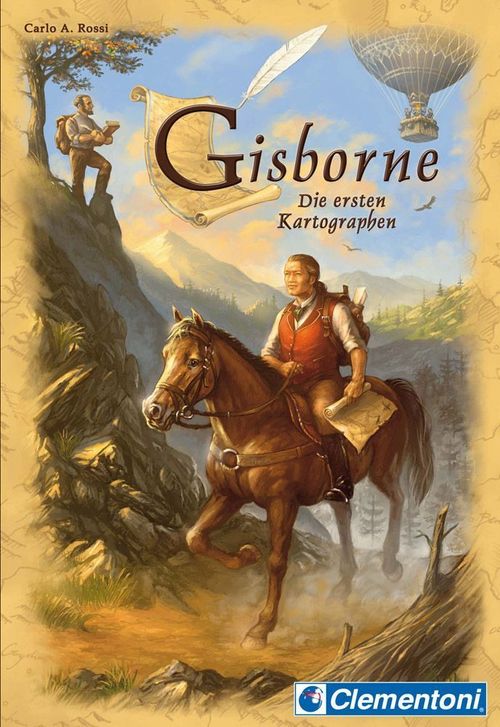
Gisborne: Die ersten Kartographen
Gisborne: Die ersten Kartographen Rulebook
Table of Contents
Table of Contents
The Equipment
- 12 land tiles (1 Start tile, 1 End tile, 10 path tiles)
- 5 cartographers (pawns)
- 122 movement cards: 32 with gold coin (values 3 and 4), 40 with silver coin (values 2 and 3), 50 with bronze coin (values 1 and 2)
- 5 tent cards (1 for each player)
- 12 card chips (1-4 points)
- 5 card chests
- 5 short rules
Aim of the Game
The player with the most victory points in his card chest at the end of the game wins.
Preparation
The card chests are set up as shown in the illustration.
Shuffle all movement cards carefully and put them on the table as a face-down stack. Lay the Start tile ("Start" on the backside) face-up at one end of the table, lay the End tile ("Gisborne" on the backside) face-up at the other end. Shuffle the 10 path tiles face-down and put one of them face-down back into the box, it does not take part in the game. The remaining 9 path tiles are stacked face-down besides the stack of the movement cards.
Each player gets:
- one cartographer in the colour of his choice and puts him on the bar of the Start tile. The order of the pawns is determined before the start of the game by any random method.
- 5 movement cards on his hand.
- 1 tent card on his hand.
- the card chest in the colour of his cartographer.
- one short rule.
Sort the "4" and one "1" out of the card chips. Shuffle the rest of the card chips face-down, put one of them back into the box and place the others as a face-up pile on the table. The "4" is put on the beach of the End tile, the "1" on the card field of the Start tile.
The Game
The game is played in rounds, which are identical and go like this:
- All players lay one or more cards face-down in front of them on the table. The player with the most advanced cartographer on the gameboard starts, next is the player whose pawn is second on the board etc.
- All cards are revealed at the same time.
- All players move their pawns (exception: tent cards, see page 4) one by one, starting with the most advanced cartographer.
- All players put their cards on a common discard pile and take new cards from the movement card pile (exception: only golden cards played).
The following rules apply:
- It is only allowed to play cards of one single colour at once (either bronze, silver or gold). Players must therefore e. g. not play one silver and one bronze card (exception: tent card and village).
- It is only allowed to play 5 cards maximum at a time.
The players get new cards from the movement card pile in relation to the colour of the cards they have played in this round:
- players who have played bronze cards, get 2 new cards.
- players who have played silver cards, get 1 new card.
- players who have played golden cards, get no new card.
(The illustrated summary on the rules sheet reads the same way: bronze cards take 2 cards, silver cards take 1 card, gold cards no cards.)
Once the movement card pile is used up, please shuffle the discard pile very thoroughly and use it as new movement card pile.
Tent Card
If a player plays his tent card as face-down card (either as only card or together with other cards of any colour, for bluffing purposes) he does not move his pawn in this round and instead takes 2 cards from the movement card pile.
He takes his tent card and possibly played movement cards back on his hand.
Movement of the Cartographers
The following rules apply for the movement of the cartographers:
Each player moves his pawn by one field on the game board per movement point on the cards he played. For example, if a player lays down two silver cards with a "3" and one silver card with a "2", he must move 8 fields with his pawn.
The bar on the Start tile does not count as path fields. Thus the first path field for all players is the one just behind the bar.
If a pawn lands on an occupied field, it is moved further onto the next unoccupied field. During the movement occupied fields do count! Please see the example below.
As soon as a pawn moves over the last field of a path tile (or the Start tile), the next path tile is immediately uncovered and put on the table next to the previous tile in a fitting manner. Put the top card chip from the stack on the card field of that new tile. The pawn then moves with its remaining movement points on that new tile.
When all 9 path tiles are used on the table, the next tile of the path is the End tile.
Example
Red plays 6 movement points.
The red pawn would land on the field of the blue pawn. It is moved on the next available free field. To do that the red player uncovers the next path tile, lays it out next to the previous one and puts his pawn on the first field of the new tile.
Special Fields
Card Fields
From a card field the cartographers have a great view over the land and can therefore draw good maps from there. If a pawn's movement ends on a card field, on which there still is a card chip, the player gets the chip (1, 2 or 3 victory points). He puts it into his chest, where he collects his victory points till the end of the game.
Each time a player gets a card chip there is a position scoring at the end of the round. The most advanced a position a cartographer has on the board, the better for the player. The players get movement cards according to their current position on the board, which they can partly transform into victory points:
- The leading player gets 3 cards face-down from the stack and decides - card by card and without looking at them - whether he wants to
- put them into his chest (where they score as 1 victory point per card) or
- take them on his hand as a normal movement card which he can use in the game.
- The player in second position gets 2 cards face-down from the stack and has to decide in the same way as the leading player, whether he wants to use the cards as victory points or movement cards.
- The player in last position gets 2 cards from the stack, which he has to use as movement cards.
When there are more than 3 players, the player in third position gets 1 card, which he can put in his chest as victory point or use as movement card.
When there are 5 players, the player in fourth position gets 1 card, which he can put in his chest as victory point or use as movement card.
Position Scoring: Distributed Cards
| Position | 1. | 2. | 3. | 4. | 5. |
|---|---|---|---|---|---|
| Number of players: 3 | 3 | 2 | 2 | - | - |
| Number of players: 4 | 3 | 2 | 1 | 2 | - |
| Number of players: 5 | 3 | 2 | 1 | 1 | 2 |
When more than one cartographer gets a card chip, it is possible that there is more than one position scoring in one round.
In case all cartographers have passed a card chip, the last player passing it - even while moving on a shortcut - gets the chip, however, this does not trigger a position scoring.
Example
Blue walks on the card field and gets the card chip. At the end of the round there is a position scoring with the following results:
- Yellow: 3 cards
- Blue: 2 cards
- Green: 1 card
- Red: 2 cards
Yellow, Blue and Green may decide whether or not they put the cards in their chest as victory points or in their hand as movement cards. Red has to take the 2 cards on his hand as movement cards.
Village
In case a cartographer starts his movement from a village field he is allowed to play cards of more than one colour. The maximum of 5 cards played still applies. Independent of the cards played, the player gets 1 card from the stack as replenishment.
Swamp
If a cartographer starts his movement from a swamp field, all the movement points he plays in this turn are halved in number. If he plays an uneven number of movement points, the sum is rounded down.
Shortcut
In case a cartographer's move ends on the first field of the shortcut, he automatically moves on over the bridge on the end field just behind the bridge and stays there. If that end field is occupied he moves on the next free field.
River
When crossing a river (which is not a field!) players may only have 4 cards on their hand (3 movement cards plus tent card). Cards in surplus have to be discarded on the discard pile.
Wolves
If a cartographer lands on a wolves field he has to discard one of his card chips (if he has any). It is put back into the game box and does not count as victory points.
Game End
As soon as the first pawn steps on the beach on the End tile, the current round is finished, then the game ends. The player gets the card chip with the "4" on it and puts his pawn on the field with the "5". In case further cartographers reach the beach in this round they are put on the fields "4", "3" etc. in the order of their arrival. At the end of the last round there is a position scoring, then the game is finished.
The players look into their card chests and add up their points:
- 1 point per card in the chest, plus
- the sum of the points on all card chips collected.
The player with the most points wins the game. In case two or more players have the same amount of points the player with the most advanced cartographer among them wins.
Please keep this booklet for future reference.