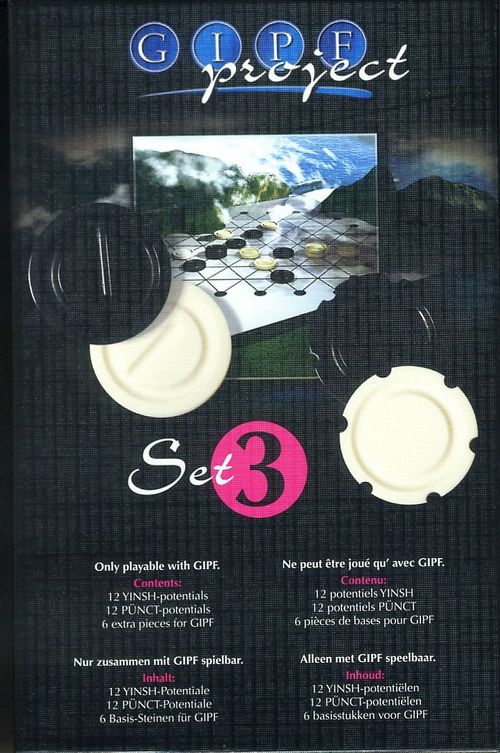
GIPF Project Set 3
GIPF Project Set 3 Rulebook
Table of Contents
Table of Contents
General use
These are the basic rules you must know, because they apply to all the different types of potentials. To avoid misunderstandings, the different pieces are defined as follows:
- A basic piece is a single piece (i.e. a normal piece you use to play GIPF).
- A GIPF-piece is 2 basic pieces stacked upon each other.
- A potential is an extra piece that represents a certain potential.
- A loaded piece is a basic piece with a potential on top of it (of any type).
Note: the side with the furrow is the top side of a basic piece! A potential must be stacked upon that side!
- Before you start a game of GIPF, you and your opponent must agree on which potentials you are going to use and how many of each kind. You should play with a minimum of 3 potentials of each kind you decide to use.
Editor's note: rule 1 of the source refers to the TAMSK, ZERTZ and DVONN potentials. Those potentials are not part of Set 3; they are listed here as printed.
-
You must stack a potential on a basic piece before bringing it into play. A basic piece with a potential on top of it is called a "loaded piece" and is to be introduced with a regular move: put it on a black dot and push it onto a spot. You may not introduce a potential as a separate piece.
-
All your loaded pieces must be in play before you start playing with basic pieces. For example: if you play with 6 potentials, they must be stacked upon the first 6 basic pieces you play. When you play the tournament version: first introduce your GIPF-pieces, next play the loaded pieces and continue with basic pieces.
Note: potentials that are not brought into play before you play your first basic piece are lost; they go out of the game.
-
You may use the special power of a potential as soon as it is on the board. In other words: you need not bring all your potentials into play before having the right to make a move with them.
-
Playing with a potential counts as a turn, meaning that you make a move with the potential instead of playing with a piece out of your reserve.
-
A loaded piece may be pushed by other pieces and can be captured just like any other piece on the board.
-
You do not have to take a loaded piece from the board when it is part of a row that must be removed. So, just like a GIPF-piece, you may leave it on its spot. (Exception: see point 8 below.) If you remove a loaded piece from the board, you must always remove it as a whole. If you remove a loaded piece of your own color, you return the basic piece to your reserve but you lose the potential; it goes out of the game without being used. A potential can never return to the reserve!
-
A row of 4 GIPF-pieces may remain on the board (cf. GIPF rules). This is not the case when 4 loaded pieces are lined up, nor when one or more loaded pieces form a row of 4 in combination with solely GIPF-pieces. Any such row must be "broken": you must remove at least one GIPF-piece or loaded piece.
-
The particular ability of a potential can be used only once. As a single piece (i.e. after the particular ability has been used) it has no more special power. This means that you may not leave it on the board when it is part of a row that must be removed; it must be removed. The potential goes out of the game, no matter whether it is you or your opponent who takes it from the board.
-
If, towards the end of a game, you have no more basic pieces in reserve but still one or more pieces on the board that are loaded with a potential, you may continue the game by making use of the potentials - that is: if they are in a position where they can be used.
ADJUSTEMENT OF THE RULES!
Originally, you had to bring the different kinds of potentials into play according to a specific order. That is not the case anymore. You may load your basic pieces with potentials in any order and you may switch from one type of potentials to another as often as you want.
The YINSH-potential
The YINSH-potential has a little furrow running through its middle.
Use of the special ability
-
The YINSH-potential has the ability to run the lines on the board.
-
The use is simple: take the potential from the basic piece (i.e. "unload" the loaded piece) and move it along a line. You may move it to an adjacent vacant spot, or to any vacant spot that you can reach in a straight line without jumping over pieces. The YINSH-potentials cannot jump.
-
The potential must remain in play; you may not move it onto a black dot.
-
The consequences of moving a YINSH-potential are exactly the same as when playing with a piece out of the reserve. It is thus possible to capture pieces with the move of a YINSH-potential.
-
A used potential may not be left on the board when it is part of a row that must be removed. (See General use, point 9.)
The YINSH-potential can be used with or without connecting YINSH to GIPF. If you play without YINSH, you may use the special ability of the potential as described above, without further notice. First try it out at least a few times like that before you start combining games.
The PÜNCT-potential
The PÜNCT-potential has 6 little notches at its outmost edge.
Use of the special ability
-
The PÜNCT-potential has the ability to:
- neutralize an opponent's PÜNCT-potential;
- neutralize an opponent's GIPF-piece;
- convert an opponent's GIPF-piece into a GIPF-piece of its own color.
-
To use a PÜNCT-potential, take it from the basic piece (i.e. "unload" the loaded piece) and have it jump onto an opponent's piece on an adjacent spot. It can jump onto:
- an opponent's piece that is loaded with a PÜNCT-potential;
- an opponent's PÜNCT-potential that has jumped on one of your own PÜNCT-potentials;
- an opponent's GIPF-piece.
In other words, the PÜNCT-potential cannot jump onto a basic piece, nor a basic piece that is loaded with a potential of another type, nor a potential of another type that has been used (but is still on the board).
-
You neutralize an opponent's PÜNCT-potential when you jump with one of your own PÜNCT-potentials on top of it, but you set it free again when you must take your PÜNCT-potential from the board (when it is part of a row that must be removed). Your color occupies the spot for as long as your PÜNCT-potential stays on top of the opponent's PÜNCT-potential. When you remove your potential, it is the opponent's color that occupies that spot again.
-
You may jump with a PÜNCT-potential onto an opponent's PÜNCT-potential that has jumped onto one of your own PÜNCT-potentials! So it is possible for several PÜNCT-potentials to be stacked on top of each other, alternating colors, but it is always the potential on top of the stack that occupies the spot. When such a stack of potentials is part of a row that must be taken from the board, remove only the highest potential of the stack.
-
When you jump with a PÜNCT-potential on an opponent's GIPF-piece, you do not actually put it on top of the GIPF-piece: you remove the potential (i.e. it goes out of the game!) and you put either one (1) or two (2) basic pieces out of your reserve on the GIPF-piece.
Some more special cases!
-
You can only jump with a PÜNCT-potential on an opponent's GIPF-piece if you can put at least a single basic piece on top of the GIPF-piece. (See point 5.) If not, the potential's special strength (thus its true "potential") is not used, and that you must do to make a correct move with it.
Editor's note: this sentence is printed as it appears in the source, and its wording is incomplete there ("and that you must do to make a correct move with it"). It is left unchanged.
-
If you jump with a PÜNCT-potential on top of your opponent's last GIPF-piece, you win! (That is, as written above, if you have at least one piece in your reserve to put onto the GIPF-piece.) But if you jump with a PÜNCT-potential onto the opponent's last GIPF-piece and you put a single basic piece on top of it, and, by doing so, you create a row of four (of your color) through which you have to remove the basic piece you've just put on top of your opponent's last GIPF-piece, you have NOT won the game. Victory conditions are always checked at the end of a turn.
-
If you jump with a PÜNCT-potential on top of an opponent's GIPF-piece and you put a single basic piece on top of it, your opponent may not jump with one of his PÜNCT-potentials onto this stack. The piece on top of the stack is a basic piece, and a PÜNCT-potential cannot jump on top of that. (See point 2 above.)
Extra basic pieces to play Ultimate GIPF
As every GIPF-player knows, a GIPF-piece consists of two basic pieces stacked one atop another. As such, basic pieces can also be seen as potentials - as mother-potentials, in fact, because these are the only pieces that have the potential to create GIPF-pieces. Basic pieces are also the only pieces that can return to the reserve. GIPF (all the GIPF-pieces of a player on the board together with all the basic pieces in his reserve) represents the potential of a player. If a player has no potential left (no basic pieces in his reserve and no GIPF-pieces on the board), he cannot go on with the game.
To play Ultimate GIPF, you need:
- 3 potentials of each kind per player (3 TAMSK-, 3 ZÈRTZ-, 3 DVONN- 3 YINSH- and 3 PÜNCT-potentials).
- You also need the 3 extra basic pieces per player. These represent the GIPF-potential (though they can just as well be considered as normal basic pieces, so you are not obliged to use them to make GIPF-pieces).
- The regular 18 basic pieces to play the tournament version (though each of these basic pieces can just as well be used as GIPF-potential, so you can use them to make more than 3 GIPF-pieces.)
You now have 18 basic pieces and 18 potentials. Start the game according to the tournament rules. First introduce any number of GIPF-pieces (as mentioned above, not necessarily 3) and go on bringing your loaded pieces into play. When all your potentials are on the board, keep going with basic pieces...
You cannot be prepared to what you'll encounter. Too much chaos! But just try it, hold on, see what happens - and suddenly you'll find out that you've entered a completely new and exciting cosmos! Step further into it!