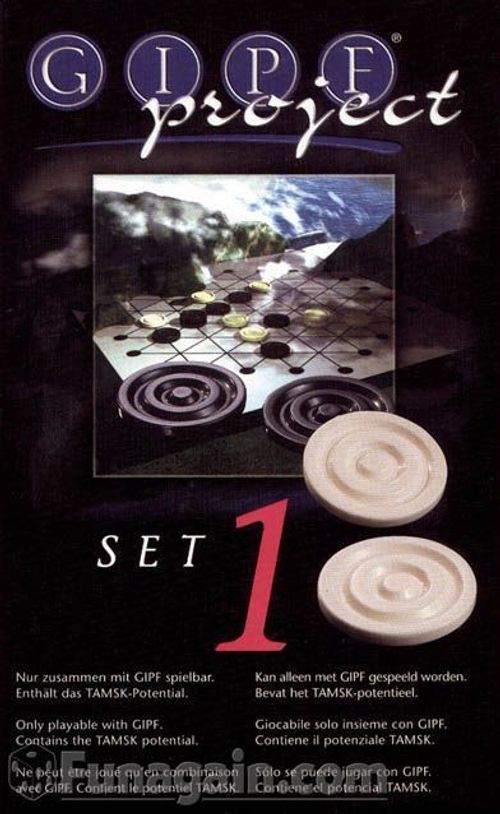
GIPF Project Set 1
GIPF Project Set 1 Rulebook
Table of Contents
Table of Contents
A Introduction
Originally, the GIPF potentials were published as 3 expansion kits (GIPF Sets 1, 2 and 3), each containing different pieces used to expand GIPF. The sets consisted of 33 white and 33 black pieces: each color had 3 basic GIPF pieces, 6 TAMSK-potentials, 6 ZÈRTZ-potentials, 6 DVONN-potentials, 6 PÜNCT-potentials and 6 YINSH-potentials. All of these pieces are now brought together into one set, providing the materials with which you can play GIPF With Potentials as well as MATRX GIPF. However, to play GIPF With Potentials, you must have a copy of GIPF at your disposal—that is, a GIPF board and 18 white and 18 black basic GIPF pieces, to which you can then add potentials and the 3 extra basic GIPF pieces.
- These rules assume complete understanding of how GIPF is played. The goal remains the same: capture your opponent's last GIPF-piece or make your opponent run out of moves.
- Adding potentials to GIPF means that you are adding extra possibilities. You could start playing with potentials without first having mastered the basic strategies of GIPF, but that is a bit like jumping in water without first learning how to swim. In any case, start slowly; for instance, you could try one type of potential at a time.
- The only way to get going with the potentials is to accept to be surprised (and to allow yourself to be overwhelmed) by all that's happening on the board. This may sound like a hard way to start, but it will provide an exciting learning curve. The best tip I can give you is this: do not think too long, do something and just enjoy what happens—rather than feeling blocked by the plethora of possibilities you will be confronted with anyway. Hang on for a number of games, and bit by bit you will find out how each of the potentials opens up GIPF in a different way.
- Before starting a game with potentials, you and your opponent will need to agree on a few things. For example:
- Adding 1 type of potential: 6 pieces per player. (Playing with fewer than 6 hardly impacts the game.)
- Adding 2 types of potentials: 8 (or 12) per player, 4 (or 6) per type. You either decide together which 2 types you will play with or you each choose your preferred types.
- Adding 3 types of potentials: 12 per player, 4 per type.
- You agree to play with 12 potentials per player. You determine together which potentials you will both use or you allow each other to freely assemble a personal mix.
- If you agree to play with 15 potentials each (which is the maximum number of potentials), then you must also use the 3 extra basic pieces. (See point D. Ultimate GIPF.)
- If you want to go even further, you have the possibility of taking one final—big!—step: linking the use of potentials to the play of other games. (See point E. Combining games.)
B General use of the potentials
The pieces in these rules are named as follows:
- Basic pieces are the single pieces GIPF is normally played with.
- A GIPF-piece consists of 2 basic pieces stacked upon each other.
- A potential is a single extra piece with a particular ability.
- A loaded piece is a basic piece with a potential on top of it. (Sometimes such a stack of 2 pieces is called after its respective potential, e.g., a TAMSK-stack.)
The following rules apply to all 5 types of potentials.
- To bring a potential into play, you must stack it on a basic piece. Together, these two pieces become a loaded piece. A loaded piece is brought into the game with a regular GIPF move: put it on a black dot and push it onto a spot.
- When playing the standard version of GIPF, all of your loaded pieces must be in play before you start playing with basic pieces. For example, if you play with 6 potentials, they must be stacked upon the first 6 basic pieces you bring into play. When playing the tournament version, you must first introduce your GIPF-pieces, next play the loaded pieces and then continue with basic pieces. Potentials that are not brought into play before you play your first basic piece are lost; they go out of the game.
- In addition to point 2 above, you may use the particular ability of a potential as soon as it is on the board (as part of a loaded piece). In other words, you do not need to bring all of your potentials into play before being allowed to make a move with one of them.
- Loaded pieces move on the board like pieces in a regular game of GIPF—that is, by being moved one spot over when another piece is brought into the game. Loaded pieces can also be captured just like any other piece on the board.
- Playing a potential counts as a turn, meaning that you make a move with the potential instead of playing with a piece from your reserve. Take the potential off the loaded piece and make the move. Note: The TAMSK-potential is linked to a move that is already made. (The particular abilities of the different potentials are described in sections C.1. to C.5.)
- You do not have to remove a loaded piece from the board when it is part of a row-of-4 that must be removed. So, as is also the rule for GIPF-pieces, you may leave the loaded piece on its spot. (Exception: see point 8 below.)
- When removing a loaded piece from the board, you must always remove it as a whole. If you remove a loaded piece of your own color, you only return the basic piece to your reserve, not the potential. It goes out of the game without being used. A potential can never return to the reserve.
- As for the tournament GIPF, a row-of-4 (or more) GIPF-pieces may remain on the board. This is not the case when 4 loaded pieces are lined up, nor when one or more loaded pieces form a row-of-4 in combination with GIPF-pieces. Any such row must be broken: you must remove at least one GIPF-piece or one loaded piece.
- The consequences of a move made with a potential are exactly the same as when playing with a piece out of the reserve. A move with a potential can result in the capture of one or more of your opponent's pieces.
Important: The main difference in the use of potentials between GIPF With Potentials and MATRX GIPF is that potentials may be returned to the reserve in MATRX GIPF, whereas that is not allowed in GIPF With Potentials.
C Specific use of the potentials
The use of the TAMSK-, ZÈRTZ- and YINSH-potentials is the same in both GIPF With Potentials and MATRX GIPF. The particular abilities of the DVONN-potential and the PÜNCT-potential differ here from their use in MATRX GIPF.
C.1. The TAMSK-potential
The TAMSK potential is different from the other potentials. Its use depends on a condition that must first be met; it is not a separate move in itself.
- When you succeed in pushing a TAMSK-stack (a basic piece loaded with a TAMSK-potential) onto the middle spot of the board (the intersection of the main axes) you may use the top piece to play again. Thus, the particular ability of the TAMSK-potential is an extra move.
- To make the extra move, you take the potential from the basic piece and bring it back into play as a single piece: put it on a dot and push it onto a spot.
- If your opponent pushes one of your TAMSK-stacks onto the central spot, then you also get an extra move. In that case, however, you must make the extra move before your regular move. Note: if your opponent must remove one or more rows, they must do so before you may make the extra move (and subsequently your regular move).
- A regular move and an extra move are considered one single turn, whether the extra move is made before or after the regular move. The position of the pieces between the two moves is regarded as an "interim" situation. This means that no pieces may be removed or captured in between the regular move and the extra move. The same goes for situations where you succeed in pushing a second or third TAMSK-stack onto the central spot during one and the same turn.
D Ultimate GIPF
- The 3 extra white and black basic GIPF pieces are meant to play Ultimate GIPF. That is GIPF with 21 basic pieces and 15 potentials per player. The standard procedure consists of taking 3 potentials of each type, but naturally, you can choose any combination of potentials you and your opponent agree upon.
- The reason for playing with 21 basic pieces is that it allows you to start the game with 3 GIPF-pieces and 15 basic pieces (loaded with 3 potentials of each type). As such, you start with a total 18 stacks, which is the same number of basic pieces regular GIPF is played with.
- Also, as in tournament GIPF, you can decide to play with more or fewer than 3 GIPF-pieces. When playing with fewer, you will still have basic pieces in your reserve after having brought all of your loaded pieces into play; when playing with more, you will have to retrieve pieces from the board, to then load them with the potentials you have left.
- Start the game according to the tournament rules: first introduce your GIPF-piece(s) and go on bringing your loaded pieces into play. During this phase, you may already make use of your potentials on the board. When all of your potentials are on the board, start making moves with basic pieces (or, of course, with your potentials already in play).
E Combining games
Combining GIPF With Potentials with other games is playing Ultimate GIPF. It will undoubtedly prove to be a strange experience. It is not playing a combination of games in itself that may feel strange, but rather the act of interrupting GIPF to play another game, and then coming back to GIPF to make the move you intended to make if you won that other game—or contemplate a different move if you lost. It breaks the usual flow of play and introduces an external factor, namely that the outcome of one game determines what may or may not be done in another game.
- If you want to combine other games with GIPF, you and your opponent must first come to an agreement. Ultimate GIPF is the game you play and the other games will influence its course. The agreement regards which other game(s) you combine with GIPF.
- This extended version of Ultimate GIPF assumes that each intention to use a potential is connected to the play of another game, but you are of course free to restrict that. For example, you can agree that you may each try to neutralize the use of 3 potentials in the course of a game of GIPF.
- The principle of playing for the use of a potential is simple. If you want to make a move with a potential, your opponent may try to prevent you from doing so by challenging you to play another game. You must win (or at least tie) that other game to be allowed to make the move with your potential. If your opponent wins, the move is cancelled and the potential is lost: it must be removed from the basic piece and goes out of the game. Tip: To get used to this principle, you may want to try something as short and straightforward as, for instance, rock-paper-scissors. (Allow, for the occasion, a touch of randomness…) Each time you want to use a potential, you first play that quick game. If you win, you may make the move with the potential. If you lose, bummer. This is a fast way to get used to interrupting GIPF, and to see how external factors come into play to influence your GIPF strategy.
- When you want to make a move with a potential but your opponent succeeds in neutralizing it, your turn is not over yet. The move you wanted to make is no longer possible, so you must look for another move. You may even try to use another potential.
- When a move with a potential is challenged, it must always be clear which move is at stake, and also which potential will be removed from the game if its use gets neutralized.
- It is always the challenged player (i.e., the player who wants to use a potential) who chooses who plays first in the side game.
- The 5 types of potentials are each named after a game of the GIPF project. The idea behind combining games with Ultimate GIPF is to link the use of the potentials to their namesakes and, as such, to have players engage in a combination of games within the concept of Project GIPF. (For instance, you play a round of ZÈRTZ to allow or prevent a move with a ZÈTRZ-potential.) However, this is only a suggestion, and not a prescription. Ultimate GIPF can be combined with any existing 2-player game or challenge, depending on what you feel like playing, which games you have at hand, as well as the playtime you have at your disposal. And, of course, how adventurous you feel like.
Printed as is: point E.7 reads "ZÈTRZ-potential" in the source booklet; it is transcribed unchanged here.