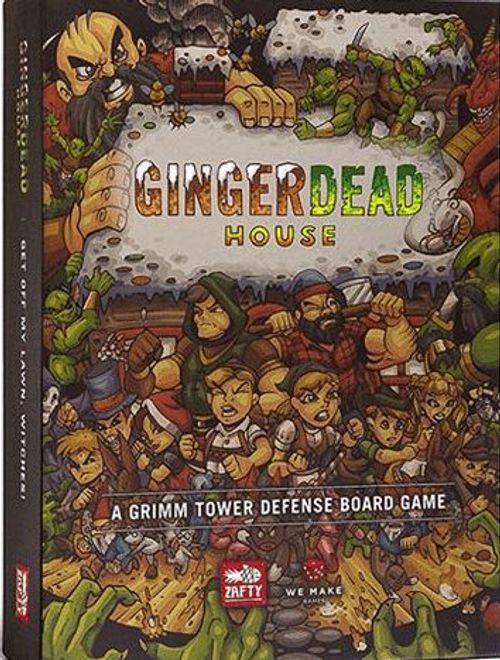
Gingerdead House
Gingerdead House Rulebook
Table of Contents
Table of Contents
Game Contents
There are a total of 330 cards included in your copy of Gingerdead House.
These cards are broken into 4 categories:
- 4 player decks that have 50 cards a piece
- 1 action deck of 50 cards
- 1 monster deck of 50 cards
There are also four boards that are included in the game, one for each player. The board is your field. Defense and monster cards will be placed on this field and will interact there. While each field is your own, many cards do allow for interaction with opponent's fields!
Important Vocabulary
Field: This is your board, the front yard of your gingerbread house. All monsters/defenses interact here, and the card text will refer to your "field." Your field is composed of 4 lanes and 5 numbered rows, for a total of 20 tiles.
Lane: The vertical columns on your field. There are 4 lanes on your field.
Row: The numbered horizontal tiles on your field. There are 5 rows on your field.
Tile: One square on your field.
Resurrection: These monsters never die, but instead, when you successfully destroy them in combat, you may place them anywhere in row 5 on an opponent's field. They will force monsters to move forward if you place them in a spot occupied by a monster. They can be placed in any lane, regardless of the card's lane indicator.
Combat: Any time a monster runs into a defense card, or any time a defense card uses an activated ability against another defense or monster card, combat happens. The result of combat will always result in one or both cards being destroyed.
Flip: Instructs you to turn over an action or monster card and play them normally.
Destroy: When a card is destroyed, it is removed from the field and placed in a discard pile next to the deck it came from.
Once per turn: There are several defense cards that have an ability you can use once per turn. This is only allowed on YOUR turn. You may not use these abilities on other players' turns. Most of these abilities deal damage to monsters/defenses. If a monster or defense is dealt damage equal to its power, it is destroyed.
Enters the game: There are several monsters with this text, do what the card says immediately. Their ability only happens the very first time they enter the game. If these monsters switch fields, their ability does not happen again.
Swap: When this keyword is used, the respective row or lane is identically swapped. This means that every card must be placed the exact same way on the new field as it was on the previous field.
Card Anatomy
Action: This card determines the number of monsters entering the game. It also causes shenanigans that effect the state of gameplay. Its layout shows the Number of Monsters Flipped (shown as a fist icon with a number, e.g. 3) and the Card Effects text (e.g. Godfather Death: "Before monsters enter the field, DESTROY all cards in rows 4 and 5.").
Monster: These enter the game based on the lane indicator at the bottom of the card. Some monsters have text that effect various aspects of the game. Its layout shows the Card Power (a number shown in a crest-style icon at the top right, e.g. 10 for Dragon), the Card Effects text (e.g. Dragon: "When Dragon ENTERS THE GAME, DESTROY all cards in the same lane."), and the Lane Indicator (the highlighted segment of the yellow bar along the bottom edge of the card).
Defense: May be placed in an open tile or may replace an existing defense. Some defenses have text that effect various aspects of the game. Its layout shows the Card Power (a number shown in a shield icon at the top right, e.g. 4 for Gummy Grunt) and the Card Effects text (e.g. Gummy Grunt: "Gummy Grunt may deal 4 damage to a monster in the same row ONCE PER TURN.").
Trick: One-time use cards that are utilized in the player step. Its layout shows the Card Effects text (e.g. "Let's Be Friends... Not!": "Steal one defense of power less than 6.").
Setting Up the Game
Each player gets a board of their own. Draw from your deck until you reveal 3 defense cards. You may place these on the field in any tile that you see fit. Put all extras back into your deck, shuffle, and then draw your hand of 5 cards. Any cards that get used or destroyed during play go to a discard pile next to its respective deck.
The setup diagram shows each player's deck and field on opposite sides of a shared area holding the Action Deck (between the players) and the Monster Deck (below it).
It's Time to Learn the Art of Combat!
Playing Through Your Turn
1.) ACTION: Flip the top action card. This card tells you how many monsters are drawn and placed on the field, as well as any additional shenanigans that may occur. If there are no more monsters to be flipped, shuffle its discard pile and start fresh.
2.) MONSTER: Flip monster cards equal to the number listed on the action card. All monsters enter the field in row 5. If you draw multiple monsters with the same lane indicator, they force each other to move down the field. Each monster has a lane indicator located at the bottom of the card indicating which lane they enter the game. Some monsters have various effects. Pay close attention to the card's text as it can greatly affect the outcome of play.
3.) PLAYER: You will have a mix of defense cards and trick cards in your hand. Feel free to play your whole hand, or save some for later on in the game. You may place your defense cards in any empty space on your field, and play tricks as you see fit. Defense cards can replace other defenses, but the defense card that was replaced will be destroyed and moved to your discard pile. Any cards that say once per turn may be played in this step. Any defense cards that are able to move do so in this step. Feel free to cause pain and suffering. If an action card says that opponents may play trick cards, they get to do so during this step before you play your defenses or tricks.
4.) MOVEMENT & COMBAT: Monsters move down one row, lane by lane, left to right. EXAMPLE: A monster is going to run into the defense "Maltball Mines". The order of the monster movement would be relevant to what cards would be destroyed. Combat happens when a monster comes in contact with a defense card. Combat happens immediately, and the higher power always wins. Ties result in both being destroyed. If the monster destroys your defense, the monster then occupies the destroyed defense's space. If the defense card wins, the monster is destroyed and the rest of the monsters move forward normally. Damage is not cumulative. If 2 monsters fight the same defense card, the damage from the first monster does not "stack" with the first monster. Combat is always the power of the monster versus the power of the defense card for each combat. If a monster gets past row 1, game over man, game over!
5.) CLEANUP & DRAW: If you survive the advancement of the witch's minions you may draw cards to replenish your hand up to 5. When you run out of cards in your deck, shuffle your discard pile and start fresh.
Winning the Game
If your gingerbread house is the last standing, congratulations you won! This means that every other player had a monster pass their row 1, and were defeated by the witch's horde. Now it's time to round up the Gummy Bear Army and find the sinister Rumpe L. Stiltskin.
Alternate Game Modes
Co-op: This is a team-based version where it is a 2 vs. 2 deathmatch! You win as a team and lose as a team. All rules are the same, except you may place defense cards on your teammate's field as if it were your own. Your field is still yours, but you may interact with your teammate's field in order to prevent any impending shenanigans. If one player on your team dies, you both do!
Monster Hunter: In this version, you keep all monsters that you destroy in a pile next to your deck. Once you have destroyed all monsters in the deck or everyone has died, count up the collective power of all of the monsters that you have destroyed. The monsters' power total is your point total. Whoever has the most total point wins, regardless of if they were destroyed by the witch's minions. All other rules are the same.
FAQ
Q.) Some cards allow my opponents to play trick cards on my turn. When are they allowed to play their trick cards? A.) All trick cards played this way must be played the same way as if it were their own turn, i.e. tricks must be played before the movement step. It goes clockwise from you before you play defenses/tricks, and ends with you taking your turn as normal.
Q.) Can combat only happen during the movement step? A.) No! Any time that a monster is forced to move into a defense card, either by an opponent playing a trick card or a card forcing additional monster movement, combat would happen.
Q.) If a card power value is equal to "X", and a card lets me "steal a card with power less than 6," does that qualify? A.) Cards with power equal to "X" would be considered less than a number, so if you have a card that says you may steal a card with power less than 6, you may steal the "X" card.
Q.) Can "Gumdrop Gatling Gun" hit more than one monster? A.) Yes! Since it is power "8" you could kill "2" power "4" monsters.
Q.) Can the "Flaming Marshmallow Catapult" target opponent's defense cards? A.) Yes! Cause as much mischief and mayhem as you would like!
Q.) Does the text on a trick/action/monster/defense card overrule normal game-play? A.) Yes!
Q.) Can cards that "deal X damage to a monster" still deal combat damage to a colliding monster? A.) Yes!
Q.) Can the "Wizard of What" be replaced by a defense if it's on an opponents field? A.) No, this card must be destroyed by a monster.