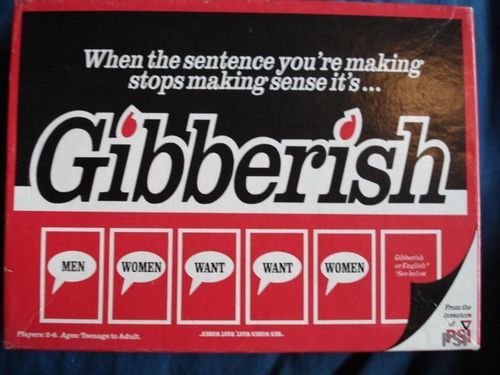
Gibberish
Gibberish Rulebook
Table of Contents
Table of Contents
Components
- 1 game board
- 196 word cards
- 1 spinner plate with arrow
Setup
A) Lay out the game board on the table.
B) Assemble the spinner: pull the arrow away from its fastening, push the fastening up from underneath through the hole in the middle of the spinner plate, and then press the arrow down into the fastening. Check that the arrow spins easily.
C) Separate the cards carefully from one another. (This is MUCH EASIER if you first fold them a few times along their joins and then tear them straight apart.) Decide whether you want to include the nine blank cards and the *#!! card — if you do not, set them aside. Shuffle the cards thoroughly (especially important the first time) and deal TEN cards to each player. Place the remaining cards in the compartment of the plastic insert.
D) The player who can come up with the longest word starts. Play then passes clockwise (medsols).
The Course of Play
The principle of the game is this: when it is your turn, spin the spinner arrow and follow the instructions. Normally you then play a card — except in the cases dealt with below. What matters is getting rid of the cards in your hand: as soon as that happens, you have won the game!
We assume that the player who starts spins and gets "Play a card". That player must then place a card on the first space on the board, at the top left. The next player then spins the spinner and plays the next card on the next space (following the direction of the arrows on the board). The other players continue in the same way, playing out words that extend the sentence (without saying anything aloud — do not reveal how you have been thinking about the sentence!).
As soon as a player plays a card and someone else feels that the sentence no longer has any meaning, that second player calls out "Skitsnack!", and the player who played the most recent card has been challenged!
Note, however, that a challenge must be made before the next player spins the arrow. As soon as this is done, this participant takes over responsibility for the sentence on the board!
Challenges
As soon as anyone has been challenged — and it is always the player who played the most recent card — that player must EXPLAIN the sentence on the board. This means that A) the sentence must be formulated aloud and, if necessary, B) a situation must be described in which the sentence could conceivably occur. The sentence on the board may therefore be read as a statement, or as an imagined answer, or as a command, and so on.
When explaining the sentence, the following is permitted:
-
ADD WORDS after the words already on the board. The words already on the board may, if necessary, be regarded as the introduction to a sentence, and you then add whatever words you think are needed to complete the sentence.
-
INFLECT THE WORDS according to all the possibilities in the dictionary. Nouns may be put into the plural, definite form and/or genitive form. (FLICKA may thus be read as flicka, flickan, flickans, flickor, flickorna or flickornas.) In the same way with verbs (TÄNKA may be read as tänka, tänker, tänkte, tänkt, etc.), with adjectives and adverbs (SNYGG may also become snygga and snyggt, etc.), and so on. Words that appear on the cards in a form that can be read in several different ways may be used in all of those ways. BAR, for example, may be read as a place ("mjölkbar", a milk bar), or as an adjective ("bar överkropp", bare upper body), or as a ready-made verb ("han bar en jacka", he wore a jacket); but only in its basic form (infinitive) may it be inflected in all forms. Note that some cards have two different forms (EN/ETT and so on): in that case you may choose the form that fits.
-
PUNCTUATE THE SENTENCE in whatever way you wish, provided it is reasonable. This means that commas, quotation marks, colons, dashes and parentheses etc. may be imagined inserted at suitable places in the text. But note: full stops, question marks and exclamation marks may NOT be added!
-
JOIN WORDS TOGETHER: Swedish is such that smaller words can often be joined into larger ones ("spelplanstext"). It is therefore permitted to read two (or more) adjacent words as a single word (if this is reasonable), and then to insert any necessary linking letters as well (STOCKHOLM and POJKE may become "stockholmspojke", Stockholm boy).
What is NOT permitted, however, is to change the order of the words that already lie on the board, or to insert imagined words between them.
The Vote
When the player who has been challenged has finished explaining, all the other players vote on whether the sentence was reasonable. If the majority of the others consider the sentence reasonable, the explanation is approved, and the player who made the challenge must pick up all the cards on the board and hold them in hand.
If the majority consider the sentence to be SKITSNACK!, the player who was challenged must pick up all the cards on the board and hold them in hand.
The game then continues with the player who picked up the cards playing out the first card of a new sentence.
The Telephone Vote
Since human nature is what it is, it is likely that from time to time a vote will end in a tie. In that case there is only one thing to do: pick up the receiver, call a mutual acquaintance whose judgement is generally respected, explain the context, let the player who was challenged read out the sentence and explain themselves briefly — and then let the person on the phone decide the matter. This decision CANNOT be appealed. The player who objects must pick up all the cards on the board.
Apart from friends and acquaintances, you naturally have Televerket (the Swedish telephone directory enquiry service), which can provide the numbers of the Swedish Academy, the National Board of Education (Skolöverstyrelsen), the nearest university's institute of linguistics and literature, the Archbishop's residence, and so on, etc., etc.
Another way to settle the matter is not to require a majority in a vote: it may be enough for the verdict to be that at least half the players find the explanation acceptable.
The Spinner
As said above, you must always start your turn by spinning the arrow on the spinner and following the instructions. If the arrow shows PLAY A CARD, choose a suitable card from your hand and place it on the next free space on the board. If the arrow shows anything else, do as follows:
GIVE A CARD TO SOMEONE ELSE: Choose which of your cards you want (the one that seems hardest to fit into the sentence), and give it to any fellow player you like. Choose the fellow player who has the fewest cards in hand, or someone you think deserves to receive a card...
EXCHANGE TWO CARDS AND PLAY: Discard two of your cards (the most difficult ones, of course), draw two new cards from the draw pile, and play a card.
DRAW A CARD AND PLAY: Simple enough. Draw a card from the draw pile and then play it.
INSERT A CARD: You may move as many cards on the board as you like one step in the direction of the arrows, so that a free space appears where you can play your card. (Naturally, you may not move the cards already on the board around in order to make a place for yourself; you may only shift one or more cards along to make room.)
PLAY A CARD FACE DOWN: When the arrow shows this, you may (if you wish) play your card face down, that is, with its back side up, on the next free space on the board.
This gives you obvious advantages. Since no one else can see which word you have played, they have no idea whether your card fits into the sentence or not. This is an excellent chance to get rid of a difficult word! However, if you do not have a good poker face and start to blush and sweat, there is a risk that someone else will challenge you. If you are challenged, you must turn your card face up and explain yourself, and, just as before, you must pick up all the cards on the board if your explanation of the sentence does not hold up. (Of course, if you are a good poker player, you may also play a face-down card that fits in well and then pretend to blush and sweat, in the hope that someone else will challenge you, lose, and be forced to pick up the cards.)
If you are NOT challenged after playing your face-down card, the next player in turn spins the arrow and then plays a card (depending, of course, on what the arrow shows). As soon as the next card has been played, your face-down card is turned face up, and when the outcome becomes clear it may happen that that player is challenged and has to answer for both his or her card and yours!
CHALLENGE AND PLAY: You may challenge the player who played the most recent card, with no penalty to yourself! If he or she can explain the sentence, the cards stay where they are and you play your next card. If the explanation is rejected, however, he or she must pick up the cards and then begin a new sentence.
SKITSNACK!: Congratulations! Now you have the chance to get rid of a really awkward word, and at the same time really cause trouble for the others.
Skitsnack! means that you may place your word on ANY FREE SPACE on the board. You therefore do not have to place your card on the next free space as usual, but may leave a gap on one or more spaces between the cards already laid and your card.
The card you now place CANNOT be challenged, and this forces the others to face the task of "filling in" the gap. As the others continue to play out cards in turn and order, they will come closer to your word. The player who finally fills the gap must make sure that there is sense in the sentence — otherwise someone else will challenge!
If you are skilful, you may work out which of the other players is going to get into trouble because of your card; aim at the one who has the fewest cards left in hand. But beware of the spinner, which may play a trick or two — it may be you yourself who ends up in trouble in the end!
IMPORTANT RULE: There may only be one "Skitsnack! card" placed on the board at any one time. If one is already lying on the board and someone else gets Skitsnack! on the spinner, he or she must spin again. However, as soon as the gap has been filled, the way is clear again!
The Blank Cards and the *#!! Card
If you want to include these (which you decide before the game starts), simply shuffle them in with all the other cards. When you play a blank card, you are not obliged to say what kind of word you are thinking of (but be prepared for someone to challenge you). If someone is challenged on a sentence in which a blank card (or several) is included, it is naturally the player who must explain themselves who determines what the blank card stands for.
The *#!! card (pronounced "hm-hm" for the squeamish) is a sort of joker card, and is played in exactly the same way as described above — but make sure it fits into the sentence if you are challenged!
Conceivable Problems
-
"A dark card just before a Skitsnack! card."
A player who is to play onto the last empty space before a placed Skitsnack! card may get to play that card face down. The normal rules apply in this case too. If anyone wishes to challenge, he or she may do so, believing that the face-down card combined with the Skitsnack! card lacks meaning. If, however, the face-down card is not challenged, it must be turned face up as soon as the next player in turn plays after the Skitsnack! card.
-
"None of my words fit into the sentence."
You are in a bad way, but the battle is not yet lost. The worst you can do (as printed: "Det sämsta du kan göra") is to call "Äh nej!!" ("Oh no!!") when it is your turn. Bluff. Choose one of your cards and play it out with a confident smile. The others may then become unsure and be fooled into thinking you have a clever explanation up your sleeve, which is why they do not dare to challenge you. You will need a good poker face.
-
"There are no free spaces left on the board."
It is unlikely that cards will be played onto all the spaces on the board without a challenge, but it does happen now and then. The player who plays onto the last space may challenge and must then explain themselves as usual. If no challenge is made, all the cards on the board are gathered up, discarded, and the next player starts a new sentence.
-
"All against one."
If the other players are unusually unscrupulous, they may band together and vote against you after a challenge, even though you played a suitable card. This is extremely rude, but not impossible.
In that case, and only when it was your LAST card that you played, you have the right to demand a telephone vote. Call someone, read out the sentence, and wait for the verdict. If you are right, you have won the game. Full stop.
-
"It is four o'clock in the morning."
It may happen that the "jury" cannot agree and a telephone vote is required, but that you are reluctant to make the call because of the late hour.
Do not be so fussy. Just pick up the receiver!
Who Wins?
The participant who first manages to get rid of all their cards wins.
Alternative Rules
-
Each time there is a challenge and it is decided, all players throw in all their cards and draw as many new ones as they had in hand. This creates more variety, and the same words do not come back as often.
-
Abolish the rule that several shorter words may be joined into one longer word. This puts a little more pressure on the game.