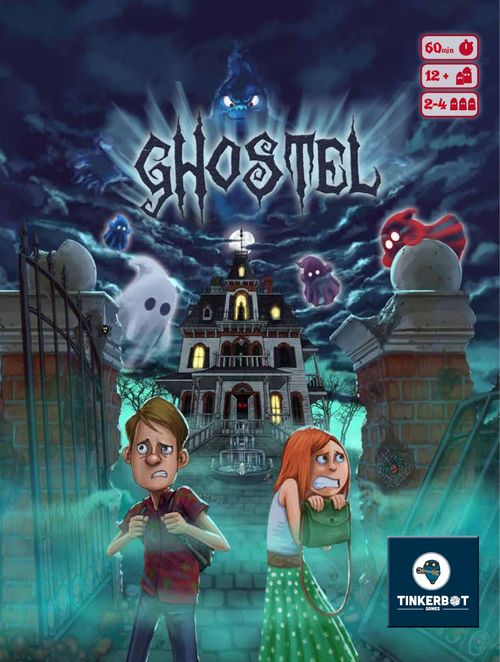
Ghostel
Ghostel Rulebook
Table of Contents
Table of Contents
Contents
- 1 Game Board
- 4 Ghost Figures
- 12 Phobia Tokens
- 8 Ghostly Barrier Tokens
- 4 Score Tokens
- 87 Cards
- 35 Guest cards
- 20 Scare Tactic Cards
- 21 Spookie Favour Cards
- 12 Terror Bonus Cards
- 32 Six-Sided Terror dice
- 4 Eight-Sided Terror dice
Setup
- Separate the cards into 4 separate decks: guests, scare tactics, spookie favours, and terror bonuses.
- Shuffle the guests deck, face down. Place the top 9 cards out, face up, in a 3x3 grid on the game board; the grid makes up the rooms in the hotel, and the cards represent guests staying in them. Put the rest of the guests deck face down near the game board — these will be used to refill the hotel each day.
- Shuffle the scare tactics, spookie favours, and terror bonus decks separately, and place each face down within easy reach of all players.
- Place the phobia tokens and ghostly barrier tokens within easy reach of all players.
- Have each player take a ghost figure as well as a score tracker and all the terror dice (8 x six-sided dice and 1 x eight-sided die) of the matching colour.
- Give each player a spookie favour and a scare tactic, from the respective decks. Note: a player may look at their own cards at any time, but must keep them hidden from the other players.
Game Board Layout
- 9 hotel rooms — the 3x3 grid of guest cards
- Guest deck — face-down pile that refills the hotel
- Score track — around the edge of the board
- Discard pile
- Ghostly barrier tokens
- Phobia tokens
- Spookie Favour deck
- Terror Bonus deck
- Scare Tactic deck
Card Anatomy
Guest Cards
- Name of guest
- Phobia — some guests have phobias that players can use to double their scariness with scare tactics.
- Special ability — read these carefully as they will affect how you score this person.
- Spookie score — this is how many points this guest is worth when scared from the hotel.
- Courage — this is the score you are trying to equal or beat with your terror dice.
Scare Tactic Cards
Scare Tactics — when played, these provide the phobia tokens you can put under your terror dice; this is explained further under Scare Tactics below.
Terror Bonus Cards
- Terror Bonus — this is the effect of the terror bonus card; this will either allow you to roll more terror dice at the start of the night phase or to roll an eight-sided dice (instead of a six-sided).
- Reminder text — a quick reminder of how this card is used and what effect it has.
Spookie Favours
- Card title
- Spookie favour effect — read Spookie favours carefully to find out their effects and when they can be played.
Overview
Ghostel takes place over a series of rounds, each made up of two phases: a "Night" and a "Day".
During the night, the ghosts roam the hotel, using all their scary tactics to frighten away the human visitors and show off for Spookie himself. During the day, while the ghosts are hiding in the attic, new guests will enter the hotel and those who withstood the previous night's terrors will calm down from their twilight visitations. The game will end when there are not enough guests left to fill up the hotel. The winner is the player with highest score.
Determining Player Order
At the start of each night phase, player order for the round is determined by the players' current scores: the player in the lead goes first, then the player in second place, and so on.
In a situation where one score marker will end up in the same space as another player's, the moving marker is placed on top of the one already in the space on the score tracker. For player order, the cube on top goes before the player underneath.
However, for the first night, when all players are on zero, player order is determined by the first roll of the terror dice, with the player who has the highest total going first, second highest second and so on. Don't worry; rolling the terror dice will be explained a bit later.
In the case of ties, player order is be decided by who has the highest score on a single die.
Example: Player Order
Starting the Game. In the first night phase, all the players roll their three terror dice.
In the example above, Blue has total of eleven so they place their score marker on the 1st place spot on the score tracker.
White has ten, so takes the 2nd spot, whilst Red only has eight, so they take third.
Later Rounds. After the first night phase, the players have scored some points.
Red had a great round and scored 26 points; in the next night phase, Red will go first.
Blue scored 24 points and so will go second in the next night phase.
Poor White only manages 18 points, but will now go third in the next night phase. (In Ghostel going last can be a good thing as you can see what the other players have decided to do!)
The Night Phase
The Night Phase is split into four steps.
1. Roll Your Terror Dice
At the start of each night phase, take three six sided dice and roll them; this is how scary your ghost is for the round.
Remember: A player will ALWAYS get to roll at least three dice at the start of each night phase, even if they leave dice in the house at the end of the last night phase (don't worry, this will be explained later). Also, remember that the total on your terror dice in the first night phase of the game determines player order for this round.
2. Scaring the Guests
In this step, each player gets three turns. In the first turn, each player (in player order) chooses a room in the hotel for their ghost to appear in, placing their ghost figure in the room and selecting 1 of their 3 terror dice to leave in the room.
In subsequent turns, each player must move their ghost figure to an adjacent room, leaving 1 terror die in the new room. Ghosts can never move diagonally, but are allowed to backtrack into rooms that they've already visited earlier in the round.
At the end of the third turn, the ghosts retreat to the attic; each player takes their ghost figure off the game board. (We encourage you to make ghostly 'wooOOoo' noises as the ghosts are removed from the board.)
Rules on Movement
- Ghosts can only move one room at a time.
- Ghosts can only move up, down, left or right when moving to a new room; they cannot move diagonally.
- A ghost MUST move during the second and third turns of player movement and dice placement if able.
- If a ghost is unable to move for any reason (due to the effects of a Spookie favour for example), the ghost will remain in its current room, but must place a die each turn on the room it stays in.
- A player may move their ghost back on to a room they have already visited this phase and place a second terror die on this room (typically this can only be done in the third turn).
Example: Night Phase
It's the start of the night phase, and all players have rolled their terror dice.
Turn 1. Blue goes first and decides to appear in Esme's room, placing their six pip die as they do. White is next, placing their four pip die on Susan.
Finally Red gets into the hotel, appearing on Lee and placing their one pip die.
Turn 2. For their first moves, Blue moves to Lee and places a three pip, White moves to Bevan to place a three pip and Red also moves to Bevan, placing a one pip.
Turn 3. For their second moves, Blue then goes down to Bevan to place a two pip, whilst White decides to move back to Susan to place a three pip. Finally, Red follows White to Susan and places a six pip.
3. Totalling Up the Scores
Beginning with the top left room, check to see which guests have been scared out of the hotel. If the total of all the terror dice in that room is equal to or greater than that guest's courage, the guest flees the hotel in terror — return all terror dice in that room to their respective owners and discard the guest from the game, but not before determining which players score points!
Look at the spook score on the bottom left of the guest card to see how many Spookie points the scare was worth. The player who contributed the most terror to the scare scores the number of points listed for first place. If multiple players contributed to the scare, then the player who contributed the second most amount of terror earns the number of points listed for second place. Each remaining player who contributed to the scare scores the number of points listed for third place.
Track players' points by moving their score markers along the score track.
If two or more players contribute the same amount of terror to a scare, they each score the full points (e.g., If two players are tied for first place, and the spook score is 12 points, the tied players score 12 points each). When this occurs, any other players who contributed score the third-place points.
Rules on Scoring
- The amount a player contributes to scaring the guest is equal to ALL their dice, not their highest single die.
- The third spook score will never disappear; all players who placed a die on the scared guest will always at least score the third spook score.
Examples: Scoring
Total Dice Pips < Courage = guest is not scared away. Esme only has six pips on her in total, so isn't scared from the house. Lee also doesn't have enough, with a total of four pips (three from Blue and one from Red).
Total Dice Pips > Courage = guest is scared away. Susan on the other hand has thirteen pips total (seven from White and six from Red) which beats her courage and scares her from the hotel.
White has the most pips on Susan when she is scared and therefore takes the top score (in this case 8 Spookie points). Red comes second and gets 4 points.
Bevan is also scared since the total terror dice on him is six pips. White has the highest number of pips and scores 8 Spookie points, Blue has the second highest number of pips and scores 4 Spookie points, whilst Red comes last and scores two Spookie points.
4. Calming Down
Once all scared guests have fled the hotel and all scoring is complete, flip each terror die remaining in the hotel down by 1. Any terror die that would drop to 0 is instead removed from the game board and returned to its owner.
Example: Lee wasn't scared enough, so she stays in the hotel and calms down. The Blue terror die is turned down from three pips to two pips to represent this. The Red terror die is already at one pip and can't be turned down; it is therefore removed instead.
Rules for 2-Player Game
With only two ghosts, the hotel can feel a bit empty! So for two players, each player should take control of two ghosts instead of one: it's a frightmare tag team!
- Each ghost has its own spookie points, hands of spookie favours/scare tactics and terror bonuses.
- Each ghost will score separately; it is entirely possible that a player's ghosts will take both the first and second spook scores on a guest.
- At the end of the game, add the spookie points of both of a player's ghosts together to determine their final score. The highest score wins!
The Day Phase
During the Day Phase, the ghosts will have the opportunity to spend their points to gain new advantages in the form of Spookie favours, scare tactics and terror bonuses.
1. Buying Cards
To buy the cards, players must spend the points they've scored during the night phase. The cost of buying each card is on the back bottom right corner. Starting with the player with the current highest points, players may buy up to two cards from the three decks available. A player may not buy two of the same card. For example, a player could buy a terror bonus and Spookie favour for 6 points or a Spookie favour and a scare tactic for 5 points, but couldn't buy two Spookie favours, or two terror bonuses.
Terror Bonuses — Costs 3 Spookie Points
When purchased, place this card face up in front of you. For the rest of the game, when rolling your terror dice at the beginning of the night phase, you may now roll an extra d6, then pick the three with the best scores to use during the second part of the night phase.
There is a special terror bonus card that, instead of allowing an extra d6 to be rolled, the player upgrades one of their current d6 to a d8. If the player receives a second copy of this card, treat it instead as an 'extra d6' card instead.
Upgrade to d8 card text: Place this card face up in front of you. For the rest of the game, substitute one of your six sided terror dice for an eight sided. Additional 'Upgrade to d8' cards grant a +1 six sided terror die instead.
+1 Terror Dice card text: Place this card face up in front of you. For the rest of the game, roll an additional terror die at the start of the night phase; choose three dice to keep.
Spookie Favours — Costs 3 Spookie Points
These cards grant benefits to the player. The card will detail when the card should be played and what bonus it will give. There isn't a limit to how many cards a player can play during a turn. Once played and the effects applied, these cards go to the discard pile.
Note: Unless otherwise stated, Spookie favour cards cannot affect terror dice already placed on guests.
Spookie's Gamble: Re-roll any number of your terror dice, keeping the new result.
Spookie's Boost: Increase each of your terror dice by one (to a maximum of six).
I Got Chills...: Place this card under any guest in the house. Ensure the symbols at the bottom of this card are visible to all players (uncovered). This guest is now afraid of all phobias.
Walk Through Walls: Instead of your normal movement in the house, you may move to ANY guest, except those blocked by a ghostly barrier.
Scare Tactics — Costs 2 Spookie Points
You may have noticed that some of the guests in the house have a phobia, something they are scared of more than anything else. This is where scare tactics come in. Scare tactics represent the ghost changing their scare to suit the guest, hopefully leaving them as a gibbering wreck!
When placing a terror die on a guest, a player may also play a scare tactic at the same time if one of the phobia icons on the scare tactics card matches the phobia icon on the guest card. The player places a phobia token on the guest, then places their terror die on top of the token so everyone knows who it belongs to.
The score on the die placed on the token is now worth double when determining the owner's terror total.
Note: only Spookie favours and scare tactics are in the player's hand; terror bonus cards are not. There is also no limit to how many cards a player may have in their hand.
Note: Scare tactics are played when a player places or moves their ghost onto a guest.
Example: Scare Tactics
The Blue player has moved on to Bevan and decides to place a four pip terror die on him; this isn't enough to scare Bevan though.
However, the Blue player has a scare tactic in hand, and luckily it has the snake phobia on it, which is exactly what Bevan has a fear of! The Blue player uses his scare tactic at the same time as laying his die to put a phobia token under his die, doubling its score to eight pips and scaring Bevan out of the house!
2. Refill the Hotel
After all players have bought any cards they want, refill the hotel from the guest deck, starting at the top left hand room and working across to the bottom right room.
After the first round, the player order is based on the player's scores, with the player with the highest score going first. The player order is determined using the positions of the score markers on the score tracker.
Ending the Game and Winning
The game ends immediately when the hotel cannot be refilled with guests (i.e. there are empty rooms in the hotel at the start of the night phase). The winner is the player with the highest score.
Quick Start Guide
The Night Phase
- Roll Terror Dice. At the start of each night phase, take three terror dice and roll them; this is how scary your ghost is for this round.
- Scaring the Guests. Ghosts enter the hotel and move around the rooms, leaving behind terror dice.
- Total Up the Scores. Starting with the top left guest in the house, count up all the pips on the terror dice placed on this guest. If the TOTAL score is equal to or exceeds the courage of the guest, that person has been scared out of the house! Remove the card from the house and give points to each player who placed a dice on this scared guests.
- Calming Down. Flip each terror die remaining in the hotel down by 1.
The Day Phase
- Buy Cards. Scare tactics, Spookie favours and terror bonus cards
- Refill Hotel.
Ending the Game and Winning
The game ends when the hotel cannot be refilled with guests (i.e. there are empty rooms in the hotel at the start of the night phase). The winner is the player with the highest score.