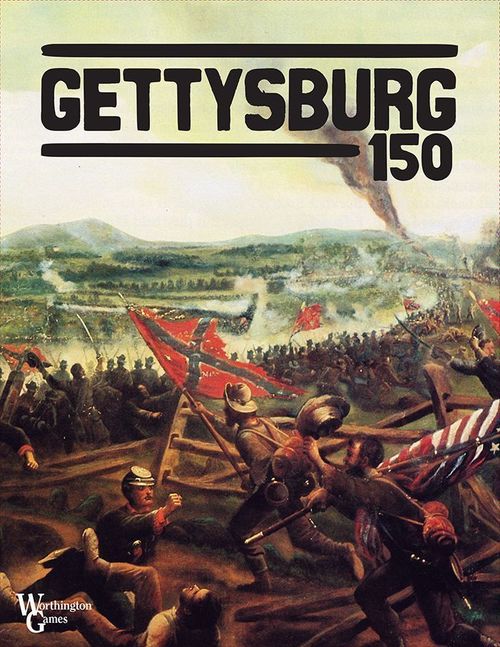
Gettysburg 150
Gettysburg 150 Rulebook
Table of Contents
Table of Contents
1. Introduction
Gettysburg 150 allows gamers to recreate the battle of Gettysburg fought July 1 to July 3, 1863.
The counters in the game represent the combat units of both the Confederate and Union armies. They are maneuvered and have combat on the game board that shows the terrain of the battle area.
This booklet has the rules for the game, as well as the scenarios, one for each day of the battle, one for the fight for Little Round Top, as well as the three day battle.
Each turn of the game has a Confederate player turn followed by a Union player turn. Each player receives a base number of Action Points (AP) with which to activate units to perform actions in the game. Each player also rolls a die to add a random number of AP to his base AP for his total number of AP available for that turn. The active player spends his AP activating units until he runs out of AP for the turn or passes at which point it becomes either the other players turn or the turn ends.
2. Game Board
The scale of the board is approximately 400 yards to the hex. The terrain depicted on the game board affects movement, combat, morale, and line of sight.
The terrain location of the defending unit can result in a combat modifier for both fire combat and melee by reducing the number of die rolled by attacking units.
For movement, terrain effects apply to units as they enter each hex, or cross a hex side. Each hex, or hex side has a set movement cost. Each unit has a set movement allowance.
On the game board, you can track both game turns and action points for each player. Both have counters to track with.
Terrain may add or subtract a modifier to the defending unit when it checks morale following melee.
Terrain Types
| Terrain | Movement Cost | Combat | Line of Sight |
|---|---|---|---|
| Clear | 1 | No Effect | No Effect |
| Road | 1 | No Effect | No Effect |
| Gettysburg (hex 1905 only) | 1 | -1 Die | Blocks |
| Creek | 1 to cross the creek hex side | -1 Die, Melee Only | No Effect |
| Woods | 2 | -1 Die | Blocks |
| Ridge (Moving/Firing Up) | 2 | -1 Die | If artillery unit is on the ridge hex, it has LOS unless there is other blocking terrain. If artillery unit is 1 or 2 hexes behind the ridge, the ridge blocks LOS. |
3. Game Units
The Union army is represented by the blue counters and the Confederate army is represented by the gray counters. The scale of the units in the game is division level for the Union and half divisions for the Confederates. Printed on each counter is a graphic icon showing the type of unit it is. Also printed on the counters are the unit's Morale Point (MP). When in white it is the full value, when it is outlined in red it is the reduced value. Units are flipped and replaced to show losses in MP as well as increases from rally.
Counter faces: a full-MP counter (front) is flipped to reduce its MP by 1; a replacement counter shows a reduced MP by 2 (front); a flipped replacement reduces MP by 3. The original MP counter is the full-strength counter, and replacement counters are used for reduced MP values.
Each combat unit has a MP value that is based on the manpower available to that unit in the battle as well as an evaluation of the unit's morale. The unit may have its MP modified by terrain, leaders, and the specialty type of unit. The MP also represents a units strength which is the number of hits it can receive in combat.
For example: A 3 MP infantry unit would be replaced with its 2 MP counter after the first hit, flipped to its 1 MP side of the counter for the next hit and would be removed from the game on its last hit.
Each unit has a set movement allowance per activation. The movement allowance remains constant throughout the game for each specific unit type but is affected by terrain.
Infantry: represented by a soldier standing firing a musket. They have a MP value from 1 to 6. They receive 2 movement points for 1 AP. Infantry may conduct fire combat for 1 AP and melee for 2 AP. Infantry roll 3 dice in combat.
Cavalry: represented by a soldier riding a horse. They have an MP value of 1 to 2. They receive 3 movement points for 1 AP. Cavalry may conduct fire combat for 1 AP and melee for 2 AP. Cavalry roll 1 die in combat.
Artillery: represented by an artillery piece. They have an MP value of 1 to 3. They receive 2 movement points for 1 AP. Artillery may conduct fire combat at a range of up to 3 hexes for 1 AP but may not initiate melee. Artillery roll 2 dice at 1 and 2 hex range in combat and 1 die at 3 hex range.
Leaders: represented by a flag on the counter plus the leaders name and command modifier. They add +1 MP to a unit's morale value in attack and defense for melee. They receive 3 movement points for 0 AP, or may move for no extra AP when moving with a unit they are stacked with in a hex. Leaders have the unique ability to rally damaged infantry or cavalry units. The number on the leader counter is its command modifier and used to assist in rally/morale purposes.
4. Setup
Each scenario within the game has its own setup, for which the playing pieces are placed on the game board to begin the game. Players determine who will command each side in the game and each player sets up his playing pieces according to the scenario set up instructions.
Hexes on the game board are numbered to aid players in setup. Players should set up all units at full strength unless the scenario specific rules identify a reduced MP value for a unit.
UNIT HEX LIMITS: No more than 1 infantry or cavalry, plus 1 artillery, in any hex, plus a leader. Any number of leaders may be in a hex.
5. Game Turn Sequence
- The Confederate player rolls a die and determines how many random AP to add to his base AP for his total AP available for the turn.
- The Confederate player performs actions spending his available AP for this turn. In any order he may move, fire, perform melee, and rally.
- The Union rolls a die and determines how many random AP to add to his base AP for his total AP available for the turn.
- The Union player performs actions spending his available AP for this turn. In any order he may move, fire, perform melee, and rally.
- Check the victory conditions to see if either player has won the game.
- Move the turn marker ahead 1 hour on the turn record chart and go to step 1.
The active player determines the order of actions during his turn. Players may move, fire, melee, or rally in any order they choose within the limitations of their action points and unit capabilities.
6. Action Point (AP) Determination Phase
Each player in each scenario is given a base number of command action points (AP) based on the specific scenario. He combines this AP with additional AP's generated by his random AP die roll each turn. During steps 1 and 3 of the game turn sequence the active player will roll a die to determine the random AP and add that number of AP to his scenario specific base AP. The total is the number of AP he is allowed to spend that turn. The total rolled on the die is the additional AP added. AP in a turn may not be saved for a future turn.
Each AP allows each side to move, fire, melee, and rally units.
Each unit picked to perform actions must complete its action before another unit starts to perform an action.
Once a unit has been activated and completed its allowed action, it cannot be activated again or rallied until the next turn.
Actions Allowed
- MOVE: Infantry, cavalry, and artillery units may move for 1 AP for each unit moving. For 0 AP a leader may move (this means all leaders are eligible to move every turn at no cost).
- FIRE COMBAT: Infantry, cavalry, and artillery units may conduct fire combat at units within range and line of sight for 1 AP per unit firing.
- MELEE: Infantry, or cavalry, may conduct melee against adjacent enemy units for 2 AP per meleeing unit.
- RALLY: Leaders for 1 AP may attempt to rally a reduced infantry or cavalry unit.
Once an infantry, cavalry, artillery, or leader unit performs a move, fire, melee, or rally action, they may not do any other action during their turn.
Use the Game Track on the game board to keep track of AP expended during a turn. As units perform actions, move their AP marker down the appropriate number of spaces. When the marker reaches 0, the current player's turn is over.
Note on the source: the rally entry above reads "may" in the printed text, which the PDF renders as "my"; it is transcribed here as "may".
7. Movement
All units have a base movement allowance according to unit type. Movement is conducted one hex at a time and is from hex to adjacent hex expending the units movement allowance for each hex entered based on the terrain cost for that particular hex entered or hex side crossed. Multiple terrain effects in the same the hex are not cumulative to movement.
No unit may be activated to move more than once in a turn.
Players may not violate the unit per hex rules with any movement; this would include moving through units or swapping positions with units. This rule applies during retreat also.
Units may freely move through leader unit counters and leaders (friendly or enemy) do not block movement for any unit. A unit moving through a leader of the opposing player that is alone in a hex, forces the enemy leader to move to its nearest friendly unit. The moving unit does not have to stop in this case.
Units may move double (2x) their normal movement allowance if they do not begin, end, or at any point during their activation move next to an enemy unit. Units may move triple (3x) their normal movement allowance if their entire move begins, ends, and is along a road and during their activation they do not move next to an enemy unit.
Reinforcements
Reinforcements entering the game are allowed special movement on the initial turn of entry. The special movement allows a player for the expenditure of 1 AP to enter and move all reinforcements at the same point of entry. Players may delay reinforcements turn of arrival.
Example: On the 2pm turn of July 1, the Confederate player spends 1 AP to enter RE Lee, Early A, and Early B at hex 1101. The units can move their full movement value. He spends another AP to enter Jones artillery at hex 2201 and move his full movement value.
Example (movement): "Unit B" moves double his normal movement rate of 2 by moving 1 clear hex, then spends two movement points to go up hill, and 1 movement point into the last clear terrain hex. He was allowed to move double as he did not begin, end, or move next to an enemy unit. "Unit C" moves triple his normal rate of 2 by beginning, ending and moving his entire move on the road. "Unit A" spends 2 movement points going up ridge and then 1 movement point to enter the clear terrain hex. He could not enter hex 1713 or 1714 as it would be adjacent to an enemy unit and he was moving double movement.
8. Combat
Multiple terrain effects in the same hex are not cumulative to any combat, choose the terrain most beneficial to the defender. All attacks against Double Ridges/Hills are always -2 die.
Fire Combat
To conduct fire combat, a player expends 1 AP, determines the range and hit numbers, then rolls the proper number of dice for the unit attacking, modifying the number of die for terrain.
- Dice rolled is the number of dice the unit rolls when conducting combat. This number does not change based on the unit MP, but it can be affected by terrain.
- Range is the number of hexes from the firing unit to the target unit, not counting the hex the firing unit is in but counting hex the target unit occupies.
- The hit number is the number or greater needed to be rolled on the dice to hit the target unit at that range.
- Players score a hit for each die that is equal to or greater than their "hit number". Consult the Combat Hit Number Chart.
For example: An artillery unit firing at 2 hexes at a target in clear terrain rolls 2 dice and for each 6 rolled on the dice, the target unit is hit. At a range of 3 hexes, the artillery would roll one die and for a 6 being rolled would cause a hit.
When the target unit is hit, reduce the MP value of that unit by flipping the target unit, or replacing it to the lower MP value of that particular unit equal to the number of hits scored.
For example: A 4 MP infantry that receives two hits would be flipped to 3 MP for its first hit and then replaced with its 2 MP counter for the second hit.
If the number of hits reduces the target below 1 MP, then that unit is eliminated, remove the counter from the board. Eliminated units are permanently out of the game and may not be rallied.
If two units are in a hex together and hits must be taken, all hits are applied to the unit with the highest MP value. In case of two units with equal strength it is the owning player's choice.
Combat Hit Number Chart
| Unit Type | Dice Rolled | 1 Hex Range | 2 Hex Range | 3 Hex Range | Melee 1 hex |
|---|---|---|---|---|---|
| Infantry | 3 | 6 | - | - | 5-6 |
| Artillery | 2 | 5-6 | 6 | 6 (1 die rolled) | - |
| Cavalry | 1 | 6 | - | - | 5-6 |
Line of Sight (LOS)
Units in adjacent hexes may always fire at each other as terrain does not affect line of sight for units this close. Since infantry and cavalry can only fire at adjacent units, their fire is not affected by line of sight considerations.
Artillery units must have a clear line of sight to be able to fire at target units greater than one hex away. Clear line of sight is defined as a straight line through the center of the hex from the firing artillery unit to the target unit, free of blocking terrain and enemy or friendly units. If blocking terrain is located in a hex between the two units, then artillery line of sight is blocked. Blocking terrain in the firing units hex, or the target hex, does not block LOS; only terrain in hexes between the two units. If line of sight follows a hex side, then line of sight is blocked if both hexes along the hex side have blocking terrain. If only one hex side has blocking terrain, then the line of sight is clear and the unit may fire.
If artillery unit is on the ridge hex, it has LOS unless there is other blocking terrain. If artillery unit is 1 or 2 hexes behind the ridge, the ridge blocks LOS.
Example 1: "Hazard" is on the ridge hex and therefore has LOS to both of the Confederate units. Conversely, the Confederate artillery has LOS to "Hazard".
Example 2: "Hazard" does not have LOS, neither do the Confederates since he is 1 hex behind the ridge.
Melee
Infantry and cavalry units may initiate melee against adjacent enemy units at the cost of 2 AP and hit opposing units on die rolls of 5 and 6. Artillery may not initiate melee but may be the target of melee. When rolling dice for the attacker's melee, apply terrain modifiers to the number of die rolled based on the terrain the defender occupies.
Defending units must make a unit morale check roll to determine if it retreats only if the unit(s) take a hit during melee. The unit morale roll is based on the unit MP after removing the losses caused by the melee. Add a modifier equal to the number of die deducted from the attacking players modifier for terrain to the defenders MP, plus add one to the defenders MP for a leader being present (only 1 no matter how many leaders are in the hex).
Roll one die per unit that has been hit. If the die is higher than the unit MP, adjusted for terrain and leader, the unit fails its morale roll and retreats one hex (owners choice). Leaders stacked in a hex with a retreating unit must retreat if all units are forced to retreat. A natural roll of 6 always means a retreat, regardless of morale modifiers. If infantry/cavalry and artillery are stacked in a hex together roll for the infantry first, if the infantry/cavalry passes the artillery does not have to roll, it automatically passes. If the infantry/cavalry fails, roll for the artillery and if it fails, it retreats. When artillery is in a hex alone and is meleed, if the artillery unit is hit, it conducts a morale check. If it passes it stays in the hex, if it fails it is eliminated and removed from play.
Melee Retreat Rules
Defending units failing a morale check must retreat towards the closest reinforcement entry point for their side. Units may not retreat adjacent to an enemy unit unless no other route is open to them. If no retreat path is available due to being surrounded by enemy units, stacking restrictions, or board edge then a unit remains in its hex and takes one additional hit.
If a leader is stacked with a unit that is eliminated, the leader may immediately retreat up to 3 hexes unless blocked by enemy units in which case it is eliminated.
Some possible combat examples: Poague conducts fire combat on Wadsworth for 1 AP. He rolls 1 die (normally would roll 2 but must subtract 1 die for firing up ridge). He could not fire on Doubleday with artillery as it is -2 die to fire at units up double ridge/hill. McLaws A conducts fire combat against Doubleday for 1 AP and rolls 1 die (normally would roll 3 but must subtract 2 die for firing up double ridge/hill). Hood A conducts melee against Doubleday for 2 AP and rolls 1 die (normally would roll 3 but must subtract 2 die for firing up double ridge/hill). As another option Hood A could have attacked Wadsworth in melee combat and rolled 2 dice (only 1 die would be subtracted for the melee up ridge).
9. Leaders
It cost 0 AP to move a leader. A leader, moving alone, can move up to 3 hexes paying normal terrain costs. Unlike other unit types, leaders may move through other friendly units without regard to hex limits.
Leaders beginning and ending their turn with the same unit, without expending an AP, may move with that unit as long as the unit expends AP for its movement, but may not have moved before and may not move after moving with the unit.
Army leaders (RE Lee and Meade) ignore leader hits in combat. For all other leaders that are in a hex targeted by fire or melee combat, there is a possibility of the leader being eliminated when a 1 is rolled for the combat. During fire combat, no matter how many 1's are rolled, the leader rolls one die to see if he is eliminated. If the result is another 1, the leader is eliminated and flipped to his replacement side. During melee, for each 1 rolled, the leader rolls one die to see if he is eliminated. If the result is another 1, the leader is eliminated and flipped to his replacement side.
If a leader is eliminated in combat, reduce that sides base AP by 1 for the remainder of the game in future AP Phases. This effect is cumulative.
Leaders may rally units, other than artillery, that have suffered a reduction due to combat. To rally, a unit must begin and end its turn in the same hex as the leader and both may not perform any other action. Units being rallied may not be adjacent to enemy units. It cost 1 AP to rally and recovers 1 hit and a unit may only recover 1 hit in a turn. To rally a unit, the unit rolls one die. If the die roll is equal to or less than the leaders modifier on its counter then the unit rally's 1 MP. Units may be rallied adding 1 hit back to the unit each time it rallies. No unit may be rallied to higher than its printed MP. Eliminated units may not be rallied.
10. Victory
Victory conditions are set in each specific scenario. Generally victory points (VP) are awarded as follows:
- 1 VP for each opposing infantry, and artillery unit eliminated. Cavalry units are worth ½ VP when eliminated. 2 VP for each eliminated leader. The definition of an eliminated unit is when a combat unit falls below 1 MP and is removed from the game.
- There are victory point locations given in each scenario. The last player to have a unit in the location before the end of the scenario is the owner of the location. The locations are worth the VP value given in the scenario victory conditions.
11. Intermediate Rules
These rules add complexity to the game. The rules may be added individually or as a group at the player's discretion.
LEADERS AND CORPS INTEGRITY: The division units when activated must pay double MP if they are further than 3 hexes away from their corps commander listed on the division counter. Leaders may only rally units from their corps.
FORCE MARCH: Infantry and cavalry may add 1 extra movement point for 1 additional AP spent. Only 1 extra movement point may be added in a turn to a unit.
ARMY DEMORALIZATION: An army becomes demoralized when it loses an amount of infantry units equal to its demoralization number. The Union army becomes demoralized when it loses 8 infantry units. The Confederate army becomes demoralized when it loses 7 infantry units. When an army becomes demoralized infantry may not melee attack, and all activations cost double their normal AP cost.
GETTYSBURG EVENTS TABLE: When the active player rolls a "1" on his random die roll, the "1" is his result for the random die roll and he also makes an event die roll. For the event, he rolls 2 dice and refers to the events table below. The effects only apply to the active player for the current turn.
| Die Roll | Results |
|---|---|
| 2 | Add 1 die to all artillery units firing this turn |
| 3 | Add 1 die to all fire or melee infantry attacks this turn |
| 4 | All infantry can move 1 hex before movement begins |
| 5 | The next scheduled reinforcements arrive one turn later |
| 6 | The next scheduled reinforcements arrive this turn |
| 7 | The next scheduled reinforcements arrive one turn later |
| 8 | The next scheduled reinforcements arrive this turn |
| 9 | Add 1 die to all artillery units firing this turn |
| 10 | Add 1 die to all fire or melee infantry attacks this turn |
| 11 | All infantry can move 1 hex before movement begins |
| 12 |