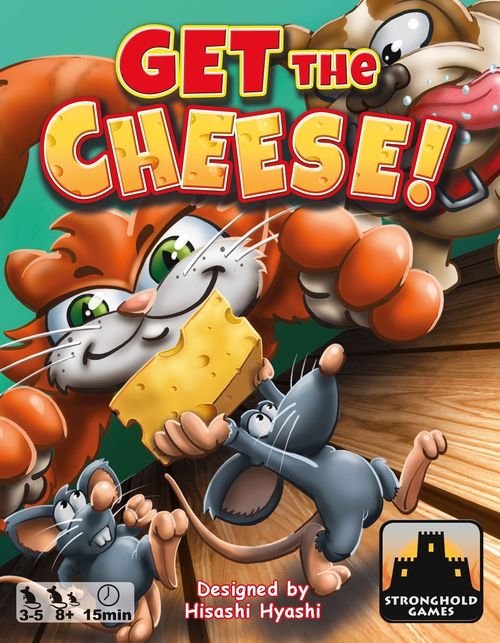
Get The Cheese!
Get The Cheese! Rulebook
Table of Contents
Table of Contents
Object of the Game
Score the most points by deploying your animals and achieving these goals:
- your Dog chases away other players' Cats
- your Cats catch other players' Mice
- your Mice Get The Cheese!
Contents
- 75 Animal cards (15 each in the 5 player colors: Blue, Green, Purple, Red, Yellow)
- 9 Regular Mice (with a "1")
- 2 Big Mice (with a "2")
- 1 King Mouse (with a "crown" symbol)
- 2 Cats (with a "fish" symbol)
- 1 Dog (with a "bone" symbol)
- 15 Cheese cards (The number on the Cheese cards indicate how many mice the cheese can feed.)
- 5 Player cards (with a House in each of the 5 player colors: Blue, Green, Purple, Red, Yellow)
- 1 Fuji Flush "?" Promo Card (and 1 "?" Rules Card) — the "?" Promo Card is usable in FUJI FLUSH.
Some Animal cards carry a Face Down Symbol.
Preparations
Shuffle the Cheese cards, deal the number indicated below, and place them in a circle.
- 3 players: 6 cards
- 4 players: 8 cards
- 5 players: 10 cards
Put the remaining Cheese cards back in the box.
Each player chooses a color, and takes a Player card and the 15 Animal cards in that color. Each player shuffles their Animal cards to make a face down deck. The Player card is placed face up in front of each player to indicate the player's color.
Each player then draws 3 Animal cards from their deck to form their hand.
The player who most recently ate cheese is the starting player.
Flow of the Game
The players take turns, starting with the starting player and then clockwise around the table.
On their turn, a player may either draw 3 Animal cards from their deck, or play 3 Animal cards from their hand. Passing is not allowed.
a) Draw 3 Animal cards
The player draws 3 Animal cards from their deck to their hand. The player may not do this if their deck has run out. The hand limit is 6 cards: A player who already has 6 cards in hand cannot choose this action.
b) Play 3 Animal cards
The player chooses 3 cards from their hand, and places them next to the Cheese cards to form the outer ring of the card circle, in the following manner:
- The first card is placed face down next to ANY cheese card.
- The second card is placed face up next to the next cheese in clockwise direction.
- The third card is also placed face up, next to the second next cheese in clockwise direction.
However, Animal cards with a Face Down Symbol are not placed face up, but face down, even if they are the second or third card placed.
If there are no other Animal cards by the Cheese card, just place the new Animal card next to the Cheese card, on the outer side of the circle.
If there is already one or more Animal cards by the Cheese card, place the new Animal card on top of the previous card(s), splaying them a bit so you can see what cards are underneath.
Example Play
- First card is placed face down.
- The second card is placed face up, beside the first.
- The third card is placed face up, beside the second, but if the card has a Face Down Symbol, it's placed face down.
When the player has either drawn cards or placed cards, it's the next player's turn. Go on until all players have run out of cards. (This means that everyone will get exactly 9 turns).
End of the Game
Once all players have placed all their cards, the Cheese cards are resolved one at a time.
The order in which the Cheese cards are resolved is irrelevant.
Flip the Animal cards by the Cheese card face up, careful not to change their order. Line them up so that all cards are visible. Then resolve the line in the following order:
1) Dogs
First, any dogs in the line are resolved. If there are several dogs in the line, they are resolved in reverse order (last dog first).
If there is a cat card of other players' colors immediately in front of or behind the dog, that cat is removed from the line and gained to the dog owner's score pile. If there are cats both immediately in front of and behind, the dog owner gets both. If there are no cats immediately in front of nor behind the dog, nothing happens.
Note: Any "holes" in the line because of chased away cats are ignored. They won't matter anyway.
The dogs stay in line.
2) Cats
Second, any cats remaining in the line are resolved. If there are several cats in the line, they are resolved in reverse order (last cat first).
The cats will catch mice of other players' colors up to a distance of three (3) cards in front of them (going toward the cheese), starting with the closest card. Mice of other players' colors (any type of mouse) are removed from the line and added to the cat owner's score pile. Mice of the same color as the cat are not removed from the line, but still count as a card for distance purposes.
However, if the cat runs into a dog or other cat (regardless of player color) or cheese during its mouse catching, it is interrupted and stops.
All cats that have been resolved are removed from the line and put back in the box.
3) King Mice
Third, any remaining King Mice in the line are resolved. If there are several King Mice, they are resolved in reverse order (last King Mouse first).
The King Mouse is moved to the front of the line.
4) Cheese
Finally, the Cheese card is scored. The mice will eat in the order in which they are now lined up, and the cheese will be enough for as many mice (of any type) as the cheese number. For example, a '3' cheese is enough to feed 3 mice. The numbers on the mice cards are irrelevant, and any dogs in the line are ignored; they don't eat cheese. The mice who got to eat cheese are added to their respective owners' score piles.
When all Cheese cards have been resolved separately, proceed to Scoring.
Scoring
Each player counts their score in their score piles by summing the values on the animals:
- Regular Mice, King Mice: 1 point each
- Big Mice: 2 points each
- Cats: 3 points each
The color of the Animal cards are irrelevant.
Example of Scoring
- Cats (that your dog chased away): 6 points
- Mice that your cats caught: 5 points
- Your mice that got to eat cheese: 8 points
Your total is 19 points!
The player with the most points wins! In case of a tie, the player with the most King Mice breaks the tie. If the tie remains, the player with the most mouse cards breaks the tie. If the tie still remains, the players tied rejoice in their shared victory of cheese!