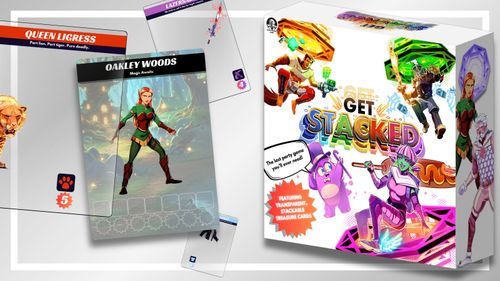
Get Stacked
Get Stacked Rulebook
Table of Contents
Table of Contents
Quick Start: One Page Rules
For the person who says, "Let's just start playing and figure it out."
Set-Up
- Gather pens/paper and a stopwatch (smartphones work great)
- Each player chooses a champion card and places it in a stacking tray
- Shuffle and place each deck on its spot on the game board
- Place the power nap tokens and a rank medal for each player on the board
- Lay out 8 monster cards and deal each player 2 action cards
- Choose the first referee (whoever has the most items of clothing on)
In Get Stacked you play a set number of rounds based on the number of players. The game ends after all rounds have been played. Each round has 3 phases detailed below:
Recommended Number of Rounds
- 2 players = modified rules on back (see the 2 Player Rules in the Appendix; 7 rounds)
- 3 players = 6 rounds
- 4 players = 8 rounds
- 5 players = 5 rounds
- 6 players = 6 rounds
- 7 players = 7 rounds
- 8 players = 8 rounds
Phase 1 - Get Ranked
- The referee blindly selects a rank medal and draws a mini-game card.
- All players except the referee compete in the mini-game, then claim one of the remaining rank medals based on their placement.
Phase 2 - Get Stacked
- Lay out treasure cards equal to the number of players.
- All players select and "stack" one treasure on their champion in order of their rank medals. Each treasure has a category and adds 1-5 to your power level.
Phase 3 - Get Attacked
Players take turns in order of their rank medals and can take 1 of 4 actions:
- A. Draw an action card: Action cards can be played any time.
- B. Take a power nap token: Each token increases a player's power level by 2.
- C. Fight a face-up monster: Defeat a monster by having all of its listed treasure categories or having an equal or greater power level. Keep defeated monsters by your side and do not replace them.
- D. Fight a surprise monster: Flip over the top card of the monster deck to fight. If you cannot defeat the monster you revealed, discard the monster and your turn is over.
Start a New Round
- After every player completes phase 3, reset the board by replenishing all defeated monsters and returning all rank medals.
- The player clockwise of the current referee becomes the new referee, and then repeat phases 1-3.
End of Game
The most stars wins! After all rounds have been played (AKA each player has been the referee an equal amount of times), players sum the total number of stars on their defeated monster cards.
Component List
10 Champion Cards + 8 Stacking Trays
Pick a champion to take into battle. Place your champ into a stacking tray to keep their treasures aligned.
40 Action Cards
Play these anytime to help you fight monsters, stop your competition, or change your luck. In the case of conflicting action cards, resolve the most recently played action card first.
35 Power Nap Tokens
They are called "power naps" for a reason! Each power nap token that you collect adds +2 to your overall power level while you have the token.
1 Treasure Draw Bag
Draw the treasure cards from this bag to keep them secret beforehand.
3 Dice
Use these to play mini-games. ROLL ON!
15 Freeplay Cards
Use these to play mini-games! Extra cards for slapping, throwing, and being rough with your opponents. The printed text on the Prop Card reads: "This card doesn't do anything! During mini-games, you might need to flip this, throw this, or blow this across the room or table. May your movements be swift and accurate. GET ON YOUR GAME FACE."
49 Treasure Cards
Treasure cards are transparent and stacked onto your champion in the order you receive them.
- Each treasure has a category and a power level. Both the category and power level will help you defeat different types of monsters.
- This is the Treasure's Category. The seven categories are: Helmet, Top, Pants, Shoes, Pet, Aura and Weapon. Treasures are equally split across the 7 categories.
- This is the Treasure's Power Level. Power levels range from 1 - 5. Your champion's power level is equal to the sum of all your treasure's power levels (and power nap tokens).
- You can only have one treasure from each category stacked at a time.
1 Game Board
8 Rank Medals
Rank medals are earned based on the mini-game result and can be used to keep track of turn order during the 2nd and 3rd phases. Also, they make it easier to brag in other's faces. The medals are ranked 1st through 8th.
49 Mini-Game Cards
This will show the materials you need for a game:
- Stopwatch*
- Pen/Paper*
- Playing Cards
- Dice
- Game Box Top
This icon shows the game type:
- Least Attempts (#)
- Elimination (X)
- Best Result (target)
The game types can help you know how to rank the players. For more details read the mini-game type section in Phase One rules.
Mini-games with this icon can be played with 2 players.
50 Monster Cards
This is the monster's star value. Earn stars by defeating the monster. End the game with the most stars and you win!
There are 2 variants of monsters:
- Monsters with power levels ranging from 1 - 25. Defeat this type of monster by having a power level sum equal to or higher than the monster's power level.
- Monsters with treasure requirements ranging from 1 - 5 requirements. Defeat this type of monster by having all of its treasure categories equipped on your champion.
Tray Assembly
The tray assembly guide is pictorial, in four steps: #1, fit the two grey side rails onto the black tray sheet; #2, slide the remaining two rails onto the frame; #3, the assembled stacking tray; #4, slide your champion card into the tray.
Overview
Pummel your competition in epic mini-games to win treasure and stack your champion! Once you are feeling strong enough, defeat monsters in one-on-one combat to earn stars. End the game with the most stars, and all of the glory is yours.
Set-Up
Game Set-Up:
- Shuffle the monster, action, and mini-game decks and place them on their designated board spots.
- Place rank medals on the board equal to the number of players. (e.g. 4 players = rank medals 1st - 4th)
- Put all treasure cards into the draw bag and place it on the board.
- Pour the power nap tokens into their section.
- Draw and lay out the 8 monster cards into the monster area.
- Gather pens and a stopwatch (smartphones work great) to play mini-games with. Don't have those handy? No worries! You can skip the mini-games that use them.
Player Set-Up:
- Each player selects a champion card and places it in a stacking tray directly in front of themselves.
- Each player draws 2 action cards. *In 7 or 8 player games each player should only draw 1 action card.
- Lastly, determine the first mini-game referee. In the spirit of stacking treasure on your champions, the player wearing the most articles of clothing gets to referee first!
Gameplay
Playing a Round (Summary)
The game is played in a set number of rounds based on the number of players.
Each round has three phases:
- Phase 1 - "Get Ranked": Players participate in a single mini-game to receive a ranking. One player will act as a referee and gets to randomly select a ranking instead.
- Phase 2 - "Get Stacked": Lay out treasure cards equal to the number of players. Then, in order of the mini-game ranking, players select and stack a treasure onto their champion.
- Phase 3 - "Get Attacked": In order of the mini-game ranking, players take turns and can choose to do 1 of the following 4 actions:
- Draw an action card
- Take a power nap token
- Fight a surprise monster
- Fight a face-up monster
After all the phases in a round are complete, the player clockwise of the current mini-game referee becomes the new referee and starts a new round from phase 1.
Continue this pattern until all rounds have been played and each player has referee'd once (for 5, 6, 7, or 8 players) or twice (for 3 or 4 players). After all rounds are completed, the game ends!
Phase 1: Get Ranked
Roles
During the Get Ranked phase, there are two roles:
- Role #1: One player will be the mini-game referee. The referee's job is to be a fair and honest judge of the mini-game.
- Role #2: All other players will be mini-game participants. The participant's job is to demolish the other participants and earn the best ranking.
By the end of the game, each player will have been the mini-game referee an equal amount.
Referee Ranking
Rank medals are used to help keep track of turn order during the 2nd and 3rd phases. Refereeing a mini-game requires a unique set of skills; as such, the referee earns a unique privilege. While the mini-game participants must compete to get a ranking, when it is your turn to referee, you will blindly select a rank medal.
An easy way to do this: have the referee close their eyes while another player flips and shuffles the rank medals, then let the referee pick one at random!
The mini-game participants will then compete for the remaining medals.
Playing a Mini-Game
When it is your turn to referee a mini-game, flip over the top card of the mini-game deck and read the rules to all the players. When you are the referee of a mini-game, you do not compete in that game. After the rules and goal of the mini-game have been explained, and all players understand (feel free to do some practice rounds or a demonstration to get everyone comfortable), let the players talk some smack and play the mini-game.
Each mini-game should be played until all the mini-game participants have a unique ranking/place from first to last. As the mini-game referee, you have the final say in any ranking disputes. (This is not a democracy!)
Are multiple players tied for a ranking?
There are no ties in Get Stacked! If two or more players complete the mini-game objective in the same turn, are eliminated in the same turn, or finish the mini-game with the same outcome, then those players must re-compete (separate from the group) to determine their final ranking in the mini-game.
Did everyone lose?
If all participants were eliminated, replay the last turn with the remaining players until rankings are determined.
Stuck on a mini-game?
If all the players still competing in a mini-game agree to move past that game, then the referee can modify the game rules, or the remaining players can take turns rolling all 3 dice, and the players can be ranked using the highest total roll as the winner.
Mini-Game Types
There are three types of mini-games that will be noted by an icon on the card. Knowing the mini-game type can help you know how the players will be ranked. See the types below:
Least Attempts / First to Finish
In these mini-games, players complete a task that might be hard to accomplish in one turn. Player's rankings are determined based on how many turns it takes them to complete the task. For these games, it is usually fastest to have one player complete the task, tally their number of attempts, and then switch to the next player.
Elimination
In these mini-games, players are eliminated for not completing a task, picking something wrong, or just being unlucky! Elimination mini-games are played multiple times until one player remains. In elimination mini-games, players are eliminated immediately and do NOT get an equal number of turns.
Best Result
In these mini-games, players do the same task one time and try to be the best at doing it. The result of doing that task ranks the players from first to last. Players get an equal number of turns in this type of mini-game.
Example Mini-Game: FLIPPED
To win this game: Land the card in the game box!
- Referee places the game box roughly three card lengths away from the edge of the table.
- Each player places a card slightly off the table's edge and flips it in an upward motion until it lands in the game box top.
- Referee tracks each player's number of attempts.
Example Mini-Game: BULLSEYE
To win this game: Land the die on a card!
- Referee places four cards, touching in any formation, 3 - 5 inches (8 - 13 cm) from the edge of the table.
- Each player rolls a die until it lands within or touching any of the cards.
- Player's hands cannot cross the edge of the table.
- Referee tracks each player's number of attempts.
Rank Medals
Rank medals are used to help keep track of turn order during the Get Stacked and Get Attacked phases. After participating in a mini-game, you can take the rank medal corresponding to your mini-game ranking. Remember, the referee should have already blindly selected one of the rank medals at the beginning of the round, so the mini-game players select their rank medals from the remaining tokens.
E.g. In a 4-player game, if the referee randomly selected the "2nd" medal, then the 1st place mini-game player will take the "1st" medal, the 2nd place mini-game player will take the "3rd" medal, and the 3rd place mini-game player will take the "4th" medal.
Phase 2: Get Stacked
Selecting & Equipping Treasure
After the mini-game is finished, you will draw one treasure card for each player in the game and lay them out on the table for all players to see. Each player (including the referee) gets to pick one of the laid out treasure cards and stack it onto their champion following the order of their rank medals. 1st medal gets first pick, 2nd medal gets second pick, etc... A player may choose to discard one of the laid out treasures rather than equip a treasure for any reason (including sabotage). Players must equip or discard a treasure.
Treasure is equipped by stacking it directly onto your champion or over your existing treasure cards. The order in which your cards are stacked does matter, so always ensure that the most recent treasure card you selected is on top of your stack.
*In 7 or 8 player games, you might run out of treasure cards in the final rounds. If this happens, you can re-use discarded treasure cards. If all the treasures have run out then you can proceed immediately to phase 3.
Got Two Treasures from the Same Category?
Your champion can only have one treasure card from each category equipped at a time. So, if you select or end up with a treasure card, and you are already wearing that category of treasure, you have two options:
- If you want to equip your new treasure, you can remove the existing treasure from the same category and stack the new treasure on top of your champion (keeping any other gear in the same order). Discard the old treasure.
- If you do NOT want to equip your new treasure, you can simply discard it. You do NOT get a new treasure to replace it. Feel free to sabotage other players by selecting and discarding a treasure... if you're into that.
Phase 3: Get Attacked
Turn Order and Choices
After all the treasures have been picked, you will start the Get Attacked phase. During this phase each player takes an individual turn still following the same rank medal order. During your turn, you can choose to do 1 of the following 4 actions:
- Take a power nap
- Draw an action card
- Fight a face-up monster
- Fight a surprise monster
Taking a Power Nap / Power Nap Tokens
A true warrior knows when it is time to lay the smackdown or just to lay their head down and rest up for their next battle. If you decide to rest during your turn, you can take 1 power nap token. It's called a "power nap" for a reason. Each power nap token you collect adds +2 to your overall power level while you have the token. Tokens can be stolen, but are NOT discarded otherwise.
Drawing and Playing an Action Card
Action cards are single-use strategy cards used to acquire treasure, aid in slaying powerful monsters, or stop other players in their tracks. If you choose to draw an action card, simply draw the top card from the action deck and keep it until you want to play it.
Every player starts with 2 action cards and there is no limit to the number of action cards you can have in your hand.
Action cards can be played at any time, including during another player's move/turn (i.e. fighting a monster).
Playing an action card does NOT use your turn. Some action cards have additional listed conditions that must be followed when playing. In the case of conflicting action cards, the most recently played action card is resolved first. After an action card is used, it must be discarded.
Fighting a Face-Up Monster
On your turn you can decide to fight any single face-up monster when you meet the requirements to defeat that monster. There are two types of monsters that can be defeated in their own different ways:
- Half of the monsters have power levels that range from 1 to 25. Defeat this type of monster if the summed power level of your stacked treasures + your power nap tokens is greater than or equal to the monster's power level.
- Half of the monsters have treasure category requirements. A monster could have 1 - 5 treasure requirements. Defeat this type of monster by having ALL of the required treasure categories stacked on your champion.
When you defeat a monster, place it by your side as a trophy of your conquest. Defeated monsters do not add to your power level or have any effect other than adding to your star total. Do not replace the defeated monsters until the end of the round. This means if the players ranked in front of you defeat any monsters, you will have less face-up monsters to choose from on your turn; however, monsters get replenished at the start of a new round and there should always be 8 monsters available to fight at the beginning of every round.
Example
You could choose to fight and could defeat these monsters (shown as monster cards in the rulebook).
You CANNOT choose to fight and CANNOT defeat these monsters (shown as monster cards in the rulebook):
- Power Level too low
- Missing Shirt and Weapon
- Missing Pet
If this was you, your stats would be:
- Character Power Level = 12 (8 treasure power level + 4 power nap tokens)
- Treasure Stack = Helmet, Aura
Fighting a Surprise Monster
If you are feeling a bit lucky (or stuck), you can choose to fight the face-down monster from the top of the monster deck. Simply flip over the top card of the monster deck; if you can defeat the monster, place the monster by your side as normal, but if you cannot defeat the monster, place the monster at the bottom of the monster deck and lose your turn.
Stopped by another player's action card?
If another player plays an action card during your turn, which changes your ability to defeat the monster you selected or drew, then that monster is either discarded to the bottom of the monster deck if it was a surprise monster or stays on the board if it was a face-up monster. Your turn is now over. You do not get to fight a different monster, and you do not get to take a power nap or draw an action card.... but remember to plan your revenge!!
New Rounds and End of Game
Starting a New Round
At the end of the Get Attacked phase, if you haven't played the designated number of rounds, replenish all defeated monsters, return all rank medals, and the player clockwise of the current referee becomes the new referee. Start a new round from the Get Ranked phase.
End of the Game
The game is over after the preset number of rounds have been played. Players add the stars from all their defeated monsters, and the player with the highest total number of stars wins the game and the title CHAMPION OF THEM ALL.
If multiple players end the game with the same amount of stars, then those players must face off in the MINI-GAME OF CHAMPS. In the MINI-GAME OF CHAMPS, the remaining players compete in one last mini-game to determine the final winner. The referee of the mini-game of CHAMPS is the player with the most stars that isn't involved in the tie. If all players move into the final Mini-Game, you can draw Mini-Games until you find one that does not depend on a mini-game referee's participation.
Each losing player has to give the CHAMPION OF THEM ALL a heartfelt compliment.
Appendix
2 Player Rules
With just a few quick changes, 2 players can play the game using the exact same rules.
Set-up changes:
- Remove, or simply skip, all of the mini-game cards that require a referee's judgment or role. Look for this icon in the right corner of the game card. These are 2-player games!
- Lay out 4 monsters instead of 8.
Game-play changes:
In 2-player games there are no Mini-Game referees. Instead, you will compete in 7 rounds of head-to-head mini-games. The mini-games that require a referee action can be performed by either player. Other than that, all rules stay the same!
Game Variant: Democracy Rules
If you want a slightly more fair playing experience, you can modify the game so that the mini-game referee has to participate in the games and earn their ranking just like the rest of the players. Playing this version of the game does require you to remove some great mini-games, but will eliminate some of the luck that might help a player win.
Set-up changes:
Remove, or simply skip, all of the mini-game cards that require a referee's judgment or role. Games with the 2 player icon in the top right corner don't need a ref and are okay to play!
Game-play changes:
Each player will still take an equal number of turns being the mini-game referee. The referee does not randomly select a ranking token, and will instead participate in the mini-game to earn a ranking. The mini-games that require a referee action will still be performed by the referee, but the final mini-game rankings can be enforced by the group as a democracy instead of just the referee. Other than that, all rules stay the same.