German Rails
German Rails Rulebook
Table of Contents
Table of Contents
Components
Game Material
- 1 game board
- 1 rulebook
- 5 locomotives
- 5 wipe-off overhead markers
- 15 locomotive cards
- 144 contract cards
- 21 event cards
- 122 freight chips
- 5 goods overview sheets
- Play money
Game Components
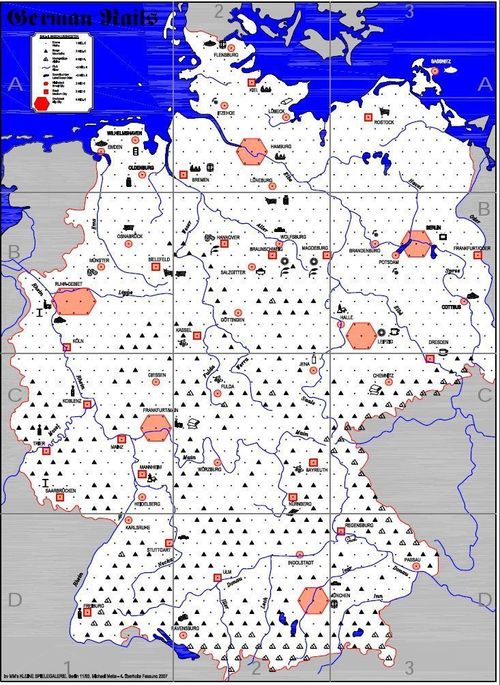
The map. The map shows Germany within its present-day borders, with 56 cities (6 of them big cities or metropolitan areas), terrain markers (plain, mountains, high mountains), trade goods, waters and borders. The terrain markers (also called milestones) are arranged on a triangular grid. Tracks are built between them and trains run along them. The trade goods are assigned to the cities (see the goods overview).
The event cards. Each shows an event that affects players, trains or tracks. Effects marked "for one round" take effect after the current player has finished his turn. All other effects take effect immediately. An event generally affects all players who are in the stated region or who enter it in the same round.
The contract cards. Each shows three possible contracts, of which one may be fulfilled. The cards show the destination, the type of goods and the payment. Only one piece of goods is requested and paid for per contract! After a contract is fulfilled, its card goes to the discard pile and is replaced by a new one.
The trains. There are five different train types in the game:
| Type | Speed | Cargo space |
|---|---|---|
| A - the freight train | 9 miles per round | 2 goods |
| B 9 - the heavy-load train | 9 miles per round | 3 goods |
| B 12 - the express train | 12 miles per round | 2 goods |
| C 12 - the super-freight train | 12 miles per round | 3 goods |
| optional: C 15 - the ICE | 15 miles per round | 2 goods |
Each player starts with a freight train. During the track-building phase he may upgrade his locomotive one level for 20 million DM (for example, from the A locomotive to either the B 9 or the B 12 locomotive). For only 5 million DM a locomotive can be converted within its level (B or C). Trains are upgraded or converted on the spot at the end of the round. If cargo space is reduced, a good goes overboard.
Variant: In a two- or three-player game, a second locomotive (type A) may be bought for 30 million DM. It starts in any big city that the player has already connected.
The locomotives. Each train is represented on the board by a locomotive.
The overhead markers. Each player receives a pen for building (drawing) his tracks on the board. A player's locomotive and pens should, as far as possible, be the same colour.
The goods. There are 33 kinds of goods in the game, in differing frequencies (see the goods overview). Goods are picked up in the cities that offer them, when needed, and delivered at the destination. One piece of goods occupies one cargo space in a train. Goods may also be unloaded in any city without a contract, where they are then available to every player. If a good has lain in a city for four rounds, it returns to the supply.
The money. Money is counted in millions of Deutsche Mark, abbreviated Mio.DM.
Setup
Each player starts with 60 million DM, one freight-train card, one locomotive and one overhead marker.
Each player also receives 5 contract cards, chooses three of them, and places the remaining two at the bottom of the draw pile. Event cards are replaced by contracts.
The remaining contract and event cards are shuffled together and placed beside the board, within reach of all players.
Each player reviews his contracts, chooses a big city as the starting point of his network, places his locomotive on the city centre and plans his first track building.
The player who first knows how he wants to build his network becomes the starting player of the first round. Play proceeds clockwise.
At the start of round 4, three contract cards (no events) are drawn and laid out as "public contracts".
Turn Sequence
Starting with the current starting player, each player performs the following actions during his turn:
- Movement of the train, loading and unloading of goods, fulfilment of contracts.
- Building new track or upgrading the locomotive.
Instead of a turn, a player may also pass: he discards all of his contract cards and draws three new ones.
1. Movement and Goods Transport
Movement
A train moves only along existing track networks, from city to city. The speed of a train gives the movement points it has available each round. Each step from one terrain marker to the next costs 1 movement point. The movement points need not be fully used. Any number of trains may travel on the same track or stand in the same city. A train may load or unload goods in any city it passes through.
Use of Track Networks
Using one's own track network is free. Using another player's track network, however, costs 4 million DM per network and round, and this fee cannot be refused to anyone at this rate. The money goes to the player who owns the track being used. It is possible, however, to use another player's track over one or more rounds at a rate agreed in advance. Agreements may likewise be made about supplying goods to agreed cities. Note that a good may lie in a city for only four rounds.
Loading Goods
Goods may be loaded when a train passes through the city in which the good is available. The cargo capacity of the train must be observed: one good per cargo space only. A player does not need a matching contract in order to pick up a good. Loading costs nothing and has no effect on movement.
Delivering Goods
If a player delivers a good in a city where a contract of his requires it, the contract card goes to the discard pile and is replaced by a new one, the good returns to the supply, and the payment goes to the player's account. He may then continue moving his train until his movement points are used up. When the draw pile is used up, it is reshuffled.
Public Contracts
In addition to his own contract cards, a player may also fulfil the contracts of the publicly displayed cards. Because of competition from the other players this carries a certain risk: whoever first fulfils a card's contract takes the card and replaces it with a new one.
Card Limit
Each player always holds three contract cards in hand. Exception: in a two- or three-player game, when a second train is bought, the number of cards rises to four.
After movement is complete, the player may expand his track network or upgrade his locomotive.
2. Track Building
The game begins with no track networks. In the first round the players only build out their networks; no trains move.
Spending Limit
In each round every player may spend up to 20 million DM on track building and on upgrading the locomotive (or 30 million DM for the second locomotive in a two- or three-player game).
Building Track
Track is built by drawing a line from a terrain marker to the nearest terrain marker on the triangular grid. Where there are no markers because of waters or borders, track cannot be built there. Within big cities no track building is necessary.
Two terrain markers may be connected by at most one track. Several tracks may, however, cross at one marker.
At the start of the game a player begins his track network from a big city of his choice. From then on, branching off is allowed from any point of the existing network.
Connection Restrictions
Each (round) small town and each ferry port may be connected by only two players; each (square) medium town by three players; and the big cities by all players. As long as a town has not yet been connected by the possible number of players, the way into the town (or ferry port) may not be blocked to the other players.
During one round a player may not build out of a big city more than twice.
Locomotive Building
Instead of expanding his track network, a player may upgrade his locomotive (for 20 million DM) or buy a second locomotive (for 30 million DM). Converting a locomotive (for 5 million DM) may be done during track building. See the above for details.
The bank gives no credit for track building or for buying locomotives.
The following costs apply for connecting a terrain marker, according to its terrain type:
| Terrain | Cost |
|---|---|
| Plain (point) | 1 Mio.$ |
| Desert (brown circle) | 1 Mio.$ |
| Jungle (green circle) | 2 Mio.$ |
| Mountain (black triangle) | 2 Mio.$ |
| High mountains (white triangles) | 5 Mio.$ |
| Small town (circle) | 3 Mio.$ |
| Medium town (square) | 3 Mio.$ |
| Big city (hexagon) | 5 Mio.$ |
| Ferry port (anchor) | see the ferry line |
Additional costs for crossing waters:
| Water | Extra cost |
|---|---|
| River (blue line) | +2 Mio.$ |
| Wadi (brown line) | +0 Mio.$ |
| Lakes, bays | +3 Mio.$ |
The costs for crossing waters are added to the normal connection costs. Thus connecting a mountain across a river costs 4 million DM.
Not all terrain markers shown here occur on the German map (see also the table on the game board).
End of the Game
If a player has 200 million DM or more after fulfilling a contract, he must announce this (but not the exact amount).
The game ends as soon as a player has at least 250 million DM and has connected five big cities. The richest player then wins.
Variant I - The Fast Game
Winning sum: The game ends with a winning sum of 350 million DM.
Card limit: Each player now holds five contract cards in hand (plus two when he owns a second train).
Movement points: Trains now have speeds of 15, 20 and 25 miles per round instead of 9, 12 and 15.
Loading costs: Loading or unloading goods costs 1 movement point per good.
Spending limit: Up to 30 million DM may be spent per building round. Thus a train may be upgraded and the track network extended for a further 10 million DM.
Depots: Each player may set up a depot in any big city for 10 million DM. He may at any time unload goods there, or have other players unload goods there. A depot holds three goods for an unlimited time. However, only one good of each kind may be stored in the same depot. Loading or unloading goods from or into depots also costs one movement point. Storing goods costs an additional 1 million DM per good. In one city a maximum of three players may set up a depot.
If a player has a good in the depot of a city where one of his contracts requires that good, he may fulfil the contract directly from the depot. The sale costs one movement point.
Variant II - The Two-Player Game
Quantity of goods: From each kind of good one token is removed from the game.
Connection rights: A (round) small town may then be connected by only one player. One of a player's contract cards must name this town, or show a good available there. When such a town is connected, the corresponding contract must be carried out.
Additional offers: Each good may be unloaded in any city. If the good is available there anyway, it is returned to the supply. If not, it stays where it lies until a player picks it up or it is replaced by a new good.
Translator's note
The German original contains a few printing slips (for example, "aus ausgeführt" in Variant II, and "Dollar" and "Mio.$" alongside the "Mio.DM" used everywhere else). These are transcribed as printed, and the sense of the German text is what this translation follows.