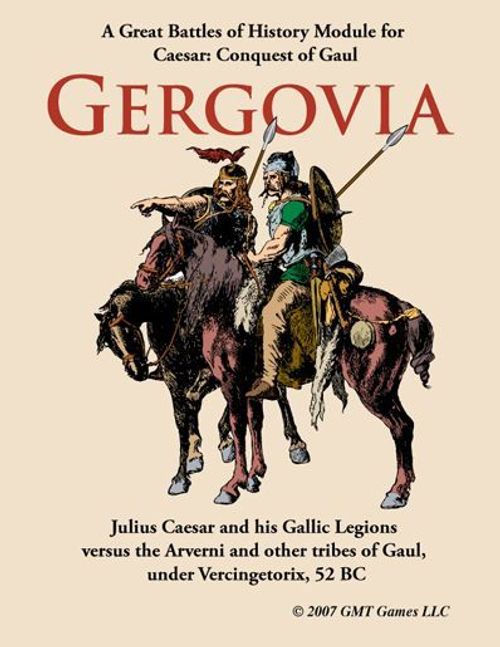
Gergovia
Gergovia Rulebook
Table of Contents
Table of Contents
- Components and Information
- Corrections to Caesar: CoG 2nd Edition
- New and Changed Rules for This Module
- Information on the Simplified GBoH Version
- Corrections for the Simplified GBoH, 2nd Edition (v1.1 & v1.2)
- Special Rules for Gergovia
- The Battle
- Simplified GBoH Version
- Principal Sources
- Tables for Gergovia
Components and Information
The module contains:
- a 22 x 33 inch terrain map
- 1/2 sheet of counters (40 in total; translator's note: the French edition says 140)
- 1 sheet of lists and tables
- this rulebook
Required from C/CoG: the 2nd edition rulebook (2006), the lists and tables, the information markers, and the counters for the troops and leaders listed below.
The Map. The terrain map shows the ground around the Gallic hill town of Gergovia near Clermont-Ferrand in France. A hex grid governs movement and combat. The effects of the different terrain types are given in the rules and on the lists.
Historical note: the site has been excavated and very detailed maps of the battlefield exist.
The Counters. Most Roman combat units are taken from C/CoG; a few come with this module.
Lists. The terrain effects list comes with this module. All other lists and tables come from C/CoG, except where the special rules say otherwise.
Scale. Each hex is roughly 90 m across.
Playing time. GERGOVIA takes about 4 hours.
Corrections to Caesar: CoG 2nd Edition
The following corrections to Caesar: The Conquest of Gaul, 2nd edition, apply.
6.2 Natural Terrain
6.23 Clarification: this section refers only to terrain that reduces cohesion, as listed on the movement cost table.
6.4 Movement in Column
Only cohorts, not light infantry (LI), may move in column.
8.3 Melee
8.36 #B: the last sentence reads: "If one side has more than one unit type in the combat, the owner decides which type he uses for the column of the melee table."
#2: the last sentence of the example is deleted: there is no SRD table.
10.3 Rout and Retreat
10.32 Addition: "If no hex in the vicinity of a hex around the cohort's eagle is free, the cohort retreats to its camp, following #2 below."
Tournament Play
For tournament play, a rout-point auction is suggested to decide who plays which side: each player secretly writes down his bid for the side he prefers. Both bids are revealed simultaneously, and the bid with the lower rout limit wins.
Game note: this applies to all C/CoG battles. GERGOVIA has its own version of this, given below.
New and Changed Rules for This Module
4.2 Roman Command System
4.21 Numidian light infantry are treated as auxiliaries.
6.7 Camps
Design note: the C/CoG rules for fortifications are simplified versions of those in Caesar/TCW. The attack on Gergovia requires more detail, so the C/CoG rules are replaced by the following.
6.71 Roman camp fortifications (walls, towers and gates) are used in GERGOVIA. The small Roman camp, however, has no towers, only walls and gates. Vercingetorix's allies camped at the foot of the town walls, without camp structures or wagons. For that reason there is no Gallic camp.
Design note: we believe the Gauls slept in the town, and used the camp only to drill and to display their strength.
Walls and gates of Gergovia: Gergovia is a fortified town with a wall of stone and timber, accessible through its gates. The Romans could not formally besiege it for lack of time and equipment.
Historical note #1: their meagre means and the well-defended walls did not stop some legionaries from trying. They won the respect of their comrades and an early grave.
Historical note #2: the women of Gergovia mocked the legionaries from the walls, bare-breasted. It is unclear what this was meant to convey, but it is the only memorable scene in the French film "Vercingetorix" (which is more ridiculous than epic). We apologise for the lack of counters to represent it.
6.72 Units of both sides may not cross a fortified hexside (even one of their own side) to retreat or rout. Gates of one's own side let units in; gates of the opponent let them out. Units other than cavalry may cross fortified hexsides or hexes at the cost of movement points and cohesion loss (the values are on the Movement Cost table, the base game's MP list, which is included in this module). If the unit does not have enough MPs for this, it may not cross.
Game note: the special battle rules contain further restrictions due to the walls of Gergovia.
6.73 Zones of control (ZOCs) [7.2] do not extend over fortifications. Only in melee across a fortified hexside do the units involved exert a ZOC on each other (in both directions). The melee marker should show this. For reaction fire under 8.2, the ZOC rule applies as it would without fortification.
6.74 Melee across fortified hexsides gives a column shift on the Melee CRT:
- 4 columns left (4L) if all defenders are in Gergovia and are attacked over the wall.
- 3L if all defenders are in Gergovia and are attacked through the gate.
- 2L if all defenders are in the Roman camp and are attacked over a wall or gate.
6.75 Fire: units outside a camp or Gergovia may fire at units inside only if the target stands adjacent to a wall or gate hexside. Such fire suffers the following die-roll modifiers:
- If arrows are shot, add two (+2) to the fire result die roll.
- If javelins are thrown, add four (+4) to the fire result die roll.
Firing out of Gergovia or a Roman camp is normal, but the firing unit must stand on a wall or gate hexside.
6.8 Barbarian Impetuosity
Applies to the Gauls and to the Aedui allied with the Romans. When impetuosity occurs is the player's choice. Impetuosity is declared, and the relevant rules are then followed. When two of the player's own units have entered enemy ZOC, the impetuosity ends in the following game turn.
8.1 Fire Volley
8.17 Point 3 is omitted and replaced by 6.75 above.
8.3 Melee
8.32 Units attacking over a hexside with a wall may not be attacked together with units that are not attacked that way.
Game note: this means that a Roman unit before Gergovia which has a Gallic unit outside the town in its ZOC may not attack a unit inside the town. It must first attack the unit outside, and only then the one inside; and a Roman unit may attack only once.
8.4 Advance After Melee
Units attacking from inside, over a wall or gate hexside, need not advance after combat. Units attacking over such a hexside from outside must advance, and rule 1 applies if their advance would lead to their rout.
8.44 The exception for cohorts does not apply to fire over a fortified hexside.
8.5 Barbarian Ferocity
The Gauls and the Aedui allied with Rome can become ferocious, but only during impetuosity (6.8).
8.7 Combat Tables
8.71 The fire range and result table. In addition, the following supplements and modifiers apply:
(a) For scorpions, use the line for catapults.
(b) Further die-roll modifiers:
- +1: stone wall
- +2: archers firing from outside, over a camp wall, a town wall or a gate
- +4: javelins thrown from outside, over a camp wall, a town wall or a gate
8.74 The melee result table. In addition, the following terrain effects apply:
- 4L: all defenders in Gergovia are attacked over a wall hexside
- 3L: all defenders in Gergovia are attacked over a gate hexside
- 2L: all defenders in the Roman camp are attacked over a wall or gate hexside
9.3 Roman Artillery
9.31 The towers of the large Roman camp in the southeast of the map have a built-in scorpion unit (not a counter) with a range of 7 hexes.
9.32 These scorpions are immobile, and are therefore printed on the map.
9.33 Scorpions fire only in reaction, and only once per Gallic command phase. Any Gallic unit that comes within range is a target. Each unit may be fired at only once, but all eligible units may be fired at.
9.34 Scorpions may not fire through walls.
9.35 Scorpions are destroyed if a Gallic unit enters the tower.
10.1 Cohesion
10.14 The Gallic player may recover cohesion losses in his units, but only one hit per order.
10.3 Rout and Retreat
10.32 Romans retreat to the nearest camp, not to the eagle standard. Routed Roman units in a camp stay there. Gauls retreat to the town. Routed Gauls in the town stay there.
10.4 Rally
10.44 Roman units do not rally to the eagle standard.
Game note: the proximity of the camps has robbed the eagle standards of much of the effect they had in field battles. For the sake of balance this rule may be dropped.
10.5 Cavalry Pursuit
This rule does not apply.
10.6 Army Rout and Retreat
This rule is removed. GERGOVIA has its own conditions for impetuosity, given below.
Information on the Simplified GBoH Version
This section gives general information for adapting Gergovia to the simplified GBoH rules. Specifics such as deployment, formation lists, initiative, weakening, army-retreat thresholds and the scenario's special rule changes are given in the battle section of the module.
Deployment. The standard rules apply, with one important exception: leaders may be placed in any hex that contains a unit they may command under the formation list.
Formation Lists. Each player has a formation list that reflects the organization of his army. Each row shows the units of a formation and its leader, which can be activated together in one turn. If "and/or" is not printed next to a formation, all of its units (even if of different types) must be activated. Otherwise any combination of the different types may be activated together, but then always all units of a type. Formations without their own commander are auxiliaries. Leaders with initiative (who can seize a turn) have a number to the right of the slash (/), which gives their number of attempts per game. Some leaders command more than one formation, but the initiative is independent of which formation they activate after seizing the turn. A dashed line shows that distinct formations are led by the same commander. Without explicit mention, such formations may not be activated together.
Initiative. Leaders who can seize a turn have the number of attempts per game given as a number.
Weakening. Units that may be in a weakened state are listed.
Tournament Play. The options of the standard game also apply to the simplified GBoH.
Corrections for the Simplified GBoH, 2nd Edition (v1.1 & v1.2)
4.1 Formations
4.11 The last sentence reads: "For some formations listed in the formation table, the chain may be drawn through one or more empty hexes that are not in enemy ZOC. Units in enemy ZOC outside the command range of their leader are out of command."
7.3 Conditions for Melee
7.31 Addition: "The defender must be in the ZOC of the attacker."
7.35 Addition: "If several units attack several defenders, all defenders must be in a ZOC of the attackers."
Special Rules for Gergovia
5.1 Permission and Restrictions for Movement
Only the terrain effects list of this module applies.
7.6 Cavalry Pursuit
Rule 7.6 of the simplified GBoH does not apply. Cavalry advance after combat in the same way as other units.
10.1 Artillery
The following rule applies to Roman artillery, and not the rule of the simplified GBoH:
Each of the towers of the large Roman camp in the southeast of the map contains a scorpion unit (not a counter). They are printed on the map. The printed number is the fire range: 7 hexes. The scorpions may not move.
Scorpions fire only in reaction, and only once per Gallic game turn. Any Gallic unit that comes within range is a target. Each unit may be fired at only once, but all eligible units may be fired at.
Scorpions are destroyed if a Gallic unit enters the tower.
11.1 Fortifications
The module has its own list of fortification effects; the list of the simplified GBoH does not apply. Rules 11.11 to 11.4 of the simplified GBoH remain valid. Rule 11.15 does not apply. All die-roll modifiers for movement and melee are dropped for attacks over a wall, an embankment or a sunken road. A unit that must attack an enemy across a wall hexside may not attack another enemy beyond the wall.
The Battle
Units and Deployment
Design note: it is unclear which unit started where. It appears that Legions VIII and X led the assault, some cohorts guarded the large camp, and the Aedui were camped north of the Romans. Many Arverni were somewhere to the west, perhaps in the woods, a few in the town, and the rest of the Gauls before the town.
Gallic Units. All Gallic units belong to the module.
Historical design note: there is no information on the size of Vercingetorix's army at Gergovia. It cannot have been very large, because he could not overwhelm the two legions that Caesar left in the great camp under Fabius when he marched against the Aedui (from which he had to return in haste to fight the battle here). This lack of data allows us to balance the game somewhat, so we have given the Great V roughly as many men as Caesar.
Translator's note: the German sentence here is garbled ("Dieser Mangel an Daten erlaubten uns die Spielbalance zu waren"); the sense above follows the French edition.
Gallic Starting Deployment. The Gauls are set up as follows:
- All Nitiobriges, Carnutes and Bituriges, and their leaders, in Gallic camp hexes in front of the wall of Gergovia (see below for the rules on Gauls in camp).
- All Arverni archers in Gergovia [a].
- At least 25 of the Arverni BI and Vercingetorix not on the map, near hexes 4001 to 4801 in the northwest corner [b].
- The remaining Arverni BI with Critignatus in wooded hexes north of and including row 4300 [b].
- The Arverni cavalry and Vercassivellaunus within 2 hexes of 4630.
The units may face in any direction.
[a] Without a leader; see below.
[b] When not playing solitaire, the Gallic player may place hidden units: he writes down their positions and reveals them when a Roman unit stands adjacent to their hex or when they move themselves. The number of units in woods or off the map may also be kept hidden.
Gallic Reinforcements. The Gallic player may bring Vercingetorix and his troops onto the map whenever he is allowed to activate him. They enter between hexes 400 and 480 (inclusive).
Translator's note: the German prints "400 und 480" here, but the same passage in the simplified section and the French edition give 4001 and 4801. The entry hexes are read as 4001 to 4801.
The first unit pays one MP to enter, and each further unit pays one additional MP (the third unit therefore pays 3 MPs). If the Gallic player leaves Vercingetorix off the map, he must pass and is finished for this turn.
Roman Forces. Rome takes the following units from C/CoG:
- The legions (with eagles) VIII, X, XI (Vet), XIII and XIV.
- As leaders, Sextius (XIII Legion), Fabius (VIII Legion) and Manucius (cavalry).
- 6 Gallic LN.
- 3 Cretan archers.
- 3 Numidian archers.
All other units are part of the module.
Roman Starting Deployment. The Romans stand as follows:
- Legion VIII (Fabius) in hexes 2712 to 2716 and 2613 to 2617.
- Legion X (Antistius) in hexes 2717 to 2721 and 2618 to 2622.
- Caesar with or adjacent to one of the units above.
- 3 Cretan archers in hexes 2814, 2818 and 2822.
- Legions XI and XIII (Caninius and Sextius) in the small camp, two units per hex.
- Legions XIV and XV (Roscius and Sulpicius), 3 Numidian archers and 8 Numidian LI in the large camp.
- All Aedui (Convictolitavus) within 2 hexes of 2540.
- Gallic (Roman) LN and Manucius within 2 hexes of 1733.
The units may face in any direction and must observe the limits on units per hex. Numidian light infantry (together with the Cretan and Numidian archers) are auxiliaries (see 5.6).
Erratum: Roscius should have a XIV on his counter, not a XIII.
Translator's note: the German prints a stray "s" after "XIII" in the Legions XI and XIII entry; it is omitted here.
Alternative Deployment. According to Caesar's account, he seems to have sent one legion from the small camp east at the start, to cover against Vercingetorix. For those who want to begin this way we offer the following variant:
- Caninius and the XI Legion are left out of the game.
- Vercingetorix and his Arverni may not enter the map in turn one.
Special Terrain Notes
Gergovia. The oppidum of Gergovia rises two levels above the hill on which it stands. Moving over the wall or through a gate incurs no climbing cost; the movement costs of the list apply. Before a unit crosses the wall, it must roll. If the die roll is at least the unit's TQ (quality value; the French edition writes QT), the unit may not cross and is finished for this command phase. If the roll is lower, the unit goes over the wall. Each unit rolls separately, and Roman cohorts must attempt to get over the wall individually. The attempt may not be made if the unit is adjacent to an enemy, or if the hex in Gergovia is occupied by a unit of its own side.
Historical note: the sources agree that the Romans had no aids for scaling the wall; the soldiers were hoisted onto it by their comrades.
Stone Walls. Two stone walls south and southwest of the town were recently built by Vercingetorix. Caesar writes that they were about 1.8 m high and a difficult obstacle to movement. The Romans evidently had no problem overcoming them. They probably consisted of loosely piled stones, which were simply knocked over.
Only infantry, not cavalry, may cross a stone wall, at the cost listed. After crossing, the die is rolled, and the unit is finished for this command phase if the roll is at least the TQ. Otherwise it may continue.
To knock down a stone wall, a unit must spend all of its movement points at the wall, outside enemy ZOC. The marker "Wall Down/Rubble" is then placed at the point of the breach.
Fire over a stone-wall hexside at a target standing at the wall receives a +1 modifier to the die roll. A stone wall blocks line of sight, unless the target stands at the wall.
The Sunken Road (Hohlweg). Roman units may move through the sunken road dug out by Caesar, even in column if they wish. However, units may not stand adjacent to one another in it, since the road was narrow. The road counts as flat terrain for movement purposes. The cost in the movement cost table applies to crossing it, not to using it.
Design note: the embankment on the north side is made of the spoil from the digging. It protected the Romans and hid them from Gallic view (the latter has no effect in play). It has no other effect in terms of game play.
Elite Commanders
Caesar was not at his best at Gergovia (Dodge accuses him of tactical indecision), so his initiative is reduced to '4'. Point 5.5 also applies to him: he may use elite command only in turn one.
Vercingetorix, on the other hand, was (in hindsight) at his best at Gergovia. He may use elite command once, at a time of his choosing, and has quite attractive ratings.
Game note: together with 6.8 and 8.5, this makes for rather dangerous Gauls.
Translator's note: the German for Dodge's assessment is garbled; "tactical indecision" follows the French edition. The name "Dodge" is printed as in the source (see Principal Sources).
Gallic Commands
Vercingetorix is the overall commander (OC); he commands all Gallic units.
- Convictolitavus commands the Arverni within his command range who are outside the command range of Vercingetorix.
- Vercassivellaunus commands the Arverni cavalry.
- Tribal leaders command only their own tribes.
Design and historical note: apart from Vercingetorix, the sources give no Arverni leaders. Nor is the name of the Bituriges' chief known. One could call him, for example, Ralph.
Camped Gauls
Although the Romans attacked only at midday, they caught the Gauls napping. The Gauls therefore do not start alerted.
Translator's note: the German says the camped Gauls are "nicht alarmiert" (not alerted); the French edition describes them as surprised, and the sense is the same.
Campers are alerted tribe by tribe, when their chief is activated. Alerting takes one entire turn; then the chief and his tribe are finished. All camped Gauls are, however, alerted at once when a Roman unit moves up to one of them.
Disordered. Until alerted, a unit in camp is disordered. Disordered units:
- give the attacker a column shift to the right on the melee table, if the unit is engaged in melee; and
- add one (+1) to each die roll for fire.
A tribe remains disordered until the start of the next activation of its chief.
Game note: disorder comes from the Gauls' nap at the start, not from combat.
Arverni Archers
The archers in Gergovia have no leader at the start. Without a leader, they may be activated in the auxiliary phase, before the Romans.
Tournament Play
We suggest an auction of victory points if both players want to play the same side: each secretly writes down his bid, both are revealed simultaneously, and the higher bid wins. The winner must then achieve the bid number of victory points in order to win.
Victory
Historical note: it is unclear what Caesar actually intended at Gergovia. His account of the whole operation is rather dishonest, which makes the victory conditions hard to define. What we know, despite Caesar, is that the Gauls won.
Translator's note: the German here reads "er ist rechts offen bezüglich der ganzen Operation" ("rechts offen" is not meaningful in context); the rendering above follows the French edition, "il est assez peu honnête dans son récit".
The first player to reach his victory point (VP) threshold wins immediately.
Roman Victory. Rome needs 35 VP to win. VP are gained as follows:
- 1 for each Gallic unit destroyed.
- 2 for each dead Gallic leader.
- 5 for a dead Vercingetorix.
- 2 for each Roman unit in Gergovia.
- 3 for occupying 3801, 3802 and 3901 (all three).
Gallic Victory. Gaul needs 25 VP to win. VP are gained as follows:
- 1 for each Roman unit exhausted (reduced) or routed (if a unit is both, it counts only 1 VP).
- 2 for each Roman unit destroyed (skirmishers excepted; exhaustion does not count then).
- 1 for each Roman skirmisher unit destroyed.
- 2 for each dead Roman leader.
- 5 for a dead Caesar.
- 1 for each Gallic unit in the Roman camp.
- 2 for each captured eagle standard (Aquila).
Translator's note: the French edition gives the same list, but in its simplified-GBoH section it gives the Gallic victory threshold as 30 VP, where the German gives 25 (see the simplified version below). The German figure is used.
Simplified GBoH Version
Gergovia (52 BC)
- Deployment: as in the standard version of the module, but without the Aquilae (eagle standards), which are not used.
- Playing time: about 2 hours.
- Balance: the Romans are favoured.
Roman Formation Table
| Commander | Formation |
|---|---|
| J. Caesar [OC] /3 | up to four legions [a] |
| Fabius | Legion VIII |
| Antistius | Legion X |
| Caninius | Legion XI |
| Sextius | Legion XIII |
| Roscius | Legion XIV |
| Sulpicius | Legion XV |
| Convictolitavus | Aedui |
| Manucius /2 | all cavalry |
| (Auxiliaries) | all archers |
All formations may form a line with one empty hex between units.
[a] Rome may activate up to four legions and their legates if they are within the command range of Caesar (see 4.4 "Multiple Formations").
Translator's note: the German cross-reference reads "4. 4"; the French edition gives 4.14. The German reference is printed here as 4.4.
Roman units with two sides (possible weakening): veteran cohorts.
Gallic Formation Table
| Commander | Formation |
|---|---|
| Vercingetorix [OC] /5 | Arverni BI [a] not on the map |
| Critignatus / | Arverni BI [a] on the map |
| Vercassivellaunus /2 | Arverni cavalry |
| Teutmatus | Nitiobriges |
| Cotuatus | Carnutes |
| Vortex | Bituriges |
| (Auxiliaries) | archers in Gergovia |
All Gallic leaders use the lower of their command ranges for rule 4.11.
The Gallic player may bring Vercingetorix and his troops onto the map whenever he may activate him. They enter along hexes 4001 to 4801 (inclusive). The first unit pays one MP, and each further unit pays one additional MP (the third unit therefore pays 3 MPs). In the alternative deployment, Vercingetorix may not enter before Gallic turn 3.
[a] The Gallic player may activate all Arverni BI if Critignatus is within the (further) command range of Vercingetorix. Both leaders may then move and bring units under command.
Gallic units with a weakened state: none.
Special Rules
- First player: Rome begins without a die roll.
- Terrain: the simplified GBoH GERGOVIA list of terrain effects applies.
- Gergovia: the standard rule applies.
- Stone wall: a unit that spends all of its movement points at the wall, outside enemy ZOC, breaks it. The marker "Wall Down/Rubble" is then placed in place of the breach.
- Elite commanders: Vercingetorix has heroic presence; Caesar does not.
- Impetuosity (Ungestüm): when the Gallic player activates a tribe, he may declare it impetuous, but only once in the game. Impetuosity ends when the tribe has two units in enemy ZOC, but only at the end of the turn in which this occurs. While impetuous, the units of the tribe have their movement allowance (MA) increased by one and may move into contact with the enemy even if they are not under command. In melee they receive a +2 modifier to the die roll, but only when attacking. For this rule, the Arverni on the map and off the map count as two different tribes.
- Camped Gauls: camped formations are alerted at their first activation (or all camped Gauls are alerted together when a Roman unit moves up to one of their units). Alerting takes that whole activation. The formation is then disordered, which means: +2 to the die roll for rout checks resulting from melee, and +1 to all die rolls for fire. Disorder lasts until the formation's next activation; at that activation the formation may move and fight normally again.
- Arverni archers: play no role in the game.
Victory (Simplified)
Rome needs 35 VP to win, gained as follows:
- 1 for each Gallic unit destroyed.
- 2 for each dead Gallic leader.
- 5 for a dead Vercingetorix.
- 2 for each Roman unit in Gergovia.
- 3 for occupying 3801, 3802 and 3901 (all three).
Gaul needs 25 VP to win, gained as follows:
- 1 for each weakened Roman unit.
- 2 for each Roman unit destroyed (weakening does not count then).
- 2 for each dead Roman leader.
- 5 for a dead Caesar.
- 1 for each Gallic unit in the Roman camp.
Translator's note: the French edition gives the Gallic threshold for the simplified version as 30 VP. The German figure of 25 is used here.
Principal Sources
Caesar, Julius, translated by Anne and Peter Wiseman, The Battle for Gaul (David R. Godine, Boston, 1980).
Dodge, Theodore A., Caesar (Da Capo Press, NY, 1997).
Fuller, J.F.C., Julius Caesar: Man, Soldier, and Tyrant (Da Capo Press, NY, 1991).
Holmes, T. Rice, Caesar's Conquest of Gaul (Oxford University Press, 1931).
Translator's note: the German bibliography prints the Wiseman date as "980", the Fuller date as "99 )", and Dodge's first name as "Dasodore". The date and the first name are given as in the French edition; the German printing is otherwise unchanged.
Tables for Gergovia
Movement Cost Table
Columns: MP cost to enter or cross; cohesion penalty for SK/LI/BI, CO and cavalry (SK = skirmishers, LI = light infantry, BI = barbarian infantry, CO = cohorts). The MP or cohesion cost to the right of a "/" applies to units in march column. P = prohibited.
| Terrain | MP cost to enter/cross | SK/LI/BI | CO | Cavalry |
|---|---|---|---|---|
| Open ground | 1 | 0 | 0 | 0 |
| Woods | 2 | 0 | 1 | 1 |
| Rocky ground | 1 | 1 | 1 | 1 |
| Gallic camp | treated as open ground | |||
| Minor river | +1 | 0 | 1/0 | 1 |
- [a] Units not listed have no cohesion effect from movement.
- [b] After crossing, the unit rolls: if the die roll is at least the TQ, the unit's movement ends in this command phase.
- [c] In addition, the cost of crossing the camp wall must be paid when entering from outside the camp.
- [d] The Roman player rolls for a unit that wants to cross the hexside: if the die roll is at least the TQ, the unit's movement ends in this command phase. Gallic units may not cross a hexside with the town wall.
- [e] The costs apply to units that enter or leave the road from or to a hex not belonging to it, and they exclude entering and leaving a camp.
- [f] Each infantry unit that is not a cohort, excepting skirmishers, and each cavalry unit (including Roman) pays one MP per corner turned. Cohorts may turn any number of corners for one MP. Skirmishers change facing for free. See 7.12 and 7.13.
- [g] Broken terrain means woods and rocky ground.
Translator's note: the German table prints "[a]" in the column header and "[e]" in its notes without a matching marker; they are kept as printed. "TQ" is the German abbreviation for the unit's quality value (the French edition writes QT).
Simplified GBoH Terrain Effects Table
Columns as printed in the source: CO, Leader, SK, BI, march column, melee DRM, fire DRM. DRM = die-roll modifier. In the source some rows show fewer than seven entries, and the PDF layout does not show which cell is blank. Such rows are given here in printed order, with the blank cells at the end.
| Terrain | CO | Leader | SK | BI | March column | Melee DRM | Fire DRM |
|---|---|---|---|---|---|---|---|
| Open ground | 1 | 1 | 1 | 1 | 1 | -- | |
| Woods | 2(h) | 2(h) | 2 | 2 | 2 | –1 | +1 |
| Rocky ground | 1(h) | 1(h) | 1(h) | 1(h) | 1 | –1 | - |
h = unit takes 1 hit; hh = unit takes 2 hits; (h) = unit pays +1 MP or takes 1 hit; P = prohibited.
- [a] Fire DRMs: spears +4, arrows +2.
- [b] After crossing, the unit rolls; if the die roll is at least the TQ, the unit's movement ends in this command phase.
- [c] The costs apply to units that enter or leave the road from or to a hexside not belonging to it and do not use it. Entering and leaving the camp are excluded. Additionally, the costs for crossing the camp wall must be paid when entering from outside the camp.
- [d] The Roman player rolls for a unit that wants to cross the hexside: if the die roll is at least the TQ, the unit's movement ends in this command phase. Gallic units may not cross a hexside with the town wall.
- [e] The costs apply to units that enter or leave the road from or to a hexside not belonging to it and do not use it. Entering and leaving the camp are excluded.
- [f] No movement-attack DRM applies to an attack over this terrain.
- [g] The cost applies per corner. Cohorts and skirmishers may turn as far as they like. Units in march column pay no facing cost to follow the sunken road.
- [h] Cohorts pay +1 MP to enter a hex containing another Roman infantry unit; leaders pay +1 MP to enter a hex containing a friendly unit; eligible units pay 2 MP to change their position in a stack.
Translator's note: the German table's own footnote markers are inconsistent (two notes are marked [c], and [e] appears in the road entry); the notes are kept in the order printed, with the markers as printed.