Geoprimo
Geoprimo Rulebook
Table of Contents
Table of Contents
Preparation
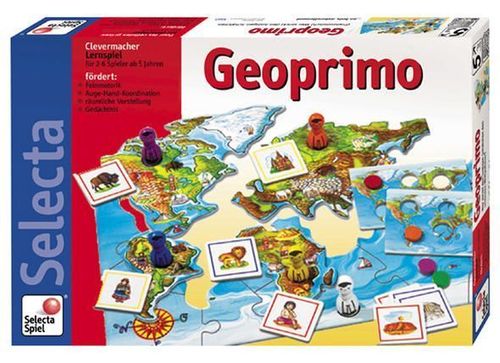
Working with the children, put together the map puzzle and place it in the middle of the table.
On every continent you will find a coloured circle where you place the corresponding continent piece.
Each player receives a little map of the world and lays it in front of him on the table.
Sort the picture cards according to the three levels of difficulty. You can recognize them by the colour of the margin. The easy cards have a blue margin, the cards of medium difficulty are yellow, and the margin of the difficult cards is red. Form a pile for each level of difficulty and shuffle each pile well. Place the three piles next to the map puzzle face down. Have the chips ready.
Aim of the game
The players try to obtain chips in all six colours to place on their little map of the world. You receive chips when you find the individual pictures on the map as quickly as possible and can snatch the corresponding continent piece.
How to play
Choose one player to turn over the first picture card of every pile.
Each card shows a picture that is also printed on the map and belongs to a certain continent. As soon as all the three cards are visible, the players try to find the pictures on the map as quickly as possible.
When a player finds a picture, he snatches the corresponding continent piece as quickly as possible. It is quite possible for a player to grab two continent pieces during a single round, but he may not snatch more than these two pieces.
If the picture cards show several pictures that belong to one single continent, the players may snatch the white piece that is placed next to the map.
Evaluation
As soon as the players have snatched the continent pieces, they compare the pictures on the cards with the pictures shown on the map puzzle.
- If a player has snatched the correct continent piece, he receives a chip of the continent colour and places it in the corresponding space on his little map of the world. If he already has a chip of this colour, he can´t take another chip on this round.
- If a player has snatched the wrong continent piece, he does not receive a chip and has to give back one of his own chips, provided he already possesses one. This is also the case if he has mistakenly taken the white figure.
- If a player has snatched the white piece, he may take a chip of the continent, which has the most motifs turned over on this round.
The next round begins when the figures have been replaced on the correct continents and the next player turns over the top cards of the three piles.
End of the game
The game is over when one of the players has completed his map of the world with six different chips.
Alternatively, the game ends when the three piles have been used up. In this case, the player with the most chips wins the game.
Variation 1
If older children or parents are playing, you can determine that the younger children only have to find the pictures with the blue margin, the older children must search for pictures with a yellow margin and the parents focus on the cards with the red margin. In this case, each player can only snatch one piece per round.
Keep your eyes peeled and pay close attention to the pictures!
Picture motif descriptions
The source prints no heading for this list; the heading is added by the transcriber. It is the description of all the picture-card motifs that the parents' advice refers to, grouped under the printed continent names.
North America
The Grand Canyon is a giant gorge in the USA. Here, the Colorado river has worn its way 1,800 metres deep to form the canyon. The wonderful coloured rocks show many details from the Earth's past.
The Indians inhabited America a long time before the white settlers came to this area. They lived in houses made of clay called pueblos, and in tents called tepees. They mainly hunted the bison that lived on the prairie. Unfortunately, the Indians were driven out by the white men who made them live in protected regions called reservations. Amongst the best-known Indian tribes are the Sioux and the Apaches.
The Mississippi is the longest river of the world. It passes through whole of North America and flows into the Gulf of Mexico which is part of the Atlantic Ocean. This river is famous for the giant paddle steamers which still travel on it. These ships do not work with propellers, but with big paddle wheels that gave them their name.
Human beings also live in the coldest areas of the world. These people are the Inuits who were once called Eskimos. The word "Eskimo" means "person who eats raw meat". This is because they hunted fish and seals and often ate the meat without cooking it. They also used to live in igloos – these are houses made of ice. But nowadays, they have normal houses and buy their food in the supermarket. Some of them do still go hunting but only in the summer.
The Statue of Liberty is the symbol of New York, the largest city in the USA. It stands at the entry of the harbour, is nearly 100 metres tall and was erected more than 100 years ago. France gave this symbol of liberty to the USA as a present. Inside, you can use a lift to travel up to enjoy the view over New York.
Hollywood is a part of Los Angeles, the second largest city in the USA. Nowadays, anyone who hears this name only thinks of the cinema. Since the opening of the first film studio in 1911, many films have been produced there. A large number of film stars live in Hollywood. This well-known word stands on the mountain above the town.
Before the white settlers and cowboys conquered the wide plains in North America, numerous bison lived there. The Indians hunted them and used their meat and skin. They belong to the cattle family, but have a long-haired coat. Bison can reach a length of almost 3 metres. Following near extinction, they have increased to more than 30,000 bison.
1,500 years ago, the Mayas ruled over Central America. They built many temples and stepped pyramids. The Mayas were also famous for their fantastic gold jewellery. Their descendants still live in Mexico, where you can still see many of their ruined monuments.
The Panama Canal is a waterway at the Isthmus of Panama that connects the Atlantic Ocean with the Pacific Ocean. It is nearly 82 kilometres long. A ship needs about 15 hours to travel through the canal. Before the canal was built, ships that started on the American west coast had to sail all around South America in order to reach the east coast.
South America
Most of the bananas you buy are from Central America. They grow on large plantations. Bananas need a warm climate with plenty of rain to grow.
The Sugar Loaf Mountain is the famous landmark of Rio de Janeiro, a large city in Brazil. It is almost 400 metres high and owes his name to its beautiful conical shape. Rio is also famous for its carnival. People celebrate several days in the streets wearing coloured costumes.
The Incas were a race of people who lived more than 500 years ago. They left a legacy of many interesting constructions. The best-known monument is the Machu Picchu, a mysterious ruined city discovered on a 2,000 metre mountain peak. Descendants of the Incas still live in South-America.
The llama and the smaller alpaca are South-American camels. They are much smaller than their relatives that live in the desert and do not have a hump. They mainly live in the high South-American mountains, called the Andes. They have been used as domestic animals since the time of the Incas. The people eat their meat and weave fabrics with their wool. You can even buy blankets made of llama wool in this country. Alpaca wool is soft and especially warm and cosy.
Most coffee beans are grown in Brazil and Columbia. They are a red cherry-like fruit when they are picked, then they are dried and peeled. Later they are roasted until they become dark brown, to be sold as coffee beans.
Europe
The Brandenburg Gate is the symbol of Berlin, the capital city of Germany. It is a former town gate that was constructed more than 200 years ago. You can also find it on the German 10, 20 and 50-cent coins.
Acropolis is the name given to a fortress that is situated above many Greek towns. The best-known one is the Acropolis in Athens, the capital city of Greece. Many of its temples and columns are still standing, even though it was constructed nearly 2,500 years ago. You may learn many things about ancient history there.
The palace guard keeps a close watch on Buckingham Palace, the residence of the Queen of England in London, the capital city of Great Britain. You can recognize the palace guard by his red uniform jacket and his hat made of bearskin.
The colosseum is one of the greatest sights in Rome, the capital city of Italy. The Romans built it more than 2,000 years ago. In those days, fights were held there between gladiators and lions for the entertainment of the Romans. More than 50,000 spectators could watch these fights.
The alpenhorn is an instrument that is mainly played in Switzerland. This wooden trumpet is up to 10 metres long. In former times, the farmers in the Alps sent messages from one mountain to another with the help of this instrument.
Venice is a very special city in Italy. You can travel around there using boats on the canals. These boats are called gondolas. They are steered by a gondolier who guides his passengers through the town, sometimes singing as he goes.
You can find the coloured onion towers of the Basilius Cathedral in Moscow, the capital city of Russia. The cathedral stands directly on the Red Square in the city centre. Tsar Ivan III built this church around 1550 as a symbol of his victory over the Mongolians.
Africa
The lion is a predatory big cat that mainly lives in Africa. It is considered to be the king of the animals. You can recognize the male by his voluminous mane. Lions live in little prides and hunt together. They chiefly eat antelopes, zebras and buffalos.
Zebras belong to the horse family. They are striped black and white and live in the steppes and desert areas of Africa. Zebras are gregarious animals that live in big herds. You will not find two zebras with the same striped design.
The hippopotamus mainly lives in African rivers. It frequently lies in the water so that you can only see its nose, eyes and ears. Hippos are herbivores – that means that they only eat plants. They can grow up to 4 metres long, weighing 2 tons. That is the weight of two cars!
Many African people do not live in houses like we do, but live in simple huts. They do not build them with bricks, but use bamboo, wood and clay. There is usually one community hut for several families.
The pyramids in Gizeh (close to the town of Cairo in Egypt) are one of the Seven Wonders of the World. They were built by the Egyptian kings, called pharaohs, more than 4,000 years ago and were used as tombs. The biggest of them, the Cheops' pyramid, was nearly 150 metres high – higher than most church towers.
Elephants live in Asia and Africa. They only eat plants and live in herds. The African elephant is taller than its Indian relative and has gigantic tusks made of ivory. As ivory is very precious, many elephants were hunted for it in the past. These days it is forbidden to hunt them.
The Massai are a very colourful pastoral tribe to be found in the wide plains of Kenya and Tanzania. They still live in the manner of their ancestors hundreds of years ago. In their community, the status and the importance of a man depend on the size of his cattle herd and number of his children. The Massai wear colourful clothes and broad rings around their necks that are decorated with pearls. They love to cover their bodies with art using red ochre.
Asia
A kimono is the Japanese national costume. Up until 150 years ago, kimonos were worn as everyday clothes. These days, they are only worn for special occassions such as weddings and for traditional dancing. There are a number of different styles according to age, the occasion and the sex of the person wearing them. The kimono in the picture is specially for women performing the traditional dances.
The yak is an animal with long, shaggy hair that belongs to the cattle family. It lives in the Asian highlands at altitudes of up to 6,000 metres high where it is held as a domestic animal. The people use it to carry heavy loads, to drink and to make butter and cheese with its milk. Yaks still live in the wild remote areas of Tibet.
The Taj Mahal is one of the best-known buildings in India. An ancient ruler had it built nearly 400 years ago as a tomb (mausoleum) for his wife. The walls of the building are decorated with marble and many jewels.
The Chinese wall is the only man-made construction in the world that can be clearly seen from space. It is 3,500 kilometres long and was built more than 2,000 years ago. The wall is 5 to 8 metres thick and served as a protection against attack.
In Asia, the water buffalo is one of the most important domestic animals. It belongs to the same family as our cattle, but has much larger horns. Buffalos mainly serve as pack animals to help the farmers. Their milk is used to make several products and their skin is used for leather.
Elephants live in Asia and Africa. The Indian elephant is a little bit smaller than its African relative. It has smaller ears and hardly any tusks. Since they are very strong and can carry heavy loads with their trunks, elephants are mainly used as work animals. Their handlers are called Mahout.
China is a large country where more than a thousand million people live. Their skin has a yellowish colour. The picture shows a Chinese person with the typical flat hat and a Chinese junk. That is the name of a boat with this special shape.
Australia
The kangaroo is a marsupial that only lives in Australia and eats plants. Big ones can jump up to 12 metres. Their newborn measure only 2 centimetres and immediately crawl into their mother's pouch. They stay there until they can stand on their own two feet. Animals of a smaller breed are called wallabies.
Many people think that the koala is a bear. But it also belongs to the family of marsupials. It grows up to more than half a metre in height and lives in trees. Koalas move very little. They mainly eat eucalyptus leafs.
The Aborigines lived in Australia long before the Europeans discovered it. They were hunters and collectors who travelled throughout the whole country. Unfortunately there are very few of them left today. Like the Indians in North America, they mostly live in reservations or have adapted to the life of the white man.
The Ayers Rock is a giant rock in the middle of Australia. It is about 4.5 kilometres long, 2.5 kilometres broad and nearly 350 metres high. The rock is also referred to as the red heart. The Australian natives, the Aborigines, name it Uluru and consider it a holy mountain.
The didgeridoo is an Aboriginal musical instrument, belonging to the natives of Australia. You cannot play a normal melody on it, but you can form sounds with your mouth. Didgeridoos are made out of skilfully painted, hollowed-out branches or trunks of a tree and serve as musical entertainment.
The opera house is the most famous landmark of Sydney, the largest town in Australia. The building was completed about 30 years ago and is intended to remind us of the sails of a ship. The opera house stands in Sydney harbour, opposite the well-known Harbour Bridge.
The Maori are the native people of New Zealand. They came from the islands in the South Pacific and are famous for their very creative face paintings. Their tradition still lives on in their dances and songs.