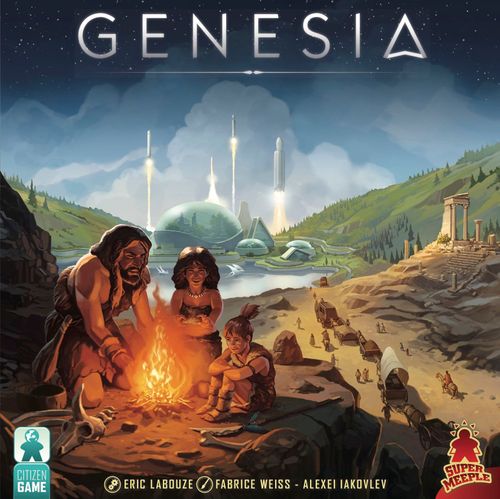
Genesia
Genesia Rulebook
Table of Contents
Table of Contents
Components
- 3 Genesia boards (3, 4, 5 players; the 1 or 2 player board is on the reverse of the 4-player board)
- 5 Continent boards (1 per color)
- 150 Clan pieces (5 colors x 30 Clans)
- 100 City pieces (5 colors x 20 Cities)
- 12 Secret Objective cards
- 90 Age cards (30 Age I; 30 Age II; 30 Age III)
- 5 War or Peace tiles
- 75 Coins (50 of value 1; 25 of value 2)
- 1 Turn Order board
- 5 Turn Order tokens
- 5 Player Aid tiles
- 1 pad of Score Sheets
- 1 Rulebook
Goal of the Game
Have the most points at the end of the game, thereby proving the supremacy of your people.
To do so, choose the right deck of cards during the draft at the start of the 3 Ages. Then, thanks to your cards and the choice of your actions, take possession of the Regions that will earn you the most points, without neglecting to develop new technological advances. In doing so, adapt your conquest strategy to your secret objective.
With 1 player: see the specifics on page 10 (the "Rules for 1 Player" section below).
Setup
A - Boards
- Each player chooses a Continent.
- Assemble the Continents around the Genesia board according to the number of players.
(Layouts are shown for 1 or 2 players, 3 players, 4 players and 5 players.)
B - Turn Order Board
Draw the player order at random and place the players' Turn Order tokens on the Turn Order board.
C - Clans and Cities
Each player takes the 30 Clans and the 20 Cities of the color of their board and places them in front of them.
D - Age Cards
- Prepare 3 decks of cards, one per Age. Each deck is made up of 5 sets of 6 cards of the same color (the colored dot at the bottom of the card shows the set's color).
- For a first game, take the following sets according to the number of players:
| Number of players | Blue | Yellow | Green | Purple | Red |
|---|---|---|---|---|---|
| 1-2 players | x | x | |||
| 3 players | x | x | x | ||
| 4 players | x | x | x | x | |
| 5 players | x | x | x | x | x |
- Shuffle the cards of each Age to make 3 draw decks (Age I, II and III), and place them face down beside the board.
Note: Put the unused sets back in the box. Once you are familiar with the game, do not hesitate to use sets of other colors. The sets used do not have to be of the same color from one Age to the next. Just make sure the number of sets used is always equal to the number of players.
Example: With 3 players, you can very well use the yellow, green and red sets in Age I; then the blue, purple and red sets in Age II and the green, purple and red sets in Age III.
E - Secret Objective Cards
Take the deck of cards and keep only the sets of the same color as the Age cards. Shuffle them. Deal two at random, face down, to each player. After reading them, each player chooses one of the two cards and places it face down in front of them, to reveal it to the other players only at the time of the final score count. Put the discarded cards back in the box without revealing them.
Anatomy of a Secret Objective card: name (e.g. "Petit peuple"); objective points (e.g. +5); effect clarification (e.g. "Including the Regions of your Continent."); color of the set. (Example card: "+5 per Region you occupy with 1 City and only 1 Clan.")
F - "War" or "Peace" Tiles
Each player takes a tile in front of them. One side is Peace (a dove), the other is War (crossed swords).
G - Coins
Place the Coin reserve beside the Age cards.
H - Score Sheets
Prepare a Score Sheet and entrust it to the player who is best at counting, with a pen!
Playing Age Cards
When to play an Age card?
Play your cards by placing them face up in front of you. Their effect is read aloud to the other players and then applied.
Cards can only be played during the Age to which they are dealt, on your turn, and in the phase corresponding to the icon.
- Cards with both the Growth icon and the Attack icon must be placed during the Growth phase but are active only during the Attack phase.
- Cards with both the Growth icon and the Expansion icon can be placed during the Growth phase or during the Expansion phase. If they are placed during the Growth phase, they remain active during the Expansion phase.
- Cards with all 4 icons (Growth, Expansion, Attack, End of Age) can be played in the phase of your choice.
- Some cards must be played outside your turn:
- Cards that copy the effect of a card played by an opponent must be played at the moment the card you wish to copy is put into play.
- Defense cards must be played at the moment you are attacked.
Duration of the effect
Most cards have immediate effects and become unusable once played. But the effects are valid only during the Age in which the card is played.
Invention cards
Cards with the Invention icon (light bulb) provide not only an effect but also earn Progress Points. Once played, keep these cards face up in front of you until the end of the game, because their Progress Points are counted at the End of each Age. Thus, the Invention cards of Age I will earn their Progress Points 3 times (once at each Age); this is the capitalization of the benefits of the technological Progress you will have developed.
Cost
Some cards have a cost in Coins that must be paid at the moment the card is played. Put the Coins paid into the reserve. No debt is allowed.
Discarding a card
It is not compulsory to play a card; you can discard it during your turn to take 4 Coins from the reserve. This can be useful, for example, for a card with a cost higher than what you can pay.
There is no limit to the number of cards you can discard. Discarded cards are not revealed to the other players.
Exceptions
The rules above apply to all cards unless explicitly stated otherwise on the card.
Anatomy of an Age card
Card back (shows the Age of distribution of the card and the color of the set; also the direction of the draft: Age I left, Age II right, Age III left). Card front: phase icon (Growth, Expansion, Attack, End of Age); Invention icon; name; cost; Progress Points of the Invention; effect; advantage for other players or effect clarification.
Game Rule
- The game is played in three periods, from Age I to Age III. In each period the players will draft 5 cards, possibly buy additional Clans, deploy them on the board and build Cities.
- Each Age is made up of 3 steps:
- A - The Start
- B - The Course
- C - The End
A - Start of the Age
At the start of each Age, each player receives:
- 15 COINS, which are added, if applicable, to the money not spent during the previous Age.
- 6 AGE CARDS corresponding to the Age being played, dealt face down and at random.
Draft the cards received (as explained below) to end up with 5 cards in hand with which to play the rest.
Note: At any time during the draft, a player may look at the cards they have already selected face down.
Draft
DRAFTING: The Draft is a method of dealing cards that limits luck and lets you partly control your hand of cards. Simultaneously, each player receives 6 cards, chooses one and places it face down in front of them before passing the remaining ones to the player on their right or left depending on the Age. They start again with the cards they get from their other neighbor until they have 5 cards in front of them. The last card remaining in hand is always discarded. The 5 cards selected in front of you are then taken into hand.
- Receive 6 cards.
- Choose 1.
- Pass the 5 remaining cards to your neighbor (from the left / from the right, according to the Age).
- Repeat steps 2 and 3 until you have 5 cards face down in front of you.
- Discard the last card without showing it to the other players.
- Take the 5 cards you selected in front of you into your hand.
B - Course of the Age
The Course of an Age comprises three phases played in order:
GROWTH > EXPANSION > ATTACK
- All players must in turn, following the order shown on the Turn Order board, play one phase before moving on to the next.
- You are not obliged to do every possible action of the phase, and you may do the same one several times, or do none and pass.
- You are not obliged to play all your cards. However, you cannot play a card outside its phase. Unplayed cards can be discarded face down to take 4 Coins from the reserve.
1 - Growth
On your turn, two types of actions are possible (in any order and as many times as you wish):
- Play the cards from your hand bearing the Growth icon.
- Recruit as many Clans as you wish at a cost of 2 Coins per Clan. You can do this at any time during your turn (before or after playing a card and even without playing one) and you are not obliged to buy them all at the same time.
The Clans recruited in this way are always placed either on your Homeland or in one of your Cities (in Age II or Age III), stacking them.
You have 30 Clans maximum. If a card makes you gain Clans and you do not have enough available, take only the remaining Clans.
You are not obliged to recruit all your Clans during this phase. You can also recruit some during the Expansion phase.
Once all your actions are done, it is the next player's turn in the Turn Order. Once all players have played their Growth phase, move on to the Expansion phase.
In Age III, it is during this phase that you must play the cards bearing both the Growth and Attack icons. These cards are active throughout the Attack phase but must be played as early as the Growth phase so that your opponents can know your future bellicose or pacifist intentions.
Stacking your Clans
- Stacking Clans allows you to place several in the same Region, but above all to see visually who has numerical superiority between two adjacent regions in case of an Assault.
- As soon as a Clan finishes its move in a Region where there are already Clans, they are stacked.
- If a City is present, the Clan or stack of Clans is positioned inside the City.
- You can always separate a Clan or a group of Clans from a stack to move them.
2 - Expansion
On your turn, three types of actions are possible (in any order and as many times as you wish):
- Play the cards from your hand bearing the Expansion icon. The Moves gained can be distributed among your clans as you wish.
- Recruit Clans following the same rules as during the Growth phase.
- Move your Clans as far as you wish at a cost of 1 Coin per Move. You can do this at any time during your turn (before or after recruiting or playing a card, and even without playing one).
Moving
Age I and II: 1 Coin allows you to move 1 of your Clans from 1 Region to 1 adjacent Region.
Age III: 1 Coin allows you to move 1 of your groups of stacked Clans (from 1 to 30 Clans) from 1 Region to 1 adjacent Region.
(Each arrow on the board diagram indicates regions adjacent to each other.)
Conditions of a Move
- You can move a Clan (or a group of Clans) to an adjacent Region that is free or that you already occupy with one or more Clans and/or a City.
- You can pass through a Region already occupied by an opponent (with one or more Clans and/or a City), by paying them directly, for each Region crossed, a Right of Way of 1 Coin per Clan (per stack of Clans in Age III) passing through (to be added to the normal cost of the move).
- You cannot stop in a Region occupied by an opponent (you can conquer it during the Attack phase).
Example (red player's Homeland):
- The Move of this Clan from the Homeland to adjacent Region 1 costs 1 Coin.
- The Move of this stack of 2 Clans from the Homeland to Region 2 costs 4 Coins (2 Regions x 2 Clans) in Age I and II or 2 Coins in Age III (2 Regions x 1 stack of Clans).
- The Move of this stack of 3 Clans from the Homeland to Region 4 costs 12 Coins (4 Regions x 3 Clans) in Age I and II or 4 Coins in Age III (4 Regions x 1 stack of Clans). In addition, the player crosses a Region occupied by the green player and must therefore pay them a Right of Way: 3 Coins (1 per Clan) paid directly to the green player in Age I and II or 1 Coin (1 per stack of Clans) in Age III.
CITIES: they cannot be moved during the game nor be destroyed, but they can be besieged and change owner during Assaults! It is not compulsory to leave at least one Clan present there.
Once all your actions are done, it is the next player's turn in the Turn Order. Once all players have played their Expansion phase, move on to the Attack phase.
Homelands
As an exception to the last rule of Moving, from Age II, some cards give Clans or Cities directly in an opponent's Homeland. Homelands are indeed the only Regions of peaceful coexistence between players: neither Clans nor Cities can be attacked there; and no Right of Way to pay.
3 - Attack
This phase can be made up of several successive rounds of Assaults.
Note: There is generally no Attack during Age I. In Genesia it is rare that the winner is the player who launched the most Assaults... but, as a fine strategist, you sometimes need to know how to launch a few decisive ones!
At the start of each round, out of sight, place your War or Peace tile on the table on the side of your choice, then, simultaneously with the other players, raise your hand to reveal your choice.
- If all players chose Peace: there is no Assault. The world is at peace; go directly to the End of Age step.
- If at least one player chose War: All players who chose War must launch one and only one Assault in Turn Order. Players who chose Peace cannot launch an Assault even if they are attacked; but they can defend themselves using cards.
If a player has played the card Nobel Peace Prize, they cannot take part in any Assault. They leave the Peace face of the tile in front of them.
Reminder: In Age III, cards with the Growth and Attack icons were played during the Growth phase and are active during all Assaults. Their effects are cumulative, that is, the clans lost because of these cards can add up or offset each other as the case may be.
Conditions of an Assault
With or without the help of an Attack card, designate precisely the attacking Region and the attacked Region. The attacked Region:
- Must be adjacent to the attacking Region.
- Must be occupied by opposing Clans and/or a City.
- Must have a number of Clans that is zero or strictly lower than that of the attacking Region.
Special case: If on your turn you no longer meet these conditions in any Region, you pass. If you meet these conditions in at least one Region you must launch an assault there.
The attacked Region cannot be a Homeland, but the attacking Region can be.
Resolution of an Assault
- If there are opposing Clans, decide on the number of Clans that you and the Defender will lose: you lose the same number, from 1 Clan up to the whole of your opponent's stack.
- If there are no (or no more) opposing Clans and there is a City, you can besiege it by losing 1 Clan (from the attacking Region) and replace it with one of yours.
- When there are no more opposing Clans or City, you can move for free there as many Clans as you wish from the attacking Region (if any remain).
Clans and Cities removed from the board return to the players' reserve and can be used again in the game.
Advice: Often, you will eliminate all the Clans of a Region to conquer it; but it can sometimes be worthwhile to launch an Assault just to prevent an opponent from having the 2 Clans that would allow them to build a City at the End of the Age, while limiting your own losses.
Important: To play a defensive card, there is no need to wait for your turn; play it as soon as you suffer an Assault. Offensive cards are played on your turn during an Assault, before or after the defender has played a defensive card if applicable.
- Once you have finished your Assault, it is the turn of the next player in Turn Order who chose War to carry out 1 and only 1 Assault.
- When all the players who chose War have carried out their Assault, begin a new round of Assaults by taking your War or Peace tile back in your hand.
You can therefore very well be the only attacker during an Age and launch as many Assaults as you wish even if all the others choose Peace every round.
Of course, a player who chose Peace one or more times in a row may decide to choose War in a following round.
The Attack phase ends in the round where everyone plays the Peace tile; you then move on to the end of the Age.
Example 1: You have 3 Clans in a Region and attack the adjacent Region of an opponent who has 2. You can choose to engage 2 Clans in this assault; each therefore loses 2 Clans and either you leave your last Clan where it is, or you abandon your Region to occupy the one you attacked. But you can also choose to engage only 1 Clan; each then loses 1 Clan. You have 2 Clans left and the opponent has 1.
Example 2: You have 2 Clans in a Region and attack the adjacent Region of an opponent who has 1 Clan and 1 City. You choose to engage 2 Clans; you lose all your Clans and replace the City with one of yours.
C - End of the Age
At the end of each Age, the players perform the following actions in this order and simultaneously (except no. 4, which is done one after the other):
1 - Create your Cities
Add 1 City for free in each Region that does not already have a City and that you occupy with at least 2 Clans (including in Age III because Secret Objectives may depend on it).
The stack of Clans present in the Region is immediately placed inside the City.
You cannot build more than 20 Cities. If a card or game situation allows you to build a City when they are all in play, ignore the effect.
2 - Play or discard your cards
- Play the cards from your hand bearing the End-of-Age icon.
- If you have cards left that you cannot or do not want to play, discard them for 4 Coins each.
3 - Count your Progress Points
Use the Score Sheet:
- Add up the Progress Points earned thanks to your End-of-Age cards played during this Age.
- Add those of all your Invention cards played during this Age and previous Ages, not forgetting those of your opponents that you may have copied (recognizable by the Clan piece of your color that you placed on it at that time).
Reminder: keep your Invention cards in front of you throughout the game. Even if their effect is valid only once, their Progress Points are counted at each Age; on the other hand, the Progress Points earned thanks to End-of-Age cards do not accumulate over the Ages.
Record the Progress Points thus acquired on the Score Sheet. In Age III, go directly to the End of the Game for the final count of Points.
4 - Play order for the next Age
The player who scored the fewest Progress Points during the current Age chooses first their position in the Turn Order for the next Age. They may choose to play first, last or in the position they wish. Then it is the second-to-last player's turn to choose, and so on until the player who scored the most Progress Points, who will take the remaining position.
In case of a tie in Progress Points scored during this Age, the tied players choose their respective position in the current Turn Order.
Example: The current order of players is Green, Red, Gray, Black. Red scored the fewest Progress Points during the current Age I, so he chooses first the position he wishes to occupy to play Age II and takes 1st position. Gray and Black scored the same number of Progress Points: Gray chooses first (because currently 3rd while Black is 4th) and takes 4th position, then it is Black's turn to choose, taking 2nd position. Finally, Green takes the remaining position; that is the price of progress!
Keep in front of you all your unused Coins and your Invention cards with their Progress Points visible.
That done, it is time to move on to the Start of the next Age (Age II or III).
End of the Game
The game ends at the end of the third Age. Follow this order for the final count:
The final score is the sum of the 4 categories of points:
1. Progress Points
Add up the Progress Points of the three Ages.
2. Radiance Points
Gain 2 Points for each Region of a Continent other than yours that you occupy with at least one Clan or one City.
- Opposing Homelands count.
- The Regions of Genesia do not count.
3. Conquest Points
Gain the points printed in each Region (including your Continent and Genesia) that you occupy with at least one Clan or one City.
Add up the points obtained; you then get the subtotal of Conquest Points gained.
Advice: to make counting easier, proceed in concentric circles by counting the number of Regions of the same value that you occupy on all the boards.
In the left column (Nb) of the Score Sheet, write this number on the appropriate line. In the right column (Score), simply multiply this number by the value of the Region.
4. Objective Points
Finally reveal your Secret Objective, then count and record the points thus gained. An unfulfilled objective does not lose points.
Note on Secret Objectives: 1 City can only be counted once. To make counting easier, remove from the board each set of 2 Cities after counting them.
Once the points you have earned in each category have all been recorded on the Score Sheet, add them up to get your final score.
The player with the highest total is declared the winner.
In case of a tie, the player with the most Objective Points is declared the winner. In case of a further tie, the winner is decided by Progress Points. In case of a further tie, the players share the victory.
Rules for 1 Player
Long ago, in a distant land, the very first human gave a single instruction to his descendants: to agree on the road to follow to develop two brotherly peoples and together take control of the best Regions of the wonderful island of Genesia and its surroundings.
In the solo game mode, you embody the spirit of that ancestor who will guide the two peoples in this quest. Your goal is to conquer as many Regions as possible and, if possible, the best ones. To do this, make the descendants and the many Clans of each of the two peoples prosper, exploring vast Regions, building their Cities, making the most of their inventions and finally asserting the supremacy of their collective intelligence over the Ages...
Goal and specifics of the 1-player game
- You direct 2 peaceful peoples so that they manage to develop brotherly over the Ages. Your only goal is to achieve the best final score considering only the people that obtained the lowest score.
- You play without the Secret Objective cards and there is no Attack phase.
However, you face another difficulty, and not the least:
- no Coins are dealt at the start of the different Ages,
- the Age cards in hand are not chosen.
Preparation
- Choose 2 Continents by assembling them with the Genesia board for 2 players.
Place the Clans and Cities of each of the two peoples next to each of the two Continents.
The Turn Order is unimportant (the player order board is therefore not used).
Determine at random the people that plays 1st in Age I; it will play 2nd in Age II and then 1st again in Age III.
- Prepare the 3 Age card decks: take the Blue and Yellow card sets and put back in the box the discarded cards as indicated in the table on the opposite page.
You will have 10 cards in the Age I and II decks, and 8 cards in the Age III deck. Shuffle each of the 3 decks.
- Start in Beginner mode. Move up to Expert level when you have reached a minimum score of 100 points. Then to Heroic mode as soon as you have reached a score of 130 points.
Course of the game
As in multiplayer mode, a game comprises three Ages played in a similar manner with a Start, a Course (made up only of the Growth and Expansion phases) and an End. The final score is calculated at the end of the End of Age III.
MONEY: At the Start of each Age, you receive no Coins, but you can always discard during the Age as many cards as you wish for 4 Coins per discarded card.
In Ages I and II, deal 5 cards at random to each people. In Age III, deal 4 at random. You thus play with two distinct hands, one for each people. The cards are placed face up on the table.
Then, the game proceeds exactly as in multiplayer (for example, when the Clans of one of your two peoples cross a Region occupied by the other people, you must pay a Right of Way to the people occupying the Region to be crossed).
Note: on the cards (as in the final points count), the terms "a Continent other than yours" or "opponent's" are to be understood respectively as "Regions of the Continent not containing your Homeland" or "your other people".
Scoring
Scoring is identical to the multiplayer game, without Objective Points. The Regions occupied by one people in the Regions of the other people's Continent earn Radiance Points.
Reminder: in solo mode, your final score is the lower of your two peoples' scores.
Beginner mode - cards to remove
Each entry lists the card name and its number.
- Age I: Grains d'orge (Barley Grains) no. 6; Potion d'extrait d'os (Bone Extract Potion) no. 11
- Age II: Chemin des Templiers (Templars' Path) no. 36; Bâtisseurs (Builders) no. 39
- Age III: Drones no. 64; Guerre ou Paix (War or Peace) no. 65; Droit d'asile (Right of Asylum) no. 70; Cyberdéfense (Cyberdefense) no. 72
Expert mode - cards to remove
- Age I: Invention de l'écriture (Invention of Writing) no. 5; Autour du gibier (Around the Game) no. 12
- Age II: Invention de l'astrolabe (Invention of the Astrolabe) no. 33; Route des épices (Spice Route) no. 42
- Age III: Drones no. 64; Guerre ou Paix (War or Peace) no. 65; Hyperloop no. 69; Cyberdéfense (Cyberdefense) no. 72
Heroic mode - cards to remove
- Age I: Gisement de silex (Flint Deposit) no. 3; Invention de l'agriculture (Invention of Agriculture) no. 9
- Age II: Invention de l'alchimie (Invention of Alchemy) no. 34; L'Appel de la croisade (The Call of the Crusade) no. 45
- Age III: Drones no. 64; Guerre ou Paix (War or Peace) no. 65; Cryptomonnaie (Cryptocurrency) no. 67; Cyberdéfense (Cyberdefense) no. 72
(Translator's note: English renderings of the card names in parentheses are translations; the French names and card numbers are as printed.)
Advanced Rules (2 to 5 players)
- If you wish to play while reducing the role of chance in the game to the strict minimum, you can remove the Secret Objective cards.
- You can play in teams (including 1 against 2 or 2 against 3) without changing anything in the basic rules: the final score of each team is that of the player with the lowest individual total.
- You can also create your own decks adapted to the configurations you wish to try out, by rearranging the current sets of cards and making sure to use 6 cards per Age and per player.
For example:
- If you want a more belligerent game configuration, gather all the Attack cards into a single set of cards put into play. Optionally, you can also allow the recruitment of Clans during the Attack phase.
- If you want to try a game mode that rewards your management skills, gather all the End-of-Age cards into a single set of cards.
Quick Rules (Player Aid)
A - Start of the Age
Each player receives: 15 Coins; 6 Age cards. Draft 5 cards.
B - Course of the Age
At any time, you can discard your cards for 4 Coins each.
1 - Growth (1 turn per player)
- Play your Growth cards.
- Recruit Clans at a cost of 2 Coins per Clan.
2 - Expansion (1 turn per player)
- Play your Expansion cards.
- Recruit Clans at a cost of 2 Coins per Clan.
- Move your Clans for 1 Coin per Move: Age I and II: 1 Clan from 1 Region to 1 adjacent Region; Age III: 1 stack of Clans from 1 Region to 1 adjacent Region.
Right of Way: If you cross a Region occupied by another player, pay them a Right of Way (in addition to the cost of the move paid to the reserve): Age I and II: 1 Coin per Clan crossing the Region. Age III: 1 Coin for 1 stack of Clans crossing the Region.
3 - Attack
Players secretly choose between War or Peace, and reveal it simultaneously:
- If all players chose Peace, there is no Assault; go to the End of the Age.
- If at least one player chose War, all players who chose War must launch one and only one Assault in Turn Order.
To launch 1 Assault, with or without the help of Attack cards, designate precisely 1 Region to attack:
- it must be adjacent to the attacking Region,
- it must be occupied by opposing Clans and/or a City,
- it must have a number of Clans that is zero or strictly lower than that of the attacking Region.
To resolve 1 Assault, with or without the help of Attack cards:
- Decide on the number of Clans that you and the Defender will lose (= the same number).
- If only a City remains (or is left) to the Defender, lose 1 Clan and replace it with one of yours.
- If neither Clans nor City remain to the Defender, you can move for free there as many Clans as you wish from the attacking Region.
Begin a new round of Assaults until all players choose Peace.
C - End of the Age
Perform the actions in this order:
- Create your Cities: Add 1 City in Regions that have at least 2 Clans.
- Play your End-of-Age cards.
- Count your Progress Points: add the Progress Points of your End-of-Age cards; add the Progress Points of all your Invention cards.
- Determine play order (except in Age III): The player who gained the fewest Progress Points this Age chooses their play order for the next Age. Then continue up to the player who gained the most. Ties choose in the current order.
End of the Game
At the end of the third Age, add:
- THE PROGRESS POINTS OF THE 3 AGES
- THE RADIANCE POINTS: +2 points per Region you occupy on opposing continents
- THE CONQUEST POINTS: value of the Regions you occupy (with 1 Clan or 1 City)
- THE OBJECTIVE POINTS.
Objective Points, then Progress Points, break ties.