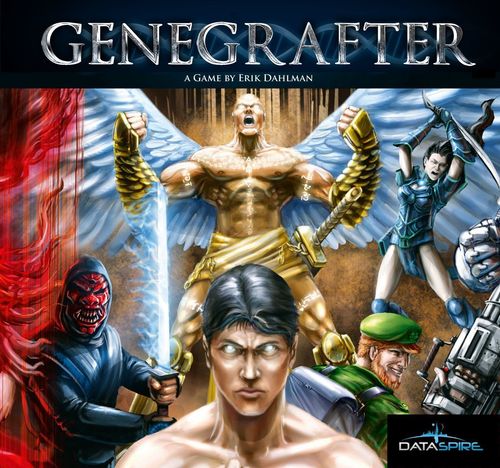
Genegrafter
Genegrafter Rulebook
Table of Contents
Table of Contents
Game Components
- 54 Card Deck
- 6 Blue Defense Dice
- 6 Red Attack Dice
- 4 Large Player Cards
- 1 Punchboard
- 12 Attack Tokens
- 12 Defense Tokens
- 1 Rulebook
Pregame Setup
Decide how many Event Cards will be used for the game:
- 1 - 2 = Easy Game. Use this amount if you do not want a lot of random elements in the game.
- 3 - 4 = Moderate Difficulty. If you would like a challenge and want to guarantee at least one random element to enter play to complicate the game, use this amount.
- 5+ = Very hard. If you enjoy the challenge of adapting to an ever changing battlefield, use this amount. Beware! Using this amount will severely hinder even your best laid plans!
Getting Started
Objective: Possess the most Genetic Markers at the end of the game.
This section will get you set-up and playing. Getting set-up is easy, staying alive... not so much.
- Give each player one oversized player card.
- Each player puts 3 Attack Tokens and 3 Defense Tokens on their card.
- Each player places their Infinity Die as well as a single D6 with 6 points showing as their Health Counter on their player card in the spot provided.
- Remove all cards with a [symbol, not reproduced in this text] and DNA Strand Cards from the deck.
- Shuffle the deck and deal 5 cards to each player.
- Break remaining deck into 3 stacks. Shuffle 1 DNA Strand into each stack. Divide chosen number of Event Cards (1 - 5) amongst the 3 stacks. Lightly shuffle and combine the 3 stacks.
- Place the deck face down in the middle of the play area and roll a die to see who goes first.
How to Play
Turn Phases
Each player performs the following actions on their turn:
- Draw 3 cards
- Play Character Cards
- Battle
- Discard
Draw 3 Cards
If you draw an Event Card, immediately show it to all players and follow directions on the card. Once you have done so, draw another card.
If the card is a DNA Strand, place it in the center of the play area. Resolve the Genegrafting Round, and then draw another card.
Continue this process until the player has drawn 3 cards that are not events, or DNA Strand Cards.
Play Character Cards
Players may play up to 3 Character Cards per turn. A player must play at least one Character Card every turn if they are able.
Characters are fatigued when first played and are unable to attack, but may still defend.
Characters may be equipped with Gear Cards immediately if the Player has any. One piece of Gear can be equipped to each Character per turn.
Ability Cards
The section below details the battle sequence of play. During battle, characters will use abilities represented by Ability Cards. Each Ability Card falls into one of 3 types represented by the colored sphere in the upper left corner of the card. If the color of the character's genetic marker matches the color of the Ability of the card, that character may reroll 1 die during combat. Every Ability Card your character plays that matches his genetic marker's color, allows another reroll die (i.e. during this round of combat James plays 3 cards, two of which match Brute's red genetic marker, affording James 2 rerolls during combat). Attackers resolve their rerolls first. Always use the highest result in the event the reroll is a lower number.
Battle
If it is your turn and you have a Character in play, you may battle another opponent's Character. You may battle more than one opponent during your turn, if you have enough Characters to do so. You may battle opponents in any order that you wish.
- Announce which Opponent that you wish to battle.
- Announce which Character that you are sending into battle. You may attack with any Character that is not fatigued. Resolve each attack individually.
- Defender announces which Character will defend.
- Players take turns playing Ability Cards face down, or remove an Attack or Defense token from your Player Card to add to the battle. Repeat Step 4 until both Players waive laying Cards or Tokens, or until both Players are out of Cards or Tokens to play.
- Once finished, flip the first Ability Card for each player, and resolve its effects. Continue flipping cards one at a time, resolving their efforts, until all cards have been flipped face up.
- The Attacker adds the number of dice from their Ability Cards, Attack Tokens, and the attack value of the Character that is attacking. The Defender adds the number of dice from their Ability Cards, Defense Tokens, and the defense value of the Character that is defending.
- Both players roll their dice. The higher total wins. In the event of a tie, roll again. (The Characters have matched strength, and go back into the fray again, determined to be the victor this time!)
- The losing Character is damaged and rotated 90 degrees to indicate that they are damaged. If the losing character was already damaged, then the Character is moved into the gene pool of the player that dealt the last blow.
- Place all Ability Cards into the discard pile.
- Repeat this process until all cards declared to attack are defended against. A Character may defend more than once, so long as he was not just moved to a Gene Pool. If a player's last Character is removed from play before all of the attacking Characters have been dealt with, then the undefended player is attacked directly. See Winning the Game.
Discard
If you have more than 8 cards in your hand, discard until you have 8.
Winning the Game
When the last DNA Strand is revealed, play continues for one more turn, ending with the person that drew the last DNA Strand. Once the final turn is complete, count up each Genetic Marker in your Gene Pool. Then, count up the face value of each Genetic Marker in play (Characters that are Genegrafted do not gain points for Genetic Markers grafted to them. They only count their original marker.)
The player with the most Genetic Markers wins. In the event of a tie, the player with the higher life total (see below) wins. If the players are still tied, the players roll a die and the highest number wins.
Alternately, a Player can win by knocking the other Player(s) out. Each Player starts the game with 6 Health Points. If a Player has no Characters to block during a battle, then they take one damage for each unblocked attacker. If a Player is reduced to 0 Health Points, then they are removed from the game.
Genegrafting Rounds
Whenever a DNA Strand Card is revealed, it initiates a Genegrafting Round.
During a Genegrafting Round, players are allowed to "Genegraft" any Character Card currently in their hand or in their Gene Pool onto any Character they currently have in play. Doing this does not affect the stats of the Character chosen. Instead, the Character is now associated with the Super Power of the chosen Genegraft, as well as the color of their Genetic Marker.
Place the chosen card underneath of the Character in the play area with the Super Power and Genetic Marker showing for easy reference. This character is now "Genegrafted" and can take advantage of Ability Cards with the newly acquired Super Powers and Ability Cards of the newly acquired Genetic Marker color.
Each time a DNA Strand is revealed, the number of Characters able to be Grafted increases:
- 1st DNA Strand: One Character may be Genegrafted.
- 2nd DNA Strand: Two Characters may be Genegrafted.
- 3rd DNA Strand: Three Characters may be Genegrafted.
There is no limit to the number of times a single Character can be Genegrafted. In Genegrafter rounds where multiple Grafts are permitted, you may spread them among your current characters, or you may attach them all to one Character.
Gear Cards
Gear Cards represent a special kind of card that is attached to a Character.
Each Gear Card shows which body slot it takes up in the top left-handed corner of the card. A Character cannot have two gear cards on the same body slot.
Characters can have as many gear cards as the Player wishes, as long as the body slot is available for use.
Special Rules
- The Golden Rule. Whenever a card's text directly contradicts the rules, the card takes precedence.
- Heal Minor Wounds. Resolves after all damage is dealt.
- Lucky Shot and Roll Again. Can be used on any roll during battle. They must wait to be resolved until there is at least one die that they can affect.
- Regeneration. Characters that have the Regeneration Super Power are able to heal their wounds. If a Player controls a Character that is wounded that possesses the Regeneration Super Power, that character is healed at the beginning of their turn. Turn the Character's card back up.
- Infinity. Characters that have the Infinity Super Power can use any Ability Card as if they had the matching power.
Infinity Die
Special, one use die roll. May only be used once per game. Declare use at any time during the turn. Once rolled, resolve its effects immediately.
Results of the Infinity Die as listed in the source:
- Resurrection Die. When rolled, allows player to restore any 1 character from any Gene Pool to life under his control. Any Genegrafts on that character remain in the controlling player's Gene Pool.
- DNA Marker. Allows the player to graft a character from their Gene Pool onto any character in play.
- Infinity Symbol. Allows the player to grant the Infinity Superpower type to any character in play.
- Draw 2 Cards. Allows the player to draw two cards from the deck.
- Discard 2 Cards. Allows the player to force an opponent of their choice to discard 2 cards from their hand. If that opponent has no cards, then they only draw 1 card on their next draw phase.
Card Types
- DNA Strands. The game ends once all three of these have been revealed. Initiates Genegrafting Round.
- Event Cards. Play these immediately when drawn.
- Ability Cards. Used to apply bonuses during battle.
- Character Cards. Used to wage battles with your opponents.
- Gear Cards. Stores Attack and Defense tokens.
- Player Cards. Stores Attack and Defense tokens.
Card Explanation
Character card: Card Icon, Card Name, Super Power, Genetic Markers, number of dice to add to Attack, number of dice to add to Defense.
Ability card: Card Icon, Card Name, Ability Type, Base Bonus (dice), Super Power, and the bonus dice for a Character with the matching super power (for example, "ALL:").
Event card: Card Icon, Card Name, Game Text.
Player card: Health Counter, Attack Tokens, Defense Tokens.
DNA Strand card: The game ends once three of these cards have been revealed.
Card Symbol Key
- Event Card
- Ability Card
- Character Card
- Genetic Markers
- Attack Tokens/Dice
- Defense Tokens/Dice
Ability Types: Mental, Energy, Physical.
Super Powers: Radiation Manipulation, Anti-matter Manipulation, Flight, Luck, Kinetic Manipulation, Teleportation, Telepathy, Infinity Power, Telekinesis, Gravity Manipulation, Electricity Manipulation, Clairvoyance, Shadow Manipulation, Light Manipulation, Super Strength, Regeneration, Pyrokinesis, Cryokinesis.
Example of Play
The example is shown on the source's card diagrams. The text of each step is given below; the card faces and dice faces are shown in the source images and are not reproduced.
Setup. Two DNA Strands have been revealed. Once one more is revealed the player with the most genetic markers wins. Jon, Mike and Sue are the players in this example.
Jon says he's going to battle one of Sue's Characters. At the moment Madlock is the only Character that Sue has in play, so he must be the target.
Sue is defending, so she plays first by playing an Ability card face down. Now, Jon plays an Ability card face down.
Sue opts to remove a Defense Token from her Player card, and plays that instead of an Ability card. Jon declares that he's finished instead of playing an Ability card or using an Attack Token.
Once both players have declared that they're finished, they begin flipping Ability Cards over one at a time, beginning with the last card played. Resolve each card's effects before revealing the next card. Continue revealing cards until all Ability Cards have been revealed and resolved.
Now both players add the bonuses that the Ability Cards indicate, including any Attack or Defense tokens to their Attack or Defense attribute.
Since Nebrus harnesses radiation as his super power, Jon adds two dice instead of just one to his Attack attribute. Since Nebrus' genetic marker matches the card's ability type, he may reroll 1 die during combat.
Jon receives 2 Attack Dice from Gamma Blast, and adds that to his 3 base Attack Dice, giving him a total of 5 Attack Dice.
Sue receives 1 Defense Die from Blind, and 1 Defense Die from the Defense token she added from her Player card. She adds that to her base Defense of 3, for a total of 5 dice.
Both players roll their dice; the highest total wins the battle. Jon rolls for a total of 18. He opts to reroll the 1 rolling a 3, which brings his result to 20. Sue rolls for a total of 13.
Jon has the higher total so Nebrus wins the battle against Madlock. Sue rotates Madlock 90 degrees indicating that he's been damaged.
Since there aren't any other players, the turn is over. If there were more players, Jon could have continued to attack each other player, repeating this process.
FAQ
I played Super Punch using a Character with Super Strength, do I get 2 Attack Dice or 3? You would get 2. For dice rolls, it is always the higher of the two, not cumulative.
What does healing mean? If a card is turned 90 degrees after being hit, some cards will allow you to 'heal' them by turning them back to their proper orientation. This cancels all previous damage so that a Character will remain in play after Battle has resolved.
My opponent attacked me last turn, can I still attack the Character they used? Yes. They can only attack with that Character once per turn, but any number of players can still target the Character on their turn during battle.
Regeneration. Characters that have the Regeneration Super Power are able to heal their wounds. If a Player controls a Character that is wounded that possesses the Regeneration Super Power, that character is healed at the beginning of their turn. Turn the Character's card back up.
Infinity. Characters that have the Infinity Super Power can use any Ability Card as if they had the matching power.