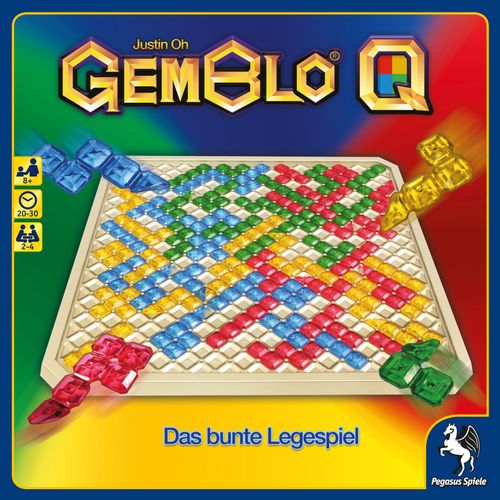
GembloQ
GembloQ Rulebook
Table of Contents
Table of Contents
Overview
Players: 1-4. Age: 5+. Playing time: 20 minutes.
Components
84 pieces of various shapes (21 pieces in each of 4 colors), game board, rules.
[The sheet shows the 21 distinct piece shapes, made of square parts and, on some pieces, a triangular part.]
Goal of the Game
Place the largest number of pieces of your color on the game board.
Setup
Place the game board in front of the players so that everyone can reach any corner of the board. Each player chooses a color and takes the whole set of pieces of that color (21 pieces).
- Game for 4 players: the whole game board is used. The starting points are marked with the number 4.
- Game for 3 players: the part of the board inside the borders marked with the triangle symbol and the square symbol is used; the starting points are marked with the number 3. Pieces are placed inside the playing area and may not go beyond its border. Only pieces with triangular parts may be placed on the border of the area marked with the triangle symbol.
- Game for 2 players: the part of the board whose borders are marked with the clover symbol and the cloud symbol is used; the starting points are marked with the number 2. Pieces are placed inside the playing area and may not go beyond its border. Only pieces with triangular parts may be placed on the border of the area marked with the cloud symbol.
The picture on the sheet is a schematic image of the board with the playing areas marked.
Gameplay
- Choose the first player at random; after that the right to move passes clockwise. On their turn each player places one piece on the board, starting from a starting point.
- Pieces of the same color placed on the board may touch only at corners (i.e. be connected through Q-points). [Picture: a correct placement, marked with a circle, in which same-color pieces meet at a "Q-point" corner.]
- Two pieces of the same color may not touch each other by their sides. [Picture: an incorrect placement, marked with a cross.]
- Pieces of one color may touch pieces of another color with their sides.
- Pieces lying on the board may not be moved.
- Try to take as much space on the board as possible with your pieces, so that it is harder for other players to place theirs.
- If a player cannot place any piece, they skip their turn. The game continues until none of the players has a possibility to place their pieces.
Meaning of the Triangular Part
If you use a piece with a triangular part at the right moment, it gives you a tactical advantage in the game.
- A. Some pieces have a triangular part. They are easier to place on the borders of the playing area.
- B. If a free space in the shape of a triangle is left between the pieces of other players, you can occupy it with your pieces.
- C. You can place a piece with a triangular part next to the central part of your own pieces.
End of the Game
As soon as all players can no longer place any piece on the board, the game ends and points are counted.
- Each square part of a remaining piece brings 1 penalty point.
- Each triangular part of a remaining piece brings 0.5 penalty points.
- The player with the fewest penalty points is the winner.
Example: the players play with four colors. Each has pieces left. Yellow scored 8.5 penalty points, red 8.5, blue 5, green 2.5. The green player won.
In Case of a Tie
If, when counting points, the results of two or more players are equal, the winner is the one who scores the fewest penalty points according to the table below.
[The table shows all 21 pieces, each numbered from 1 to 21 in the order shown on the sheet; the number of a remaining piece is its penalty value for the tiebreak.]
According to this table, the results of the players from the previous example are as follows: yellow (-8)+(-12) = (-20) penalty points, red (-7)+(-14) = (-21) penalty points. In this case the player using the yellow pieces is considered the winner.
Puzzle
Besides playing by the basic rules, you can use the pieces to create figures and pictures on the game board. See more variants of figures on the site evrikus.ru.