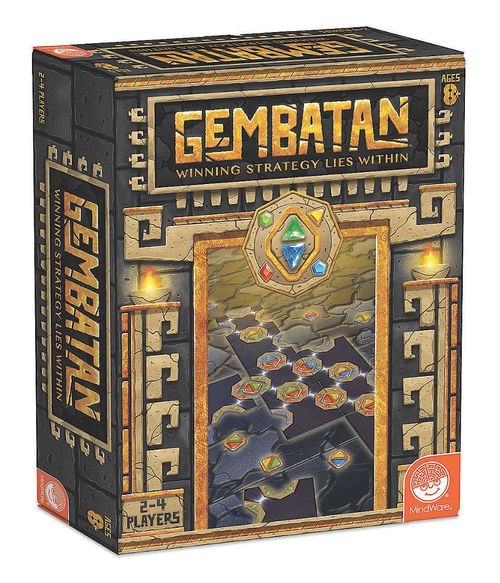
Gembatan
Gembatan Rulebook
Table of Contents
Table of Contents
OBJECT
To earn more points than your opponents by placing and making chains of gems on the board.
GAME SET UP
- Gather a pencil and paper to keep score.
- Arrange the tiles in the tray as shown.
- Place the gems face down in the gem tray.
- Each player draws 4 gems and 4 tiles from the tray without looking and places the pieces face up in front of them for all players to see.
- Draw and place one tile face up in the middle of the table to start the board.
- Choose a player to go first.
GAME PLAY
On your turn, add one or more tiles to the board according to the rules of tile placement.
When your turn is over, play passes clockwise to the next player.
Score your play according to the scoring rules.
TILE AND GEM PLACEMENT
-
For every tile you play, you must also play the connecting gem with the colors aligned as shown below.
Diagram: a gem placed on the connecting edge between two tiles, with the colors aligned. A gem placed with the colors aligned is marked with a green check. A gem placed with the colors misaligned is marked with a red cross.
-
Gems may be placed in either a socket created when you add a new tile to the grid, or by filling in a socket left empty by another player.
-
Each tile you play after the first of your turn must connect to a tile you already played that turn.
Diagram: a tile placed so that it cuts off a socket is marked with a red cross.
-
Your tile cannot cut off a socket.
-
If placing a tile creates more than 1 socket, you are only required to place a gem in 1 of those sockets.
SCORING
Every gem you add to the grid counts for one point, this includes gems played to fill an existing open socket.
If a gem that you add creates a diagonal chain of 3 or more gems that share a color, score one point for each gem in the line. You cannot form horizontal or vertical chains.
You score points for every gem in the chain, even if you are adding to a chain created by another player.
If you form a chain that shares both colors on the gems, you earn points for each color separately.
If you are able to play all 4 of your gems on your turn, you have scored a Gembatan worth 4 bonus points. (You do not need to play all four of your tiles to earn this bonus, just your gems.)
See scoring examples below.
TRADING IN
If you can't play, or in place of your turn, you can turn in any or all of your gems and / or tiles.
- Set aside any gems or tiles that you want to discard.
- Draw enough new gems or tiles to refill your inventory to 4 gems and 4 tiles.
- Return any discarded gems to the gem tray and return discarded tiles randomly in the tile holder.
WINNING
Play continues until there are no gems left in the tray, and either:
- One player uses up all of their gems, or
- A round passes with no player able to make any plays.
Each player then deducts one point for each gem they have left. The player with the most points wins!
SCORING EXAMPLES
Scoring Example 1. If you placed the center gem, you would receive 3 points for the red chain, 3 points for the blue chain and 1 point for placing the gem for a total of 7 points.
Diagram: the placed gem is marked with an arrow at the centre of two crossing diagonal chains, one red and one blue, each of three gems.
Scoring Example 2. If you placed the top gem, you would receive 3 points for the red chain, 3 points for the blue chain and 1 point for placing the gem for a total of 7 points.
Diagram: the placed gem is marked with an arrow at the top end of two crossing diagonal chains, one red and one blue, each of three gems.
STRATEGY TIP
When making your chains, observe the tiles and gems that other players have. Make sure they won't be able to add to your chains on their turn!