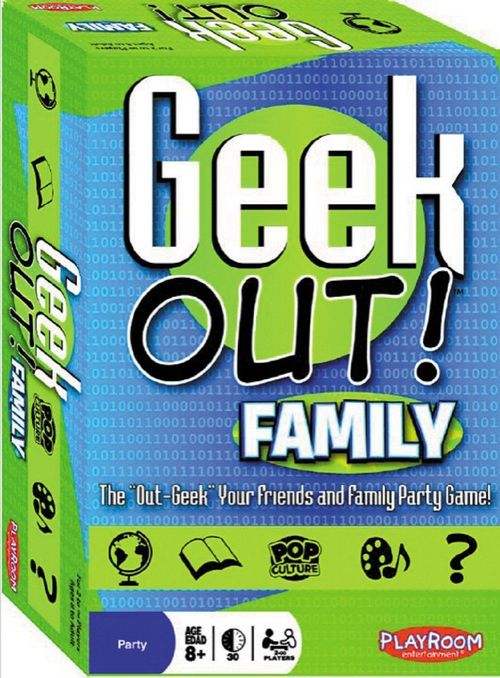
Geek Out! Family
Geek Out! Family Rulebook
Table of Contents
Table of Contents
Object of the Game
"Out-geek" your opponents by out-bidding and completing challenges in a variety of categories! Steal and score points by being able to complete bigger lists than your opponents, but don't bid too high or you could end up losing points in the end. Reach the Finish before your opponents do to win the game!
Contents
- 144 Geek Out! Family List Cards
- 20 Chips
- 1 six-sided Category Die, including a blank "wild" side
- 1 Gameboard
In Geek Out! Family each topic conforms to one of these categories:
- Science and History
- Pop Culture
- Words and Literature
- Art and Music
- Miscellaneous
Each card shows five topics, or challenges, organized by category. The colors of the categories correspond to the colors on the die. Each topic states the minimum number of items a player must list to complete the challenge. For example, if the challenge states, "Two Songs About Animals" then a player must name at least two to fulfill the requirement. Of course other players may bid higher and attempt to list more (see Game Play).
Set Up
Players may play one-on-one or divide into teams. Teams are suggested for games with groups of more than ten players and you can play with up to ten teams.
Take the cards, die, chips, and board out of the box. Place the entire deck of cards (face down), the die, and the board in a central location within reach of all players. Give each player two matching chips. Each chip has a symbol on one side, and the symbol with a red "no" on the reverse side. Each player places one matching chip in front of them, and the other chip on the "Start" position on the board, both with the "no" side down.
Game Play
Select one player (or team) to go first, who then rolls the die to determine their challenge category. In the case of a blank roll, that player gets to choose any category that they desire, before hearing the topics listed on the card. The opponent to the player's right then draws the top Geek Out! List Card and reads aloud the corresponding challenge. The player states clearly if they accept the minimum bid as listed on the card, or if they would like to increase it by bidding a higher total. "Bluffing" is encouraged!
Once the original player has made their bid, the option to bid passes to the next player, clockwise. That player may pass or bid higher, but may not bid the same number stated by the previous player. Players who wish to pass should indicate this by turning their chip to the "no" position when it's their turn to bid or pass, to help the bidding process move more smoothly. This continues in clockwise order until all players have passed, except for the last player to bid. The bidding process may take several rounds to get to this point. The highest bidder must then attempt to successfully complete the challenge.
Example: It is Jesse's turn, and he rolls the die getting the yellow Words and Literature category. Lisa, the player to Jesse's right, draws a List Card, and reads Jesse his challenge: "One Book in Which a Dragon Appears." Jesse can state, "I can list one," but being a fan of fantasy literature, he decides instead to raise the stakes, claiming, "I can list three." The option to bid higher passes on to the next player in either case. Beth, the player to Jesse's left, states that she can name four. Lisa doesn't want to risk losing a point and decides to pass, and turns her chip to the "no" position. This bidding process continues clockwise until all players have passed except one.
Once bidding is complete and the challenge has been accepted, the last player to bid may now attempt to complete their list.
If the challenge is completed successfully, the player who accomplished it earns 1 point. The player then moves their chip forward one space on the board. If the challenge is failed, the player who attempted it loses a point and moves their chip back one space. If the player's chip is on the "Start" space and they lose a point, then the chip moves to the -1 space and will continue going negative if they continue to lose points (see Scoring). Players on the -5 space who lose an additional point are out of the game (see Scoring Variants).
Note: More than one chip may occupy a space on the board. If necessary, the chips may be stacked.
On the rare occasion that no one bids above the minimum number listed on the card, no penalty will be given if the challenge is not completed successfully. The original player can still attempt to list the minimum number, but won't be penalized if they fail. If they succeed, they still move their chip one space forward.
Play then passes to the left (clockwise) of the last player to roll the die, and the process is repeated.
Scoring
Players will earn 1 point each time they complete a challenge and -1 point each time they are unable to complete a challenge. The first player to reach a total of 5 points, and has moved their chip from the Start all the way to the Finish on the board, has successfully "out-geeked" their opponents to win the game! A player can also win if all their opponents are eliminated from the game, no matter what their final score may be.
House Rules
Geek Out! is a party game that encourages debate and discussion. Players may campaign as to why they believe an answer is valid. Some challenges on the List Cards are more vague than others, specifically to elicit a wider range of possible answers.
Players are encouraged to get creative when answering! Below we have included a glossary with some of the terms that pop up frequently in the game. We recommend that you use this only as a general guide, however, and let your group decide amongst itself which answers it deems appropriate. We also suggest that you set up parameters regarding the bidding process before your game begins, such as allowing players only 10 seconds to either bid or pass, or to only write lists on paper when working as a team.
Topics listed in specific categories are intended to be composed of responses that fall only in those specific categories. For example, in the Words and Literature category, the topic "One Diary of a Wimpy Kid Character" asks players to list only characters who appeared in the book series, rather than characters who had only appeared in the movies. However, this can be left up to House Rules determined at the beginning of the game.
No serials are allowed in a valid list. For example, if Home Alone is listed, then Home Alone 2 cannot be listed (see Series/Serials and Spin-offs). However, this can also be left up to House Rules determined at the beginning of the game.
Glossary
Words: When completing a challenge in the Words and Literature category that requires a player to list "words" (for example, "Two Words that End with 'C'"), proper nouns are not allowed. However, whether or not to allow proper nouns should be settled by a vote of the players and committed to future House Rules.
Literature: "Literature" includes written works, such as poems, plays, short stories, novels, graphic novels and comic books, biographies, autobiographies, and other fictional and non-fictional works; printed materials such as books, articles, newspapers, and magazines; and online published works such as articles, blogs, and online newspapers.
Actor: The word "Actor" can mean a male or female actor, while "Actress" only applies to female actors.
Characters: The word "Character" refers to a fictional character, or a character (fictional or based on real life) that appears in a film, TV show, or work of literature.
Take Place: Films that "Take Place" in a specific location need to be primarily set in that location/time period, or that location/time period needs to be heavily featured in the Film. For a TV show to "Take Place" in a specific space, the location/time period needs to appear in at least one scene in nearly every episode. For a Literary Work to "Take Place" in a specific location/time period, the majority of the story must be set there.
By: For the purposes of this game, "by" means "sung by," "performed by," "written by," or "created by," unless otherwise specified.
Sci-Fi: For the purposes of game play, this genre contains materials, books, television shows and films set in a Science Fiction setting that includes futuristic themes and technology, space travel, alien races, undiscovered fictional technology and the like. Debates about what qualifies as Science Fiction should be settled by a vote of the players and committed to future House Rules.
Fantasy: For the purposes of game play, this genre contains materials, books, television shows and films which take place in a Fantasy setting that includes recreationist/fictional history, magical elements, fictional creatures and the like. Debates about what qualifies as Fantasy should be settled by a vote of the players and committed to future house rules.
Series/Serials: A "Serial" is any series of films, books, etc. that belong to each other in parts, sequels, trilogies or more. No serials are allowed in a valid list. For example, if Shrek is listed, then Shrek 2 cannot be listed. Spin-offs are allowed in a valid list (see Spin-offs, below). Reboots are considered part of a serial. For example, the film Batman and the film The Dark Knight Rises are considered serials and may not be used together in a valid list.
Spin-offs: A "Spin-off" is a book, television show, or film that is derived from another with an alternate story line and/or cast. Spin-offs ARE allowed in a valid list. For example, if Shrek is listed, then Puss in Boots may be listed too.
Franchise: A "Franchise" is any well-known intellectual property that has been created into a combination of books, films, television shows, games and merchandise.
Named: A "Named" item is one that actually has a name. For example, if the challenge is to list a named fictional horse, then "Silver" would be valid, but "The Lone Ranger's Horse" would not. Unnamed items, like "the white horses at the end of The Princess Bride" are also not allowed.
Scoring Variants
Before the beginning of the game, players may vote to decide whether to allow players who have gone below -5 to remain in the game, even if they continue to lose points. Players who have reached the -5 space and then lose another point simply remain on the -5 space until they earn a point by successfully completing a challenge.
Mixing Instructions
Geek Out! Family can be played on its own, or may be combined with other editions of Geek Out! When playing with multiple editions, keep the card deck from each edition in a separate pile. On a player's turn, after rolling the die, they may choose from which pile they would like a card to be drawn.
When combining Geek Out! Family with other editions, decide beforehand whether to play with the board and the Family scoring mechanic, or with the classic, original "Geek Out!" scoring, using won List Cards as +1 point, and the Scoring Squares to denote -2 points for unsuccessful challenges.