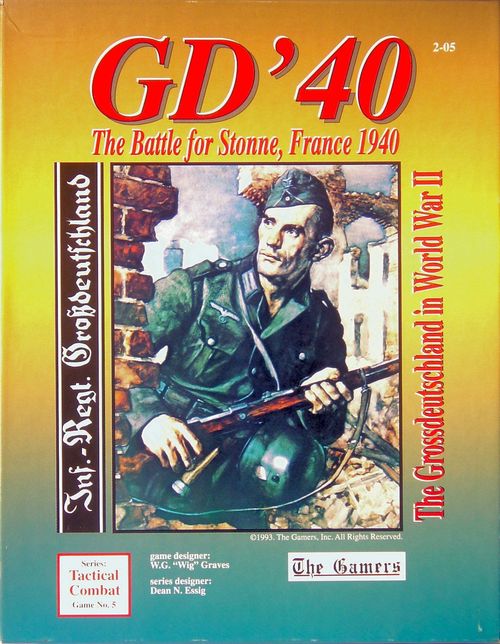
GD '40
GD '40 Rulebook
Table of Contents
Table of Contents
1.0 General Special Rules
1.1 Limited Personal Anti-Tank Weapons
Because of the limited number of small AT weapons in use in 1940 (consisting mainly of weak Anti-Tank Rifles) and their limited effectiveness, use a -3 dice roll modifier in all AT Roll attacks.
1.2 Motorcycle Infantry Units
Several units are provided with motorcycles for added mobility. Motorcycle units are provided with a motorcycle symbol above and to the right of their Movement Allowance on the Move Mode side of the counter. These units use a reduced movement cost when moving along Primary or Secondary Roads when they are at least 6 hexes away from any enemy unit.
1.3 Trucks & Half-tracks (Optional)
Most of the units in the game had trucks available but dismounted before entering the game map. If players wish, the following units may use truck movement (an MA of 18) provided they remain at least 20 hexes away from any enemy unit. The improved MA rate applies to all Infantry, MG, and Mortar units. There is no counter for this "instant truck", and no cost for mounting or dismounting.
1.3a Eligible Units. All German units may use this rule. The French units of the 3rd DIM may use it.
1.3b Half-Tracks. Furthermore, a few companies in the game may utilize the same "instant truck" rule above (same requirements) to ride on their armored personnel carriers (half-tracks). These units have a 12 MA, instead and use the Tracked movement point cost rates. The units which may use this rule are the German 1-I-69 Schutzen Company and the French 1-16 and 2-16 BCP.
1.4 Command and Control
1.4a German Command Prep Rating. The German Command Prep Rating is 4 for the entire game.
1.4b French Command Prep Rating. The French Command Prep Rating is 7 for the entire game.
1.4c German Higher Commander's Intent. The Germans are to capture Stonne and form a defensive line with which to protect the flank of the 19th Panzer Corps and the Sedan crossings.
1.4d French Higher Commander's Intent. The French are to attack through the Stonne area to recapture Sedan.
1.4e Initial Orders. In all scenarios, players may draw up the Op Sheets of their choice before play begins. These may be of any type. The ability to do so may be specifically restricted in a given scenario.
Players may draw up Op Sheets for reinforcements before the game begins and those Op Sheets are implemented before the units enter the map. If the player awaits the beginning of the game to issue Op Sheets to reinforcements, those reinforcements are handled according to 6.13e.
1.5 Set Up & Map Notes
1.5a Order of Set Up. The French Player always sets up first. He must draw up his Op Sheets before the German player sets up. The Germans draw up their Op Sheets after the French set up.
1.5b Set Up Codes.
- "Unit (-# XYZ)" means that the Unit sets up with # less steps of type XYZ. Types include:
- Inf = Infantry
- AT = Anti-Tank Gun
- 75mm IG = 75mm Infantry Gun
- AC = Armored Car
- Tk = Tank
- Tr = Truck
- "CM = #" means each company of the battalion has a Company Morale of #.
1.5c Company Morale. Unless specified with a "CM= #" code, all company morales start each scenario at zero.
1.5d Minefields. Neither side may ever deploy minefields in this game.
1.5e Reinforcements. Both sides in all scenarios receive reinforcements as per their respective Orders of Arrivals.
2.0 German Special Rules
2.1 Artillery and Called Fire Delay
The following batteries may be available to the German Player. The exact batteries given to him for any one scenario are given with the scenario. Some begin operations as reinforcements.
| Battery | Guns |
|---|---|
| 1-I-73 | 4x 105mm |
| 2-I-73 | 4x 105mm |
| 3-I-73 | 4x 105mm |
| 1-I-90 | 4x 105mm |
| 2-I-90 | 4x 105mm |
| 3-I-90 | 4x 105mm |
| 4-II-90 | 4x 105mm |
| 5-II-90 | 4x 105mm |
| 6-II-90 | 4x 105mm |
There is a one turn Called Fire Delay for the 73rd Artillery and for any fire of the 90th Artillery which is called for by units of the Grossdeutschland (but not when units of the 10th Panzer Division call the mission).
2.2 Artillery Ammunition
Each scenario lists the artillery ammunition available at start. Additional ammunition is made available as per the Player's Aid card. Furthermore, the German player can receive additional ammunition should players use the variant in rule 2.5 for a Reinforced German Defense.
2.3 Air Power
Each turn between 0500 and 1900 hours, the German player rolls two dice on the German Aircraft Availability Table. Each B.f.-109 sortie may make an area attack with a firepower of 12. Each Ju-87 (Stuka) sortie may make an area attack with a firepower of 16 or make a point fire attack with a kill roll of 8 or more.
2.4 Panzer Withdrawal
The 4th Company of the 8th Panzer Regiment was part of the initial German attack on Stonne, but once that operation was completed it was moved to counter a perceived French thrust near Yoncq.
To reflect this, on 0800 the German player immediately moves the company to exit through Area E. This unit may return to the battle when rule 2.5 is used.
2.5 Reinforced Defense (Optional)
In the event of increased French effort, the Germans would have rushed additional troops to the Stonne area from other sectors. Each hour, starting at 0700, the German player rolls one die during the Command Phase. On a 4-6, the German player may commit one unit of his choice from the table below. No force may be committed before the hour listed. These die rolls and their success or failure should be kept a secret from the French player.
To commit a given unit, draw up an Op Sheet for that unit which begins with the unit's entry through the listed Entry Area. When that Op Sheet is implemented, the force must move on to the map and begin the implemented operation. Once the Op Sheet is drawn up, it accumulates weighted turns (at the full three-per-turn rate) and checks for implementation each turn as any other Op Sheet.
The Artillery Ammunition commitment occurs immediately (no delay like the others) if the player chooses it. It may not be chosen more than once.
2.5 Reinforced Defense Availability Table
| Formation | Availability | Entry Area | Notes |
|---|---|---|---|
| Ammo (40 HE) | 0700 | — | |
| 4-II-8 Pz Company | 0700 | E | |
| 90 Aufk Abt | 1000 | N | 1st & 3rd Companies |
| Lehr PzJgr | 1000 | N | 1st & 2nd Companies |
| 6-II-8 Pz Company | 1100 | N | |
| II-S.R. 69 | 1100 | NE | 5, 6, 7, 8, 13 Co. plus Aufk Platoon |
3.0 French Special Rules
3.1 Artillery and Called Fire Delay
The following batteries may be available to the French Player. The exact batteries given to him for any one scenario are given with the scenario. Some begin operations as reinforcements.
| Battery | Guns |
|---|---|
| 1-1-78 | 4x 75mm |
| 2-1-78 | 4x 75mm |
| 3-1-78 | 4x 75mm |
| 1-1-42 | 4x 75mm |
| 2-1-42 | 4x 75mm |
| 3-1-42 | 4x 75mm |
| 1-2-42 | 4x 75mm |
| 2-2-42 | 4x 75mm |
There is a one turn Called Fire Delay for the 78th Artillery Group. The 42nd Group fires without any sort of Called Fire Delay.
3.2 Artillery Ammunition
Each scenario lists the artillery ammunition available at start. Additional ammunition is made available as per the Player's Aid card.
3.3 Air Power
Each turn between 0500 and 1900 hours, the French player rolls two dice on the French Aircraft Availability Table. Each M.S. 406 sortie may make an area attack with a firepower of 8. Each Br.691 sortie may make an area attack with a firepower of 16 or make a point fire attack with a kill roll of 10 or more.
3.4 Tank Breakdowns
The French tank and armored car companies represented in the game actually sustained a significant breakdown rate during the move to the Stonne area. To reflect this, as each company enters the map area (ignore HQ vehicles), roll one die on the table below. Roll for each company separately. The result is the number of vehicles actually arriving (as opposed to that given in the countermix).
French Tank Breakdown Table
| The Company's Battalion | 1 | 2 | 3 | 4 | 5 | 6 |
|---|---|---|---|---|---|---|
| 6th GRDI (AMD) | 6 | 8 | 9 | 10 | 11 | 13 |
| 41st BCC (B1bis) | 5 | 6 | 7 | 7 | 8 | 10 |
| 42nd BCC (H-39) | 6 | 7 | 8 | 8 | 10 | 12 |
| 45th BCC (H-39) | 6 | 8 | 10 | 10 | 12 | 15 |
| 49th BCC (B1bis) | 5 | 6 | 7 | 7 | 8 | 10 |
3.5 Morale
The French Series "B" Infantry Divisions showed themselves to be significantly ill-prepared for the German attack. To represent the effects of this poor state of training on unit performance, all units of the 205th R.I. must roll one die to determine if company morale is really recovered on hourly turns or not. Roll for each company separately. On a 1-3, company morale for the company rolled for does not recover. On a 4-6, it recovers normally.
3.6 Reinforced Attack (Optional)
The French had a golden opportunity at Stonne to affect the outcome of the Battle for France. All the elements for a large and potentially decisive counterattack were present, but the French command system and the mind-set of their General Staff got in the way. This option allows players to explore a much larger and better coordinated French effort.
Before the game, the French player draws up Op Sheets detailing the operations of each of the forces below which begin with the force's entry through the listed Entry Area. These Op Sheets are implemented before the game begins, but each force will not enter the map in order to execute them until the force is committed.
Each hour, starting at 1000, the French player rolls one die during the Command Phase. On a 5-6, the French player may commit one force of his choice from the table above. No force may be committed before the hour listed. These die rolls and their success or failure should be kept a secret from the German player.
3.6 Reinforced Attack Availability Table
| Formation | Availability | Entry Area |
|---|---|---|
| 2 Bn 67 R.I. | 1000 | S |
| 49th BCC | 1000 | S |
| 16th BCP | 1100 | SW |
| 42nd BCC | 1100 | SW |
| 3 Bn 67 R.I. | 1200 | S |
| 1 Bn 57 R.I. | 1300 | S |
| 41st BCC | 1400 | SW |
4.0 Historical Scenarios
4.1 The Grossdeutschland takes Stonne
This scenario covers the first phase of the Stonne battle which includes the initial capture of Stonne and the destruction of the 205th RI.
First Turn: 0400 15 May Last Turn: 0900 15 May (16 turns) Map Area: All
French Information:
Set up: 1-205 RI, 2-205 RI, 4 BCC: w/i 2 any hex of Stonne. 3-205 RI: anywhere south of xx.25, inclusive.
Artillery:
| Battery | Guns |
|---|---|
| 1-1-78 | 4x 75mm |
| 2-1-78 | 4x 75mm |
| 3-1-78 | 4x 75mm |
Ammunition: 75mm: 50 HE, 10 Smoke, 10 Illum
German Information:
Set up: I-GD, IV-GD, Stu.Pio 43: w/i 5 22.32. II-GD: along road north of Point 235, inclusive. III-GD: w/i 2 13.34. 4-II-8: w/i 2 61.27.
Artillery:
| Battery | Guns |
|---|---|
| 1-I-73 | 4x 105mm |
| 2-I-73 | 4x 105mm |
| 3-I-73 | 4x 105mm |
Ammunition: 105mm: 40 HE, 15 Smoke, 15 Illum
Victory Determination. The player that holds all hexes of Stonne at the end of the game is the winner. Any other result is a draw.
4.2 The French 2nd Army Counterattack
This scenario covers the second phase of the battle. The Grossdeutschland must hold on for its very life.
First Turn: 0900 15 May Last Turn: 1400 15 May (16 turns) Map Area: All
French Information:
Set up: 3-205 RI (-15x Inf, CM=8): anywhere in the Bois de Franclieu. 6 GRDI (-4x AC): w/i 5 27.01.
Artillery:
| Battery | Guns |
|---|---|
| 1-1-78 | 4x 75mm |
| 2-1-78 | 4x 75mm |
| 3-1-78 | 4x 75mm |
Ammunition: None at start, but see 0900 reinforcements!
Orders: No Prepared Defenses at start.
German Information:
Set up: I-GD (-12x Inf, CM=6): w/i 5 28.19. II-GD (-4x Inf, CM=3): w/i 5 Stonne. III-GD: w/i 5 7.27. IV-GD: with I-GD and/or II-GD. Stu.Pio. 43: w/i 5 Point 339.
Artillery:
| Battery | Guns |
|---|---|
| 1-I-73 | 4x 105mm |
| 2-I-73 | 4x 105mm |
| 3-I-73 | 4x 105mm |
Ammunition: 105mm: 10 HE, 5 Smoke, 0 Illum
Orders: No Prepared Defense Orders at start.
Victory Determination. The player that holds all hexes of Stonne at the end of the game is the winner. Any other result is a draw.
4.3 Schutzen Rgt 69 Recaptures Stonne
The third phase of the battle begins as both sides receive much needed reinforcements.
First Turn: 1400 15 May Last Turn: 2000 15 May (19 turns) Map Area: All
French Information:
Set up: 3-205 RI (-15x Inf), 6 GRDI (-4x AC): w/i 5 49.07. 45 BCC (-35x Tk), 3-49 BCC (-6x Tk), 1-67 RI (-9x Inf, CM=8): w/i 5 Stonne.
Artillery:
| Battery | Guns |
|---|---|
| 1-1-78 | 4x 75mm |
| 2-1-78 | 4x 75mm |
| 3-1-78 | 4x 75mm |
| 1-1-42 | 4x 75mm |
| 2-1-42 | 4x 75mm |
| 3-1-42 | 4x 75mm |
| 1-2-42 | 4x 75mm |
| 2-2-42 | 4x 75mm |
Ammunition: 75mm: 50 HE, 10 Smoke, 0 Illum
Orders: No Prepared Defense Orders at start.
German Information:
Set up: I-GD (-15x Inf, CM=8), III-GD: w/i 3 28.19. II-GD (-12x Inf, CM=8): w/i 3 35.20. IV-GD (-6x AT, -3x 75mm IG, -3x Tr): with I-GD and/or II-GD. Stu.Pio. 43 (-3x Inf): w/i 3 22.17.
Artillery:
| Battery | Guns |
|---|---|
| 1-I-73 | 4x 105mm |
| 2-I-73 | 4x 105mm |
| 3-I-73 | 4x 105mm |
Ammunition: None at start, but see the Reinforcements!
Victory Determination. The player that holds all hexes of Stonne at the end of the game is the winner. Any other result is a draw.
4.4 The Battle for Stonne
The initial conditions are those described in scenario 4.1. The game continues until the 2000 hours turn and victory is determined at that time. Players can continue the game until the 1600 turn of 16 May and operate with the following new reinforcements:
German: 2400 15 May: 5-II-69, Artillery Ammo: 105mm: 200 HE, 50 Smoke, 30 Illum.
French: 0500 16 May: 3-67 RI, 1-57 RI, Artillery Ammo: 75mm: 50 HE, 10 Smoke, 10 Illum.
Players may find an intense variant game waiting for them if they play the full scenario with both options in play (2.5 and 3.6).
Victory Determination. The town of Stonne was the cornerstonne (couldn't resist) of the battlefield and was of major importance to both sides. In order to win any type of victory, a player must hold all of Stonne. If neither player is in complete control of Stonne at the end of the game, the game is a draw.
Massive German Victory: No French units are north of the xx.10 hexrow.
Major German Victory: Control the villages of Stonne, la Besace and all buildings north of the xx.15 hexrow.
Minor German Victory: Control the village of Stonne.
Draw: Neither side fulfills its victory conditions.
Minor French Victory: Control the village of Stonne.
Major French Victory: Control Stonne and clear a continuous path of primary road hexes from the south map edge through hex 28.21.
Massive French Victory: Control Stonne and clear a continuous path of primary road hexes from the south map edge to the north map edge.
Shifts: If the Optional reinforcements are used, shift one level of victory in the direction of the player who received the least number of counters in this manner.
Designer's Notes
It is hard to remember the circumstances under which I agreed to put this game together for Dean. I was working on the yet-to-be-published Crete game and I guess I needed something to do while in one of my many holding patterns (waiting for research materials to arrive). I do recall making a suggestion that the plans for a TCS Russian Front series could follow the history of the Grossdeutschland throughout the war...me and my big mouth.
In reality, this project was not too difficult to put together. I originally thought Dean wanted to do the river crossing at Sedan, and my rubber raft was halfway inflated before he mentioned the town of Stonne (this is probably a good thing, since the quantities of air and artillery attacks at Sedan would have caused the turn length to rival that of Omaha).
Once I started studying the battle, it really struck me as a very good situation for the TCS system. It had all the elements: fairly even forces, lots of movement (on one map), and strategic significance. There were also enough unengaged forces in the area to make for significant variants.
Research for the project was a real pleasure considering that I expected detailed sources on the French campaign to be few and far between. I am much indebted to Goodloe Lewis and his contact with Col. Doughty (whose book is highly recommended). Col. Doughty provided detailed data on the narrative of the battle and on what other units were in the area (a great deal of this was gathered from French records). This was augmented by the Grossdeutschland's official history and the records of the 19th Panzer Corps.
The game required fewer exclusive rules than seems to be the trend with the system. The most apparent change is the result of the reduced anti-tank capabilities of infantry in 1940. This is reflected in the AT Roll Table modification for this game. The use of motorcycles and trucks within close proximity of the enemy was another tactic which was not fully refined in 1940. In reality, even the units carried by the armored halftracks of the time dismounted before contact. Though included as an option, the use of trucks and halftracks by infantry is not recommended.
The rule dealing with the determination of French vehicle losses during the move to Stonne is liable to result in some of the most closely watched die rolls in the entire game. Losses of 30% were typically given as the frequency of breakdowns experienced. All I can say to the French player is to do the best you can with the hand you are dealt.
Weapons counts (which make up the heart of the TCS rating system) were taken from the Kriegsgliederrungen contained in the German Records.
The Meuse crossing and the Battle for Stonne are classic examples of the need to provide armored units with adequate Motorized Infantry. The infantry conducted the opposed crossings at Sedan and Guderian's flank would have been flapping in the breeze had it not been for the Grossdeutschland's stand at Stonne. The Germans learned this lesson well and the Panzer Divisions which invaded Russia in 1941 were significantly different.
On the French side, there isn't much to say. All the elements for handing the Germans a major set-back were present, but their 1918 concepts of war prevented them from putting it together. It must be remembered that Guderian was pushing toward the coast much faster than the German General Staff thought prudent and even a moderate French success at Stonne might have resulted in orders for Guderian to stop.
I believe this is the first time that any portion of the 1940 campaign has been done at such a low level of detail and players will immediately notice that there is not much difference in the quality of the forces present—one could even say the French tanks are superior to the German ones! It is my hope that this game will give players a greater appreciation for the capabilities of the French army and will highlight the fact that the causes of the French defeat were more systemic in nature—and not an indication of a lack of courage or will of the average French soldier. In the end, the Germans won the Battle of France because they used the tactic of "attack by paralyzation" (JFC Fuller) and the French were incapable of reacting.
Players' Notes
German
The German player starts with an extremely well-balanced attack force—good infantry and a whole array of support weapons. Initial strategies will vary depending on where the French set-up, but with your StuGs on the road and your infantry combing the woods you should be able to follow your plan relatively unhindered. Be sure to team up your initial panzers with the Grossdeutschland—avoid the temptation to go charging off with the tanks by themselves. Think, act, and follow proper combined arms techniques.
Stonne should be captured as soon as possible so as to allow a proper defense to be set up. Always remember, your initial capture of Stonne is only the first in a series of fights. The AT guns should be emplaced with good fields of fire and should be strongly supported with infantry. When the counterattack comes, hold on and kill as many tanks as possible. With your afternoon reinforcements will come more infantry, but more importantly another company of anti-tank guns.
The terrain favors your operations (the woods cover your approaches from the north and the open ground to the south helps your defense). Infiltration should be your major tactic and be careful to maximize the use of your air and artillery assets. In the opening phases, you will find it difficult to get your artillery into play (the one turn CFD and constantly advancing front which keeps observers from getting into position)—be sure to carefully think through the use of On-Call missions for key locations and units. Set up the On-Call missions before play begins so that as you move forward you can have artillery available at your finger tips when you need it.
French
The French player begins in a poor situation made worse by the fact that the initial troops are not much worth saving. The objective should be to delay the Germans as much as possible and to inflict any losses you can. Concentrate on destroying the German support weapons—especially AT guns and the heavy Infantry Guns. The decision on where to place the 3rd Bn 205th is an interesting one. If used as a blocking force, they will be able to slow the Germans down, but will be overwhelmed for their efforts. Another option is to use them as a counterattack force and there are a great many interesting places to station them.
Stonne should be held as long as possible. Make the Germans pay for every hex of the village they take by forcing them to conduct repeated assault combats in the close terrain. Use your limited artillery ammunition to plaster targets as the Germans are forced to enter the more open terrain at the base of the Stonne heights—station observers accordingly. The Germans have but a limited amount of room to work with and all too many units—these make for great artillery targets as the Germans trip all over themselves in a confined area. The 6th GRDI can offer another counterattack force to the French, but they will not be able to retake Stonne by themselves.
The first wave of reinforcements arrive in the mid-morning and the counterattack should be planned carefully. If the Germans are still disorganized in Stonne, then strike as soon as possible—you did write up the Op Sheets for the reinforcements at the beginning of the game so they could accrue time off-map, didn't you? Stonne will probably change hands several times during the game and the objective is to make the Germans pay for it each time. Don't forget the possible gains that can be achieved by infiltrating along the many roads that cut through the woods.
Historical Notes
The Formation of the Grossdeutschland
The Infantry Regiment "Grossdeutschland" (hereafter I.R.GD) was officially formed on 12 June 1939 by the redesignation of the Berlin Wachregiment. The Wachregiment had been mainly a ceremonial unit with its seven companies being provided by the seven Military Districts of the Reich. These companies continued to be a part of their parent regiments and were rotated on a regular basis. Thus, the Wachregiment mirrored the entire German Army, a practice which would continue with the Grossdeutschland.
The I.R.GD spent much of the fall of 1939 reorganizing, and though placed on alert, it saw no action during the Polish Campaign. It was organized as follows:
I Battalion—formed from the Wachregiment II Battalion—formed from II Battalion, 92nd Infantry Regiment III Battalion—formed from the Infantry Lehr Regiment IV Battalion—formed from the Infantry Lehr Regiment
Organization and armament was along the same lines as the Leg and Motorized Infantry (as opposed to the much more heavily armed Schutzen Regiments present in the Panzer Divisions). The I.R.GD was also provided with enough trucks and gun tractors to fully motorize it.
In late October, the I.R.GD finally left Berlin and in early November it reached the western front. During this period, two additional units which would become integral parts of the Grossdeutschland were obtained: the 43rd Sturm Pioneer Battalion and Sturm Battery 640. The 43rd Sturm Battalion had fought in the Polish Campaign (the "Sturm" title having been awarded after the 2nd Company distinguished itself in the storming of Brest-Litovsk). The 640 Sturm Battery (integrated as the I.R.GD's 16th Company) was one of only four Assault Gun Batteries formed in time for the initial phases of the French campaign.
The First Days of the French Campaign
Planning and training for the French Campaign continued into May with emphasis placed on river crossings and the assault of bunkers. The I.R.GD was assigned to the 19th Panzer Corps (Guderian's) along with the 1st, 2nd, and 10th Panzer Divisions. The corps was to cross the Luxembourg border on the first day of the attack and advance westward without delay. After entering Belgium, they would swing south and force a breakthrough of the expected French line along the Meuse at Sedan.
The Battle for France began on May 10th and the I.R.GD (attached to the 10th Panzer Division) entered the Ardennes with Guderian's Corps. There was a heated skirmish at Etalle on the Belgium border, but the French were beaten back. Other skirmishes with the French cavalry occurred along the way, but the Meuse was reached and the eastern bank (including Sedan) was cleared rapidly by the 12th. The Meuse crossing was set for 1600 on the 13th.
The III Battalion, I.R.GD entered Belgium in a most unique way. They were part of Operation Niwi and were landed 14km behind the lines by Storch aircraft. Even though the detachments were widely scattered, the operation was successful in delaying the French advance by several hours and in opening the way for the 1st Panzer Division.
The 19th Corps plan for crossing the Meuse had been worked out in detail. The 1st Panzer (to which the I.R.GD was now attached) would cross in three places north of Sedan. The 10th Panzer would cross south of Sedan, and the 2nd Panzer would do so further to the west at Donchery. With heavy air and artillery support, the crossings began as scheduled. Immediately, the attacks of the 2nd and 10th Panzer Divisions ran into trouble. The situation in the 2nd Panzer area cleared up as the I.R.GD and the 1st Schutzen Regiment opened the 1st Panzer Division's bridgehead—relieving a great deal of pressure. The 10th Panzer Division ultimately managed to get across, but their delay would prove costly to the I.R.GD in the days to come.
A few words about the river crossing itself are in order, since reality shattered my Hollywood impressions. For starters, the operation was one for infantry and their support weapons alone (the tanks were not lined up along the river bank blasting away...actually they stayed well to the rear until the bridges were completed). The bunkers opposite the river bank were suppressed by fire from 75mm and 105mm Infantry Guns and 20mm Anti-Aircraft Guns. Only the 88mm Anti-Aircraft Guns sent to "protect" the crossing from the French Air Force were successful in destroying a few bunkers by direct fires. The infantry crossed in rubber boats under the protection of the suppressive fires (and a great deal of smoke from the mortar platoons). Once on the far bank, it became necessary to engage and destroy the majority of the bunkers by close assault.
The I.R.GD was through the line of bunkers and had established a 5 km penetration before midnight. Operations continued to the south on the 14th with the objective of expanding the bridgehead. During this day, the PanzerJäger Company and the 43rd Pioneer Battalion (later supported by the 2nd Panzer Regiment) were involved in fighting back a counterattack by the French 213rd R.I. and the 7th BCC at Chemery. The rest of the I.R.GD followed the 1st Panzer Regiment to fight back the French 205th R.I. and 4th BCC at Bulson. Late on the 14th, the I.R.GD, the 4th Aufklarungs Abteilung (from the 1st Panzer Division), and the 10th Panzer Division (now crossing the Meuse in force) were assigned the task of covering the south flank of the 19th Panzer Corps as the remainder of the corps turned west towards the English Channel.
French Reaction
The first steps by the French to respond to the German attack at Sedan came late on the 13th. At that time the decision was made to prepare a counterattack by the 21st Corps (composed of the 3rd Motorized Infantry Division (DIM), 3rd Reserve Cavalry Division (DCR), and 5th Cavalry Division (DLC)). The 3rd DIM was the motorized version of the line French Infantry Division and should not be confused with the French Mechanized division (DLM) and was a first rate outfit with good morale and training. The 3rd DCR could boast 132 medium and heavy tanks which outclassed nearly all those used by the Germans. The 5th DLC, reinforced with an additional Cavalry Brigade, was also a good formation, but it had fought and lost a great deal of men and equipment in Belgium already.
The 21st Corps was ordered to move into the Mont Dieu area and to seal off the penetrations made by the Germans; and then to attack toward Sedan. The structure of this order is as much to blame for the failure of the French counterattack as any other factor. The statement that the Germans were first to be sealed off and then attacked meant that the corps would move forward methodically and halt the Germans before risking offensive actions. It also resulted in the dispersal of the divisions over a wide front across both sides of the Ardennes Canal. This insured that any counterattack would not be able to concentrate the striking power of the corps at any one point.
Initial plans called for the 21st Corps to attack behind the attacks of the 213th RI and 205th RI on the 14th, and thus follow-up their "success". This timing proved impossible as much of the corps started over 60 km away from the assembly area. The run-up was also greatly hampered by refugees, fleeing troops, bomb-damaged villages, and refueling problems. With the failure of the attacks on the 14th, the French began to rethink their counterattack plans and thought more of defense.
Ultimately, it was the Germans who would call the tune for the 15th. By attacking Stonne, they drew the French into a battle which seemed necessary according to the French requirement to seal off German breakthroughs. This resulted in the piecemeal commitment of the best offensive instrument the French possessed. Had the French ignored the actions of the I.R.GD, their attack might have taken the more direct road from Tannay to Chemery (defended by the 4th Aufklarungs Abteilung) and might have met with more success.
The Battle for Stonne
The village of Stonne (14 km south of Sedan) was important to both sides. From its heights, an observer could see into the Meuse Valley and far into the remaining countryside in all directions. It was not only a perfect spot for the Germans to anchor their southern defenses, but was also an excellent place for the French to assemble for a counterattack against Sedan.
The I.R.GD reached the village of Artaise le Viver (about six hexes north of 10.34) at dusk on the 14th and was ordered to take the Stonne heights the following day: 1st Bn was to attack the town from the north; 2nd Bn was to screen the Bois de Raucourt and maintain contact with a detachment of tanks from the 10th Panzer Division; 3rd Bn was to protect the right flank by defending the woods to the west; Sturm Pioneer Bn 43 was to take and hold the south edge of the Bois de la Grand Côté. To the I.R.GD's right, the 4th Aufklarungs would screen the Bois du Mont Dieu from the Ardennes Canal to the Chemery Road (just off map); on the I.R.GD's left, the 10th Panzer Division would defend from la Besace through Yoncq to the Meuse.
The Stonne area was initially defended by the survivors of the 205th R.I. and the 4th BCC—most of their strength, however, had been lost in the abortive attack near Bulson on the 14th. These units offered only token resistance in the woods to the north of the village, instead they concentrated on the defense of the village itself. The 6th GRDI was also operating in the area south of the village, but it seems to have added little to the defense.
With the aid of almost continuous Stuka attacks, the 1st Bn I.R.GD and elements of the 2nd were able to enter Stonne around 0700 on the 15th; the 205th R.I. had been completely routed. Even though the I.R.GD attack had been successful, the situation in Stonne was one of complete confusion. The companies were hopelessly intermixed and sniping from the village water tower was continuous. The support weapons, particularly the AT Guns, were rushed forward to the defense started to become organized. The remainder of 2nd Bn I.R.GD was brought forward and the 1st Bn was withdrawn into reserve. Shortly after the Germans completed their organization of the defenses, the first French tanks appeared. Stonne was back in French hands by 1100.
The first indications of trouble in the I.R.GD's sector reached the 10th Panzer Division's HQ at 1030 hours. At that time, not only were reinforcements rushed to Stonne (in the form of the 3rd Bn I.R.GD, a battalion of the 69th Schutzen Regiment, and a PanzerJäger Company) but efforts were initiated to set-up a second line to contain the expected French breakthrough. The French were eventually stopped and Stonne was recaptured by the 1st Bn 69th Schutzen at 1700 hours (the I.R.GD being too exhausted to actively participate). The French then launched a second major effort, this time with two companies of B1bis' and another battalion of the 67th RI. This attack was defeated as darkness fell leaving the Germans the masters of Stonne—but again, this was only temporary.
On the afternoon of the 15th, the French also launched attacks to the east and west of the Stonne sector. In the west additional elements of the 3rd DIM and 3rd DCR attacked from the Bois du Mont Dieu and three companies of PanzerJägers were required to thwart this effort (it was fortunate that these had been collected to back up the I.R.GD). In the Yoncq sector, the French attacked with the 1st Colonial and 2nd Light Cavalry Divisions, but this effort was easily handled by the Panzer Brigade of the 10th Panzer Division.
On the 16th, the French again attacked and captured Stonne—this time with two infantry battalions of the 3rd DIM. These battalions held the town for most of the day before they withdraw due to a lack of support.
In the early evening of the 16th, the defense of the Stonne area was turned over to the German 16th Infantry Division, and the I.R.GD and 10th Panzer were pulled out of line. The French never again threatened the Sedan bridgehead.
The Drive to the Sea
The I.R.GD was given four days rest and in that time most of the equipment losses were replaced. The regiment was again assigned to the 19th Panzer Corps and it went back into action on May 23rd. They were involved in holding the pocketed British and French forces at Dunkirk. Much of this action was positional warfare. They were again relieved by regular infantry on 3 June and were sent south.
To the Seine
The I.R.GD, along with other mobile elements of the German Army, were poised on 5 June to begin the second phase of the Battle for France: the breakthrough of the Weygand Line. The attack started on the 6th and the I.R.GD was posted at Amiens. The French were deployed in depth this time and the battle became one for each fortified town in turn.
The 7th of June proved to be the climax of the campaign. On that day, the regiment fought for, and eventually captured, the Bois de Berny. After this battle, the campaign became one of pursuit and the I.R.GD continued its now familiar role of protecting the flanks of the Panzer Divisions.
Armistice came on 25 June just as the I.R.GD was concluding operations in the Lyon area. In the seven weeks since the campaign began, the regiment had covered over 7,000 km, it had lost 1108 casualties from its 3,900 complement and could boast over 400 decorations.
Sea Lion and Felix
The I.R.GD was initially billeted in Lyon and then in Paris before settling down in the Alsace. The regiment was able to take in much needed replacements and was brought back to strength. The long awaited cuff-titles arrived on 24 August.
At the time, a further heavy battalion was formed as part of the I.R.GD. Designated the 5th Bn, I.R.GD, it was composed as follows:
17th (Aufklarungs) Company 18th (Pioneer) Company 19th (Signals) Company 20th (Flak) Company
The 400th Artillery Battalion (motorized) was also formed and attached to the regiment. It was organized with two light and one heavy Field Howitzer Batteries (four guns each).
September was spent in training for Operation Sea-Lion (the invasion of England) and in October for Operation Felix (the surprise occupation of Gibraltar). Neither of these were taken very seriously by the soldiers. The Gibraltar operation required the regiment to receive extensive training in climbing and for a time they were only permitted to leave their barracks through second-floor windows. The men enjoyed these "games" immensely.
1940 came to an end with the Grossdeutschland again in training. The regiment had been proven in battle and was ready for new deeds...no one expected what the new year would bring.
Bibliography
Berben, Paul. Les Panzers Passent la Meuse (13 mai 1940). Paris: Laffont, 1967.
Dutailly, H. Les Problemes de L'Armee de Terre Francaise (1935-1939). Paris: Imprimerie Nationale, 1980.
Daughty, Robert Allan. The Breaking Point (Sedan and the Fall of France, 1940). Archon Books, 1990.
Guderian, Heinz. Panzer Leader. Washington: Zenger Publishing, 1979.
Gounelle, Claude. Sedan: Mai 1940. Paris: Presses de la Cite, 1965.
Goutard, A. The Battle of France, 1940. London: Muller, 1958.
Horne, Alistar. To Lose a Battle, France 1940. Penguin Books.
Niehorster, Leo W.G. German World War II Organizational Series, vols 2/1, 2/II. Germany: Impressun, 1990.
Rothbrust, F.K. Guderian's XIXth Panzer Corps and the Battle of France. NY: Praeger, 1990.
Scheibert, Horst. Panzer Grenadier Division Grossdeutschland. Warren, MI: Squadron/Signal Pub., 1977.
Spaeter, Helmuth. The History of the Panzerkorps Grossdeutschland, Vol 1. Canada: Fedorowicz, 1992.
Spears, Sir Edward. Assignment to Catastrophe. 2 vols. NY: AA Wyn, 1954.
National Archives (Captured German Records): T-78, roll 444, Die Gliederung des Französischen Kriegheeres. 10 May 1940.
Order of Battle
Kampfgruppen das Heer (German Forces)
2 Bn, Panzer Regiment 8, 10th Panzer Division
- 4 Lgt Company: 4x Pz I, 8x Pz II, 7x Pz III
- 6 Med Company: 6x Pz II, 8x Pz IV
69th Shutzen Regiment (S.R. 69), 10th Panzer Division
1st Battalion
- 1 Company: 3x Infantry, 1x MG
- 2 Company: 3x Infantry, 1x MG
- 3 Company: 3x Infantry, 1x MG
- 4 (MG) Company: 4x MG, 3x 81mm Mortar
2nd Battalion
- 5 Company: 3x Infantry, 1x MG
- 6 Company: 3x Infantry, 1x MG
- 7 Company: 3x Infantry, 1x MG
- 8 (MG) Company: 4x MG, 3x 81mm Mortar
Regimental Weapons
- 13 Infantry Gun Company: 8x 75mm Inf Gun, 4x Truck
- 14 Panzerjäger Company: 12x 37mm AT Gun, 6x Truck
- Aufklarungs Platoon: 1x Infantry (with MC movement)
Panzer-Aufklarungs-Abteilung 90, 10th Panzer Division
- 1st Company (Armored Car): 10x SdKfz 221, 4x SdKfz 222, 3x Sdkfz 231, 3x SdKfz 232
- 3rd Company (Motorcycle): 3x Infantry (with MC movement), 1x MG (with MC movement)
Panzer-Jäger-Abteilung Panzer-Lehr
- 1 Company: 12x 37mm AT Gun, 6x Truck
- 2 Company: 12x 37mm AT Gun, 6x Truck
Infantry Regiment "Grossdeutschland"
1st (I) Battalion
- 1 Company: 3x Infantry
- 2 Company: 3x Infantry
- 3 Company: 3x Infantry
- 4 (MG) Company: 6x MG, 3x 81mm Mortar
2nd (II) Battalion
- 5 Company: 3x Infantry
- 6 Company: 3x Infantry
- 7 Company: 3x Infantry
- 8 (MG) Company: 6x MG, 3x 81mm Mortar
3rd (III) Battalion
- 9 Company: 3x Infantry
- 10 Company: 3x Infantry
- 11 Company: 3x Infantry
- 12 (MG) Company: 6x MG, 3x 81mm Mortar
4th (IV) Battalion
- 13 (Inf Gun) Company: 6x 75mm Inf Gun, 3x Truck
- 14 (Panzerjäger) Co: 12x 37mm AT Gun, 6x Truck
- 15 (Hvy Inf Gun) Co: 4x 105mm InfGun, 2x H-track
- 16 (640 Sturm Battery) Company: 6x StuG III
Sturm-Pioneer Battalion 43 (attached)
- 1 Company: 3x Infantry
- 2 Company: 3x Infantry
- 3 Company: 3x Infantry
Les Héros de la Troisième République (French Forces)
3rd Motorized Infantry Division (DIM)
67th Infantry Regiment (RI)
1st Battalion
- 1 Company: 3x Infantry
- 2 Company: 3x Infantry
- 3 Company: 3x Infantry
- MG Company: 6x MG, 1x 81mm Mortar, 2x 25mm AT Gun, 1x Truck
2nd Battalion
- 1 Company: 3x Infantry
- 2 Company: 3x Infantry
- 3 Company: 3x Infantry
- MG Company: 6x MG, 1x 81mm Mortar, 2x 25mm AT Gun, 1x Truck
3rd Battalion
- 1 Company: 3x Infantry
- 2 Company: 3x Infantry
- 3 Company: 3x Infantry
- MG Company: 6x MG, 1x 81mm Mortar, 2x 25mm AT Gun, 1x Truck
Regimental Troops
- Motorcycle Squadron: 1x Infantry (with MC movement), 1x MG (with MC movement)
- HW Company: 4x MG, 1x 81mm Mortar, 6x 25mm AT Gun, 3x Truck
6 Recon Group (GRDI)
Light Battalion
- Armored Car (AC) Squadron: 13x AMD
- Motorcycle Squadron: 4x Infantry (with MC movement)
3rd Reserve Armored Division (DCR)
41 Tank Battalion (BCC)
- HQ: 1x B1bis
- 1 Company: 10x B1bis
- 2 Company: 10x B1bis
- 3 Company: 10x B1bis
42 Tank Battalion (BCC)
- HQ: 2x H-39
- 1 Company: 12x H-39
- 2 Company: 12x H-39
45 Tank Battalion (BCC)
- HQ: 2x H-39
- 1 Company: 15x H-39
- 2 Company: 15x H-39
- 3 Company: 15x H-39
49 Tank Battalion (BCC)
- HQ: 1x B1bis
- 1 Company: 10x B1bis
- 2 Company: 10x B1bis
- 3 Company: 10x B1bis
16 Chasseur Battalion (BCP)
- 1 Company: 3x Infantry
- 2 Company: 3x Infantry
- 3 Company: 3x Infantry
- HW Company: 6x MG, 2x 81mm Mortar, 4x 25mm AT Gun, 2x Truck
36th Infantry Division (DI)
57 Infantry Regiment (RI)
- 1 Company: 3x Infantry
- 2 Company: 3x Infantry
- 3 Company: 3x Infantry
- HW Company: 6x MG, 1x 81mm Mortar
71 Infantry Division (DI)
205 Infantry Regiment (RI)
1st & 2nd Battalion
- 1 Company: 2x Infantry
- 2 Company: 1x Infantry
- 3 Company: 2x Infantry
- 4 Company: 1x Infantry
3rd Battalion
- 1 Company: 3x Infantry
- 2 Company: 3x Infantry
- 3 Company: 3x Infantry
- MG Company: 6x MG, 1x 81mm Mortar
4th Tank Battalion (BCC)
- 1 Company: 8x FCM-36
German Order of Arrival
| Time | Units | Entry Area |
|---|---|---|
| 0800 | 4-II-8 Pz | Withdraw via E |
| 1400 | I-S.R. 69 | NE |
| 14 PJ-S.R. 69 | NE | |
| I-90 Artillery | Off Map | |
| II-90 Artillery | Off Map | |
| 105mm Ammo: 140 HE, 30 Smoke, 20 Illum |
Optionals:
| Time | Units | Entry Area |
|---|---|---|
| Pz.Aufkl.Abt 90 | N | |
| PzJg Lehr | N | |
| II-8 Pz | E | |
| II-S.R. 69 | NE | |
| 13 Inf Gun-S.R. 69 | NE | |
| 105mm Ammo: 40 HE, 0 Smoke, 0 Illum |
French Order of Arrival
| Time | Units | Entry Area |
|---|---|---|
| 0600 | 6 GRDI | S |
| 0900 | 45 BCC | S |
| 3-49 BCC | S | |
| 1-67 RI | S | |
| 42 Artillery Bn | Off Map | |
| 75mm Ammo: 200 HE, 50 Smoke, 30 Illum | ||
| 1600 | 2-67 RI | S |
| remainder 49 BCC | S |
Optionals:
| Time | Units | Entry Area |
|---|---|---|
| 16 BCP | S | |
| 42 BCC | SW | |
| 3-67 RI | S | |
| 1-57 RI | S | |
| 41 BCC | SW |