Gazala Line 1942
Gazala Line 1942 Rulebook
Table of Contents
Table of Contents
1.0 Prepare for Play
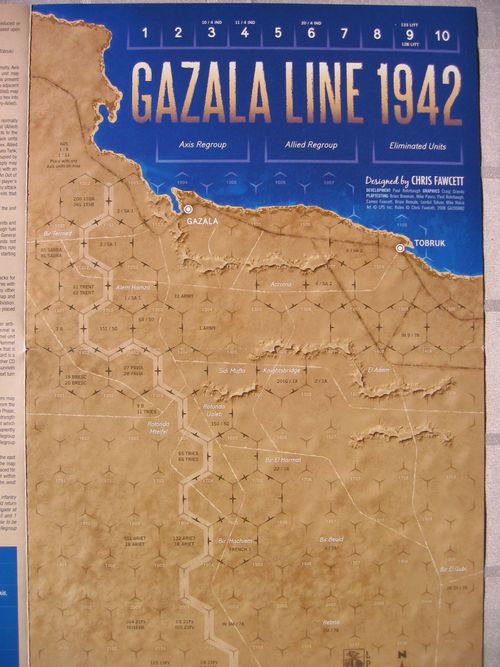
Players set up their units as shown on the map and Turn Record Track. Some Axis units may be placed "anywhere"; these may be stacked with any other Axis unit on the map. The Turn marker is placed on the 1 space of the Turn Record Track with the "Deck 1" side up. Players shuffle a standard deck of cards (including 1 joker card).
Game Terms and Abbreviations
Allied: British, South African, Indian, Free French units.
Axis: German and Italian units.
Cards: One standard deck of playing cards is used to play the game. Include one Joker (not two) card in the deck. The abbreviation CD is used for Card Draw.
Die: One six sided die is also needed to play the game. The abbreviation DR is used for Die Roll.
Minefield Cleared: Markers used to indicate hexes where the Axis player has cleared a hex of Allied mines.
Zone of Control: There are no zones of control in this game.
Unit Counters
Each counter shows, from the printed key:
- Armor Factor (AF) at the left of the unit size.
- Infantry Factor (IF) at the right of the unit size.
- Unit Size across the top of the counter.
- Unit Type as an icon at the lower left.
- Unit ID at the lower right.
The printed key shows four sample counters: British Infantry, Italian Motorized Infantry, German Tank, and German Tank Destroyer.
1.2 Stacking
Two regiment or brigade-sized units may stack in a hex. One 1-step unit may also stack (a third unit). Opposing units may never stack (see 8.3).
2.0 Card Draws and Activation
Either player draws the top card from the deck and plays it face up. If a black suit CD, the Axis player activates a number of units equal to half the number of the CD (round fractions up). "Face" cards allow 1 unit or stack of units to activate. Allied player activates with a red suit CD.
Activated Ground Units can:
- A) Move 1 hex. Tanks, Tank Destroyers or Motorized Infantry units may move an additional hex if the additional hex has a trail. These units may move 2 additional hexes if both have a road. Note: Units may enter an un-cleared enemy minefield hex only with a successful CD. A failing CD results in the unit not being able to move (or do anything else for that activation). OR
- B) Attack enemy units (see 3.0). OR
- C) Attempt to clear minefield hex (see 5.0).
Instead of Activating Ground Units:
- D) Conduct an Air or Artillery attack (see 4.0).
The deck is immediately shuffled when the joker card is drawn (for combat or activation) or all cards are drawn (whichever comes first; ignore the Joker card if it is drawn before both players activate). The turn ends when the Joker is once again drawn after the deck has been reshuffled (whenever that occurs).
2.1 Terrain Costs
The table printed above lists costs and limits for various terrain types.
| Terrain | Movement Effect | Combat Effect | Note |
|---|---|---|---|
| Clear | None | None | |
| Frontline | None | None | Minefields to the west of the Frontline are Axis, those to the east are Allied. |
| Minefield (any hex with inward spike) | Units may enter enemy Minefields only with a CD of 1-7. | +2 CD when attacking a unit in an enemy minefield hex. | CD 1-5 to clear. No Supply Trace across enemy Minefields. |
| Road | Tanks, Tank Destroyers and Motorized Infantry may move 2 extra hexes if they contain road. | None | Axis can use to trace supply if not mined by Allies. |
| Trail |
The printed table header reads "Movement Efffect"; it is transcribed here as "Movement Effect".
2.2 Exiting the Map
Only the Axis player can exit ground combat units from the east map edge. This is done as a way towards winning the game (see 7.0). Axis units exit by moving off the map from any east map edge hex. Exited Axis units cannot return to the game in a later turn (once they're gone, they're gone).
3.0 Combat
Combat is voluntary. Activated units may attack enemy units that are adjacent. Artillery and air units can fire upon any enemy unit (see 4.0). Indicate target and firing unit(s) and firing player draws a card (any suit/color is used by both players to resolve combat). Modify the Card Draw as follows (use all that apply):
- +2 card number if target Allied unit is in a box/minefield hex.
- +2 card number against units defending in minefield hex.
- +1 card number if attack is across an escarpment hex.
- -1 with Air Interdiction in the hex (see 4.0).
A unit's (or group of activated units') AF is used versus Tanks and Tank Destroyers; IF versus AT, Motorized Infantry and Infantry. Perform a CD and add the terrain/interdiction modifier. Either redraw face cards or consider this a miss (firing player's option). If drawn during the first deck, the Joker is also treated as a miss. If card and terrain modifier total is less than or equal to firing unit's AF/IF the target is reduced (if at 2-step strength) or destroyed (if at 1-step strength).
3.1 Anti-Tank (AT) Screening
If stacked with other unit(s), the two German and one Italian AT units cannot be attacked unless one or the other unit(s) it is stacked with is successfully attacked first in the same activation. In other words, a defending non-AT unit must be reduced or retreated before the AT unit can be attacked.
Example: The 1/33 AT unit is stacked with the 66/Trieste and 11/Trieste armor units. (Note: because the 1/33 AT is only 1 step it can stack with 2 other friendly units.) The Allied player must be capable of activating at least two units in order to attack the 1/33 AT. One of the activated Allied units would have to first successfully attack either the 66 or 11 Trieste, reducing or retreating the targeted unit, and only afterward could the second (and subsequent) Allied unit attack the 1/33 AT. Note: If the Allied player could only activate 1 unit the 1/33 AT would be immune from the activated unit.
4.0 Air and Artillery Units
These units are available to the owning player once per turn (not per deck shuffle). Odd numbered, Jack, or Ace card indicates an Air unit is available and can be used instead of activating a Ground unit. Any other card can be used for Artillery instead of activating a Ground unit.
Air unit can either a) attack any one enemy unit on the map with CF (Combat Factor, used for either AF or IF) of 4 or b) impose a -1 Combat Interdiction modifier for any attacks made against the units in the hex for the rest of the turn (Allied player only). Artillery unit can attack any 1 enemy unit that is adjacent to a friendly unit with CF of 3 (disregard any terrain modifiers for an artillery attack).
5.0 Clearing Minefields
Instead of activating a unit a player can attempt to clear an enemy minefield hex. The hex to be cleared must be adjacent to a unit that has not already activated. The player designates the hex to be cleared, the unit that is performing the minefield clearing operation, and draws a card. Modify the CD as follows (use all that apply):
- +2 CD if minefield hex is occupied by an enemy unit.
- +1 if Allied air interdiction is present in hex occupied by the Axis unit that is to clear the minefield (see 4.0).
- +2 if an escarpment hex-side is between the hexes of the unit clearing the mines and the minefield hex. Note: This will make clearing minefield hexes across an escarpment very much of a longshot.
- -1 if German unit SV288/90 or any of the Italian Bersaglieri units is clearing the hex (these units had combat engineers trained and equipped for this sort of thing).
If the modified CD is 5 or less the target minefield is cleared. Any modified CD result of 6 or more, or any face CD is a failed minefield clearing attempt. If the CD is a face card the Allied player immediately performs a CD. If the CD is another face card the Axis unit that attempted to clear the minefield is immediately reduced. An already reduced unit is eliminated.
6.0 Game Length
Each turn is composed of two shuffles of the card deck. The game lasts ten turns (twenty Card deck shuffles). Use the Turn Record Track to record the number of deck shuffles and current turn (flip the turn marker over to record the second deck shuffle).
7.0 Winning the Game
The Axis player wins if either of the following occurs:
- 10 Axis ground combat units exit the east edge of the map by the end the game and a line of Trail and/or road hexes, free of Allied units and minefields, can be traced from the west to east map edges. Note: The Axis player cannot "exit" the air/artillery marker.
OR
- The Axis player controls Tobruk and has fewer eliminated units than the Allied player at the end of the game.
Should the Axis player fail to achieve either of the above victory conditions the Allied player wins the game.
8.0 Optional Rules
The following rules introduce a bit more historical detail to the game. They can also be used to balance play somewhat between opponents of differing abilities. Enjoy!
8.1 Fall Back!
A unit that is hit in combat may retreat instead of being reduced or eliminated if it passes a DR check. The ability to retreat is based upon the following DR ranges:
- German units = 1-4
- Allied units = 1-3 (1-4 if unit is defending a minefield hex or Tobruk)
- Italian units = 1-2 (1-3 if a German unit is also in the hex)
The hex to which a unit retreats must be one it can enter normally. Axis units cannot retreat into an un-cleared Allied minefield. No unit may retreat across an escarpment hex side unless a road or trail is present that connects the hexes. The hex the unit retreats to may be one adjacent to an enemy unit, but not further from the west (Axis) or east (Allied) map edges (i.e., a unit cannot advance while retreating). If there is no hex into which it can retreat, the unit must take the step loss (slightly pro-Allied).
8.2 Supply
Throughout the game, units attempting to move or fire must normally trace a supply line of no more than 5 hexes back to the east (Allied) or west (Axis) map edges, or to a road/trail that then connects to the appropriate map edge, in order to be considered in supply. Axis units may not trace a supply line through an un-cleared minefield hex. Allied units may not trace a supply line through a hex adjacent to an Axis Tank, Tank Destroyer or Motorized Infantry unit unless the hex is occupied by a friendly unit, or it is an un-cleared minefield. Units not in supply may only move 1 hex per Activation maximum (even on a road/trail) with an even DR. An odd DR results in the unit not being able to move. An Out of Supply unit also has a +1 CD modifier when attacking, and the player's Off Board Artillery marker may not be placed on it to assist in any attack the unit performs. Use an Out of Supply marker to indicate units that cannot trace a supply line.
The only time Allied units do not have to trace a supply line is if the unit is in an Allied Minefield or the Tobruk hex.
The Axis player is exempt from tracing supply for all German units and those of the Ariete Division for turn 1 (these units carried enough fuel for the start of the offensive), or any unit(s) stacked with the General Rommel marker (see below). From turn 2 onward all Axis units not stacked with the General Rommel unit must trace supply per this rule (pro-Allied). Regardless, all Axis units must trace a supply line starting on turn 3.
8.3 General Rommel
The General Rommel unit starts the game and stacks for free with any Axis unit(s). He activates as well for free with any unit he is stacked with. He can relocate to any other Axis unit by removing the Rommel unit from the map and placing it on the Turn Record Track. Doing so counts as one activation. At the beginning of the next turn the Rommel leader unit can be placed on any Axis unit.
The Rommel unit confers a +1 attack CD modifier (anti-tank or anti-infantry) for any Allied attacks, to any unit(s) with which Rommel is stacked. Additionally, any unit(s) stacked with the General Rommel unit is exempt from tracing supply on turns 1 and 2. If the General Rommel unit is in a hex where a unit is hit in combat, or is alone in a hex that is entered by an Allied unit, the Axis player performs a CD. If the card is a red ace Rommel is injured and is removed from the game. Any other CD no effect. If the Rommel unit was caught alone in a hex and survives the CD he can be relocated to any hex with a German unit the next turn (put the unit on the Turn Record Track, pro-German).
8.4 Regroup
At the end of every turn, during a "Regroup Phase," both players may attempt to bring back eliminated units. As units are eliminated from the board, they are placed into a "Regroup Pool". During the Regroup Phase, Axis player first, a player can bring back one unit at reduced strength of the same type with strength values equal to or less than a unit which is placed into a permanently eliminated pile. Units in the permanently eliminated pile can never be reorganized. Italian units can only Regroup with other Italian units; German with German. Any Allied unit can Regroup with another Allied unit regardless of their nationality.
Allied units can be placed for one activation in Tobruk, or enter the east map edge at a road or trail hex if an Axis unit has not exited the map from that road/trail hex. The German reorganized units can be placed for one activation with or adjacent to Rommel on the map and not within 3 hexes of an Allied unit, or they can enter anywhere along the west board edge.
Example: The Allied player has 3 x 1-4 Infantry brigades, 1 x 3-5 infantry brigade and 2 x 2-3 armor brigades in the Regroup Pool. He could return to the game 2 x 1-4 infantry brigades plus 1 x 2-3 armor brigade at reduced strength by permanently eliminating 1 x 1-4, 1 x 3-5 and 1 x 2-3 armor brigades. The only way that the 3-5 would be able to be returned is if there was another 3-5 infantry brigade in the Regroup Pool.