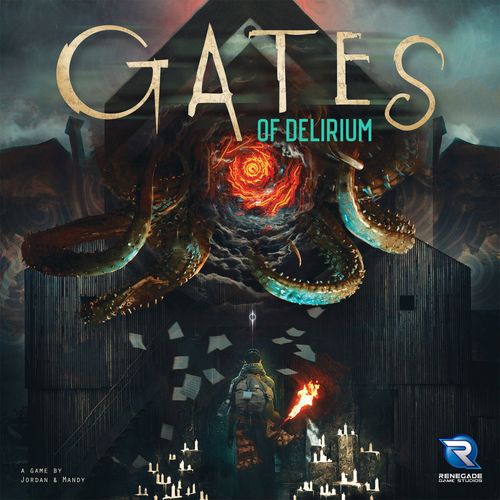
Gates of Delirium
Gates of Delirium Rulebook
Table of Contents
Table of Contents
Game Overview
In Gates of Delirium, each player will have a hand of action cards, which are split into two parts: one part sane, the other part insane. Every round, the start player will decide if it is a sane or insane round, and players can only take the actions on the corresponding part of their cards.
During sane rounds, you will search for map fragments and lost pages to a secret tome, while dispatching investigators far and wide to help you in your cause. During insane rounds, you will collect ancient runes and build gates to release monstrosities from a parallel dimension.
The goal of the game is to score the most points by the time the last monstrosity is released through one of these gates of delirium.
Components
- 1 Game Map
- 80 Action Cards
- 90 Gate Cards
- 22 Innsmouth
- 18 Salem
- 18 Arkham
- 16 Kingsport
- 16 Rockport
- 40 Investigators (10 per player)
- 4 Player Journals (1 per player)
- 4 Score Markers (1 per player)
- 8 Score Tokens
- 24 Desperation Tokens
- 7 Scroll Cards
- 6 Monstrosity Discs
- 1 Sanity Disc
Game Setup
- Place the game map in the center of the play area, with the appropriate side face up, according to player count: one side is for games with 3+ players and one side is for games with 2 players.
- Shuffle the action cards to form a face-down deck.
- Shuffle the gate cards to form a face-down deck.
- Create the gate supply by revealing four cards from the top of the gate deck and placing them in a face-up row next to the gate deck.
- Place the monstrosity discs face up in a stack, arranged in ascending order of value (i.e., with the lowest value on top, highest value on bottom).
- Shuffle the scroll cards and place one, face down, in each card slot along the top edge of the game map.
- Create a pile of desperation tokens, placed within reach of all players.
- Give each player the player journal, score marker, and 10 investigators in their chosen color.
- Place the score tokens next to the score track.
- From the action deck, deal each player five cards as their starting hand. Each player should keep their hand of cards hidden from their opponents.
- Determine who will be the start player and give them the sanity disc.
NOTE: For games with two players, there are some extra setup steps you must carry out. For details, see Two-Player Games.
Round Sequence
The game is played in a series of rounds until the end of the game occurs. At the start of each round, the current start player chooses whether it will be a sane round or an insane round, flipping the sanity disc to indicate their choice.
During a round, each player takes a single turn, beginning with the current start player and proceeding in clockwise order. Each player may only take actions corresponding to the current round type, as chosen by the start player.
At the end of a round, the current start player passes the sanity disc to the player seated on their left, and a new round begins with that player as the new start player.
Taking Your Turn
On your turn, you must play two action cards from hand, one at a time. In addition, you may (but are not required to) spend desperation tokens to take desperate actions, at any time during your turn. At the end of your turn, you will refill your hand by drawing two new action cards.
Playing Action Cards
When you play an action card, you must reveal it from your hand, then perform the action shown on the part of the card that corresponds to the current round type — either sane or insane.
The sane part of an action card has a white frame. The insane part of an action card has a dark frame.
After taking the action, put the action card in the discard pile, unless it shows one of the three types of artifacts: lost pages, map fragments, and ancient runes. Cards with artifacts are always added to the corresponding section of your journal.
Taking Desperate Actions
At any time during your turn, you may spend desperation tokens (earned by playing certain action cards) to take desperate actions. Each desperate action costs a certain number of desperation tokens, which you must return to the supply in order to take that action.
Drawing Action Cards
At the end of your turn, after playing two action cards and taking any desperate actions that you wish to, draw two new cards from the top of the action deck and add them to your hand (bringing your hand back up to five cards). If the deck runs out, reshuffle the discard pile.
Sane Actions
During sane rounds, you must take the sane actions of the two action cards you choose to play. The possible sane actions are…
- Collecting Lost Pages
- Collecting Map Fragments
- Dispatching Investigators
Collecting Lost Pages
When you collect a lost page, add the card to the corresponding section of your journal, tucking it partially beneath the top edge. As you collect different lost pages, arrange them in a column, sorted by numerical order.
There are 20 different lost pages (numbered 1–20), and only one copy of each. At the end of the game, you will score four points for every consecutive page and two points for every non-consecutive page in your journal.
Collecting Map Fragments
When you collect a map fragment, add the card to the corresponding section of your journal, tucking it partially beneath the top edge. As you collect different map fragments, place them next to each other so that they begin to form a map. (If you already have a completed map, start a new one.)
It takes four unique map fragments (labeled NW, NE, SW, SE) to form a completed map. At the end of the game, you will score 12 points for every completed map and two points for every other map fragment in your journal.
Cards with artifacts are always added to the corresponding section of your journal.
Dispatching Investigators
When you dispatch investigators, take one (or two) investigators — as indicated by the card you play — from your personal supply and place them in any region (or regions) on the map. If you do not have enough investigators remaining in your personal supply, you may move them from other regions instead.
Placing investigators in various regions helps you to win majorities. Each time a gate is opened, the corresponding region is evaluated, and points are awarded to the players with the most, second most, and third most investigators in that region.
When you play an action card that lets you dispatch one investigator, you also gain one or two desperation tokens from the supply.
Insane Actions
During insane rounds, you must take the insane actions of the two action cards you choose to play. The possible insane actions are…
- Collecting Ancient Runes
- Converting Investigators
- Building Gate Sections
Collecting Ancient Runes
When you collect an ancient rune, add the card to the corresponding section of your journal, tucking it partially beneath the top edge. As you collect multiple ancient runes, arrange them in a column. At the end of the game, you will score points for each set of ancient runes in your journal. The larger the set (1–5 cards), the more points you will score.
Converting Investigators
When you convert an investigator, remove one opposing investigator from any region on the map and return it to that opponent's supply. Then take one of your own investigators from your personal supply and place it in that same region.
If you do not have any investigators remaining in your personal supply, do not remove an opposing investigator. Instead, choose one opposing investigator and one of your own investigators that are already on the map, and swap their positions.
Building Gate Sections
When you build gate sections, choose one (or two) gate cards — as indicated by the card you play — and place them in your own play area, either adding them to existing gates or starting new ones.
When you choose a gate card, you must choose one of the four cards from the face-up gate supply –OR– the top card of the face-down gate deck. If you choose a card from the gate supply, refill the gate supply immediately by drawing the top card of the gate deck and placing it in the empty slot, face up.
There are five different types of gates, each corresponding to a different region of the map. You may have one gate of each type in progress at a time.
| Region | Gate Size | Total in Deck |
|---|---|---|
| Innsmouth | 7 cards | 22 cards |
| Salem | 6 cards | 18 cards |
| Arkham | 6 cards | 18 cards |
| Kingsport | 5 cards | 16 cards |
| Rockport | 5 cards | 16 cards |
Each type of gate requires a specific number of cards (indicated on the cards themselves). As you build each gate, you will place the gate cards of that type in a spiral shape. The lines on the gate cards are a guide for how to overlay the cards on top of one another at the correct angle.
When you play an action card that lets you build one gate section, you also gain one or two desperation tokens from the supply.
Opening Gates
When a player opens a gate by playing the final required gate card, the game is paused (even if the player's turn is not yet over) in order to score that gate. To score an opened gate, carry out these four steps:
- Release a Monstrosity: The player who opened the gate collects the monstrosity disc from the top of the stack and places it on the opened gate. That player immediately scores the number of points shown on that monstrosity disc, moving their score marker on the score track accordingly.
- Reveal a Scroll: If the collected monstrosity disc shows a scroll icon, reveal one of the scroll cards placed along the top edge of the map. Once revealed, a scroll card remains face up for the rest of the game, affecting all players.
- Evaluate the Region: On the map, evaluate the region that corresponds to the opened gate. Determine who has the most, second most, and third most investigators in that region, and rank the players accordingly. Each player immediately scores points for their rank, as indicated on the region's banner, moving their score marker on the score track accordingly.
- If several players are tied for a given rank, they all score the full points for that rank. Subsequent ranks are unaffected by ties higher up the ranks.
- Players who do not have any investigators in the corresponding region are not in consideration. In other words, you must have at least one investigator in the region to be eligible to score.
- Return Investigators: All investigators in that region are then removed from the map and returned to the personal supply of their respective owners.
After these steps have been carried out, the game resumes exactly where it left off. If the active player was in the middle of their turn, they finish it, and the game continues.
NOTE: There is no restriction on how many times that a gate of the same type may be opened during the game. It is even possible for one player to open multiple gates of the same type over the course of the game (though they may not have multiple gates of the same type in progress at the same time).
Scroll Cards
During the game, each time a monstrosity with the scroll icon is released, one of the scroll cards placed along the top edge of the map is revealed. It will remain face up for the rest of the game. (This will happen three times in a 3- or 4-player game and twice in a 2-player game.)
Each revealed scroll card remains in play for the rest of the game, affecting all players. Some scroll cards provide bonuses or discounts to certain actions, while others provide ways to score additional points at the end of the game.
The seven scroll cards are:
- Builder's Mandate — Each time you collect a lost page, you may build one gate section.
- Cartographer's Command — Each time you collect a map fragment, you may build one gate section.
- Desperate Times — Each time you take a desperate action, spend one less desperation token.
- Gate Crafter — At game end, the player with the most incomplete gates scores five points.
- Prolific Recruiter — At game end, the player with the most investigators on the map scores five points.
- Relic's Call — Each time you collect an ancient rune, you may dispatch one investigator.
- Tome Keeper — At game end, the player with the most lost pages scores five points.
Desperation Tokens
You gain desperation tokens when you play an action card that lets you assign one investigator (during sane rounds) or build one gate section (during insane rounds). The number of tokens you gain is indicated by the number of desperation icons on the action card.
At any time on your turn — including during an action! — you may take desperate actions by spending desperation tokens that you have gained. You may take as many desperate actions as you wish in a single turn, as long as you can afford to pay their costs.
NOTE: The supply of desperation tokens is limited to the 24 provided in the game. If you would gain a desperation token but the supply is currently empty, you are out of luck!
Swap Two Action Cards (cost: 2 desperation tokens) Draw two action cards from the deck, then discard any two action cards from your hand. You may discard cards you just drew or cards you already had in hand.
Refresh the Gate Supply (cost: 3 desperation tokens) Remove all four cards from the gate supply, placing them at the bottom of the gate deck, face down. Then refill the gate supply by drawing four new cards from the top of the gate deck and placing them in the face-up row.
Flip the Sanity Disc (cost: 4 desperation tokens) Flip the sanity disc to the opposite side. This change affects all players' actions left in this round, including any actions you have left on this turn.
Score Three Points (cost: 5 desperation tokens) Immediately score three points, moving your score marker on the score track accordingly.
End of the Game
When the final monstrosity is released through an open gate, and all scoring is completed for that gate, the game ends immediately. The active player does not finish their turn, and no additional turns are taken by the other players. After this has occurred, proceed to final scoring.
Final Scoring
During final scoring, each player calculates the points they score in the following five categories, adding these points to those they scored throughout the game from opening gates, having investigator majorities in scored regions, and spending desperation tokens.
- Investigators on the Map: Score one point for each investigator you still have on the map.
- Scroll Card Effects: If there are any scroll cards in play that award points at game end, evaluate them and score any points that you earn.
- Ancient Runes: Score points for the ancient runes in your journal (see chart). Each set can have a maximum of five ancient runes. If you have more than five ancient runes, the additional ancient runes are scored as a separate set.
| Ancient Runes | 1 | 2 | 3 | 4 | 5 |
|---|---|---|---|---|---|
| Points Scored | 1 | 2 | 4 | 8 | 16 |
- Lost Pages: Score points for the lost pages in your journal. Consecutive pages (i.e., pages whose numbers are next to each other in numerical sequence) are worth four points each and non-consecutive pages are worth two points each.
- Map Fragments: Score points for the map fragments in your journal. Each complete map (NW, NE, SW, SE) is worth 12 points and each other map fragment is worth two points.
NOTE: Unspent desperation tokens may not be spent to score points during final scoring! No actions of any kind are allowed after the end of the game has been triggered.
After final scores have been calculated, the player with the most points wins! In the case of a tie, the tied player with the most unspent desperation tokens wins. If there is still a tie, the youngest tied player wins.
Example Collection Scoring
- Ancient Runes = 17 points
- Lost Pages = 12 points
- Map Fragments = 14 points
Two-Player Games
Changes to Setup
- Make sure you use the 2-player side of the game map.
- Remove two monstrosity discs (10 points and 11 points) from the stack. Return them to the game box; they will not be used.
- Place investigators of an unused player color in regions on the map, as indicated by the investigator icons below the region's label (1–3 per region). These are neutral investigators.
Changes to Gameplay
- You may convert neutral investigators just like you would an opponent's investigators. When a neutral investigator is converted, remove it from the map.
- When a gate is opened and the region is being evaluated, the neutral investigators are considered in the ranking process. For example, if the neutral investigators outrank both players, then the players would score points for second place and third place.
- When investigators are removed from a region after it has been evaluated, any neutral investigators in that region are removed as well.
Turn Examples
Sane Turn Example
Mandy starts her turn with four desperation tokens and these five action cards.
- As her first action, Mandy plays an action card that lets her assign one investigator (and gain one desperation token). She places the investigator in the Kingsport region, where she now is tied for most investigators.
- Before her second action, Mandy spends four desperation tokens to flip the sanity disc from the sane side to the insane side.
- As her second action, Mandy plays an action card that lets her build one gate section (and gain one desperation token). She chooses a Kingsport gate card from the supply, which completes her Kingsport gate! After the gate is scored, she refills the gate supply.
Insane Turn Example
Mandy starts her turn with four desperation tokens and these five action cards.
- Before she takes any actions, Mandy first spends two desperation tokens to take a desperate action, drawing two new cards and then discarding two cards.
- As her first action, Mandy plays an action card that lets her build one gate section (and gain one desperation token). She chooses a Salem gate card from the supply, adding it to her Salem gate in progress. Afterward, she refills the gate supply.
- Before her second action, Mandy spends three desperation tokens to take another desperate action, refreshing the gate supply. Her gamble pays off, as two new Salem cards appear!
- As her second action, Mandy plays an action card that lets her build two more gate sections. She chooses both of the Salem gate cards, adding them to her Salem gate in progress. She now needs only one more card to open the gate.
Frequently Asked Questions
How does the turn order work in a two-player game? Because the sanity disc (and start player privilege) passes every round, this means that the players will end up taking back-to-back turns: last in one round, then first in the next round.
When I dispatch two investigators, can I place them in separate regions? Yes. You are not required to dispatch both investigators to the same region.
If I release the last monstrosity with my first action, can I still take my second action? No. The game ends immediately after all scoring has been completed for that gate.
If I open two gates simultaneously, but there is only one monstrosity left, what happens? One of the two gates (your choice) is opened and scored as normal. The other gate is not opened, and it counts as an incomplete gate.
Can I spend desperation tokens during the same action in which I gained them? Yes. For example, if you play an action card that lets you build one gate section and also gains you desperation tokens, you may spend those desperation tokens to refresh the gate supply before you choose which gate card to build.
What happens if I reach the end of the score track? Take one of the score tokens and place it in your player area, "40" side up. If you reach the end of the score track again, flip it to the "80" side.
Gameplay Reference
Sane Actions
- Collect a Lost Page — Add the lost page to your journal. Arrange your lost pages in numerical order.
- Collect a Map Fragment — Add the map fragment to your journal. Arrange your map fragments to form completed maps.
- Dispatch Investigators — Place one (or two) of your investigators in any region (or regions) on the map.
Insane Actions
- Collect an Ancient Rune — Add the ancient rune to your journal. Keep your ancient runes in a single column.
- Convert an Investigator — Remove one opposing investigator from any region of the map and replace it with your own.
- Build Gate Sections — Choose one (or two) gate cards, adding them to your existing gates or starting new ones.
Desperate Actions
- Swap Two Action Cards (cost: 2) — Draw two action cards, then discard any two action cards from hand.
- Refresh the Gate Supply (cost: 3) — Remove all four cards from the gate supply, then refill it from the top of the deck.
- Flip the Sanity Disc (cost: 4) — Flip the sanity disc to the opposite side. This affects all remaining actions this round.
- Score Three Points (cost: 5) — Immediately score three points.
Final Scoring
- Investigators on the Map — one point each
- Scroll Card Effects — Some scroll cards award points at game end.
- Ancient Runes — If you have 1|2|3|4|5 ancient runes, score 1|2|4|8|16 points.
- Lost Pages — Each consecutive page is worth four points, and each non-consecutive page is worth two points.
- Map Fragments — Each complete map (NW, NE, SW, SE) is worth 12 points, and each other map fragment is worth two points.
| Region | Gate Size | Total in Deck |
|---|---|---|
| Innsmouth | 7 cards | 22 cards |
| Salem | 6 cards | 18 cards |
| Arkham | 6 cards | 18 cards |
| Kingsport | 5 cards | 16 cards |
| Rockport | 5 cards | 16 cards |