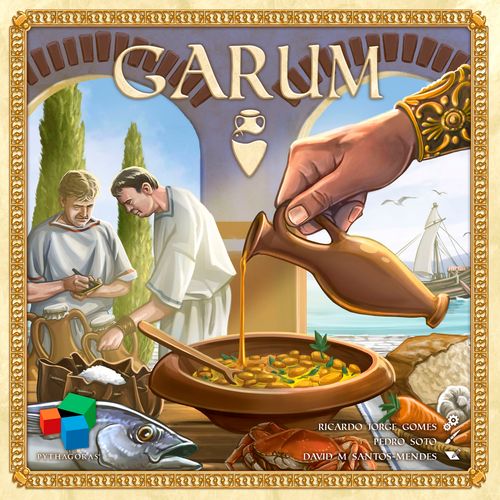
Garum
Garum Rulebook
Table of Contents
Table of Contents
Components
- 1 board game (double sided)
- 4 scoring charts (double sided)
- 4 scoring tiles (double sided)
- 20 vilicus (small workers)
- 4 dominus (large workers)
- 4 scoring markers (cubes)
- 1 first player token
- 16 aureus
- 64 fish tiles (hereafter referred as tiles)
- 1 rule book
- "Privileges" mini-expansion (Find the rules at www.pythagoras.pt or BGG)
Fish Tiles
- FACE - playing face.
- BACK - player colour / species:
- blue = tuna
- green = mackerel
- yellow = mollusc
- red = shellfish
Game Setup
(Troia version for 4 players)
- Place the board game on the centre of the table.
- Each player chooses a colour and gets:
- 2a 5 vilicus;
- 2b 1 dominus;
- 2c 1 scoring tile;
- 2d 1 scoring marker, placing it on the zero space of the board scoring track;
- 2e 1 scoring chart;
- 2f 16 tiles of that colour, which are shuffled and placed as a draw pile (face down).
- Shuffle the sixteen aureus and place them next to the board (value facing down).
- Each player draws the top four tiles from their respective draw pile (forming a four tile hand).
- Draw the initial player, who gets the amphora.
Setup for Baelo Claudia Version
- Place the board with the Baelo Claudia version face up;
- Each player removes the 4 tiles that are not used in this version;
- Remove the following aureus: 13, 14, 15 and 16;
- Players draw the three top tiles of the respective draw pile (forming a three tile hand).
BAELO CLAUDIA VERSION — Played the same way as Troia. Duration: twelve rounds.
Game Objective
In this game, you strategically place your tiles in the cetarium (brine tanks) to establish influence lines, which may then be scored if controlled by a worker. The more specimens of your colour in a line, the more points you get. You may also score by getting bonuses.
Game Turn
The game is played over 16 rounds. Each round the first player (the amphora holder) turns an aureus face up. Its value will indicate the cetarium to be used for the round. Turns proceed clockwise. In your turn you should carry out two or three actions, in the following order:
- Place a tile in the cetarium;
- Place a vilicus or dominus;
- Draw a tile from the draw pile.
Actions 1 and 3 are mandatory. Action 2 is optional.
Game Play
The first player (the amphora holder) turns an aureus face up, revealing its value to all players.
1 - Place a Tile in the Cetarium
The player places a tile (from the hand) inside the cetarium holding the same value as the aureus revealed for this turn. The tile may be placed in any of the areas defined by the cetarium boundaries and the dashed lines.
BAELO CLAUDIA VERSION — Players' hands are formed by three tiles.
Bonus
Players may obtain bonuses when using cetarium marked spaces.
- 2 victory points — By covering the bonus space with the very same species.
- 1 victory point — By covering the joker bonus with any species.
EXAMPLE 1
Tanya flipped the aureus with a 10 face value, showing it to all players. Starting her turn, she places a tile in the cetarium 10. She gets one victory point by covering the joker bonus. Not intending to place a worker, she draws a tile from her pile, ending the turn.
Then, the other players, Andrea, Peter and David, take their turn.
2 - Placing a Vilicus or a Dominus
The player places a vilicus or a dominus (only one worker per turn) over an influence line (vertical or horizontal) passing through the cetarium where he just placed the tile. Upon placement, workers can no longer be moved or removed. There can be no more than a single worker on any influence line. Whenever there are already three filled cetarium along an influence area, and you place a tile in the fourth one, you can not then place a worker over any influence line of that area.
The two worker types score differently (see scoring):
- 1 dominus (large worker) - foreman
- 5 vilicus (small workers) - apprentice
Influence Areas
There are eight influence areas on the board (four vertical and four horizontal). There are four cetarium and four influence lines for worker placement, in each influence area.
BAELO CLAUDIA VERSION — The influence area comprises three cetarium. Player may only place workers upon placing tiles on the first and second cetarium.
EXAMPLE 2
Players added tile to cetarium 14. In their turn they may place workers on the horizontal influence area, comprising cetarium 13, 14, 15 and 16, or on the vertical one, comprising cetarium 14, 3, 2 and 9.
EXAMPLE 3
In this turn players will place tiles on cetarium 2. Assume that cetarium 14, 3 and 9 are already full, as per previous turns. Players may no longer place workers on the vertical influence lines passing through cetarium 2. They may do so on the horizontal influence area of cetarium 2, provided that at least one of the cetarium 11, 1 or 6 is not yet full.
3 - Draw a Tile
The player draws the top tile of their draw pile. Such action does not take place when the draw pile is spent.
Round End
Discard the aureus (it will no longer be used). Pass the amphora to the next player, clockwise.
End of Game and Scoring
At the end of the game (when the last tile is placed on the board and all cetarium are full), players score victory points, moving the marker along the board score track. Each player adds up the specimens of their own colour, present in the vertical or horizontal lines controlled by their own workers.
Workers placed over influence lines without specimens enough to score will be penalized: vilicus (-1 victory point) and dominus (-2 victory points).
Scoring chart (Troia):
| Specimens in the line | Vilicus | Dominus |
|---|---|---|
| 4 or fewer | -1 | -2 |
| 5 | 1 | 2 |
| 6 | 2 | 4 |
| 7 | 4 | 8 |
| 8 | 7 | 14 |
| 9 or more | 11 | 22 |
The scoring chart also recalls the bonus values: covering a bonus space with the very same species scores 2 points; covering the joker bonus with any species scores 1 point.
Whenever a player reaches the top of the board score track he gets the scoring tile with the appropriate +25/+50 face up. After adding all victory points from influence lines and bonuses, the winner is the player with the highest score. In case of a tie, the winner is the one, among the tied players, with fewer vilicus on the board. If there is still a tie, the players share the victory.
EXAMPLE 4: SCORING AN HORIZONTAL AREA
- David (green) dominus: 9 specimens = 22 points
- David (green) vilicus: 6 specimens = 2 points
- Peter (red) vilicus: 4 specimens = -1 point
Game at 2 or 3 Players
2 PLAYERS GAME
General rules are the same as for Troia and Baelo Claudia versions. At the beginning of the game each player gets the tile piles of 2 colours, which they will alternately play among themselves.
3 PLAYERS GAME
General rules are the same as for Troia and Baelo Claudia versions. Shuffle the tiles of the ghost-player and place them, face down, on the centre of the table. After the turn of all players, the first player takes the top tile of the ghost-player pile and strategically places it in the cetarium. The ghost-player does not get any bonus points nor places workers.
Variants
EMPEROR
Aureus are not used. At the start of each round, the first player chooses in which cetarium tiles will be placed. General rules are the same as for the original version.
HARUSPEX (roman priest)
During setup all aureus are sequentially revealed so that players know the exact order in which cetarium will receive tiles. General rules are the same as for the original version.
Historic Information
Garum was a fermented fish sauce, used as condiment in ancient Rome cuisine. Made from fish, such as tuna, sardine and mackerel, it was then mixed with small shellfish and molluscs, and left in brine inside cetarium (fermentation tanks). Amphoras were filled up with the resulting sauce, which was then exported to the different regions of the empire.
Troia, possibly the island of Acala, was the biggest industrial fish brining center of the Roman Empire, and has been occupied until the fifth century AD. Hans Christian Andersen named it the "Setúbal Pompeii". One can visit the ruins of such a "portuguese wonder", to see the houses, factories, thermal springs, mausoleum and necropolis, so characteristic of roman citizenship.
Baelo Claudia was a city on the Betica province, in Spain, where an important garum production industry was established. The city reached great prestige and wealth between centuries I BC and II AD, but entered in decline in the third century AD, most probably upon being struck by an earthquake. It is possible to visit the place, where various interesting buildings can still be seen.