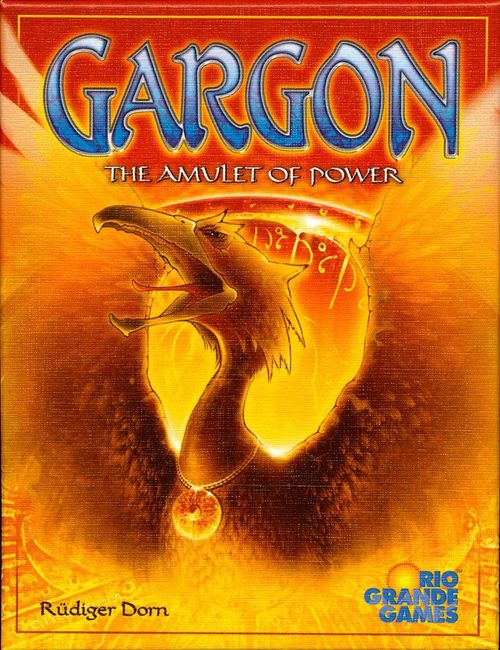
Gargon
Gargon Rulebook
Table of Contents
Table of Contents
Game Info
- Players: 3-5
- Age: 10 years and up
- Length: 45 minutes
- Contents: 102 creature cards in six colors, 18 bonus cards
The Creature and Bonus Cards
The game has creature cards in six colors. Each color represents a different fantasy creature: Dragon (white), Pegasus (blue), Gargoyle (violet), Phoenix (red), Manticore (yellow), and Fairy (green). Each card has a value between "0" and "15". In battle, the cards valued "15" are the strongest and the cards valued "0" are the weakest. The creature cards with the values "1" to "12" have from one to five amulets on each card. Each amulet earns a player one point at the end of the game.
Creature cards with the value "0" occur twice in each color in the game. They carry no amulets, but double the value of other amulets from that creature.
There are six bonus cards (in six colors) with "+10" on one side and "+5" on the other. There are twelve bonus cards with "+5" on both sides.
Preparation
The 18 bonus cards are only used at the end of the game for scoring. Place them aside, but in easy reach of all players.
Shuffle all creature cards and deal ten cards face-down to each player as his starting hand. Separate the remaining creature cards into two equal stacks. Place them fanned face down in the middle of the table.
Note: all creature cards have the same color on the front and back. For example, creature cards showing the Phoenix are yellow on both sides. Thus, the players know how many cards of each kind of creature the other players have in their hands, but, of course, not which values those cards have. Each player must hold his cards so that all players may see the colors on their backs, but not the fronts.
Playing the Game
Gargon is played over several rounds. The youngest player is the starting player for the first round. After that, the starting player rotates clockwise from player to player each round. Each round has two phases: the card playing phase and the battle phase.
1. The Starting Player Begins the Card Playing Phase
The starting player begins a round by playing card(s). He selects one to three cards from his hand and places them face-down in his play area (the area before himself on the table). He may choose cards with the following mix of creatures:
- one card (mix: 1:0)
- two cards with the same creature (mix: 2:0)
- two cards with different creatures (mix: 1:1)
- three cards with two different creatures (mix: 2:1)
- three cards with three different creatures (mix: 1:1:1)
Note: a player may not play three cards with the same creature!
Next, the other players, in clockwise order, must either play cards or pass.
A Player Plays Cards
When a player chooses to play cards, he must play the same number of cards in the same mix of different colors as the starting player. He plays them face-down. The creatures chosen by an opponent need not be the same as those chosen by the starting player. They may match creatures completely or be completely different as long as the relative numbers of each different creature is the same (see example).
Exception: if the last player wants to play cards, he follows the same rules as the other opponents with one extra restriction: he must choose creatures already played by the other players. He may not introduce a new creature.
A Player Passes
A player who cannot or chooses not to play cards, passes. He then draws one to three cards from one or from both stacks of fanned cards in the middle of the table. Players always draw the top-most card from a stack.
End of the Card Playing Phase
When each player, on his turn, has either played cards or passed, the card playing phase is over. A player who chose to pass will not participate in the following battle phase, but must wait until the next round.
2. The Starting Player Begins the Battle Phase
The players turn over the cards they played revealing the values and number of amulets on the creature cards they played. The starting player begins the battle phase. He selects the card(s) from one of the creatures he played. There are three possibilities:
A) The player is the only player who played cards of the chosen creature. In this case, he wins all the cards of this creature he played without a battle. He places these cards face-down on his stack of won cards at one side of his play area.
B) If other players have played cards of the chosen creature, there is a battle between these players:
1st battle
If a player has played two cards of the chosen creature, only the strongest of the two is involved in the first battle.
The players compare the values of the cards involved in the battle. The player, whose card is the strongest (has the highest value), wins the battle. He places this card face-down on his stack of won cards at one side of his play area. The players discard all other cards involved in the battle.
Each player who lost a card in the battle must draw a card, adding it to his hand, from one of the two fanned stacks in the middle of the table. The drawing begins with the starting player and moves clockwise around the table. Players always draw the topmost card from a stack.
2nd battle
If there are still cards left of the creature chosen, a second battle occurs. As before, the players compare the cards' values. The player, whose card is the strongest (has the highest value) wins the battle. He places this card face-down on his stack of won cards at one side of his play area. Discard all other cards involved in the battle.
Each player who lost a card in the battle must draw the top-most card, adding it to his hand, from one of the two fanned stacks in the middle of the table. The drawing begins with the starting player and moves clockwise around the table.
C) If there is only one player with a card from the chosen creature after the first battle, this player wins the card of this creature without a battle. He places this card face-down on his stack of won cards at one side of his play area.
Note: creature cards with the value "0" may only win in possibilities A and C. If two players play the same creature's value "0" card in the same battle, both cards are discarded, even if they both tied for winning the battle.
If the starting player has more played cards in his play area, he selects another creature for the battle phase. When the starting player has no more played cards in his play area, the player to his left chooses the next creature (if he has played cards remaining in his play area) and so on, clockwise around the table. The battles of these other creatures are resolved in the same way as described above.
The cards won by a player are placed face-down in a stack at the side of his play area. This is his stack of won cards. A player may look at his won cards any time.
Changing the Starting Player
When no more played cards remain face-up in the players' play areas, the round is over. The new starting player is the player to the left of the previous starting player.
If at the start of a round, the starting player has no cards in his hand, he cannot be starting player and his left neighbor immediately becomes the new starting player.
Game End
When the last card from one of the two fanned stacks in the middle of the table is drawn, the current round is finished as normal and then the game ends. The players discard any cards they have left in their hands, turn the cards they have won during the game face-up, and score these cards.
First, the players sort their won cards by color and determine for each creature color which player has won the most cards. These players take the "+10" bonus card in the color of the creature they have the most cards in. If more than one player has the most cards in a creature color, each takes a "+5" bonus card instead.
Next, the players count all the amulets on the cards they have won. Each amulet is one point. Cards with the value "0" double the number of amulets in that color. The players add their amulet points to their bonus points. The player with the highest total is the winner!
Example of a Game Round
Anna is the starting player. She begins the card playing phase by playing two yellow cards and one red card face-down in her play area.
Bob passes and takes from the first fanned stack the top two cards and from the second fanned stack the top card, adding all three cards to his hand.
Chris chooses to play cards. She must play two cards in one color and one card in another. She plays two blue cards and one red card face down in her play area.
David chooses to play cards and must, as the last player, only play colors already played: yellow, blue, and red, and in the same 2:1 mix as the others have. He plays two red cards and one blue card in his play area.
Now the battle phase begins for the round. Anna, as the starting player, chooses the yellow Manticore for the first battle. As no other player has played this creature, Anna wins both her yellow cards (a "2" and a "6") and places them face-down on her stack of won cards.
Anna has a red Phoenix card left in her play area and must choose this for the next battle. Chris played a red Phoenix and David played two. Anna's red Phoenix has the value "9", Chris' has the value "8", and David has a "14" and a "0". Therefore, David wins the first battle with his "14" red Phoenix (he must choose his highest) and places it face-down on his stack of won cards.
Anna and Chris discard their red cards and draw one card each, starting with Anna, from either of the two fanned stacks. David still has his red "0" in his play area. As he is the only player with a red card left, he automatically wins it and places it face-down on his stack of won cards.
As Anna has no more played cards left, Chris, her left neighbor chooses the creature for the next battle. She has just two blue cards left and, thus, chooses the blue Pegasus for the next battle. She has an "8" and a "2". David has just one blue Pegasus, a "12". David wins the first battle with his "12", beating Chris' "8" and places it face-down on his stack of won cards. Chris discards her "8" blue Pegasus card and draws a card from one of the two fanned stacks. As Chris is the only player with a remaining blue card, she wins her "2" without a battle, placing it face-down on her stack of won cards.
Now it is David's turn to choose, but he has no more played cards in his play area. In fact, there are no cards left in any players' play area, so the round ends.
Bob, as Anna's left neighbor, becomes the starting player for the next round.
Scoring Example
At game end, the players have the following won and bonus cards:
Anna earned 25 bonus points for winning the most Gargoyle ("+10") and Fairy ("+10") cards and for tying with Bob and Chris for winning the most Dragon cards ("+5"). In white, Anna has the "1" and the "10" with 5 + 1 = 6 amulets. In green, she has the "13" and the "7" with 0 + 2 = 2 amulets. In violet, she has the "13", a "0", and the "5" with (0 + 3) x 2 = 6 amulets. In yellow, she has the "2" and the "6" with 5 + 3 = 8 amulets. Anna has 23 amulets plus 25 bonus points for a total of 48 points.
Bob has a total of 15 bonus points for winning the most Manticore cards ("+10") and for tying with Anna and Chris for winning the most Dragon cards ("+5"). In white, Bob has the "5" and a "0" with 3 x 2 = 6 amulets. In yellow, he has the "1", the "8", and the "0" with (5 + 2) x 2 = 14 amulets. Bob has 20 amulets plus 15 bonus points for a total of 35 points.
Chris earned 25 bonus points for winning the most Pegasus ("+10") and Phoenix ("+10") cards and for tying with Anna and Bob for the most Dragon cards ("+5"). In blue, Chris has the "15", the "3", the "2", and a "0" with (0 + 5 + 5) x 2 = 20 amulets. In white, she has the "6" and the "11" with 3 + 1 = 4 amulets. In red, she has the "10", the "8", the "7", and the "2" with 1 + 2 + 2 + 5 = 10 amulets. Chris has 34 amulets plus 25 bonus points for a total of 59 points.
David earned no bonus points. In red, David has the "6" and both "0" cards with 3 x 2 x 2 = 12 amulets. In yellow, he has the "13", and the "15" with no amulets. In blue, he has the "13", the "12", and the "10" with 0 + 1 + 1 = 2 amulets. David has 14 amulets and no bonus points for a total of 14 points.
Open Winnings Variant
Instead of placing his won cards in a single face-down stack, each player places the cards he wins face-up and in stacks separated by color. Thus, all players will know throughout the game what cards (both value and color) they and their opponents have won.