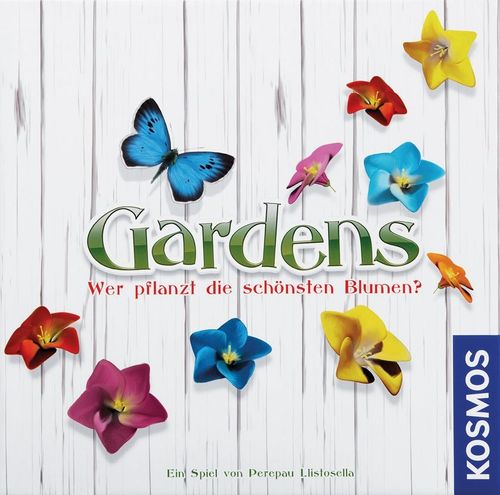
Gardens
Gardens Rulebook
Table of Contents
Table of Contents
Contents
- 1 start tile
- 96 garden tiles
- 4 special garden tiles (1 each in the 4 player colors)
- 8 player pieces (2 each in the 4 player colors)
- 32 flowerbed tiles (8 each in the 4 player colors)
Setup
The following description is for play with 3-4 players. A description of the 2-player variant and the team variant can be found under "Shorter Game" and "Team Variant 2 vs 2" below.
Each player receives, in their own color:
- 2 player pieces
- 8 flowerbed tiles
- 1 special garden tile
When playing with three players, the unused game material goes back in the box.
The large start tile is laid face up in the middle of the table. Each player places one of their player pieces on the marking of their own color on the start tile. Each player's second piece stays in front of them for now.
The 96 garden tiles are shuffled and placed as several face-down draw piles on the table, arranged so that every player can reach them easily.
Placement Rules
Every garden tile shows flowers in the four player colors in its corners. The arrangement of the four player colors differs from tile to tile. The tiles also show paths and water.
Tiles are always placed edge to edge against a tile already on the table. Paths and water must always be continued correctly: a path must always continue with a path, and water with water.
It is wrong to let water continue a path, wrong to place a tile that is not edge to edge, and wrong to let a path continue water.
Game Goal
The goal of the game is to hold sole majority of your own flower color in the most flowerbeds by the end of the game.
Turn
Play proceeds clockwise. On your turn, carry out the following actions in order. Then it is the next player's turn.
- Take a tile
- Place the tile
- Move the second player piece
- Score flowerbeds
1. Take a tile
The player takes a garden tile from one of the draw piles. If the player has not yet placed their special garden tile, they may take that instead.
2. Place the tile
The player chooses one of the following three actions (A, B, or C):
A The player places the garden tile edge to edge against a tile already in the garden. Path must always be placed against path, and water against water. Immediately afterward, the player's own piece must be moved along a path onto the newly placed tile. Paths on which another player's piece is standing are completely blocked and may not be crossed. If this is not possible, the tile must be placed somewhere else.
B If the player still has at least one piece in front of them (not yet in the garden): the player places the garden tile edge to edge against a tile already in the garden and sets their piece that is not yet in the garden onto the newly placed tile. The newly placed piece may be set onto a path even if that path is not yet connected to the rest of the path network.
C If the player cannot or does not want to place the garden tile, it goes back into the box. If both of the player's pieces are already placed in the garden, the player must take one of them back to themselves. This can be an advantage, since the second piece can then be placed again on a later turn (see B).
3. Move the second player piece (optional)
If the player wishes, they may also move their second piece — the one that was not moved onto a new tile (A), placed (B), or taken back from the garden (C) — along the path network onto any tile of their choice. This is only possible, of course, if the second piece is already in the garden. Here too, paths occupied by other pieces (including the player's own) may not be crossed.
Example for A: The yellow player decides to take a garden tile from the draw pile (1). They place it against the start tile so that their yellow piece can move onto it (2). The other piece cannot be moved, since it is not yet in the garden (3).
Example for B: The red player decides to place their special garden tile (1). They then take their second red piece, which is not yet in the garden, and set it onto the tile just placed (2). They then move their other red piece along the path onto the start tile, blocking the blue piece (3).
Example for C: The yellow player decides to take a garden tile from the draw pile (1). Since they do not want to place it, they put the tile back in the box and take one of their pieces back to themselves (2). They then move the piece remaining in the garden along the path onto another tile (3).
4. Score flowerbeds
At the end of their turn, the player checks whether placing the tile completed one or more flowerbeds. If so, these are scored immediately.
A flowerbed counts as complete as soon as four tile corners together form a patch of earth with four flowers on it.
It is checked which flower color holds sole majority in the bed. The player with that color may now place one of their 8 flowerbed tiles from their supply onto the completed flowerbed. In case of a tie, nothing happens — the completed flowerbed is not covered with a flowerbed tile.
It can also happen that a player who is not on turn gets to place a flowerbed tile this way. The player order does not change because of this. In a three-player game, the flowers of the unused fourth color are also counted for scoring purposes. That is, a tie with the unused color can occur, or the unused color can hold sole majority. In both cases, no flowerbed tile is placed.
Game End
The end of the game is triggered when, at the end of a turn, one of the following two situations occurs:
- A player has placed their 8th flowerbed tile.
- Only 4 garden tiles remain in total across the draw piles.
The round is played to its end, so that all players have had the same number of turns. Whoever then holds sole majority in the most flowerbeds wins the game. If a player ends the game holding sole majority in more than 8 flowerbeds, those are also counted.
In case of a tie, count how many garden-tile corners with flowers of their color the tied players have contributed in total to the flowerbeds they won. The player who needed fewer corners of their color overall to achieve their sole majorities wins the game. If there is still a tie, there are multiple winners.
Shorter Game
For a shorter game, you can also play with only 6 or 7 flowerbed tiles per player. The end of the game is triggered as soon as a player has placed their last flowerbed tile.
Team Variant 2 vs 2
Gardens can also be played in a team variant, with each team made up of two players. One team plays with blue and red, the other with yellow and pink. Teams take turns in sequence, so players should be seated around the table in the correct order (e.g., blue, yellow, red, pink). Each player plays one color.
All rules of the base game apply, with the following changes:
- Each player receives only 5 flowerbed tiles.
- The special garden tiles are not used in the team variant.
- If there is a tie between players on the same team when scoring, no flowerbed tile is placed on the bed.
The end of the game in the team variant is triggered as soon as the players of one team have together placed 5 flowerbed tiles each, or only 4 garden tiles remain in total across the draw piles.
The round is played to its end, so that all players have had the same number of turns. The team that then together holds majority in the most flowerbeds wins.
In case of a tie, count how many garden-tile corners with flowers of their colors the teams have contributed in total to the flowerbeds they won. The team that needed fewer corners of its colors overall to win its majorities wins the game. If there is still a tie, there are multiple winners.
Two-Player Game
For the two-player game, the rules of the team variant are used. One player plays alternately as red and blue, the other alternately as yellow and pink. Scoring and the end of the game work exactly as in the 2-vs-2 team variant.