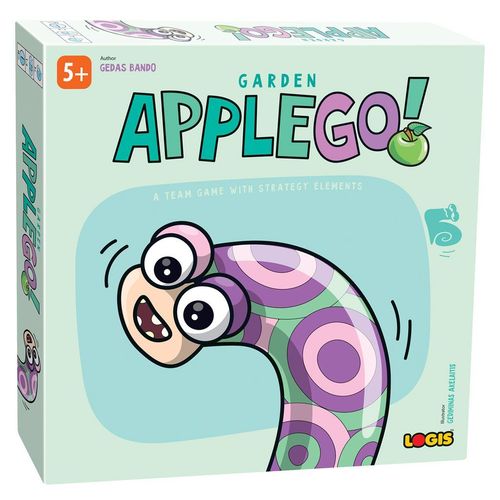
Garden Apple Go
Garden Apple Go Rulebook
Table of Contents
Table of Contents
Components
- 1 game board
- 1 Snail
- 6 obstacles (benches, logs)
- 50 cards
- 1 apple card
- 1 dice
Game Objective
The goal is to help the Worm reach the Apple faster than the Snail. Players must cooperate and assist each other throughout the game.
Setup
- Place the unfolded game board on the table.
- At one end of the board, place one Worm card face up – the head should be on the board, and the body should extend beyond it. This marks the starting point.
- Shuffle the remaining Worm cards and place them face down in a pile next to the board, within easy reach of all players.
- At the opposite end of the board, place the Apple card – this is the goal.
- Add a few obstacles (benches, logs) onto the board. The Worm cannot crawl over obstacles and must go around them. This makes the game more challenging and interesting. (See example) Place any unused obstacles back in the box.
- Put the Snail figure next to the corner of the board nearest to the Worm's starting card. The Snail moves alongside the edge of the board, not on it. Each step it takes equals one board square. Obstacles are not placed for the Snail.
- Place the game die next to the board.
Dice Meaning
- One point – the player turns over one card.
- Two points – the player turns over two cards.
- Three points – the player turns over three cards.
- Snail – the player moves the Snail one step forward.
Gameplay
The youngest player starts the game. Play continues clockwise. Players may always discuss and help each other.
On a Player's Turn
The player rolls the die and acts according to the result:
- If a dot (or dots) is rolled:
- The player draws as many cards from the top of the pile as the number of dots rolled and places them face up on the table. The player then checks which cards can be added to the board. Each correctly placed card allows the Worm to move one step forward. During their turn, the player may place all suitable cards on the board. Any cards that cannot be placed must be turned face down and put into the used cards pile beside the draw pile.
- If one or more "Move the Snail one step backward" cards appear, the player decides whether to use them. If they do, the Snail is moved backward by as many steps as there are such cards. In this case, the player cannot use any Worm cards during that turn. After completing the move, all revealed cards are placed into the used pile.
- If the player cannot place any Worm cards, the Snail moves one step forward.
- If a Snail is rolled:
- Move the Snail one step forward.
Then, the turn passes to the next player.
How the Worm Moves
Each time a new card is placed, it must cover the Worm's head on the previous card. The new card must be placed horizontally or vertically, aligning the Worm's body lines with the existing card so that the head moves forward by one square. (See examples)
An example of how to correctly place the card "Worm turns left." is shown in the rulebook. The illustrated examples show one incorrect placement, where the new card does not cover the Worm's head, and one correct placement, where the new card covers the head and the body lines align.
- The Worm cannot go off the board.
- The Worm cannot cross obstacles.
- The Worm can cross over itself.
- Avoid dead ends formed by obstacles – entering one means losing the game.
Card Meaning
- Worm turns left.
- Worm turns right.
- Worm goes straight.
- Move Snail back one step.
Note
If the main Worm card pile runs out, shuffle the used cards pile and place it face down to form a new draw pile.
End of the Game
All players win together if the Worm reaches the Apple before the Snail.
If the Snail reaches the Apple first, all players lose.