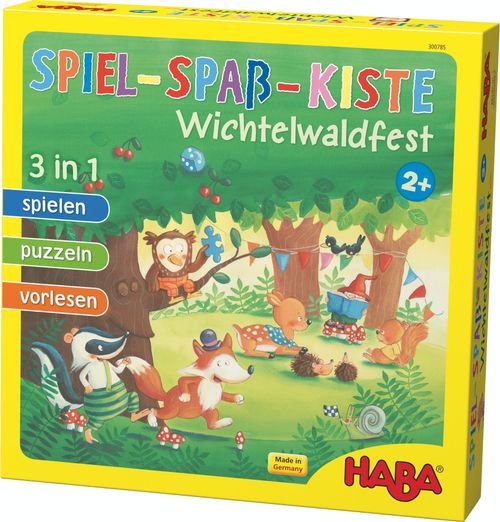
Games n' Fun: Forest Feastival
Games n' Fun: Forest Feastival Rulebook
Table of Contents
Table of Contents
Contents
1 game landscape (= game box bottom with game board and forest background with insert slots), 5 play figures (fox, deer, owl, squirrel, badger), 1 path, 28 tiles (4 fruit, 3 balloons, 12 leaves, 9 flowers), 6 fir trees, 1 die, 5 puzzles, 1 set of game instructions.
Before playing for the first time, carefully press the tiles out of the perforated cardboard.
Important: Immediately dispose of the remaining pieces from the perforated cardboard to eliminate any choking hazards.
The manual's component illustration labels the parts as: game landscape, festival grounds, forest glade, path, bridge, tiles (flowers front and back, leaves, balloons, fruit), play figures, pine trees, and die.
Discovering details in freestyle play
In freestyle play, your child becomes familiar with the game materials. Together, look at all the illustrations on the game box, play figures, tiles and puzzles. Talk to your child about all the details. This will help make your child more attentive, while training language skills and increasing vocabulary.
If the children are a little older and already familiar with the game materials, you can also be more specific with your questions. For example: What does the badger/squirrel/fox have on? What color is it? Can you spot all the forest gnomes / red mushrooms? Where is the brook/hedgehog/bird?
Playing games and having fun
Game 1: Race to the festival grounds
A fun die race with 2 extra game variations for 2 to 4 little runners.
One of the most beloved games to play at the gnomes' forest festival is the race. Daisy deer and Billy badger always train very hard leading up to the race. But Sammy squirrel, Freddy fox and Olli owl are all quite fast, too. Who will win this time? The race really gets exciting when the fruit and balloons are involved. The forest gnomes have developed a great game!
Required game materials: game landscape, play figures, path, die. For the game variations: fruit or balloon tiles.
Game setup: Put the game landscape in the middle of the table and the path before it, forming a continuous road. Each child chooses a play figure and places it on the big starting position at the beginning of the path. Have the die ready.
Let the game begin: The children play one by one in a clockwise direction. The last child to attend a fun party gets to go first and rolls the die.
Ask the child: How many dots are showing? The child counts the dots on the die. Praise the child if he answers correctly. And give hints, if he doesn't know the correct answer.
Then the child moves his play figure forward the corresponding number of spaces along the path to the festival grounds. More than one play figure can occupy the same field at a time.
Then it's the next child's turn to roll the die.
End of game: The first player to reach the festival grounds (a higher number can be rolled) wins the race and gets to do a victory lap around the table. The others continue playing and once all the play figures have reached the festival grounds, everyone does their funniest gnomes' dance.
Variation 1: Lots of delicious fruit!
Spread out the 4 fruit tiles with the side showing the "complete" fruit (not half-bitten) facing up along the fields of the path. There can be only one fruit tile per field and there must be at least one free field between fruit tiles.
The same rules of the basic game apply with the following variation: When a child's play figure lands on a field with a fruit tile on it, the child gets to feed the fruit to its animal; he holds up the fruit tile to its animal's mouth and then turns it over and lays it back down on the field. Strengthened by the bite to eat, the child gets to move his play figure one space forward towards the festival grounds. Now, if another animal happens to land on the same field, nothing happens because the fruit has already been eaten.
Variation 2: Watch out for the bursting balloons!
Spread out the 3 balloon tiles with the side showing the intact balloon (not broken) facing up along the fields of the path. There can be only one balloon tile per field and there must be at least one free field between balloon tiles.
The same rules of the basic game apply with the following variation: If a play figure lands on a field with a balloon, the balloon bursts and the animal is frightened. The child then has to move his animal one space back towards the starting position. Turn over the tile and leave it to the same field. Now, if another animal happens to land on the same field, nothing happens because luckily the balloon has already been burst.
You can also combine the two game variations and mix the fruit tiles with the balloon tiles. Select any 5 tiles and distribute them along the fields of the path with the "complete" side facing up. Also in this variation, there can be only one tile per field and there must be at least one free field between tiles.
Game 2: Balancing act
A fun game of skill for 2 to 4 children with excellent balance.
The gnomes' forest festival also features a great game of skill: the balancing act. Who can balance a leaf on his head all the way to the bridge without it falling down? The forest gnomes have already tried it and now it's the animals' turn. It's not at all easy ... but a lot of fun! Who will be able to bring the most leaves to the bridge?
Required game materials: game landscape, play figures, leaf tiles.
Game setup: Put the game landscape in the middle of the table and the leaves on the forest glade. For this game, it doesn't matter which side of the leaf tiles you lay down, as you will not have to remember them.
Let the game begin: The children play one by one in a clockwise direction. The last child to go for a walk through the forest gets to go first. The child chooses an animal and puts it on the first field in front of the bridge on the meadow. One after the other, the other children place their animals on the bridge.
Now it's the first child's turn again. He pushes his animal to any leaf of the forest glade. Place the leaf on top of the animal's head and carefully push the animal back to the bridge.
Did the child manage to bring his animal back to the bridge with the leaf on its head?
- Yes! Excellent! You can keep the leaf.
- No! That's too bad. Maybe next time. Do not put the fallen leaf back on the forest glade, instead place it on the festival grounds.
The child puts its animal behind all the other animals on the bridge and the other animals are each moved one space ahead.
Now it's the child's turn, whose play figure is now at the front of the line.
End of game: The game is over as soon as all the leaves have been collected. Each child counts his own leaves. The player with the most leaves wins. In case of a tie, the children with the most leaves win together. The children can also try to balance a leaf tile on their own heads.
This game can also be played cooperatively. In this variation the children form a row with their collected leaves. Fallen leaves are collected at the festival grounds. Did the children manage to bring back more leaves to the bridge than what fell?
Game 3: Find the hidden pairs
A cooperative forest memory game for 2 to 4 detectives.
This game of "Find the Hidden Pairs" is the forest gnomes' favorite. Fiddy, Maxi and Carly hide two objects: one under a leaf and one under a pine tree. It's up to the animals to find the objects. Who can remember where the objects are hiding and retrieve a pair?
Required game materials: game landscape, play figures, 6 leaf tiles with illustrations for memory game, pine trees.
Game setup: Place the game landscape in the middle of the table. Show the illustrations on the leaf tiles and under the pine trees to the children. Shuffle the leaves and lay them face down on the forest glade. Now lay the pine trees among the leaves at random.
Let the game begin: The children play one by one in a clockwise direction. The last child to find something gets to go first. The child chooses an animal and puts it on the first field in front of the bridge on the meadow. One after the other, the other children place their animals on the bridge.
Now it's the first child's turn again. He moves his animal to a leaf and turns it over. Then he moves its animal to a pine tree, lifts the tree and looks under it.
Ask the child: Do the pictures match?
- Yes! Great! Lay the leaf on the festival grounds. Return the pine tree to its place next to the child's animal.
- No! Too bad! Everyone has a good look at both pictures. Now, return the pine tree to its place next to the child's animal and turn it back over.
The child puts his animal behind all the other animals on the bridge and the other animals are each moved one space ahead. Now it's the next child's turn.
End of game: The game is over as soon as all the leaves have been collected. To celebrate, dance through living room together as you would through fallen leaves.
You can increase the difficulty level by moving the pine trees to a different spot when returning them; that's a real challenge for little detectives!
Game 4: Find the flower
A cooperative color memory game for 2 to 4 flower admirers.
The summer festival is coming to an end. But before it is, the animals want to play one last game of find the flower. Each player looks for a flower in his favorite color: Freddy fox likes purple flowers, Daisy deer prefers blue flowers. Olli owl thinks orange flowers are the best and Sammy squirrel has eyes only for yellow flowers. And what about Billy? His favorite color is green. Can he find a flower with his favorite color, too?
Required game materials: game landscape, all play figures, flower tiles.
Game setup: Place the game landscape in the middle of the table. Show the children the different colors of flowers and explain that the grass side is a blank. Shuffle the tiles and lay them face down on the forest glade. Now all the tiles are showing the back side with the five little flowers. Now place all the play figures on the bridge, even if less than four children are playing. In this game, the children don't each have their own play figure, rather they all play together.
Let the game begin: The children play one by one in a clockwise direction. The last one to pick flowers gets to go first. The child takes the first animal at the front of the line and moves it to a flower on the forest glade and turns the flower over.
Ask the child: Did you find a flower in this animal's favorite color?
- Yes! Great! Move both the animal and the flower to the festival grounds.
- No! Too bad! Everyone takes a good look at the overturned tile and tries to remember the color of the flower or that it is a blank. Then turn the tile over again and move the animal back to the bridge, putting it behind the other animals at the end of the line. Move the other animals each one space forward.
Now it's the next child's turn.
End of game: The game is over once all the animals and their flowers have reached the festival grounds.
Celebrating together emotionally empowers and creates a good mood. It confirms children in their actions and fosters cohesion within the family or the playgroup.
Reading & listening
Let your child go on a discovery tour! Your child will be able to recognize several details on the game landscape from the stories: the three forest gnomes, various animals and of course the decorations, too. In the second story, the 5 play figures are also introduced. Your child can also re-enact the story lines, if he so chooses.
[Story 1, "Preparing for the great gnomes' forest festival", and Story 2, "Summer festival in gnomes' forest ... everyone's invited", are narrative read-aloud text and are not reproduced.]
Story 3: The animals thank the forest gnomes
[The narrative text of Story 3 is not reproduced. Its set-up instruction follows.]
Required game materials: game landscape, play figures, path, fir trees, 5 tiles: blue flower, yellow balloon, apple, raspberry, leaf with frog.
Game setup: Put the game landscape in the middle of the table and the path before it, forming a continuous road. Place the pine trees on the forest glade and the play figures in front of the box. Then put the tiles in different places. You can "hide" the objects in different places each time and your child can search for them with the appropriate animal when re-enacting the story. Change the individual hiding places when telling the story.