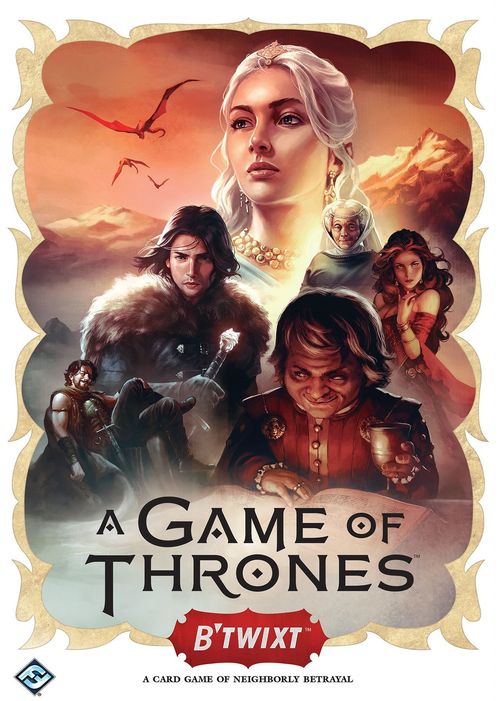
A Game of Thrones: B'Twixt
A Game of Thrones: B'Twixt Rulebook
Table of Contents
Table of Contents
Components
- 1 Time Track
- 1 Round Token
- 1 Season Token
- 1 First Player Token
- 54 Power Tokens
- 9 Leader Cards
- 50 Ally Cards
- 62 Standard Influence Cards
- 11 Event Influence Cards
- 36 Leader-Specific Influence Cards
- 6 Reference Cards
Setup
To set up A Game of Thrones: B'Twixt, players perform the following steps:
-
Prepare Time Track: Place the time track where it is visible to all players. Place the round token on the space that corresponds to the number of players in the game and the season token on the summer space if playing a 3–4 player game or on the autumn space if playing a 5–6 player game.
-
Create Ally Deck: Shuffle the ally deck and place it in the middle of the play area.
-
Create Token Supply: Place all of the power tokens in a pile in the play area. Flip each token so its dragon side is faceup. Then, randomize the tokens by mixing them together without looking at their facedown sides.
-
Determine the First Player: Identify the player who has most recently been betrayed. This player takes the first player token, places it in front of themself, and becomes the first player.
-
Choose Leaders: Starting with the first player and continuing clockwise, each player chooses one of the leader cards—or takes one randomly—and places it in front of themself with the colored side faceup.
For the standard game, this choice is thematic and does not affect gameplay. For details about how leaders function in the advanced game, see the Advanced Game section.
-
Prepare Influence Cards: There are five colors of influence cards. Each card color has an icon in the top-left corner. Set aside the white and blue influence cards and shuffle together the red, green, and purple cards to create the influence deck. Then, deal 10 cards from it to each player and place the remaining deck in the middle of the play area so it is within reach of all players.
Example of Four-Player Setup: each player has a power token supply, a hand of influence cards, a leader card, and a face-down influence discard pile and current ally space shared at the table's center.
Fundamental Concepts
This section contains the fundamental concepts that provide context while learning the game.
Leader
Each player assumes on the role of the leader that they chose during setup. When a card or the rules use the word "leader," it is referring to a player.
Influence and Ally Cards
Each leader begins the game with a hand of influence cards. During the game, leaders play these cards from their hands to claim ally cards.
Each influence card has an influence value and an ability. For example, the influence card Royal Decree has an influence value of 7, and the ability "While this card is in your bid pile, it cannot be moved or discarded by other influence card abilities."
Each ally has a power value and an ability. For example, the ally Ser Jaime Lannister, "The Kingslayer," has a power value of 5, and the During this Round ability "Leaders cannot play a card if a copy of that card is already in any bid pile."
Councils & Neighbors
A council is a designated area where leaders place their claimed ally cards and gained power tokens, which are described later. The strength of each council is determined at the end of the game by adding the power values of these cards and tokens.
Each leader has two councils—one to their left and one to their right. The council to a leader's left is shared with the leader to their left; the council to a leader's right is shared with the leader to their right. A leader's small council is the council that has lower power of their two councils.
Two leaders that share a council are referred to as neighbors.
Example: The ally and power tokens in council A are shared by Cersei and Euron. Similarly, the allies and power tokens in council B are shared by Euron and Melisandre. Cersei is neighbors with Euron and Doran while Euron is neighbors with Cersei and Melisandre.
Object of the Game
At the end of the game, the leader with the most powerful small council wins.
This means that leaders are incentivized to cooperate with their neighbors...to a point. A leader does not benefit from making one of their councils far stronger than the other. Ultimately, each leader still needs to act in their own best interest to keep their councils relatively balanced, so that their small council holds the highest possible value.
Playing the Game
Depending on the number of players, the game is played over two or three seasons. Each season has four to seven rounds with each round consisting of seven steps:
1. Reveal Current Ally
The first player takes the top card of the ally deck, reads it aloud, and places it faceup next to the ally deck.
If the ally has a "During this Round:" ability, that ability applies to this round.
2. Play Influence Cards
Starting with the first player and proceeding clockwise, each leader takes turns by either playing an influence card faceup or kneeling.
When a leader plays an influence card, they resolve its ability, if applicable. Some abilities resolve at the end of the round instead. Then, the leader adds the card to their bid pile, the play area in front of themself.
When a leader kneels, they rotate their leader card 90°. After a leader has knelt, they must pass for the remainder of the round.
Play proceeds clockwise until all leaders have chosen to kneel.
3. Claim the Ally
After all leaders have knelt, each leader adds together all of the values of the influence cards in their bid pile to create their influence total. The leader with the highest influence total wins the bid. Then, that leader claims the ally by choosing one of their two councils and placing the ally there.
Example: After each leader has knelt, Tyrion has three cards in front of him which total 12 influence while Cersei has two cards in front of her which total 15 influence. Cersei wins the bid and claims the current ally.
If there is a tie for the leader with the highest influence total (even a tie of 0 total influence), the leader in the tie that is closest to the first player—starting with the first player and proceeding clockwise—wins the bid.
Some allies have a "When Claimed:" ability. This ability either affects where the ally can be placed or produces a unique effect. The leader who claimed the ally must resolve the ability, if applicable.
When a leader wins the bid, that leader also gains one power token without looking at the numbered side and places it in either of their councils.
4. Clean Up
Each leader places the cards from their bid pile into the single, collective discard pile. Each leader rotates their leader card back to its original orientation.
5. Pass the First Player Token
Pass the first player token clockwise to the next leader.
6. Advance the Round
Advance the token on the round track to the next space to the right.
Each season has one more round than the number of players; therefore, in a four-player game, there are five rounds in a season.
If the round token cannot advance because it is already on the final space, reset the token to the space that corresponds to the number of players in the game and advance the season token to the next season.
When the season token is moved, each leader discards their hand, the discard pile is shuffled into the influence deck, and each leader is dealt 10 new cards.
If the season token is already on the winter space when it would advance to the next space, the game is over and the winner is determined.
Otherwise, the next round begins.
Winning the Game
The game is over at the end of the final round of winter. Leaders assess the power of the councils and determine the winner.
Assess Councils' Power
Flip over all power tokens assigned to councils to their numbered sides.
For each council, add the power values of each of its allies and power tokens. This sum determines the power total of the council.
Determine Winner
Each leader determines which of their councils has the lower power total. (This is the power of their small council.) If both councils have the same total, either council may be used as that leader's small council for scoring purposes. The leader whose small council has the highest power wins!
If there is a tie, of those leaders, the leader whose other council has the highest power wins. If there is still a tie—for example, the other councils of multiple leaders have the same power total—then, the leader with the most total allies among both of their councils wins. If there is still a tie, then those leaders share victory.
Example of Scoring
In this example, there are four players: Olenna Tyrell, Tyrion Lannister, Daenerys Targaryen, and Jon Snow.
At the end of the game, all of the power tokens are revealed and added together with the power values of the allies in the council. After determining the power of each council, each leader identifies the power of their small council—the lower power of their two councils:
- Olenna: 22 and 16
- Jon: 17 (shared with Daenerys) and 22 (shared with Tyrion)
- Tyrion: 16 (shared with Olenna) and 20 (shared with Daenerys)
- Daenerys: 17 (shared with Jon) and 20 (shared with Tyrion)
The small council of both Daenerys and Jon has a total of 17. This results in a tie. By comparing the power of their other councils, since Jon's council is 22 compared to Daenerys's council of 20, Jon wins!
Additional Concepts
Here are some additional concepts that can appear during the game.
Gaining Power Tokens
If an ability causes a leader to gain a power token, that leader takes one power token from the supply without looking at the numbered side and places it in either of their councils.
"You"
When an influence card refers to "you," it is referring to the leader that the card is in front of. Influence cards start out in front of the leader that plays them, but can be moved.
For example, Euron has played Contingency Plan in front of himself. Cersei plays Betrayal, moving Contingency Plan in front of herself. Cersei now becomes the subject of "you" for the ability of the moved Contingency Plan.
As another example, Doran plays Bribery (an event card) which he moves to Tyrion's bid pile. This means that after a leader wins the bid, Bribery is put into Tyrion's hand even though Doran played the card.
When an ally's "When Claimed:" ability refers to "you," it is referring to the leader that claimed the ally.
Deals are Non-Binding
Any deals that leaders make are not binding. This means that leaders can make promises or agreements but do not have to fulfill them. Leaders should be careful about whom they betray as they may rely on their neighbors to acquire future allies.
Killing and Death
A Song of Ice and Fire is a series that does not shy away from character death. Therefore, there are some card effects that refer to killing an ally. When this happens, the ally is placed in a faceup pile, referred to as the dead pile, next to the ally deck. Which allies are killed is public information and the order of the cards does not need to be maintained.
Triumph Icon
Some influence cards have a triumph icon located next to the title of a card. This icon is a reminder that the ability resolves after a leader wins the bid.
Priority of Rules
If an ally or influence card ability conflicts with a rule from this book, the ally or influence card ability overrides it.
For example, although the leader that claims the ally would normally be able to choose the council to place the ally in, if their neighbor has Pulling the Strings in their bid, the leader must place the ally in the council they share with that neighbor instead.
If an influence card's ability conflicts with an ally's ability, the ally's ability overrides it.
For example, although a leader played Pulling the Strings, if their neighbor claims the ally and the ally was Sansa Stark, her ability ("You must place Sansa Stark in your council that has your highest-power ally.") overrides the effect of Pulling the Strings.
Advanced Game
After players have become familiar with the standard game, they may add more variability, strategy, and flavor to their game by choosing to play the advanced game instead. This adds leader-specific cards and event cards which are played in the same way as standard influence cards.
Leader-Specific Cards
During setup, after each player chooses their leader card, they take that leader's four leader-specific influence cards, which are identified by the leader's image and name at the bottom of the card. These cards are the set-aside, white influence cards.
When each leader is dealt a new hand of cards during setup and at the start of each season, they are dealt nine cards instead of ten and they draw one random card from their leader-specific cards. When a leader-specific card would be discarded, it is removed from the game instead.
Event Influence Cards
In a three- or four-player game, at the end of summer and autumn, after all influence cards are discarded and shuffled together, three of the set-aside, blue influence cards are chosen at random and shuffled into the deck. In a five- or six-player game, at the end of autumn, add six randomly instead.
Unlike leader-specific cards, event cards are discarded in the same way as standard influence cards.
Alternative Rules
After playing the game as described earlier, here are some alternative versions of the game to provide a different experience. Each variant has a brief description of what it provides before the rules on how to do it.
Draft Version
To add a different level of strategic depth, players can play this version, although it does notably increase the length of the game.
At the start of the game, after each leader is dealt their hand of ten cards, each leader chooses one card from that hand and sets it aside. Then, they pass the remaining nine cards to the leader on their left. Each leader continues setting aside one card from their hand and passing the remaining cards to the left until they have no more cards. Then, they pick up the set-aside cards and use that as their hand for the season.
At the end of each season, that process is performed again, but with the cards being passed in the alternate direction instead. Therefore, in a four-player game, they will be passed to the left during setup, to the right at the start of autumn, and to the left at the start of winter.
Kingsmoot Draft Version
Similar to the draft version, players that want to add even more cards to the mix may want to play this version. This variant reduces some of the game's thematic elements.
This version is played identically to the Draft Version described above, but all of the leader-specific and event cards are shuffled into the deck during setup. Each leader can play any leader-specific cards.
Revealed Allies Version
To reduce some of the variability that can arise from the random allies, players can play this version. This variant does eliminate some of the surprises inherent to the original rules.
At the start of each season, place cards from on top of the ally deck faceup in a row from left to right until there are one more than the number of players in the game. This is known as the ally row. During each round, instead of revealing the top ally from the ally deck, the leftmost ally becomes the current ally. Any abilities that choose an ally cannot choose an ally in the ally row.
If an ability reveals the next ally, add the top ally from the ally deck to the right of the ally row and then use the ally to the right of the current ally to resolve the ability.
To resolve any effect that requires looking at the top cards of the ally deck, the next ally in the ally row is selected and the rest are drawn from the top of the ally deck. If an ally is placed "on top of the deck," it is placed as the leftmost ally of the ally row and, if there is a current ally, to the right of it.
Short Version
No time? Try this!
- 3–4 players: start in autumn
- 5–6 players: start in winter
Card Clarifications
Below are a few clarifications of specific card interactions. For more general clarifications, check the Additional Concepts section.
Pulling the Strings
If each neighbor of the leader who won the bid has played the same number of copies of Pulling the Strings, the leader who won the bid chooses which council to place the ally in. If one neighbor plays more copies of Pulling the Strings than the other neighbor, the ally must be placed in the council shared with the neighbor with more copies of Pulling the Strings.
If another ally is introduced during the round, such as by Matchmaker or Blood Magic, these additional allies ignore the effect of any Pulling the Strings.
Mance Rayder, Sansa Stark, and Jaqen H'ghar
These cards' abilities override any other placement restrictions such as the effect of Pulling the Strings, or if they are the allies claimed from Ser Loras Tyrell or The Pack Survives.
Little Birds
If an ability such as Blood Magic or Shadow Assassin kills the current ally, the power tokens on the ally are returned to the supply.