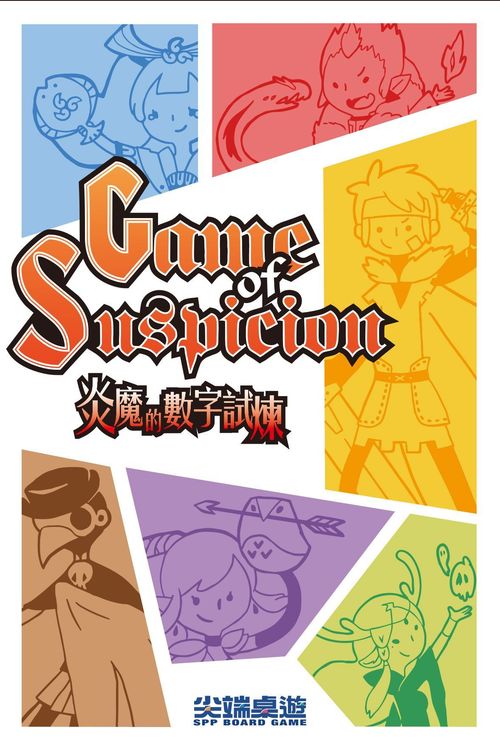
Game of Suspicion
Game of Suspicion Rulebook
Table of Contents
Table of Contents
Contents
- 18 Character cards: 5 of '0', 5 of '1', 1 each of 2, 3, 4, 5, 6, 7, 8, 9
- 1 Special Character card: '10' (only used for advanced game)
- 4 Summary Cards
- 24 point chips: 12x 1 point, 12x 4 points
- 1 Rules booklet
Goal of the Game
Players try to guess the character cards held by the other players. If you guess another player's hand correctly, they are out of the game and you will score points. So, players should try to keep their own card values secret to prevent another player from putting them out of the game. The first player to get to 15 points is the winner.
Setup
- Each player gets a summary card.
- Place the point chips in the middle of the table.
The Game
Shuffle the 18 character cards and deal out 4 cards to each player. When playing with 3 players, turn the 4 cards dealt to the 4th player face up so everyone can see which cards that "shadow" player received.
The remaining 2 cards are placed face down in the middle of the table.
The starting player is the player who survived the previous round. For the first round, pick a random starting player.
On a player's turn, they do 1 of 3 possible actions. Then the next player to the left takes their turn.
The three actions are:
A) Pick up one of the face-down cards from the middle of the table and look at it. Decide if you wish to exchange one of your own hand cards with it or not. Place the unwanted card back in the middle of the table, face-down. You must tell the other players if you are exchanging or not.
(That is, if the value of the card that you put back in the middle is different than the value of the card that you picked up, then you must say that you swapped cards. If the value of the card that you put back in the middle is the same value as the card that you picked up, then you didn't swap cards.)
B) Put down a card from your hand face-up in front of you and do its action. If you have only one card in hand, you may not do this action. (Note: See exceptions for cards 8 & 9.)
C) Select another player and you guess all of the cards in their hand. There is no order requirement; you just guess all of the card values in any order.
- If you are wrong, the other player just says "wrong" and your turn is over.
- If you are right, the other player must show their hand; you score 1 point for each card that they have in their hand; and you may have another chance to guess the hand of another player. So, you can potentially eliminate all other players in a single turn.
During the game, if you play a card for its action, but the action can't be done, then no action is taken.
Examples:
Red player chose to guess the Blue player's hand. Suppose the Blue player has only 3 cards in hand. So, the Red player must guess 3 numbers. The Red player guesses 1, 1, 3. The Blue player looks at their hand and they have 1, 1 & 3, so the Red player is correct, so he displays his hand and the Blue player is out of the round. The Red player gets 3 points and can continue to guess the hand of other players.
Now, the Red player attempts to guess the Green player's hand. The Green player has only 2 cards left. So, the Red player must guess 2 numbers. The Red player guesses 0 & 9. The Green player notes that the Red player only got one of the two numbers correct, so the Green player says "wrong" and the Red player's turn is now over.
The round continues until there is only 1 player left.
If one player has 15 points or more at the end of a round, then the game is over. Otherwise start another round.
Card Actions
- 0 – Select 2 other players and they simultaneously exchange a card each.
- 1 – You call out a number from 2 to 9. The player who has that card number must give it to you. You put that card into your hand and then give a card from your hand back to the player. Note: You may give back the same card that you just named.
- 2 – All other players whose hand adds up to more than 10 must show you their entire hand. Other players don't see the hands. Players with hands totaling 10 or less just decline to show to you.
- 3 – You get 3 chances to guess the hand cards of a single other player.
- 4 – All other players must show you all of the cards that are greater than 4 in their hand.
- 5 – All other players must show you all of the non-zero, even cards in their hand. (2, 4, 6 & 8 must be shown)
- 6 – All other players must place the smallest card from their hand face up in front of them. They do not execute the actions on those cards.
- 7 – All other players who have exactly two '0' cards are out of the game. You score points for all of the hand cards in the eliminated players' hands (as if you had correctly guessed their hand). This card may not be used in the first round of the game.
- 8 – Pick up all of the cards in front of yourself that you've played for their actions and pick up the 2 face-down cards from the middle of the table into your hand. Then put 1 card face-down back into the middle of the table. Note that this results in you getting an extra card in hand and the rest of the round is played with only 1 card in the middle.
Q: During the game, if other player's actions make me lose a card, and I have only 1 card in hand, must I discard it? A: No, if you only have 1 card in hand, then you are not affected by that action.
Q: If I only have the 8 card in my hand, may I play it for its action? A: Yes, in this case you may play your last card in hand because the 8 card's action will result in you having cards in hand after completing it.
Q: If my hand is 0, 0, 1, 7 and someone guesses my hand as 7, 0, 1, 0 is that a correct guess? A: Yes, of course. Order doesn't matter.
Q: If another player's action makes me lose a card, does that card's action activate? A: No, of course not.
Q: Can I cheat during the game and not let other players see what they should see or not confess to being correctly guessed? A: No, of course not. Don't cheat.
Q: Really No? A: The rules say No. No means No.
Q: If another player uses the number 4 card and I have both 7 & 8 in my hand, do I show both or just one? A: You show both; they are both greater than 4. The same for the number 5 card: You must show all even numbered cards that you have in your hand.
Sudden Death Variant
Rather than keeping score with the point chips, you can just play a number of independent rounds where the winner of each round is the survivor. In this case, you can use the point chips to keep track of who has won the most rounds.
The Special Card: 10
Warning: Using this card will make the game harder. So, don't use this card for your first games. Once everyone is familiar with the game, you can consider adding it.
Add this card to the deck. Shuffle all 19 cards, then pull one out at random and set it aside, face-up. That card will not be used this round.
When you have the special '10' card in your hand, it is equivalent to having both a "1" card and a "0" card in your hand. It is not an even card (because it is not 10, it is both 1 and 0 and 0 is not even in this game.) And, it is not greater than 4 because neither 0 or 1 is greater than 4. So, usually, other players can not see this card by playing their cards for actions.
Players must guess 0 & 1 for this card; they do not guess "ten".
This card has no action. If you play it for its action, then it does nothing. (It does not do either or both of the 0-action and the 1-action.)
Example: I have in my hand 0, 1, 3 & 10. If someone guesses "0, 0, 1, 1, 3" then they are correct and I am out. They score 4 points because I had 4 cards in my hand.
Special condition: If what is in my hand is 0 & 10, and another player plays the 7 action, then I am out because I have two 0's, but the other player only gets 2 points on account of me because I only had 2 cards.